Being Homeless Is Even More Complicated When You're Autistic and LGBT

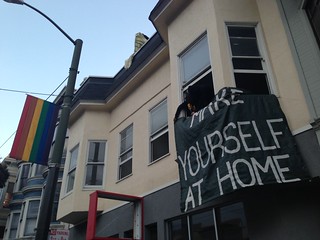
Make yourself at home Castro #lgbt #worldhomelessactionday #ows #occupysf #oo #osf
World Homeless Day in San Francisco's Castro District
Photo © Steve Rhodes

[image: Black banner with white lettering reading, "Make
Yourself At Home" draped from a second-story window,
next to a LGBT Pride flag.]
Kris Guin
queerability.tumblr.com

Homelessness is not discussed as much as it needs to be, especially as it relates to marginalized groups like the LGBTQ and disability communities.

LGBTQ people and people with disabilities are disproportionately impacted by homelessness. 40% of homeless youth identify as LGBTQ, and 40% of people with disabilities are homeless. LGBTQ people and people with disabilities often become homeless because of skyrocketing rent, unsupportive families who have kicked them out of the family home, and discrimination from landlords—among many other reasons.

Some cities are getting better at addressing LGBTQ youth homelessness by funding LGBTQ housing programs, and some people with disabilities may qualify for housing assistance through Housing and Urban Development. However, with all this progress, the housing system still needs a lot of work as many people still experience significant gaps. Some of these gaps are the result of age restrictions, confusing bureaucracy, and long waiting lists.

I was one of those people who experienced gaps in the Washington, DC and Birmingham, Alabama housing systems. I am an autistic transgender man, and my parents kicked me out of the house in late September 2016. While I was in Birmingham, I tried accessing housing services with a local LGBTQ nonprofit, but their services were only for young adults up to age 24 (I was 26).

Because I have an amazing support system, I was able to move to Washington, DC. But there I experienced similar difficulties with the LGBTQ housing system, because I was too old. I was able to piece together four months' worth of housing with friends, though, as an autistic person doing so was exhausting and draining. During those four months, I stayed in nine different friends' apartments and houses, crashed on couches in living rooms and, when I was lucky, in private guest rooms. Then I was able to move into the spare room of an older couple, where I was able to stay for another full four months.

I was very uncomfortable going to traditional homeless shelters in both Birmingham and DC because, despite identifying as a binary trans man, such shelters are often gendered in the binary: If I were to go to a women’s shelter, I might be safer from assault, but I would get misgendered. If I were to go to a men’s shelter, it would be a little more affirming of my gender identity, but I would be vulnerable to assault.

I attempted to get help navigating the government safety net from local nonprofits in DC, such as SNAP, SSI, and housing programs, but they often had prerequisites to receive their full services. One local LGBTQ-affirming nonprofit, Whitman-Walker, required that I become a medical patient with them in order to receive their benefits navigation services. In order to become a medical patient, I needed health insurance. They were able to help me apply for Medicaid, but I still had to wait a month for a new patient appointment. To make matters more difficult for me, their benefits navigation department was walk-in only—and being autistic, I have a hard time going places without a scheduled time. I was also uneasy about handling the uncertainty of not knowing how long I would have to wait to see a benefits navigation staff member. Waiting around for undetermined amounts of time, regardless of length, gives me a lot of anxiety and can be overwhelming. But I was fearful to go elsewhere in DC because I was scared of being misgendered, and I was drained enough from trying to get help that I had little energy left to self-advocate with regards to my gender identity.

I have been able to stay relatively safe and housed because of my truly amazing support system, but I can only imagine how much more difficult a situation like mine can be, for people who don’t have the support system I have. It angers me when I hear elected officials talking about how it’s "too easy" to get government benefits, and then propose policies to make accessing benefits harder. We, as a community, need to challenge ourselves to do better, and for our elected officials to do better.

Share:

Ultra Testing: When Companies Actively Recruit Autistic Employees

M. Kelter
theinvisiblestrings.com

Ultra Testing is a New York-based tech firm that was founded on the idea of incorporating autistic differences into their work ethos. At a time when an estimated 80% of adults on the spectrum are unemployed, Ultra Testing is using attribute metrics and other non-traditional hiring practices to recruit autistic employees. A 2016 Recode article reported that 75% of the company's employee base identifies as being on the spectrum.

I recently communicated with the firm's co-founder, Art Shectman, about how the company began, the value of ditching traditional hiring practices, and what employers need to know about developing a neurodiverse workforce.

M: Regarding Ultra Testing's decision to focus on hiring autistic employees: can you describe the origins of this idea, both generally (how the idea came about), and specifically (how you actually went about recruiting and bringing in folks on the spectrum?)

Art Shectman | source: Twitter
[image: White man in dark suit jacket, posing in
front of a summer-foliage wisteria bush
Art Shectman: My co-founder Rajesh Anandan is my hero, my MIT schoolmate, and fraternity pledge brother. He's the one person I know who's chosen a path of philanthropic and foundational social impact work, and he works every day to make the world a better place. In his travels with UNICEF he saw many children and disabled folks discarded, and living very difficult lives. He had a theory on sustainable change, that if you could align the extra abilities that sometimes accompany disabilities with a competitive advantage, you could create a competitive business and a job creation engine.

We had dinner, and we're reviewing a list of disability, size of population and extra ability and possible career alignment. That list was compiled by a  strategy firm called STAX, run by our first supporter, Rafi Musher, a great philanthropist and impact investor. I saw Autism and Software getting on the list and as I also run a software engineering firm and buy QA services. I said "let's give it a try." Three days later, we hired some testers and gave it a rip, and the results were great. Then we set to work to operationalize that early success into a scalable repeatable differentiated service provider.

The recruiting process at first was to call GRASP and ASTEP for referrals. Over time, we've built a network of some 200 "nodes," where we hunt for talent on the spectrum. We have a community manager who is on the spectrum, and who helps us build that network out and helps us coordinate candidates.

Once we had a process for sourcing candidates, we had to build an attribute and simulation-based set of recruiting tasks that try to leverage the most current talent research—which mostly says traditional interviews are junk. It's been a unique challenge to make it all work, but really it is a system or set of behaviors around recruiting that would apply for neurotypical and neurodivergent folks alike.

M: Work places tend to develop a distinctive office culture over time, though if I understand correctly, Ultra Testing employees work remotely. Are people doing their jobs independently, or is it more of a cooperative, interactive scene?

Art: We have rich interactions every day with Engagement Managers, other testers and on our corporate Slack channels of all varieties. The culture is extremely interactive and collaborative.

M: Does Ultra Testing have an "office culture"? I wonder if this concept looks any different when many of your employees are autistic. If you could paint a picture of what it feels like to work at Ultra Testing on a daily basis, I would love to hear that.

Art: There is an amazingly rich corporate culture. It looks very much the same as any other culture, folks are serious, silly, insightful, and a whole host of other emotions that you might find anywhere else. Above all our team has a culture of collaboration over accommodation, and we are focused on creating a neurodiverse space where we embrace our differences. It's a fun and caring place to work. If we succeed we want people to have options of where to work, and to stay at ULTRA because it's a great place to work.

M: There are ongoing concerns in the autism community about the way the media presents any job for an autistic as a positive thing, regardless of whether or not the work is actually meaningful or valuable to the autistic employee. I think people are hoping to see more of an emphasis on good jobs, not just busywork that others may not want to do.

Art: I disagree to some degree here. I feel that there are a spectrum of jobs that are great fits for the spectrum of folks on the spectrum. Where do I agree is that there is a knee jerk concept of what those jobs should be (busywork).

While there are many jobs regardless of whether you are on the spectrum that are busy work, a job still brings empowerment and self-sufficiency in a way that being unemployed does not. There are neurodiverse folks who are happy to do all kinds of jobs. With 1MM or so folks on the spectrum who are readily employable, any job where an employer is embracing neurodiversity (not accommodating it), and where a candidate wants the job, and has a natural propensity to do that job, is a good job in my opinion.

I do take your point, and we fight the general media bias all the time. We created the DifferentBetter Challenge to try to shift the discussion to competitive advantage, and away from human interest, for many of the same reasons.

This is somewhat of a loaded question, and there's a personal bias there about "meaningful" and "fulfilling." However, that said, I'd agree that a person should have employment options and should be able to have a job that they find meaningful and fulfilling. Maybe I'll defer to a quote from a recent neo.life article about Ultra Testing:
"Now the fact of his employment has become routine for Cha. When asked whether he plans to stay on, he says, simply: “The work is interesting, and I like the people. As long as those two conditions apply, I will be here.”"
M: I know Ultra Testing does regular satisfaction checks with employees. Can you discuss that—why Ultra Testing decided to perform satisfaction checks, and how you ensure that they are meaningful and not just a token effort?

Art: We decided to do it because there is documented research on the productivity costs of team happiness, and how it pays to measure and track it. We've evolved our survey over the years to gauge the many facets of anxiety and job satisfaction that our teams have taught us are meaningful, through their survey responses.

The only way to ensure the responses are meaningful is to really care about them from the most senior level down, which we do, and then to make a culture and habit of responding to feedback. If the staff thinks feedback isn't heard or acted upon, they stop giving it. If they feel they don't have a sense of agency to impact their environment, they stop trying.

Most of our staff need to be coaxed out of their shell, and our super supportive and caring culture helps us do that. Many employees have had experiences where their differences were a source of stress, conflict and ridicule. It takes time to feel comfortable sharing and embracing differences, and realizing that we are all building the company together, and that their feedback is welcome.

M: I read that you tailor hiring practices to a variety of autistic differences (for example, you offer alternatives to traditional interviews, and do not emphasize a need for prior work experience). At first glance, these seem like genuinely beneficial practices that many businesses could replicate. Help me understand employer thinking about this. What are the barriers that would make it difficult for other companies to engage in similar efforts and find alternatives to old school hiring methods?

Art: Folks just can't let go of tradition, even when the research says people are terrible at interviews, and suffer nearly insurmountable first impression biases. It also takes work, measurement of data, and testing and learning and reconfiguring until you get to role-specific practices that help you recruit in non-traditional ways. Most bigger companies do this, but they haven't expanded their programs to include neurodiversity yet.

M: What would your advice be to other companies, about creating mutually beneficial spaces for autistic workers?

Art: Recruit for unbiased attributes that make an employee successful in the job. Then exercise and build collaboration over accommodation.

M: On a personal level, have you learned anything about autism from your experiences at Ultra Testing that you didn't know before? Popular culture generally offers a distorted view of what autism is really like, so I was wondering if your view of autism has evolved in any unexpected ways.

Art: It has, but I'm not qualified to have an opinion here. I would just say that I'm continually reminded that our original theory that our differences make us better remains true. I'd say my views on the power of a neurodiverse workforce are what have evolved the most, and it is a really powerful thing.
Share:

Book Review: There’s More Than One Way Home

Maxfield Sparrow
unstrangemind.com

A mother’s worst nightmare: That’s what Anna thinks she might be facing at the beginning of Donna Levin’s spellbinding novel There's More Than One Way Home. It’s 2004 and Anna has accompanied her Autistic son, Jack, as a class chaperone on a field trip to Minotaur Island near San Francisco. When four children—Jack among them—turn up missing, Anna fears the worst.

Everyone pulls together to comb the island, and the boys are found.  One is dead after all, but to Anna’s guilty relief, it is not her Jack. Thus begins a mother’s second worst nightmare, as Jack is accused of murder. The story unfolds from there: Jack’s loving but authoritarian father’s hands are tied with respect to the case, since he is the district attorney and thus has a conflict of interest. Free-spirited Doctor Valentine helps keep Jack out of the crushing institutionalization of the combined penal and psychiatric systems, while flirting with Anna behind her husband’s back. And Anna is caught in the middle of everything, facing choices not unlike those of her namesake in Tolstoy’s classic novel, Anna Karenina.

Can Jack be saved from a life of imprisonment? Can Jack’s father, Alex, get re-elected to his position in the midst of such a public scandal? Will Anna follow her head and stay with Alex, or follow her heart with sensitive and seductive Dr. Valentine—Val, as he asks everyone to call him? All these questions are explored in the novel’s pages, and primarily the story focuses on Anna.

There were things I loved about this novel and things that made me rather uncomfortable about it. Before I elaborate, I should note that I don’t think I am the book's target reader. This was a novel clearly written about, and for, non-autistic mothers of Autistic children. As an Autistic adult who has not raised a child, my view of the story might be slightly different from that of the intended reader. Do I think the mother of an Autistic child will enjoy this novel? Oh, definitely yes. But I hope potential readers will find value in my insights about the novel as well.

First off, I did greatly enjoy the novel. It is well-written and pulled me right into the story straight away. I was eager to find out what would happen next at every moment, and all the characters were well-developed, with blessings and flaws, quirks and agendas. I felt like I was reading about real people, not characters ... although this leads me to my first complaint about the story: Jack himself was not a well-developed character.

Jack felt more like a plot point to me than a person. I knew some of his preferences and fears, and his speech pattern made it always clear when he was speaking. But he never felt like a full person to me like Anna, Alex, or Val did. It wasn’t just because Jack wasn’t the protagonist, because I felt more full-roundedness from Alex, whose presence in the story was much like his presence in his home: brief appearances here and there, but mostly disengaged from the action and the emotions of the novel. Yet even his character felt more real to me than Jack’s. Although the novel was about Anna and her character was very well developed, I was disappointed to feel like Jack was more of a plot device.

Despite Jack’s less-articulated character, Anna very clearly loves Jack, and I loved that about the novel. Her love is depicted as complex and questioning, but very strong. Opening on a crisis gives us a chance to see Anna regretting being irritated with some of Jack’s autistic traits, and resolving to be more accepting and more appreciative. Throughout the novel, Anna moves back and forth between being bothered by Jack’s autism and being accepting of it. While some might expect me to dislike that, since I write so much about autism acceptance, actually I was delighted by the depiction of Anna’s struggles with autism acceptance because it made her feel so much more real to me.

Anna has a great voice as story narrator. She is extremely well-educated and regularly makes references to literature and pop culture. Not only is she smart, but she’s snarky, making her perspective on events lively and entertaining. There was one point, however, where I felt like she crossed a line with her zesty sense of humor, leaving me feeling cold and uncomfortable.  “I hadn’t left him with a sitter for an evening the first six months,” Anna tells us readers, “but by then I was sympathizing with Andrea Yates.”

I understand that Anna’s character is trying to be darkly humorous with that comment, but it went too far into darkness for my tastes. Joking about murdering one’s children is already in very poor taste. But when the child in question is also autistic? That goes far beyond the pale. An average of 80 disabled people per year, many of them autistic, are killed by parents of caregivers. So often, society’s response is to shrug and say how understandable it is that a parent would want to be rid of such a burden. Filicide is an ongoing and very painful issue in autism communities and even a work of fiction has certain political obligations to the demographic it portrays. While I loved Levin’s book overall, this one sentence weighed heavily on my heart when I read it. I can forgive Jack being less developed than other characters, but it’s not so easy for me to shrug off Anna’s identification with a woman who murdered her five children.

Other than that gruesome note, I do recommend There’s More Than One Way Home to readers. Anna felt like a clever, chatty friend, and I genuinely cared about her decisions and the repercussions of those choices. Jack was lively and lovable. Levin’s villains had humanity, and her heroes had feet of clay. Overall, I feel she rose to the challenge of writing a story with an autistic major character and her storytelling skills had me turning page after page, late into the night. Readers, particularly those with autistic children of their own, will find a friend in Anna Kagen—someone who’s been down the same path, with her wit and humor intact.
Share:

IMFAR: Now With More Autistic Priorities! TPGA's 2017 Conference Report

Shannon Des Roches Rosa 
Senior Editor, TPGA

Welcome to IMFAR 2017!
[image: three white autistic folks: Corina Becker,
Steven Kapp, & Carol Greenburg, posing by
the "Welcome to IMFAR 2017" sign.]
We have been reporting from IMFAR, the annual International Meeting for Autism Research, since 2011. This year we provided general live coverage via Twitter, with select roundups including the Press Conference, and highlights from sessions such as Autism and AgingUnderstanding Barriers to Autism Diagnoses for Children from Racial/Ethnic Minority Groups in the U.S.Mental Health Crises in Autistic Youth, and Autism and Sexuality. We also co-hosted the #AutIMFAR chat with autistic and autism research community members.

While the research presented at IMFAR continues to be varied in scope, and is still too disproportionately skewed towards prenatal, infant, and early childhood findings, our takeaway is that the 2017 meeting in San Francisco had the biggest increase in neurodiversity-oriented content and attendees we've seen so far. This is a welcome shift.

There were no fewer than five autistic media members at the press conference, including first-time IMFAR attendees John Marble for NOS Magazine, and Elizabeth Bartmess of #autchat, along with IMFAR veterans Carol Greenburg of TPGA, Corina Becker of Autism Women's Network, and Dena Gassner. In addition to this increase in (openly) autistic participants, several events were dedicated to autistic feedback on the direction of autism research. And I can't imagine acceptance-based research being included in IMFAR's early years, yet in 2017, there it was:
Even though IMFAR 2017 saw improvement in the direction(s) of autism research, there was also much of the same old same old, according to University of Edinburgh researcher Sue Fletcher-Watson. And the needed epiphanies and attitude shifts resulting from focusing more on autistic needs often meant discussing unpleasant under-scrutinized realities, as Emily Willingham reported, in Half Of Autistic Adults Feel A Low Sense Of Well Being. But overall, a positive shift in including and respecting autistic people themselves was palpable:
"The focus at IMFAR on an autistic perspective and autistic adults represents a change in attitudes and emphasis at this enormous international conference over the years. Five years ago, the phrasing in most of these talks was “people with autism” and “subjects” with a distinct tone of condescension, and the populations in the studies were mostly boys. This year, people are “autistic people,” the tone is one of much greater respect and care, autistic people were visible and participating, and researchers seem to have realized that not all autistic people are little boys."
The more people talked about unmet autistic needs, the more under-examined topics emerged. Sue Fletcher-Watson (in person) and John Elder Robison (online) emphasized the need for researchers to pay attention to autism subjects autistic people and their allies consider common knowledge, then reinforce that knowledge with studies and data to both legitimize areas of need, and make them actionable. Precedents discussed during the conference include Liz Pellicano and Felicity Sedgwick's findings on autistic women's friendships, Noah Sasson and crew's observations on non-autistic people's harshly judgmental attitudes towards autistic people, and Lynsey Calder and team's confirmation that autistic children don't always share non-autistic social motivationsAutistica UK, a UK autism research charity that aims to be "the bridge between people with autism and researchers, ensuring that research responds to the needs of individuals with autism and their families," has even provided a list of Top 10 Questions for Autism Research.

Researchers who addressed autistic needs at IMFAR itself include Sarah Cassidy, of Coventry University, who followed up on last year's groundbreaking autism and suicidality SIG with a SIG dedicated to asking the right questions and developing autism-appropriate support methods. Laura Crane and the team from University College London's Centre for Research in Autism and Education (CRAE) talked about helping autistic people, specifically minors, navigate Family Court systems (a TPGA interview with Dr. Crane is forthcoming). And the researchers in the panels on Mental Health Crises in Autistic Youth and Autism and Sexuality were mostly on point, according to autistic audience members.

But part of the problem, as CRAE's Liz Pellicano reported in 2014, remains that:
"Research into effective ways of responding to the immediate needs of autistic people is, however, less advanced, as are efforts at translating basic science research into service provision. Involving community members in research is one potential way of reducing this gap."
Which is exactly what was discussed during Dena Gassner's Special Interest Group on Incorporating Autistic Intellect (a follow-up to her IMFAR 2016 panel), for example:
IMFAR 2017 Autistic Intellect SIG panelists:
Steven Kapp, John Robison, Dena Gassner, Stephen Shore

[image: four white autistic people posing in a hotel conference room.]
Another IMFAR 2017 event channeling autistic priorities and knowledge was AutIMFAR, a Twitter chat with both onsite and online participants from the autistic and/or autism research communities, co-hosted by #autchat, The Autistic Self Advocacy Network, Autism Women's Network, NOS Magazine, and Thinking Person's Guide to Autism. During the chat, we asked participants these 10 questions:
  1. What top three priorities would you pick for autism research, if you could? 
  2. What are some really obvious-to-autistic people under-researched autism areas? 
  3. What are some disconnects you’ve observed between research findings and #actuallyautistic experiences?
  4. What kinds of feedback from autistic people are most useful to researchers? 
  5. How can autistic communities support researchers whose work we value? Can we provide leverage in getting funding?
  6. How can autistic & autism research communities better support autistic autism researchers and increase their numbers?
  7. What shifts have you seen in inclusion of autistic community feedback on research over time? How can this improve?
  8. For people with experience interfacing with both communities: What has surprised you about each?
  9. What disconnects do you see between autism research and clinical practice? 
  10. Any topics we’ve missed that you’d like to discuss? 
The #AutIMFAR chat's full responses were valuable, varied, and voluminous (and very much worth your time). Some highlights:

And a few responses that need to be plastered on the wall of every autism research area, such as:

The #AutIMFAR Onsite Crew
[image: hotel conference room gathering of autistic & non-autistic researchers
& community members, of various genders & races, mostly white & female,
which is fairly representative for IMFAR.]
Even the traditional stakeholder's lunch pivoted on autistic input. Emcee John Elder Robison put representatives from Autism Speaks, SPARK, and the Autism Science Foundation on the spot, by asking them to tell the audience how they incorporate autistic people and priorities into their efforts, and why he thinks this is important:

The autism research organizations' representatives' responses to Robison's challenge ranged from enthusiastic and exemplary, to surprised and tentative, but the message is clear: Autistic people are holding autism research organizations accountable, and need to be included in autism research efforts. It is no longer acceptable for autism research conference participants to talk about autistic people as "them"; these discussions need to be about "us."

IMFAR selfie: Shannon Rosa & Deb Karhson
[image: a white woman with red hair and duck lips,
and a smiling Sri Lankan/Nigerian-American woman
with glasses and long curly black hair]
I also spent time chatting with Stanford's Dr. Deb Karhson, whom TPGA recently interviewed, and whose adult brother is a high-support autistic dude like my own son. When weren't politely but firmly dual-info-firehosing a journalist who unwittingly dropped the oh-no-he-didn't of an "autism is like cancer because" comparison on us during Deb's poster on blood-based biomarkers, we were musing about how people with ability profiles like the beloved autistic men in our lives were still mostly sidelined, disrespected, pitied, or objectified during IMFAR 2017:


Hopefully future IMFARs (which will be rebranded as INSARs, starting in 2018) will make progress in addressing and respecting the needs of autistic people of all abilities as well. Deb and I and many others will certainly be monitoring the situation.

----

P.S. It's not a contest, but, we did win #IMFAR2017—purely in terms of our Twitter coverage. Spectrum's team won for articles published during and about the conference.
TPGA earns its media press pass, once again
[image: Twitter analysis of the top influences of #IMFAR2017:
two columns: top ten by mentions, & top 10 by tweets;
TPGA as @thinkingautism holds the top position in both columns]
Share:

Autism and Biowearables: An interview with Matthew Goodwin at IMFAR 2017

Carol Greenburg and Matthew Goodwin at
the IMFAR 2017 Press Conference

[image: White woman with short platinum hair
and glasses posing with a taller white man
with a shaved head and goatee.]
Northeastern University researcher Matthew Goodwin gave an IMFAR 2017 keynote speech about his work on "Wearable Sensor-Based Physiological and Physical Activity Biomarkers for Use in Laboratory and Naturalistic Environments to Assess Arousal and Repetitive Motor Movements in Individuals with Autism Spectrum Disorder." Thinking Person's Guide to Autism's Carol Greenburg and Shannon Rosa, and Autism Women's Network's Corina Becker, spoke to Goodwin after the IMFAR press conference, about the real-life applications of his work, and how they can benefit autistic people.

Carol Greenburg: What constitutes a behavior, insofar as it’s something that needs to be mitigated? A behavior like flapping or other “stims” may mean something different to the person who’s doing the intervention, as opposed to the autistic person themselves. What I consider a behavior is different than what you consider a behavior, and therefore the treatment, intervention, or mitigation may differ. Does that make sense?

Goodwin: Perfect sense, and philosophically, we’re aligned. It’s actually a pet peeve of mine that in the clinical arenas, we refer to challenging behaviors as “behaviors” with a negative connotation. Because everything we do is a behavior! All the positive things are behaviors. So, A) I wouldn’t define behavior only by negative consequences. And B) I’m actually more interested in determining the function of these behaviors, assuming that they are purposeful and regulatory, and that there’s a reason, and it’s just our failure to understand what that is. Even things like aggressing to other people, or self-injury. I would rather suppose that that is something of a stress response, or a fight-or-flight response, or a panic response, in the absence of being able to cope or communicate with other people than assume it’s oppositional, or defiant.

Greenburg: Or of frustration that one is not getting through what is perfectly obvious to the autistic themselves, and cannot express, especially because we often don’t understand that other people are not sharing our definitions, or frame of reference.

Goodwin: Correct. And that’s another thing that I like about the physiological measures, is that even when you have a difficult time in articulating to me what might be stressful, or disorganizing, I can record it from your body. I can view it objectively, and I might have a little bit more empathy and compassion for you as a result of that, than assuming you’re not having that issue or because you can’t explain it means that it’s not having some negative consequences.

Greenburg: It is a presuming competence issue at its core.

Goodwin: Yes. And we live in a social world, with norms, and if those norms are violated, we say, “There’s something wrong, get in line,” instead of thinking “What would the world be like for someone who is neurodivergent, and then trying to think about “How do I interact with that person?” So the neurotypical might adjust their behavior to be more complementary in reaction to someone on the spectrum.

Greenburg: The whole idea or norms, it just seems to me that there’s a hierarchy of norms that are important to me, and that hierarchy is radically different for educators, for example, or for professionals, than they are to us as autistics.

Goodwin: I’m not interested in trying to shape anybody’s behavior, unless they tell me they want it shaped themselves. Or a parent is saying it is somehow preventing well-being, learning, or independence for their child.

Greenburg: Well the question is, whose agenda is it? Is it the parent’s agenda? Is it the child’s agenda? Who is benefiting? Who is writing the subtext here?

[Goodwin nods]

Goodwin: I agree. I mean, I don’t know if biosensors are going to solve that problem but if it's another source of information to reflect on yourself and share with other people and to think about, I do see value in it.

Greenburg: Well, pattern detection is always important and pattern detection is what wearable devices are all about so I can certainly can see great value in that.

Goodwin:  So you have the FitBit.

Greenburg:  I’m surprised that my heart rate is so low. At IMFAR, in this conversation.

Goodwin: So let’s see if it’s different -- I’m at 77, where are you at?

Greenburg: I’m at a mere 69.

Goodwin: not that far out.

Greenburg: Mine should be topping 100, given how I feel.

Goodwin: Do you track how many steps you take? Do you track what your heart rate is doing periodically?

Greenburg: I track how many steps I’m taking. I track my heart rate more because I want to see how upset I am compared to how upset I was before what I was feeling.

Goodwin: Fantastic. So you’re getting some self-insight and self-awareness.

Greenburg: I am using my FitBit for feedback on aspects of my autism, specifically. I also use the meditation function when I start to feel myself hyperventilating. I meditate quite a bit and so I’m able to use it and it’s an invisible way to meditate and self-soothe without doing anything that will necessarily draw attention to me, at a time when it would not be practical for me to draw attention to myself. So instead of rocking or stimming or doing something else while I’m starting to get overloaded I can trigger this and it’s an invisible way of my self-regulating.

Goodwin: You should come work for me. You said that better than I could have said that.

Greenburg: How much are you paying?

Goodwin: We’ll go off record [laughing]

Shannon Rosa: We actually did get questions at Thinking Person’s Guide to Autism on Twitter, when you mentioned alexithymia, asking, “what can I do? How can I do it?” It sounds actually, Carol, like you just explained what people can do.

Greenburg: I mean, in general autistics spend their entire lives—all of us, no matter how much spoken language we have or not—we spend our entire lives in regulating and work-arounds. It’s all about work-arounds. Everything. So the minute I get any new device, the minute I get a new hat, I think of it in terms of,  “How is it going help me as an autistic? is this going to shield me from light better than another type of hat?” So of course when I got a Fitbit, it didn’t even occur to me not to figure out, “okay how do I use this?” It’s a little surprising to me to hear a non-autistic point of view saying, “wow, it's really great that you use this as a work-around!” I’m like, “how could I not?”

Goodwin: So here’s where I really would love to learn from your community about the ways that you're using this so that we can provide it to people who can't afford it or have not thought about using it. I mean it's one thing that I can give you that, but the sensor itself is not enough. You have to then take that information and turn it into meaning.

Rosa: Right. Tools are tools.

Corina Becker: I don’t know how usable it is nowadays, but I had an idea a couple years back of developing an app that was basically an alarm system for an autistic person to self check themselves on how they’re feeling.

Rosa: There’s an education point of this regular FitBit that needs to be adapted.

Goodwin: So you’d like to set a threshold and if it was crossed or if you’re getting close...

Becker: Yeah, and basically it would check in and be, “okay, how are you feeling? Are you overwhelmed?” and basically then it would come up with a script that they had developed and say, “do you need help? Here’s a script to present to someone to ask for help.”

Rosa: That would be amazing.

Goodwin: We’re working on that. We really are trying to build that.

Becker: A FitBit version of a five point scale, in the beginning at least. How anxious am I? And from there if it could give me a script, that would be really helpful. It was a very simple app, it was this script: check list of here's what I'm feeling, here are my symptoms, go.

Rosa: Carol and I are both parents of very high support young autistic men and I've been texting my son’s teacher about his regulation throughout the press conference.

Goodwin: Great way of saying that.

Rosa: High support? We’ve been working on that phrasing for a long time.

Goodwin: It’s good terminology. I say severely impacted but that still feels a little pejorative.

Greenburg: Severe. Severity equals, in my experience, how obvious it is to non-autistics which has limited value to actual autistics.

Goodwin: Yeah, great point. I’ve never heard it phrased in terms of support needs.

Rosa: That’s the language that we try use.

Goodwin: Great. I’ll try to do that.

Rosa: Yay! We can go on now.

Greenburg: We've reached one person!

Rosa: I would like to hear more about what kind of outcomes have you seen so far in being able to support people. In high support people, or people with communication disabilities? Have you been able to determine thresholds? Have you seen actual success in being able to detect when people were getting aroused before it would typically happen without your system?

Goodwin: Yes. So for the challenging behavior, the aggression to other people, very concretely, in inpatient units, we’re finding that the biosensor data is predictive of an event about a minute before it happens.

Rosa: Wow, it’s like an early earthquake system, right?

Goodwin: Perfect analogy.

Rosa: It’s actually better because I think they only have earthquakes up to seven seconds now.

Goodwin: Part of what we need to do is try to increase the accuracy of the prediction and give more time to give the warning so there’s more time to prepare for it. But I think as we get more data and there’s more signal processing of that data we might be able to do that.

Greenburg: What I’m wondering is what would that warning look like to the professional? In other words, it’s a very different thing to say, “okay, I’m getting a warning that there’s about to be something happening.” If that’s an actual aggression, if somebody’s going to come up and hit you, it’s useful to know so you can duck. But there’s a way in which it has to be more qualitative. It’s not just that something is coming. What is it that’s coming?

Goodwin: And what should we do about it?

Greenburg: And what should we do about it that will most benefit the autistic person, once again, and not necessarily benefit my ability to control the autistic person’s behavior. That’s another underlying philosophical issue.

Goodwin: I agree. I mean, we’re just alerting. So then the next phase is stakeholder groups. So, you being the autistic person, your people who care about you and who you’ve agreed to have care for you on your behalf—what’s effective for each of those stakeholders in that situation?

Becker: I want you guys to get scripts. Scripts are really helpful!

Goodwin: They’re like safe words, right?

Becker: Yeah, they are like safe words. They are very easy to memorize. I don’t speak as well as I appear to speak because I spend most of my life scripting. Scripts would be very, very helpful to you. Every time the alarm goes off for X thing that’s coming up, if you have a script of how to respond to me quickly, then that’s going to be very helpful to me.

Greenburg: Even a routine. You know this is happening, okay this needs to happen in order to at least decrease the severity or at least help get into position. That would help.

Rosa: We’ve been doing workshops with developmental pediatricians and also autistic people who work in high support young adult groups, on understanding autism and aggression—including potential medical reasons. My concern, and one of the things they talked about, is that sometimes when behaviors decrease and so are "mitigated" from the carer or family member’s perspective, that actually means that the autistic individual is sick or unwell. So I think there are a lot of ethical issues.

Greenburg: I don’t want to be mitigating when my son is already in distress. This is something I don’t want to be mitigating. I want to clarify.

Goodwin: Yes, or some seizures, or gastrointestinal pain, or reflux, or some aversive sound in the environment that nobody else is having a response to. I mean… all I can tell you is the physiology is changing and there’s an association between physiology and behavior. What in the environment is changing the physiology and what the individual and their supports can do about it, that I can’t predict.
Share:

What the Fidget Spinners Fad Reveals About Disability Discrimination

Aiyana Bailin
restlesshands42.wordpress.com

Traducción al español incluida a continuación de la versión en inglés

spinner
Photo © Robert Couse-Baker / Creative Commons
[image: Hand holding a spinning fidget]
I'm angry about the sudden popularity of fidget spinners, but probably not for the reasons you think. I'm not mad that they're disruptive in class, or obnoxiously trendy. I'm furious because of what they reveal about societal power structures, and the pathologizing of disabled people by non-disabled persons.

Autistic people (and others with developmental disabilities) have been fighting a war for decades. It's a war against being forcibly, often brutally, conditioned to behave more like neurotypicals, no matter the cost to our own comfort, safety, and sanity. And those of us who need to stim in order to concentrate (usually by performing small, repetitive behaviors like, oh I don't know, spinning something) have endured decades of "Quiet Hands" protocols, of being sent to the principal's office for fidgeting, of being told "put that down/stop that and pay attention!," when we are in fact doing the very thing that allows us to pay attention instead of being horribly distracted by a million other discomforts such as buzzing lights and scratchy clothing. We've had our hands slapped and our comfort objects confiscated. We've been made to sit on our hands. We've been tied down. Yes, disabled children get restrained—physically restrained—in classrooms and therapy sessions and many other settings, for doing something that has now become a massive fad.

Think about this: Decades of emotional punishment, physical violence, and other abuses. And then some guy (who just happens to be in a position with more social clout than most disabled people will ever attain) writes an article about how having a fidget toy helps him concentrate during meetings, and all of a sudden, every neurotypical person in America is falling all over themselves to get a fidget toy of their own. The first time I heard about the fidget spinner craze on the news, I wasn't sure whether to laugh or cry. But I was leaning toward "cry," for the reasons I just explained, and because the irony made me feel ill. Sometimes the universe has a cruel sense of humor.

This is important. Really important, so read this next sentence twice: Something that was considered entirely pathological and in dire need of correction when done by disabled people is now perfectly acceptable because it is being done by non-disabled people. This should make you stop and think, especially if you are someone who works with, educates, or researches people with diagnoses like autism.

What else might we de-pathologize overnight once the "right" people, the "normal" people, the "healthy" people start doing it? Will somebody write a tweet that makes it socially acceptable to avoid eye contact? Will a Facebook meme make it suddenly trendy to have texture sensitivities? Will hand-flapping become cool after it shows up in a music video?

Normality is an illusion. It doesn't exist. Human culture is constantly changing, and our everyday behaviors are changing with it, more than ever in the fast-paced digital age (yeah, I'm old enough to remember when phones couldn't go everywhere with you, and believe me, social norms were very different back then). Even if "normal" did exist, setting it as the goal towards which disabled people should strive is unacceptable.

Because insisting that disabled people act more like non-disabled people is not about improving functionality, it's about who has the power to set social standards. It's the same reason certain accents and dialects are considered less "educated" and the people who speak that way snubbed. It's the same reason people with one skin tone are portrayed as less capable, or more dangerous, than people with the majority's skin tone. It's​ why "women's work" is devalued and underpaid. In short, it's oppression, plain and simple.

Perhaps I should be more hopeful. Perhaps we're moving towards an era of acceptance. Even before the fidget spinner hit the spotlight, more and more professionals have agreed that sensory needs are real, and should be acknowledged and met. Many websites now sell chewy toys, app stores abound with sensory relaxation apps, and plenty of autism "treatment" programs (though certainly not all) have moved away from their prior focus on sitting still with immobilized hands while grudgingly accepted that stimming is actually a perfectly healthy thing for autistic people to do.

But the power structure is still there. There's still a rigid hierarchy of who gets to decide which behaviors are normal or pathological. There's still a societal subtext that tells people who are different "be less like yourself and more like us." We need to work on that.

----

Qué revela la moda de los Spinners acerca de la discriminación capacitista
Traducción: Moira Pérez

Me enoja la repentina popularidad de los Spinners, pero probablemente no por la razón que creen. No me enoja que sean disruptivos en clase, o que estén tan de moda que resulta molesto. Me enfurece por lo que revela acerca de las estructuras sociales de poder, y la patologización de personas discapacitadas [sic] por parte de personas no discapacitadas.

Las personas autistas, y otras con discapacidades de desarrollo, han estado librando una guerra durante décadas. Es una guerra contra el hecho de que se nos condiciona a la fuerza, frecuentemente de manera brutal, a comportarnos más como las personas neurotípicas, sin importar el costo para nuestra comodidad, seguridad, y salud. Y quienes necesitamos estímulos para concentrarnos (en general con comportamientos pequeños y repetitivos, tales como, digamos, hacer girar [spin] algo) hemos sufrido décadas de protocolos de “Manos quietas”, o que nos envíen a la oficina del director por movernos, o que nos digan “¡dejá eso/pará de hacer eso y prestá atención!”, cuando de hecho estamos haciendo precisamente aquello que nos permite prestar atención en lugar de estar horriblemente distraídxs por millones de otras molestias como luces que titilan o ropas frotando. Nos pegaron en las manos, nos confiscaron los objetos que nos ayudaban. Nos obligaron a sentarnos sobre nuestras manos. Nos ataron. Sí, a lxs chicxs discapacitadxs se les ata -físicamente- en el aula, en las sesiones de terapia, y en muchos otros lugares, por hacer algo que ahora es una moda masiva.

Piensen en esto: décadas de castigo psicológico, violencia física, y otros abusos. Y después un tipo cualquiera (que casualmente está en una posición con más influencia social que la que podrían llegar a tener la mayoría de las personas discapacitadas en sus vidas) escribe un artículo sobre cómo tener un juego para mover las manos le ayuda a concentrarse durante las reuniones, y de repente todas las personas neurotípicas en Estados Unidos se están desviviendo para tener su propio juego. La primera vez que escuché de esta locura por el Spinner en las noticias, no sabía si reir o llorar. Pero me inclinaba a “llorar”, por las razones que acabo de exponer, y porque la ironía me enfermaba. A veces el universo tiene un sentido del humor muy cruel.

Esto es importante. Realmente importante, así que lean dos veces la oración que sigue: algo que era considerado completamente patológico y que necesitaba urgentemente ser corregido cuando lo hacían personas discapacitadas, ahora es completamente aceptable porque lo están haciendo personas no discapacitadas. Esto debería hacer que se detengan a reflexionar, especialmente si sos una persona que trabaja con, educa, o investiga acerca de personas con diagnósticos tales como el autismo.

¿Qué otra cosa podríamos depatologizar de la noche a la mañana, una vez que empiece a hacerlo la gente “correcta”, la gente “normal”, la gente “sana”? ¿Alguien va a publicar un tweet que haga socialmente aceptable el hecho de evitar contacto visual? ¿Va a venir un meme de Facebook para que esté repentinamente de moda tener sensibilidad a las texturas? ¿Golpear las manos va a ser cool tras aparecer en un video musical?

La normalidad es una ilusión. No existe. La cultura humana está en permanente cambio, y nuestros comportamientos cotidianos cambian con ella, más rápido que nunca en esta era digital acelerada (sí, soy lo suficientemente vieja como para recordar cuando los teléfonos no podían ir a todos lados con unx, y créanme, las normas sociales eran muy distintas en esa época). Incluso si existiera lo “normal”, establecerlo como el objetivo hacia el que deberían luchar las personas discapacitadas es inaceptable.

Porque insistir en que la gente discapacitada se comporte más como la gente no discapacitada no tiene que ver con mejorar la funcionalidad; tiene que ver con quién tiene el poder de establecer los estándares sociales. Es la misma razón por la que ciertos acentos y dialectos se consideran menos “educados” que otros, y se mira mal a la gente que los habla. Es la misma razón por la que a las personas con un cierto tono de piel se las representa como menos capaces, o más peligrosas, que a las personas con el tono de piel de la mayoría. Es el motivo por el cual el “trabajo de mujeres” está devaluado y peor pago. En pocas palabras: es la opresión, pura y simplemente.

Quizás debería tener más esperanzas. Quizás estamos avanzando hacia una era de aceptación. Incluso antes de que el Spinner llegara a las primeras planas, cada vez más profesionales concuerdan que las necesidades sensoriales son reales, y que deben ser reconocidas y satisfechas. Ahora hay muchos sitios web que venden juegos para morder, abundan las aplicaciones para relajar los sentidos, y muchos programas de “tratamiento” para el autismo (aunque ciertamente no todos) han dejado de poner el foco en sentarse quietos con las manos inmobilizadas, y han aceptado a regañadientes que la estimulación es algo totalmente saludable para que hagan las personas autistas.

Pero la estructura de poder sigue estando allí. Sigue habiendo una jerarquía rígida de quién puede decidir cuáles comportamientos son normales o patológicos. Sigue habiendo un subtexto social que dice a las personas que son diferentes “sé menos como vos, y más como nosotrxs”. Necesitamos resolver eso.
Share:

Highlights: Supported Decision-Making in Medical Scenarios

Highlights: Supported Decision-Making in Medical Scenarios

Highlights: Supported Decision-Making in Medical Scenarios

Because medical decisions often need to be made in stressful situations, involve complex information, and require weighing of significant risk, planning is important. There are many ways that people with intellectual and developmental disabilities (I/DD) can receive support to make decisions about the health care they want to receive.
  1. [image above: The Arc's logo: An orange/yellow paint swoosh on a white background, above black text reading, "The Arc".]

    The following tweets are from a webinar hosted by The Arc National's Center for Future Planning, on supported decision making for people with intellectual and developmental disabilities, both in general, and regarding medical care. The speakers discussed how supported decision making works, why it's a less restrictive option than guardianship, and how people with ID/DD can benefit -- in ways their caregivers and loved ones can get behind. The webinar was conducted by Sam Crane and Kelly Israel from The Autistic Self-Advocacy Network, and Dr. Clarissa Kripke of the UCSF Office of Developmental Primary Care.

    For more information, see The Center for Future Planning's Resource page on Supporting Daily & Major Life Decisions.
  2. Now: Attending webinar on Supported Decision-Making: Planning for Medical Decision-Making, with @Samanticka & @TheArcUS.
  3. We have to get past the assumption that an adult with a #disability is a perpetual child. People with ID can make supported decisions.
  4. Kripke: Everyone uses experts like lawyers to help them make complicated decisions. Supported decision making for ppl w/ID is no different.
  5. Supported decision making is a game changer. It needs to also be a legally supported right. #disability
  6. Israel: supported decision making is a system that allows the person with #disability to have the final say in their lives.
  7. Supported decision making means the person with a #disability has a team of trusted advisers with different kinds of expertise.
  8. Supported decision making gets complicated with health care: needing to make calls, manage meds etc. Why support is needed, but with agency.
  9. You want to presume competence on the part of the person with DD. Otherwise team of advisors can take over or strong arm decision maker.
  10. Young people may need a transition program and/or training to learn how to participate in supported decision making. #disability
  11. Supports to help people with developmental disabilities make decisions & sign forms include easy read documents and extra processing times.
  12. Under the ADA & ACA, ppl with disabilities have the right to fully informed consent, that includes having someone help you understand forms.
  13. While most states do not have supported decision making laws, in all, all you have to do to set someone up 4 SDM is NOT enact guardianship.
  14. Informal supported decision making arrangements work. Title II & III of the ADA prohibits medical discrimination against ppl w/disabilities.
  15. PWD don’t have to sign HIPAA forms to have a supporter at medical appointments. HIPAA is only for disclosing medical forms. #disability
  16. HIPAA = only for the decision maker’s suporter to review medical records, or have conversation with supported person’s doctor. #disability
  17. The ADA requires federally funded medical care providers to provide ppl with #disability with appropriate communication supports.
  18. Durable medical power of attorney allows you to assign person to make medical decisions for you in communication/other crises. #disability
  19. Durable medical power of atty or health care proxy are legally binding but easily legally revoked/changed, unlike guardianship. #disability
  20. Note: Thinking Person's Guide to Autism interviewed Dr. Kripke recently about Why Supported Decision Making Is a Better Choice Than Conservatorship.
  21. Kripke: supported decision making understands that capacity of decision makers with DD can fluctuate depending on environment.
  22. Kripke: supported decision making is not coercion. SDM means person is included, coercion means they’re begin forced or bullied.
  23. Supported decision making is for everyone, even people who have never been given the opportunity to make a decision in their entire life
  24. Even if someone has never made a decision before, supporters need to keep trying to support them to be able to engage in decision making.
  25. Kripke: We need to remember that people don’t learn to make decisions or communicate in one interaction. It can take time to learn.
  26. **everyone can participate in supported decision making***
  27. Presuming competence doesn’t deny ID/DD. It means that everyone has the potential to learn, & direct own life w/ right supports. #disability
  28. We need to be patient & give ppls with disabilities the time to respond, and process. Can’t put ppl on the spot for complicated decisions.
  29. Supporters have to understand : Making decisions involves taking risks. We also need to reside ppl’s boundaries, take their “no” seriously.
  30. Supporters need to attend all their client’s meetings, include client in the meetings, not talk over/ignore their clients. #disability
  31. It’s also important to prepare clients with full info before supported decision making meetings. #disability
  32. Non-cooperation or refusal to participate doesn’t necessarily mean “no”; can mean confusion, fear, involuntary movements.
  33. Also: Supported decision maker may change their minds over time. Understanding this is also part of presuming competence.
  34. PWD have a right to maximize their potential, and so do family members/supporters. All must clarify when supports/compromise needed.
  35. Note: PWD who have had a lot of compliance training may need extra supports to feel comfortable making decisions with agency.
  36. A DNR for a PWD can be complicated; doctors and hospitals may not believe a DNR is the PWD’s own wishes. Need legal documentation.
  37. Coercion is a real issue with PWD & end of life issues, and people/med professionals making negative assumptions re: PWD’s quality of life.
Share: