Showing posts with label Julia Bascom. Show all posts

Dangerous Assumptions

proud parents
Photo © Lucy Downey | Flickr / Creative Commons
[image: Two Canada geese swimming with a fluffy baby gosling.]

Julia Bascom
juststimming.wordpress.com

There is this thing that happens sometimes.

Parent has an autistic child. Autistic child doesn’t speak, or their speech isn’t an accurate window into what they are thinking. Autistic child is presumed to be very significantly intellectually disabled.

Years later, a method of communication is found that works for the child, and it turns out that they are in fact very smart. Very smart! The parents are overjoyed. They begin talking about presuming competence, the least dangerous assumption, that not being able to speak is not the same as not having anything to say.

They are so, so excited.

And they start talking about all the incorrect assumptions they had. If we’d known, they say, we wouldn’t have done X. If we had known they could read, think, hear us.

And it’s a big problem, because the way they talk… they think the problem was that they treated their child like they were intellectually disabled, and they weren’t. But that’s not the problem. The problem is that they thought their child was intellectually disabled, and so they didn’t treat them like a person.

These revelations, about presuming competence, human dignity, and the least dangerous assumption—they don’t apply only to kids who are secret geniuses. They apply to everyone. They are the most important for the kids who really do have intellectual disabilities, who really can’t read or use full sentences and who really do need extensive support. The people who came up with these terms came up with them for a population where there is very little doubt that significant disability is a factor. These terms don’t mean assume they aren’t actually disabled. These terms mean assume they are a person, and remember what you don’t know.

When the neurodiversity movement first got its legs, oh so many years ago, we got a LOT of pushback from people who thought we were denying disability. And we had to be clear that we meant everyone. And I worry, more and more, that certain very academic circles have left that behind, in practice as much as in theory. It makes liars out of the rest of us, and it makes a lot of work very, very difficult.

If I told the parents in question that I am thinking about this, they wouldn’t understand. They’re not saying intellectual disability doesn’t exist, they would say. But the truth is, they’re either saying that, or they’re saying thank god, it wasn’t my kid.

And it’s a slap in the face, every time.

----

Originally published at juststimming.wordpress.com. Sincere thanks to Julia for allowing us to share it here.
Share:

How Does The HCBS Settings Rule Affect Housing and Day Program Rules and Rights?

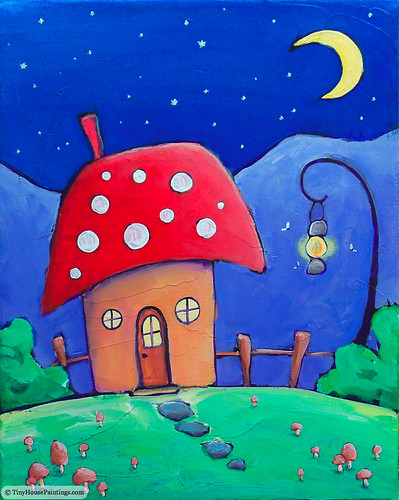
The Mushroom Hut
Painting © Tracy Booth | Creative Commons/Flickr
[image: Painting of a tiny home with a red roof with
white spots, and a lantern, under a crescent moon]
Many of our U.S.-based community members, including parents and caregivers, want guidance and clarity about how the impending Home and Community Based Services (HCBS) Settings rule will affect both adult housing choices and adult day programs.

So, we spoke with policy expert Julia Bascom, Executive Director of the Autistic Self Advocacy Network, who explained in plain conversational language how exactly the new HCBS Settings rules will affect housing options, how some common misunderstandings about the rule happen, and why the rule is essentially about trying to ensure adults with disabilities have the same basic rights as non-disabled adults do.

Thinking Person's Guide to Autism: Why was the rule enacted in the first place?

Julia Bascom: The HCBS Settings Rule sets ground floor, baseline standards for what qualifies as home and community based services (HCBS). Unlike institutions, which have had basic rules to adhere to for decades, these standards have actually never existed in an enforceable way for HCBS. This has contributed to the problem we're all very familiar with, where "community services" like group homes or day programs can end up being mini-institutions. The settings rule is trying to fix that.

This is important, so I want to dwell on it for a minute. Right now, if someone is on Medicaid and has high enough support needs to qualify for services, they are entitled to receive those services in an institution. That entitlement means there isn't a waiting list—if you need services, you can get them right away, as long as you are willing to give up your freedom and your life in the broader community.

And that's an unacceptable trade-off to ask people to make. By their nature, institutions are extremely restrictive settings. People living in institutions don't get to make their own choices. They have to live by the rules, schedule, meal plan, and decisions made by the instruction. They are segregated and isolated, and that makes them less safe—institutions are hotbeds for abuse and neglect.

In contrast, decades of research shows that people with disabilities living in the community make more choices for ourselves, have a better quality of life, are safer and more included in our communities, live longer, and maintain and develop more skills—and this is true regardless of how disabled a person is or how intense our needs are. Community settings are vastly preferred by people with disabilities and our families, and over the last three decades, there's been a huge push to move people from institutions into the community.

But Medicaid rules haven't kept up with that progress. For example, even though there's no waiting list for a spot in an institution, states are allowed to have wait lists for HCBS. These wait lists can last years, or even decades in some states. So if someone chooses to receive HCBS, they have to waive their right to receive services in an institution (that's why these services are often called "waivers") and then spend years foregoing ANY services while they sit on a waitlist. And right now, over 600,000 people with disabilities and families have made that choices and are currently sitting on a waitlist, with no services, waiting for a spot to open up. That's how popular these services are. That's how badly people with disabilities, including people with the most significant disabilities and our families, want to live in the community.

But prior to the rule, something hideously unfair kept happening. A person with a disability would choose community instead of an institution, spend years on a waitlist without any services, finally get a waiver slot—and end up in a group home or a day program that was exactly like a miniature version of an institution. People theoretically living in the community nonetheless had no choice or control over their own life. They were still segregated and isolated from people without disabilities.

And that's where the HCBS Settings Rule comes in. The rule doesn't close any institutions. If someone wants to live in an institution, they still have that choice. What the rule DOES do is say that if a setting is getting paid to provide home and community based services, they need to actually provide home and community based services.

The new standards in the rule are wild [sarcasm] things like: you can't withhold food from people. The person with a disability gets to make our own schedule. We get a choice between living with other people with disabilities, or living in our own home—and if we chose a group setting, we get to chose our roommate, decorate our room, and lock our door. The rule says we have rights that non-disabled people get to take for granted. That's all. That's the whole thing.

It's also important to point out that it took years to make this rule. The federal government received thousands of comments from people using services, providers, and families, and they had to respond to each and every one. The final rule is a compromise. It sets minimum standards, and it doesn't go as far as self-advocates wanted. Having the right to lock your door or eat when you're hungry isn't radical stuff—it barely scratches the floor of what disabled people deserve. But because the process was so comprehensive, and because the rule does for the first time establish that people receiving HCBS have basic rights, it's supported by the vast majority of national organizations representing people with disabilities and our families, along with hundreds of community providers. It's just a start—but at least we're starting.

TPGA: How long do states and providers have to come into compliance with
the new rule?

Bascom: States and providers have until 2022 to come into compliance. Since the rule was released in 2014, that means they'll have had a total of eight years to get up to speed.

TPGA: Will all adult programs have to change?

Bascom: No. If a community service is good—if it respects people's rights, supports our inclusion in the community, and makes sure that people with disabilities are in charge of how we spend our day—it won't have a problem. If it's not good, but wants to be better, it won't have a problem. If a setting is really dedicated to keeping people with disabilities segregated and subordinate, then it will have to decide to either change, or to find another source of funding.

There's a very limited amount of funding for HCBS services. That's why we have waiting lists. The point of the settings rule is to make sure that those limited dollars are being spent on services that really are home and community based, not services that are just institutions with a new coat of paint. If a setting doesn't meet criteria for HCBS, it can look for institutional funding, or it can switch to private pay. Or it can treat the people it purports to serve fairly. It's up to them.

TPGA: How does this affect adult programs that appear institutional in nature?

Bascom: One of the things that we really like about the rule is that the rule is based on the experiences of people with disabilities living or spending their days in a given setting. So it doesn't do things like set limits on the size of a setting by itself. At the same time,  the rule recognizes the decades of research and lived experience which show that certain types of settings—large congregate settings, or settings that clump a lot of disabled people together and provide a lot of services in one place—are more likely to function as an institution that not. The rule calls these settings "presumptively institutional" settings, or "settings that isolate."

But these settings still aren't banned by the rule! States have a choice. A state can decide to look at settings which, on their face, seem institutional, and give them a chance to prove that they are in fact HCBS. They have to use a process called heightened scrutiny, in which the setting demonstrates that it meets all the criteria. If a setting can prove that the people living there really do keep all their rights, and really are integrated into the broader community, it can keep its HCBS funding. Since the standards are so basic—again, can I eat when I'm hungry, can I lock my door, can I spend my time how I want—this should be pretty easy to prove. If a setting can't meet that baseline, it has no business calling itself HCBS.

TPGA: Does this mean that all clients of adult programs will have to adhere to the same rules without exceptions? What about individualized and competing access needs?

Bascom: Nope! If someone has a disability that means that a certain part of the rule won't work for them (e.g., unrestricted access to food for someone with Prader Willi,) the rule has an exception process that can be done as part of person-centered planning. The flip side, though, is that my exception can't impact someone else's services. If I need to eat on a specific schedule, for example, my provider is no longer allowed to make the whole group home follow that schedule. It's all about what I as an individual person need.

TPGA: How are HCBS rules affecting adult day programs different from those affecting residential programs?

Bascom: There's more clarity around residential services than day services right now. States have a huge amount of flexibility under the rule, so some day programs in progressive states are changing how they operate, to ensure that people set their own schedules and don't spend all day in a facility. By 2022, all adult day programs will have had eight years to figure out any changes. And again, good programs that work to integrate people into their communities and either find employment or do other things during the day that are meaningful to them, won't have to make any changes at all.

TPGA: So why do you think some people might be opposed to the HCBS rules for adult day programs?

Bascom: I think there are a few different reasons. A lot of people are just confused, because there's so much misinformation flying around about the rule. There are also people deliberately spreading this misinformation, and they tend to have a couple different reasons.

First, there are providers who have a vested financial interest in operating miniature institutions and calling it HCBS. There are actually a lot of rules about running formal institutions—there are basic standards you have to follow, licensing regulations, all of that kind of thing. But those rules haven't really existed before in that same way for HCBS. That means a lot of these providers have been able to run mini-institutions for decades with virtually zero regulation or oversight. They aren't wild about changing. This is, bluntly, too bad.

There are also a lot of wealthy families who want to build new institutions. They don't like to call them institutions—they call them farmsteads, or intentional communities, or campuses, or villages. But these are all literally what the first institutions looked like, and they are still large settings that lump a lot of disabled people together and segregate us from the broader community. It's a fresh coat of paint on a bad idea. But these families want to build them, and they've invested a lot of money in their construction, and now they're worried that Medicaid won't pay for services in these settings. So they oppose the rule.

There are also people who are worried that their family member can't live in the community. We know that community living is actually possible and beneficial for everyone, even for people with the most significant disabilities, but I think some families are afraid to take the plunge, especially if they haven't seen a lot of successful examples of people like their family member living good lives in the community. These families aren't helped by misinformation—they need concrete examples of how this works, like those in parent/professional Dr. Clarissa Kripke's article on successful community living for people with developmental disabilities.
Share:

Autism and Suicidality: Conversations Between Researchers and Autistic People

Sadness
Photo © Gayan Gunawardana | Creative Commons
[image: Backlit photo of a sad ponytailed person
with their head down, in profile in front of an
ocean sunset.]
Dr. Sarah Cassidy co-chaired a SIG (Special Interest Group) on Autism and Suicidality at IMFAR 2016, in Baltimore. We weren't able to attend her session, but Dr. Cassidy was kind enough to take time, later that same day, to talk with TPGA editors Shannon Rosa and Carol Greenburg, autistic autism researcher Dr. Steven Kapp, and Autistic Self Advocacy Network Executive Director Julia Bascom. The following is a transcript of our conversation.

----

Shannon Rosa: Tell us about what you discussed in the SIG. What has your research revealed about suicidality in autistic people?

Dr. Cassidy: We’ve published two studies so far. The first study we did, which is free to access in the new Lancet (Psychiatry) journal, was a medical chart review, a type of data mining, at the Autism Research Center, Cambridge University, UK. It had a clinic called the Cambridge Lifetime Asperger’s Service (CLASS) Clinic, which was set up by Simon Baron-Cohen, and specialized in the diagnosis of Asperger’s in adulthood.

The clinicians collected a lot of data from individuals before they went though the diagnostic appointment, such as:
  1. Have you ever contemplated suicide in your lifetime
  2. Have you ever planned or attempted suicide in your lifetime
  3. Have you ever been diagnosed with depression.
Everyone seen over a nine-year period was asked these same three questions very consistently. They also completed the AQ and EQ questionnaires.

When we analyzed all the data, we found 374 people had been diagnosed with Asperger’s syndrome, and out of those individuals, 66% had self-reports of contemplating suicide at some point in their lifetime. In the same group, one third had planned or attempted suicide in their lifetime, and about another third had been diagnosed with depression.  

That depression diagnosis was a significant risk factor in planning or attempting suicide, or suicidal ideation—those who had a diagnosis of depression were at significant risk for both those factors.

While everyone in the group had a diagnosis of Asperger’s, those who had planned or attempted suicide also had significantly more self-reported autistic traits than those who didn’t.

Carol Greenburg: I have a question, and I’m not quite sure how to ask it. How can you differentiate between an actual attempt at suicide, and an overdose that happens because of an autistic person’s medication not being properly monitored? Do you control for that?

Cassidy: I think that’s a really excellent question. In this particular study, which was retrospective, we just asked one question—one self-report question—which was “have you ever planned or attempted suicide in your lifetime?”

So it wasn’t looking at “completed” suicides, where you’re not sure if it was an accidental overdose or it it was deliberate. And this was self-report. I think that’s a real challenge, for coroner studies, or studies of “completed” suicides. In the UK, those kinds of suicides are recorded as “open verdict.” We don’t know unless they leave a note.

Greenburg: That’s what we have in the U.S., too; they say that it was not possible to determine whether it was an accidental or deliberate overdose.

Steven Kapp: I’ve seen in many studies that higher numbers of autistic traits, whether in adolescents or adults, or perceived differences from typical peers, or attributing social difficulties to oneself—any way you slice it—exposure to normalization attitudes is usually related to higher rates of depression, and anxiety, and internalized ableism. We did find this even in a self-reporting using an online screener, that a higher level of  autistic traits was related to lower self-endorsed quality of life, and a feeling of disempowerment. Because the stigma is still so high, and there are still so many forces against you, that people might not be disclosing even if they’re relatively comfortable with who they are.

Cassidy: The 66% rate of depression of autistic people in our study was higher than those in other studies, higher than the 59% rate in a sample of patients diagnosed with psychosis, and significantly higher than people diagnosed with one or more medical illnesses, significantly higher than the UK general population, where a similar self-report questionnaire was used, and where the rate is 17%.

Julia Bascom: What are the next steps, in terms of supports and prevention? What did you talk about during the SIG?

Cassidy: It was really eye-opening to hear from autistic people and family members, and quite hard-hitting as well. Because a lot of the limited research, which is really only about eight studies looking at suicidality in adults, adolescents, and children with autism, are usually only counting studies about prevalence, about “how common is it?? But nothing about how does it develop, what are the family experiences and dynamics. What are the interventions we can do now? It’s not enough to talk about rates. You can have as many counting studies as you want, but knowing that the rate is high doesn’t really tell you what to do about it, especially in the short term.

We need to know what the risk factors are, whether there are protective factors? What is the difference between people with autism who experience suicidality and those that don’t, and how does that compare to the general population?

What really came out of the study is that we need some short-term goals, right now, and to come up with useful guidelines for parents and clinicians who are trying to help people experiencing these difficulties.

What was really great is that there were people at the SIG who had access to really big research databases like the Interactive Autism Network, ones in Newcastle and Cambridge, and Swedish databases. We talked about sharing out expertise, and actually do a qualitative survey targeting parents, young people with autism, and adults with autism—and asking them “what kind of supports do you actually need? What would help you, if you were experiencing these kind of difficulties?” So we could try to make recommendations about what the next steps could be, and interventions or preventative measures or supports we need to develop.

Another thing we discussed during the SIG was sharing data. In our study, we have a short set of questions that could be collected routinely in all of the studies that we do, so we could put data together and look at a variety of factors. Things like quality of life are really, really important. And there is really exciting work going on, in developing quality of life measures specifically for people with autism, and the unique challenges that they have. So if we provide these quick questions to go with it, we’d be able to directly compare and pull resources, and ideally untangle some of the causatory factors.

The last thing that came out, because there are lots of research questions to sift through and get feedback on, but another thing we really want to do is to run a seminar series. In the SIG we only had 1 1/2 hours, and could only scratch the surface. So we want to hold a seminar series in the UK, try to get funding for that, and invite people from Canada, Sweden and other European countries, The US, involving autistic people, families, funders, researchers, clinicians who are interested in this topic. I want it to be like the SIG, involving lots of different stakeholders, because it’s really important to include everyone involved when talking about next steps and research priorities.

I think we’ve done as much as we can with the prevalence and counting studies; we need to go a bit further and ask what we’re going to do about it, what is the response going to be, and how can we pull resources so we don’t waste time doing more of the same? So we can do something useful?

Bascom: Was there any discussion (in US or other countries) of where to find supports and resources for people with developmental disabilities and communication disabilities (autistic or not)? Because this is a huge problem—it’s very difficult to find mental health providers for people with developmental disabilities, especially if they’re autistic, especially if they also have intellectual disability, limited speech, or don’t have a good communication system. As an advocacy organization, ASAN considers this area really important, but we often feel like our hands are tied because people will come to us, and ask for resources—and they just don’t exist, because the providers don’t exist. Was there any discussion about how these factors might be affecting the numbers?

Cassidy: What we did discuss—and it was to do with preventative strategies, interventions, and treatments—is trying to improve experiences of hospitalization. There was talk of doctors or clinicians overreacting, and over-intervening, or not knowing how to intervene. We need those guidelines, and there’s so little research on it. Just taking simple steps, like using the NAS hospital passports that give out information like:

  • This is what my pain threshold is like
  • This is how I prefer to be communicated with
  • I’m verbal/I’m not verbal
  • These are my interests
  • This is how you talk to me

And things like that. Also training health providers that they need to provide structure, they need to provide a bit more explanation, a little bit more processing time. Or they have to be aware of really literal interpretations. Just small things like that can make peoples’ experiences with health care scenarios so much better.

But we do need to have a research study, because most of this is anecdotal, from discussions with clinicians experiences with people with autism coming in, and they’re not to sure how to deal with them. And then there are other clinicians who are really excellent, who really do have experience in autism. But it’s not consistent.

Bascom: In the States, we have this huge gap between autistic people who need services and providers. You find people, like primary care providers or therapists, who don’t necessarily have autism training but are good with autistic people—and then people find out about them and then they’re overloaded and can’t take more patients. We have an association, The NADD, that tries to be specifically for people with autism and developmental disabilities who need mental health support, but it’s so tiny, because there just hasn’t been funding for the training, and providers often think accommodating autistic patients is going to be a lot more complicated than it is. There’s a lot of room for specific training, but we certainly don’t have any large US organizations who are trying to do anything like the UK’s NAS Passport yet. ASAN helped AASPIRE develop a customizable healthcare toolkit, and it’s great, but it hasn’t gone to scale in any meaningful way. So it’s interesting to hear that that’s what you’re looking at, as well.

Cassidy: NAS Wales had a great, very customizable toolkit. You go to the website, and you can click on different kinds of difficulties, and you can put in picture symbols.

The UK overall is evaluating the effectiveness of the passports, in terms of what’s the uptake, and what’s the experience of using it.

Bascom: There are people who are going to need specialized expertise. People who, for instance, are autistic and have communication disabilities, and they don’t have good access to AAC, and they have challenging behavioral issues—there are very few practitioners who even know where to start. Which is frustrating, because we know mental health disabilities are underlining a lot of what is going on, though that’s also kind of a separate population from what you (Dr. Cassidy) are talking about, I think. Or maybe there’s an assumption that it’s a separate population. It would be good to know how many of those kids grow up into suicidal adults.

Shannon Rosa: If you’re never accommodated, or understood…

Bascom: I can think of several people I know, who were that way as kids. And now as adults, they seem to be doing a lot better. But when you pay attention to their mental state, it’s a lot more dangerous than maybe when they were a little more open about what they were feeling.

Cassidy: We have a group of adults with autism who experienced suicidality, and they are helping us design a survey that goes into more detail, about the issue of lack of supports, and different kinds of difficulties and what causes them. One of them is a parent who has a diagnosis herself but also her son has a diagnoses. And she was saying similar things to what you (Julia Bascom) are saying, in looking back at the lack of supports throughout. I think it does take its toll, and we’re going to explore that a bit more.

My work is just for adults, but we need to expand it somehow, to look at children, and that developmental pathway. Or following up autistic children, because there are a lot of cohort studies in the UK and overseas, and making sure people include those questions and look at those things is going to be really important.

----

Dr. Cassidy will be co-chairing another SIG on autism and suicidality at IMFAR 2017.

----

SUICIDE RESOURCES

Anyone who is feeling suicidal may receive immediate help by logging onto Suicide.org or by calling 1-800-SUICIDE. Suicide is preventable, and if you are feeling suicidal, you must get help. So please visit Suicide.org or call 1-800-SUICIDE immediately. Please also know that you are not alone.

MHAutism, which focuses on mental health for autistic people, has developed a Safety Plan, which allows those who are vulnerable to plan for when and if they experiencing suicidal thoughts, and also to record information to help other people provide supports.

For autistic people seeking specifically autistic perspectives, please read our archive posts below. While aimed towards younger people, they discuss getting through the kind of tough times familiar to autistic people of any age who have been conditioned into negativity:

Share: