Showing posts with label memoir. Show all posts

Autism Uncensored: A Dangerous and Spirit-Crushing Book

Photo © Charley Lhasa | Flickr/Creative Commons
[image: Plush red Elmo doll lying on asphalt.
A yellow chalk speech bubble has Elmo appear to be yelling "Help!"]
Maxfield Sparrow
unstrangemind.com

[Content note: Extensive discussion of restraints. Discussions of gaslighting, denying Autistic autonomy and competence, child abuse, autism profiteering, and similar goblins. Discussion of the 1960s medical view of autism as it continues to occur today.]

You may have seen the recent Washington Post article titled “Bystanders were horrified. But my son has autism and I was desperate,” an excerpt from Whitney Ellenby’s new book, Autism Uncensored: Pulling Back the Curtain. True to the exposé tone of the title, Ellenby describes in livid detail the day she wrestled her panicked son, Zack, by clamping his 50 pound frame tightly between her thighs and locking her feet together. The two spent over half an hour in combat as Ellenby dragged him inch by inch toward the red curtain beyond which the Sesame Street puppet Elmo was performing. Zack’s piercing shrieks alarmed onlookers who screamed at Ellenby to stop, threw an iced drink on her, and spat on her.

When the venue attempted to kick Ellenby and Zack out for causing a disturbance, she told them the ADA (Americans With Disabilities Act) gave Zack the right to reasonable accommodations to access public venues, and she was Zack’s accommodation.

I learned from reading her forthcoming book that Ellenby began her career as an ADA lawyer. She had a dream of fighting the huge battles. I’m picturing her mind set on something like a cross between Spencer Tracy in Inherit the Wind, and Gregory Peck in To Kill a Mockingbird. She went into ADA law starry-eyed about all the great work she would do, but became frustrated when the bulk of her work turned out to be things like getting down on all fours to measure doorways and stalls to see if they were up to code. That didn’t feel important enough to her, so she switched to a boutique adoption firm. Then she became pregnant with Zack, and thought she would take a little time off to give birth but soon be right back in the thick of things at work.

The first half of Autism Uncensored is a brutal description of how angry and bitter Ellenby became at her son, Zack, when he turned out to be autistic. Ellenby feels like giving birth to Zack was some kind of punishment for her sins, and expresses that belief through declarations like, “After weeks of being entombed by numbness, my heart is finally giving way to the realization that I’m being justly punished.”  “Zack’s autism is collateral damage for a life poorly lived. I just never imagined the punishment for my bad deeds would be inflicted on my innocent child, or be so brutal, so permanent.” “I’m chained to this denigrating, unpaid forced labor with no tangible reward for all my sacrifice.” “I will be incarcerated and tied to him for the rest of my life, a prison sentence” “I can’t pretend this is anything but punishment. At its very worst, autism feels like a living, walking, breathing nightmare.”

The book could use a thorough editing for typos and word usage—writing “synchronicity” for “synchrony,” or “bespectacled” for “bespangled,” for example—but I don’t think the last quote of my previous paragraph was a typo. I believe the author fully intended to say “autism feels like…” because she believes that autism is not a word to describe the structure and function of her son’s brain, but rather a punishment inflicted on her. Like many martyr parents, she has co-opted her son’s identity and cast herself in the role of victim. Autism is not a neurotype; autism is what was done to her. And in between sessions with her hair shirt, she makes it clear that she thinks she is better than this: “I am a well-educated woman. I am an accomplished civil rights attorney. I am a woman who spends hours every night on her hands and knees scraping feces off walls.”

Sometimes her concept of autism is as a separate beast, something outside and inhuman: “Autism is angry. The infuriated beast of defiance is rearing its head, snarling, writhing, biting, only I’m not trying to defeat the beast or even subdue it. I need its passion and power. It’s this very passion that fuels the resistance with which I must align myself, harnessing and channeling that live energy.”

I have heard people defend the phrase “combat autism” by saying that they love their child and hate autism. When the average person says they’re fighting autism, it feels bad to me but I try not to say too much because I’d rather win hearts and minds, than be too direct and alienate anyone I might otherwise have influenced. But when Whitney Ellenby was fighting autism, it was very much not a case of “love the child; hate the autism.” When Ellenby writes about fighting autism, she is talking about fighting Zack. 

Ellenby wrote very clearly about hating Zack, and she used the kind of language I’m not used to seeing outside medical books from 40 and 50 years ago. “He’s not even a boy really, but the shell of a boy, an exquisite cutout of a child with no actual stuffing. He is damaged ... deformed ... disgraced. And his disgrace is my own. This is what my glorious womb has produced, a profoundly dysfunctional child.”

The author tells us that she has intentionally chosen to use the present tense when writing her history with Zack as if everything were happening in the moment in order to achieve maximum emotional impact. She succeeded in that aim; her book is harrowing. I felt clobbered reading the first half of Autism Uncensored. After enough clobbering, I just felt numb and empty.

The second half of the book starts when Ellenby’s daughter Cassie is born. Cassie is not autistic, and at first Ellenby loves her more than Zack because she is typical. “Cassie exhibits everything Zack did not, and more. I feel truly appreciated, indispensable, valued. I’m not just smitten but truly grateful to my daughter for allowing me finally to know true reciprocal joy and interdependence. So this is why so many parents describe newborns as transformative, revolutionary and all-encompassing. Now I get it. Now I can’t pretend that I don’t.” Zack clearly sees the overwhelming favoritism going on and in a panic about his own survival he does things to hurt the baby.

Ellenby complains about all the extra work of policing Zack while taking care of Cassie. She wishes she could get rid of Zack and start fresh with Cassie and forget she ever had a child who wasn’t normal. “I cannot see a way out or how will it [sic] ever subside in the face of such obvious, lasting discrepancies between my two children. I’ve never been one to repress my fantasies, the theme of which are now overwhelmingly versions of 'starting over.'” “What if Keith and I could start over with just her and then have just one more typical child? Now that we know it’s reproductively possible, the notion is intoxicating, the vision of Cassie as the older sibling to another adorable healthy baby, rounding out the family to the four I’d originally envisioned, before all hell broke loose.”

Ellenby realizes she’s sharing a horrifying thought and tells the reader “no one who hasn’t walked in my shoes gets to judge me.” She reasons that it’s natural for her to feel this way after everything she has endured from Zack. But around 60% into the book, Ellenby’s affections for her children suffers a sea-change. The catalyst? Cassie starts talking. Now Cassie uses logic to resist doing what Ellenby wants her to do. Cassie treats her mother to streams of insults: “From now until forever, I’m going to be friends with everyone except you!” “And I don’t even like the way you dress! And you try, but you are not even funny!” “And you know what? Daddy is SO much more funner than you! And he’s a better cook, and he’s better at video games, and he looks better in his clothes than you do in yours.”

Ellenby can’t stand it and begins to hate her daughter, opening up room to love her son as she uses the ambiguity of his silence to layer dehumanizing mystical interpretations of autism onto him. “Unbelievably, the scales of enjoyment between my two children are tipping in a direction I had not thought possible.” She begins to really appreciate Zack’s silence. “Zack’s own economy of words works to our mutual advantage—I talk too much, he too little. Somewhere between us lies a normal amount of speech.” From this point on, she always writes about Zack with a stereotypical new age-y praise of his innocence and higher spiritual nature.

Around the same time, she starts noticing that people will be overwhelmingly supportive and helpful when she makes a public announcement about Zack’s autism. People on the train provide an endless supply of tissues and plastic bags when Zack soils himself unexpectedly and Ellenby announces it’s due to autism. Gang members at a water park band up to protect and assist Zack on the giant water slide after she gives an impromptu speech about Zack’s autism on the steps of the water slide. Ellenby wrote in the first half of the book that she was Zack’s accommodation and he “rides” her. By the second half of the book it is becoming clear that she is riding Zack, using his autism for a social payout to herself.

Ellenby describes a turning point at which I sense she first began to realize she could commodify Zack’s autism for money, social status, or both. Ellenby stages another wrestling match with Zack, this one to get him inside a movie theater to see Happy Feet. This time, instead of springing the performance on an unsuspecting and captive audience, Ellenby goes into the theater alone first to announce that she will be dragging Zack in during the previews and that he’s got autism and this is part of his exposure therapy.

The theater-goers silently watched Ellenby drag her son into the theater—kicking, clawing, biting, shrieking—and then, “A few members actually kneel to give me strong hugs; others pointedly ask me for my business card so I can work with their disabled children, cousins, grandchildren. Once again history has been made in the life of my child. Savor it.”

Ellenby ends her book by telling us about her business and all the good it is doing in the world of autism. The book reads like a business card. It’s the kind of book meant to drum up more business and I think it will be highly successful in that regard. And I think that’s a horrible state of affairs.

Ellenby began dragging her son places after she felt Zack was not making enough progress on ABA therapy. She decided mother knows best and began her own program of forcibly dragging him places he didn’t want to go so he could see for himself that it wasn’t so bad once he got there. The author spends a few pages of her book enumerating the flaws of ABA and, for a moment, I agree with her:

“A flat prohibition against certain behaviors wipes out a panoply of ritualistic comforts for an entire population, some of whom may very well depend on them to function at all. And if we suffocate those adaptive behaviors, even when the child is learning, are we not teaching the child to be ashamed of his own natural impulses, telling him his are disfavored or deviant? And would we do the same to typically developing children, or to ourselves as adults?”

“But something even more sinister is going on here: we are undermining Zack’s autonomy and sense of self-worth. ABA protocol is literally robbing Zack of independence and bodily choices, because we are making them for him.” Yet what is Ellenby’s Tackle and Drag Therapy but a super-intense experience for Zack of completely losing his autonomy and bodily choice?

Ellenby felt like a small fish in a big pond as an attorney; making her life about autism makes her feel like a much bigger fish. Again, she co-opts Zack’s identity to fill her ego needs: “I am autism and it is me; I live and breathe it, fully intoxicated: it’s in my marrow. And most unexpectedly, it gives me profound joy and sense of purpose to acknowledge it. It doesn’t matter that I was trained to be an attorney. I’m meant to be something more feral, more hands-on, more intimate and immediate. After a decade spent wandering the wilderness as a little attorney lost, possessing raging zeal with no clearly identifiable group to ignite it, I have come home.”

Ellenby admits she’s not even got the proper training to safely restrain a child. With her attorney instinct, she makes sure to tell people not to do what she did. Yet she uses such scientific phrasing when she describes her “experiments” and writes about her perception of the success in such glowing terms many vulnerable parents will do exactly what she describes, as closely as possible to the way Ellenby did with Zack in search of some magic outcome.

And for all Ellenby’s criticism of ABA in her book, when I Googled her business I found that it’s based on an ABA model. And in her Washington Post article, Ellenby admits that what she is doing with her Tackle and Drag therapy is exactly what ABA therapists do if the 40-hour work week of ABA therapy isn’t making a dent in a child’s behavior. She told Zack’s doctor about the Elmo show, after the fact, and he explained that: “as a last resort, in a controlled way and only after years of therapy, a licensed behavioral clinician might have physically restrained Zack to force him to confront his fears, had he not responded to more gradual methods.”

As Sid Ziff once quipped, this is not a book to be lightly thrown aside; it should be thrown with great force. But it is in the midst of being published and the publisher has defended the author, using some particularly nasty rhetoric against Autistic people who don’t like the book. It will be published.

Ellenby has said no one should speak badly about her book unless they’d read every word. Well, I’ve done that now and I feel soiled and deflated. Demanding that Autistics who are upset by one bite of her book must go on to consume the whole thing before being permitted to have an opinion is the demand of a bully who knows they are requiring vulnerable people to traumatize themselves with her words.

While Ellenby has, perhaps unwittingly, exposed a lot of the ugliness and unsuitability of ABA, she embraces the behavioral paradigm still and enacts the very worst versions of it. Autism Uncensored is a traumatic read and should be resisted as much as possible. I’ve read it for you and saved you the trouble and trauma. Instead of this revolting mess, I suggest you read the following:

Respectfully Connected

Blog: respectfullyconnected.com
Facebook: www.facebook.com/RespectfullyConnected

"Authors of this blog come from a wide range of backgrounds and between them have an enormous amount of parenting experience. They all share a desire to parent in a way that both models and facilitates respect and connection, and that values all kinds of diversity. The authors of this blog also share the experience of being part of neurodivergent families."

"This blog exists to share the authors stories, with the hope they will empower and encourage other parents on their journey with the knowledge that there is a gentler, more compassionate way of raising autistic children than much of society tells us, and that close attached relationships are very possible."

We Are Like Your Child

Blog: wearelikeyourchild.blogspot.com
Facebook: https://www.facebook.com/WeAreLikeYourChild

“We Are Like Your Child [is] a collaboration of Autistic (& occasionally, other disabled) adults. We discuss our difficulties & how we work with or around them from a neurodiversity & social model of disability perspective.”

WALYC was organized in response to the many parents who refuse to listen to what Autistic adults have to say about the lived experience of autism, telling us that we can’t possibly have any useful insight or advice because we’re “not like their child.” But you can’t compare an adult to a child and the members of WALYC often discuss challenges many people’s children of all ages face, along with strategies for circumventing or overcoming those challenges.

The Thinking Person’s Guide to Autism

Oh, wait, that’s where you are right now, reading this. Well keep reading TPGA! There is so much collected wisdom here from Autistics, parents, therapists, and more that it would take a shelf of textbooks to hold it all (and the valuable content continues to grow.)

These three sites alone will keep you very busy reading and learning things that will actually help you and your child. Reject Ellenby’s Tackle and Drag therapy and anything that comes from Dr. Lovaas and his ABA practices. Boycott Autism Uncensored and tell everyone why Autistics deserve better.
Share:

Why To Siri With Love Is a Wrecking Ball of a Book

Maxfield Sparrow
unstrangemind.com

[Content note: possible triggers include: forcible sterilization of minorities including Autistic people, forcible gynecological experimentation on minorities, Judge Rotenberg Center, electric shock, stereotypes about Autistics lacking empathy or a sense of humor, stereotypes about Autistics or Black people lacking the ability to feel pain, snakes and feeding live rodents, harmful Supreme Court verdicts, dehumanizing of Autists, getting drunk, preferring drunkenness to talking with Autistic children, humanizing the author of a grossly dehumanizing book.]

Come mothers and fathers / Throughout the land 
And don't criticize / What you can't understand 
Your sons and your daughters / Are beyond your command 
Your old road is rapidly aging. 
Please get out of the new one / If you can't lend your hand 
For the times they are a-changin'. 
-Bob Dylan

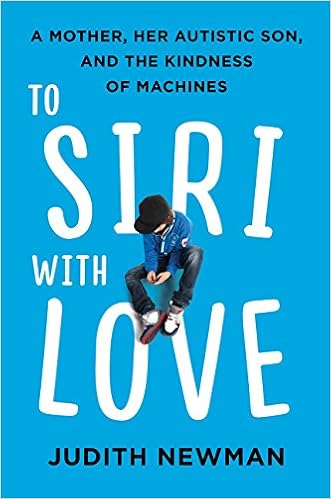
[image: Book cover: A blue background
with informal font white text reading,
"To Siri With Love," with a photo of a
child looking at an iPhone seated in the
middle of the text, wearing a baseball cap
and seen from overhead.]
Like many of my fellow Autists, I first heard about Judith Newman’s book To Siri With Love: A Mother, her Autistic Son, and the Kindness of Machines through the Twitter hashtag #BoycottToSiri. The book itself is expanded from Newman's same-titled 2014 New York Times Fashion/Style column, and is a memoir of her New York City life with twin boys, Gus and Henry. Gus is diagnosed Autistic; Henry is not.

#BoycottToSiri arose on Twitter after an encounter between Newman and Autistic activist and educator, Amythest Schaber. In To Siri With Love, Newman described Schaber as “look[ing] like everyone’s favorite manic pixie dream girl” (page 42). Schaber was understandably displeased with this description, as it is not a compliment.

"Manic Pixie Dream Girl" was coined by Nathan Rabin, a film critic who described a Manic Pixie Dream Girl as “that bubbly, shallow cinematic creature that exists solely in the fevered imaginations of sensitive writer-directors to teach broodingly soulful young men to embrace life and its infinite mysteries and adventures.” Two years later, Rabin and colleagues wrote an article about the Manic Pixie Dream Girl (MPDG) in which they compared the sexist trope to a racist film trope known as “the Magical Negro,” saying both archetypes are, “largely defined by secondary status and lack of an inner life.”

I have a passion for film studies, so I can't gauge how widespread awareness of these movie tropes are. But MPDG and many other tropes are featured on a website, TV Tropes, that has an Alexa ranking of 664th in the United States, where over half its traffic originates. That’s pretty popular. For semi-random comparison, Autism Speaks—the largest autism charity in the world—has a U.S. Alexa ranking of 8,241. I’d say that means there’s a strong likelihood that Amythest and I are not the only people out there immediately aware that “Manic Pixie Dream Girl” is a grave insult. Newman, whose life appears to be quite filled with family and career, may not be as much a film buff as some of the rest of us, but MPDG is such an odd phrase that I would have looked it up before I felt comfortable including it in a piece of writing in which I could have simply referred to a person as “pixie-like”...if I felt the need to describe their appearance at all.

Perhaps I have waxed over-long, gentle reader, on a sexist slur innocently cast upon someone Newman clearly admired. After all, as Newman and her fans pointed out several times, the words following MPDG were a description of some of Schaber’s t-shirt slogans, followed by, “These videos should be required viewing for every parent of an autistic child.”  But I want you to understand what pre-formed opinions I brought to my reading of To Siri With Love.

The confrontation between Newman and Schaber quickly escalated to a full-out battle with recriminations and mass blockings. If you’ve ever been swept into a Twitter war, you have some idea of how stressful the event must have been for all involved, particularly the duo at the center of the maelstrom. What caught my eye in the midst of it all were multiple warnings under the hashtag, telling me that Newman wanted to sterilize her teenage son. Of course I then wanted to read that book for myself and review it, so here we are.

I’d like to move forward, but first a few background links regarding the Twitter battle and boycott call. Amythest Schaber posted their own Twitter thread about the boycott. Culturess wrote about the boycott, including a link to a lengthy Twitter thread by Autistic reviewer Kaelan Rhywiol. Romper’s article about the boycott includes a USA Today video clip in which you can see glimpses of Gus for yourself. Senior editor of The Thinking Person’s Guide to Autism, Shannon Des Roches Rosa, supports the boycott in an essay on her personal blog, Squidalicious. And although I have been participating in the #CrippingTheMighty Boycott for a few years now, I made a lone exception to read their article about #BoycottToSiri and was favorably impressed with their reporting. And while I was working on writing this review, Schaber released a video discussing #BoycottToSiri.

It took me three days to read the book. Yes, I am a slow reader, but also no, I’m not that slow of a reader. I wanted to take my time with the text, to read it carefully and critically, and take time to process the actual content of what I was reading. I also read in a state of dread, not entirely dissimilar to the sensation one experiences in a commercial haunted house, continually apprehensive about what may be jumping out around the next corner. Maintaining this state of high alarm for days is draining and I needed lots of time to rest and recover from the work of reading a book that had raised such intense emotions in my communities, both among those who had read the book and those who had not.

External control over the reproductive rights of disabled adults is an understandably emotional topic in the autistic community. I do not want to co-opt any other group’s struggle, but it is difficult to convey how strongly we feel about this issue without pointing to related suffering among other minorities: Deaf people who were regularly sterilized and refused immigration to the United States, for example. Marge Piercy’s sci-fi classic Woman on the Edge of Time explores the aftermath of the protagonist’s forced sterilization for the “crime” of being poor and a Woman of Color in 1970s New York City—a scenario that actually happened repeatedly.

For additional context, activist, mother of a Black Autistic teenager, and dear friend Kerima Çevik, wrote of Newman’s book:
“This is a human rights affront. It is presenting the idea of involuntary sterilization of her son to a mass audience that may not have considered this in a time when eugenics is waxing globally. There is no context in which this is okay. There is no teachable moment here. The book is published and the idea is out there. For me, knowing what harm forced sterilization did to my race and to disabled people in the past, this is an unacceptable thing, and her thoughtless, cruel words in her vain book have now placed thousands of disabled adults at risk. There is ignorance and there is this Pandora’s box of an evil book that can have devastating public policy consequences.”
Later, Çevik shared a video with many of us, discussing atrocities committed against Black women’s reproductive rights. (The mini-documentary was so distressing that it took me four viewing sessions to make it through its four minutes of video.) A parallel between the Black experience and the Autistic experience leapt out at me: Doctor James Marion Sims, inventor of the gynecological speculum, conducted many experiments and surgeries on enslaved women without the benefit of anesthesia. Some of the women had over 30 surgeries at Sims’ hands, all without any pain relief whatsoever because of the false belief that Black people did not feel pain.

Hearing this history, I had to stop viewing the video and collect myself, because I immediately thought of the long history of claims that Autists do not feel pain, which culminated in testimony at an FDA hearing concerning whether it was okay to use electric shocks on Autistic children. Beyond the revulsion I feel at the fact that anyone needed to debate the ethics of using a Graduated Electronic Decelerator on children, I am nauseated by testimony and debate concerning “whether autistic people feel pain, if pain equates to harm, and if individuals with disabilities suffer any harm from being shocked.”

As I said, I don’t want to co-opt another marginalized group’s struggles, but there are so many similarities in the reproductive oppressions of Black people and those of developmentally disabled people that knowledge of the issues facing both communities, historically and currently, is crucial. Leaving aside the complexity of intersectionality—people like Çevik’s son who are both Black and Autistic experience exponentially increased struggles stemming from the union of two marginalized identities—understanding the systematic dehumanization slaves and their descendants have faced shines a light on the systematic dehumanization that developmentally disabled people face. I absolutely agree with Çevik that advocating for taking control of someone else’s reproductive rights is unacceptable, normalizing the removal of a disabled adult’s capacity to reproduce has devastating public policy consequences, and a book that would promote such ideas is an evil book.

It was with these thoughts in mind that I sat down to read To Siri With Love. I spent those three days reading it because I wanted to provide the most unbiased reading and review I possibly could. But I confess that I am completely biased when it comes to human rights issues. I had already witnessed the author calling Schaber a “brat” and snidely questioning their upbringing. Facebook and Twitter were abuzz with fury, with the words “transphobic” and “forced sterilization” appearing again and again. I opened the book feeling as if I were entering enemy territory.

To Siri With Love began well, with Newman explaining quite eloquently why PC insistence on person-first language is misplaced: “‘Person with autism’ also suggests that autism is something bad that one needs distance from,” Newman writes—and it’s perfectly fine to use the word “autistic.” But didn’t take long to learn why Newman was being called transphobic. Before page one, before the introduction, I got my first slap from Newman’s book in the author’s note.

Newman writes of a friend who wrote a book on parenting and used the singular "they" rather than "he" or "she." Never mind that using the singular they as a pronoun for unknown or generalized people long pre-dates the 18th century linguistic prescription movement. Newman declares it, as well as the use of the word “cisgender,” to be “ugly and imprecise.” I cannot argue for or against “ugly” as qualitative assessments are subject to the proverbial eye of the beholder, but for the great utility of the singular they one needs only look to the writing of William Shakespeare or Jane Austen. As for the cis-/trans- pairing, which dates back to the mid 1990s (or, as has been pointed out, as far back as 1914) it has as much linguistic utility as other pairings such as het-/homo- or masc-/fem-.

The book has many high points: Newman champions the right and necessity of Autistic stimming on pages 41 through 43, for example. It also has many low points, such as Newman repeatedly describing her son Gus’s interests as bizarre, even going so far as to suggest it “require[s] magic mushrooms to see it the way he does” (page 41).

Overall, I was left with the impression of an author who loves her children much in the same way she loves her dogs. She cares about their safety and welfare. She cares about feeding them nutritious food and ensuring they get sufficient sleep. She wants them to be happy and feel loved. She understands them only as well as one can understand a distinctly separate species. And she feels she has ownership of their bodies and minds.

In one passage, on page 35, Newman compares her intense interest in repeatedly reading and re-reading the opening words of Nabokov’s famous novel of chronic child rape, Lolita, to her son’s love of a fifteen-minute video of the wooden escalators at Macy’s department store. Newman insinuates that her preoccupation with a novel in which the middle-aged narrator begins by referring to a 12-year-old girl as “light of my life, fire of my loins” is somehow more elevated, wholesome, and comprehensible than the beauty of escalators: ridged plates neatly sliding through grooves to fold upon themselves and return to their point of origin, mystically creating interlocking platforms—shining metallic magic carpets endlessly conveying people on an intricate conveyor belt that looks just like stairs and does not abduct children to spend three years driving them across the country, raping them in hotel rooms while destroying their lives.

Yes, I can see how Newman might find Gus’ interests mundane and intolerably boring when contrasted to the delights of literary hebephilia.

That last sentence, by the way, was sarcasm. For those not in the know, sarcasm is a form of cutting humor. I explain, because Newman has repeatedly announced that Autistic people do not like her book because we are unable to understand humor and cannot see that her book is just so funny.

I had a private online discussion with Newman within an hour of finishing her book but before I began writing this review. My opening comment to her:
“I just finished reading your book about 15 minutes ago. I have spent the last three days reading it and taking notes. And I understand that it is probably frightening to talk to me. I'm a bit terrified, myself.”
Newman's opening comment to me:
“I was just saying, Maxfield, to someone online, that what NT people liked about this book was that it looked at the funnier side of things that are often, in books about autism, seen as upsetting. But it is difficult, often impossible, to explain humor. I am not sure that people here see the difference between laughing ABOUT something and laughing AT someone.  There is a huge difference. I laugh at a lot of things -- at myself, at my family, at Gus -- but they are not the butt of my jokes, if you see what I mean.”
This is not Newman’s first or last time to insinuate that Autistic people do not like her book because we cannot understand humor. Not only is she making blanket assumptions about our abilities, she is engaging in one of the most classic forms of gaslighting: telling others they have no sense of humor, or don’t know how to take a joke.

I just don’t think it’s funny to say (repeatedly) that no one will ever want to date your son, and that if they did have sex with him the result would  be so ludicrous it would require a Benny Hill soundtrack to accompany it (page 116). I don’t think it’s funny to say that you are glad vasectomies can be reversed because you will be able to get one for your son when he turns 18 and reverse it when he’s 35 so you can have grandchildren (page 117). And I don’t think it’s funny to tell us that you’re able to bond with your non-autistic child despite the fact that “the overlapping area in the Venn diagram of our common interests is the size of a pinhead” (page 39), but your Autistic child bores you so much that the only remedy is to get drunk to escape “discussing weather, trains, or Disney villains” (page 40).

Two nights after our first long chat, I was two-thirds of the way through writing this review and feeling mentally and emotionally drained. You see, our lengthy private discussion started off on a rough tone and for quite some time I felt that Newman was evading actually talking about the issues I had with her book. Early in, she seemed to dismiss the entire possibility of talking, writing,
“Max, you are the reviewer so you write exactly what you want. I’m sorry we don’t see this the same way. I hope you write the book about your life that best represents you and people you love. That’s all any of us can do.” 
That was where we found our volta, our fulcrum, our swerve. Our non-conversation took a turn into real connection.
“I have written books about my life,” I typed to her. “That's part of why I don't want to attack you on this. I know what it feels like to put personal life details out there. Most of my family will no longer speak to me because of things I have written about my grandfather.” 
And then we started to talk. We left talk of her book aside and just chatted—mostly about me, since I already knew so much of her life from reading her book. I came away feeling conflicted at first. We had talked until bedtime and then stayed up another hour, talking some more. We said goodnight by sending one another animated animal gifs. I liked her and I sensed that she liked me, too.

But ... her book. Her book is evil.

Yes, evil, and I do not use that word lightly. Despite being an atheist, I have drawn my understanding of the definition of evil from reading Augustine. In my understanding—slightly modified from the Augustinian concept—“good and evil” are purely human constructs that do not exist in nature. “Good” is anything that increases the sum total of compassion and caring in the world. “Evil” is somewhat akin to the scientific definition of cold as the absence of heat. Just as the Kelvin temperature scale has an absolute zero, so does the measure of human goodness have an absolute zero and that is where one finds evil.

To Siri With Love is an evil book because it normalizes the notion of owning another human being. When we discuss the ethics of having one’s pet neutered, we talk about responsible pet ownership, the fate of stray animals, overpopulation of cats and dogs but those who personally identify with the notion of a cat’s loss of “manhood” are dismissed as overly sentimental and irrelevant. The dog or cat does not get a vote in the matter.

Newman seems to grow agitated whenever I use the word, “sterilize,” because she never wrote about permanently neutering her child like a pet, but rather delaying his ability to procreate until she felt he was ready. I, however, do not see those two positions as occupying different ethical zip codes. Both are reprehensible. The idea of sterilizing one’s child is not something isolated or unusual. Forced sterilization has been explicitly legal in all fifty states since the famous 1927 Supreme Court Case, Buck v. Bell.

Justice Oliver Wendell Holmes, Jr. used the precedent of mandatory vaccination to justify sterilization of those “manifestly unfit” to prevent society’s need to “execute degenerate offspring for crime” or the social cost of letting “them starve for their imbecility.” The decision was eight to one, with Justice Pierce Butler, a staunch Catholic, the lone dissenter. As a result of the court case, Carrie Elizabeth Buck was permanently sterilized.

Although many people remain appalled by the ruling, Buck v. Bell has never been explicitly overturned. In fact this very month the state of Washington has been working on creating forms to make it much easier for parents to pursue sterilization of their children. I believe that sterilizing people because of their I.Q. or developmental disability is evil, just as is sterilizing people for their race, religion, or other disability—all of which have been enacted in the United States within my lifetime. I agree with Julia Bascom, president of the Autistic Self Advocacy Network (ASAN) who recently said in her ASAN Gala speech, “there is not an IQ test that determines when human rights are relevant.”

To Siri With Love is an evil book, just as Çevik wrote, because it makes it easier for parents to choose the reprehensible option that is legally open to them, that of having their child sterilized. “Wait,” you may be thinking, “you said earlier that Newman had good things to say about identity-first language, the importance of stimming, and more. Yet you say that evil is the absence of good. How can a book with such good things in it be evil?” To you I respond that those apparently good things in To Siri With Love merely bolster the core of evil it contains by serving as the sugar coating that makes a toxic pill inviting to swallow.

Critics have praised the book as courageous, honest, moving. Those qualities make it more likely that parents will feel validated in choosing to sterilize their child, just as they read about in that courageous and moving book. Newman lays her fears bare in ways other parents can’t help but connect with. From page 17 through page 28, Newman ruminates on the causes of autism and lists out the many ways she and her husband could have been responsible for Gus’ autism. This line of thinking has likely kept many a neurotypical parent of an Autistic child awake at night, filled with self-recrimination. On pages 11 and 12, Newman writes a particularly evocative passage about the paralyzing grip of fear, comparing it to the last moments of the live mice she fed to her childhood pet boa constrictor, Julius Squeezer. I felt the cold grip of horror and fear, reading that passage. What parent who had experienced fear upon learning their child’s diagnosis would not feel an immediate kinship with Newman, upon reading those words?

So I stand firm: To Siri With Love is an evil book, and it is evil because of those passages of proclaimed love for Gus, not in spite of them.

But Judith Newman is not an evil person. Evil is the absence of good and I do believe Newman has good in her. Like all of us, she is complex. I hate her book, as I hate all that is evil. But I do not hate Newman. Last night the library closed and I turned off my computer and bought dinner: popcorn, and a bottle of merlot. I only drink alcohol two or three times per year; it takes more than a boring child to encourage me to reach for a bottle. It took coping with my growing cognitive dissonance about Judith Newman and her book.

Under the influence of the grape, I turned to Newman once more. “Still working on the review. Hoping to finish tomorrow. It's tearing my heart to shreds.” We chatted for a couple more hours. I could never have predicted it, but Newman encouraged me to finish my review of her book and to write it honestly. “It’s important for you to write what you think,” she told me.

She also told me again that we do not understand her. “I have gotten a great many notes from autistic people, and autistic parents, who are afraid to say that they really enjoyed it, and that they knew I wasn't going to sterilize my son.”
“He’s not getting a vasectomy,” Newman told me later in the same chat. “It’s ridiculous. But I also think I would be an irresponsible person and an asshole if I didn't think about what's going to happen to my son when I'm gone. And what would happen to a CHILD of his when I'm gone.”
The thing is, so many of us—Autistic and allistic alike—did come away from reading her book with the strong feeling that she was going to pursue that vasectomy she kept mentioning. And no matter how ambiguous Newman’s feelings about her child’s reproduction may be, it is unethical to permit that same ambiguity to surround her discussion of the topic.

Several times, Newman mentioned censorship and said all writers must be free to say exactly what they think and feel. I, too, am against censorship but I don’t believe censorship is the issue here. My father had a folksy saying that he had probably gotten from his own father: “your right to swing your fist ends where  my nose begins.” Newman has a right to say exactly what she thinks and feels, but that right ends at the point where she does harm to me and my people. Yes, she has force of law behind her as the Supreme Court decided in 1969’s Brandenburg v Ohio that speech can only be prohibited if it is “directed at inciting or producing imminent lawless action,” and also “likely to produce such action.”

And, as much as I hate it, sterilizing one’s developmentally disabled child—whether permanently or temporarily—is not illegal. Newman has the law on her side. But it is a law I resist, just as Martin Luther King Jr. said we must when he wrote from the Birmingham Jail:
“One may well ask: 'How can you advocate breaking some laws and obeying others?' The answer lies in the fact that there are two types of laws: just and unjust. I would be the first to advocate obeying just laws. One has not only a legal but a moral responsibility to obey just laws. Conversely, one has a moral responsibility to disobey unjust laws. I would agree with St. Augustine that 'an unjust law is no law at all.'”
But, upon reflection, I find that I do not want to censor Newman. She says we do not understand her, and that may be true, but she stands by her words because she does not understand us. She takes it for granted that people say dangerous things. She told me she will continue to block every person who writes a death threat to her, yet she does not grasp that what she has written is implicitly a death threat for an entire people and we do not have the luxury of simply blocking her book.

She loves Gus and wrestles with the reality that some parents do not love their Autistic children. She told me that some people should never have become parents, and by that she meant those parents who harm and murder their Autistic children. But she naively assumes that no real harm can come from her words because she takes it for granted that most families are like hers.

This is a natural human tendency, taking our good fortune for granted. For years I took so many things granted because my skin is white. There are still things, currently unknown to me, that I take for granted because my skin is white and I have never known the struggle and oppression People of Color face every day.

When one is part of the group that has set the rules for what is “normal,” “natural,” and “healthy,” as Judith Newman is, one isn’t grateful to be considered those things any more than a person who has never experienced respiratory distress is grateful to take each breath.

Last night, Newman urged me to finish writing this review, telling me to pretend she would not read it and adding that she would not ... at least not for a while. She is feeling raw and wounded and misunderstood, and cannot understand why so many people are so angry with her. We discovered with surprise that we had independently chosen the same dinner that night—popcorn and wine. Despite massive differences, she and I are so alike and we are also each utterly convinced that we are right and that the other just doesn’t understand.

I don’t want to censor Newman, but I do fervently want her to change her mind. I realize that I don’t have the right to force that on her any more than I believe that she has the right to tell the world she wants to take control of her son’s reproductive choices. But I wish it anyway, because my heart is broken at finding a potential friend in someone who has written a very evil book.
Share: