Emanuel Frowner
www.instagram.com/emanuelfrowner
I grew up mostly in the Bronx with my dad and my grandmother, and I still live there. The neighborhood was dangerous during my childhood because of fighting and drugs—a few people were killed. Therefore, I could not go out alone (until I was 17) and my folks were very protective of me. I would see my mom on the weekends. Sometimes, I would hang out with my siblings (with my folks). They had a different mom than I did, but we had the same dad and grandmother. Even though my grandmother looked very white, she called herself black, but my dad did not agree with her on that. My mom called herself black as well.
I was very quiet, and I would stutter sometimes. My grandmother told me that this was because I think faster than I talk. She also told me that a still tongue keeps a wise head. I took these as compliments.
I went to an elementary school right near where I lived. At first, I did some mischievous things like breaking forks. During a test, I bubbled in all of the choices and the kids started saying that I was all wrong. The teacher erased them. My grandmother found out about this and she was not happy. At that point, I started doing a lot better and I began getting good grades on my report card. I kept working hard and with the help of my folks, I was named student of the month. This was an honor for me and it made me feel proud.
This did not prevent me from being bullied by other students and teachers just because I was different, which led to my dad homeschooling me from the 6th grade until I got my GED in 2000. Being homeschooled helped me excel academically. It also helped me develop a strong work ethic, and it helped me to think outside the box.
Another reason my dad homeschooled me was because he did not want me to be fed nonsense. My dad did not want me to get a diagnosis that would put me in a box, or have a label so others could categorize me. He also did not want my brilliance and sensitivity to be overlooked, or want me to be marginalized to the point where it would do irreparable damage. This was a culturally specific issue (which is described later in this essay) as well as a generational issue; my folks stressed that getting an education was the most important thing. And my dad also did not want me to be apart of the herd mentality; he wanted me to develop along my own lines. He took me to his job to meet his coworkers and we all would hang out sometimes. It was okay for a while, but I would have liked to been around others who were similar to me.
Technology really came into my life when I was in my late teens. I began emailing and texting, and no longer had to rely on talking when communicating with others: I could take my time, and respond at my own pace. This also helped me have more privacy, and over time I began making my own decisions.
Before I knew I was autistic, quite a few people told me that I was very bright person who was just quiet and shy—even though I had particular interests like dates, sports stats, being punctual and being patient, yet did not have a few social nuances that others had. This may be because, being mixed race and from a minority culture (I am part Caucasian, part African American, some Native American, some German and a little Scottish, just to name a few), I found that talking about psychological subjects like autism is overlooked and is often talked about in a bad way. Also, I hardly received the type of support or empathy I needed when I was struggling. For example, when I stuttered a bit, I was told that I was hesitating. Another example is when I chose Psychology as my major in the summer 2004, one of my relatives was not supportive of this. But it made me even more determined to do well and I got my BA in Psychology from St. John’s.
In 2005, I started hanging out with my oldest brother Blair, who lived in Canada. He knew an autistic lady, started reading about ASD, and began telling me that I might be autistic. He did some research online and found the Seaver Autism Center at Mt Sinai for me. I did interviews and tests there, and the doctor told me that I was on the autistic spectrum. I was a little surprised, but it was a blessing in disguise.
I began reading up on autism. Two years later When I told my dad what the doctor said about me, he was surprised, but then he came to accept it. I joined some support groups over the years and made a few friends. In 2009, a lady, Katrina R. from Job Path, helped me obtain two jobs through customized employment. I have had those jobs for eight and a half years.
Today, I still work, and also do some speaking gigs. I am also a die-hard Knicks fan, and have been for years. In the future, I would like to do even more public speaking and I would like to run workshops relating to autism. I would like to write a book about my life story and I would like to write more articles on topics relating to autism. I would like to one day run an autistic group designed for minorities. I would definitely like to do more acting in order to improve my skills.
www.instagram.com/emanuelfrowner
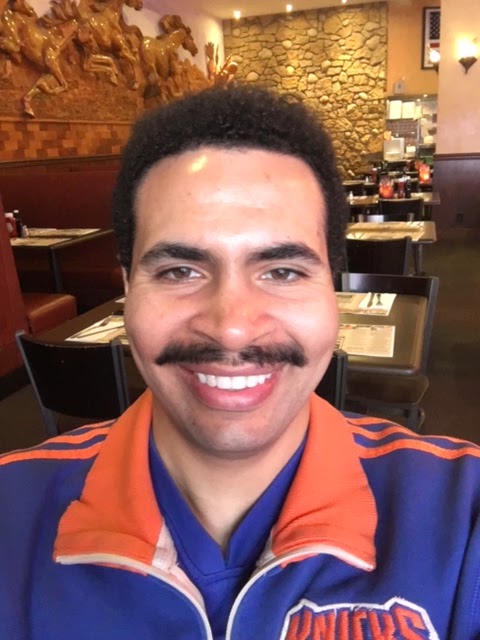 |
| Emanuel Frowner (photo courtesy the author) [image: A smiling mixed race man with short black hair in a natural style, and a mustache. he is wearing a collared orange-and-blue Knicks pullover.] |
I was very quiet, and I would stutter sometimes. My grandmother told me that this was because I think faster than I talk. She also told me that a still tongue keeps a wise head. I took these as compliments.
I went to an elementary school right near where I lived. At first, I did some mischievous things like breaking forks. During a test, I bubbled in all of the choices and the kids started saying that I was all wrong. The teacher erased them. My grandmother found out about this and she was not happy. At that point, I started doing a lot better and I began getting good grades on my report card. I kept working hard and with the help of my folks, I was named student of the month. This was an honor for me and it made me feel proud.
This did not prevent me from being bullied by other students and teachers just because I was different, which led to my dad homeschooling me from the 6th grade until I got my GED in 2000. Being homeschooled helped me excel academically. It also helped me develop a strong work ethic, and it helped me to think outside the box.
Another reason my dad homeschooled me was because he did not want me to be fed nonsense. My dad did not want me to get a diagnosis that would put me in a box, or have a label so others could categorize me. He also did not want my brilliance and sensitivity to be overlooked, or want me to be marginalized to the point where it would do irreparable damage. This was a culturally specific issue (which is described later in this essay) as well as a generational issue; my folks stressed that getting an education was the most important thing. And my dad also did not want me to be apart of the herd mentality; he wanted me to develop along my own lines. He took me to his job to meet his coworkers and we all would hang out sometimes. It was okay for a while, but I would have liked to been around others who were similar to me.
Technology really came into my life when I was in my late teens. I began emailing and texting, and no longer had to rely on talking when communicating with others: I could take my time, and respond at my own pace. This also helped me have more privacy, and over time I began making my own decisions.
Before I knew I was autistic, quite a few people told me that I was very bright person who was just quiet and shy—even though I had particular interests like dates, sports stats, being punctual and being patient, yet did not have a few social nuances that others had. This may be because, being mixed race and from a minority culture (I am part Caucasian, part African American, some Native American, some German and a little Scottish, just to name a few), I found that talking about psychological subjects like autism is overlooked and is often talked about in a bad way. Also, I hardly received the type of support or empathy I needed when I was struggling. For example, when I stuttered a bit, I was told that I was hesitating. Another example is when I chose Psychology as my major in the summer 2004, one of my relatives was not supportive of this. But it made me even more determined to do well and I got my BA in Psychology from St. John’s.
In 2005, I started hanging out with my oldest brother Blair, who lived in Canada. He knew an autistic lady, started reading about ASD, and began telling me that I might be autistic. He did some research online and found the Seaver Autism Center at Mt Sinai for me. I did interviews and tests there, and the doctor told me that I was on the autistic spectrum. I was a little surprised, but it was a blessing in disguise.
I began reading up on autism. Two years later When I told my dad what the doctor said about me, he was surprised, but then he came to accept it. I joined some support groups over the years and made a few friends. In 2009, a lady, Katrina R. from Job Path, helped me obtain two jobs through customized employment. I have had those jobs for eight and a half years.
Today, I still work, and also do some speaking gigs. I am also a die-hard Knicks fan, and have been for years. In the future, I would like to do even more public speaking and I would like to run workshops relating to autism. I would like to write a book about my life story and I would like to write more articles on topics relating to autism. I would like to one day run an autistic group designed for minorities. I would definitely like to do more acting in order to improve my skills.


