 |
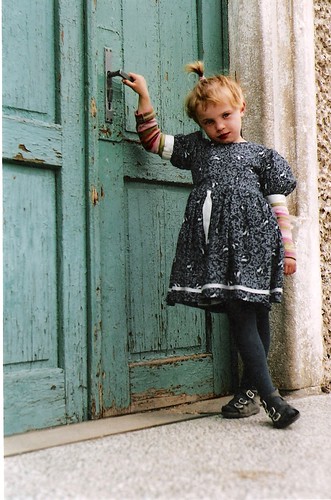
Photo © Kasia_Jot | Flickr / Creative Commons
[image: Photo of a young blonde girl standing outside a
wooden door painted with aqua paint. Her legs are crossed at
the ankle. She is holding on to the door handle with one hand.] |
Ann Memmottannsautism.blogspot.comOften, in my consultancy and training work, we get questions such as, “Can my child ever learn to speak?”
The answer to this is important, because, for a lot of parents of newly diagnosed autistic children, it’s easy to become misinformed or misled on this point. A number of organisations will be keen to tell such parents that without their ‘ACME Treatment X’ or ‘Potion Y with Added Secret Ingredient,’ their child will never speak, never learn to communicate. The parents may be told that most autistic children who do not use speech at (say) four years of age will never do so. “Early intervention to enforce speech is vital!” they’re told.
Is it?
Frankly, too much of this is scaremongering. It may lead to some parents being parted from a lot of their money, for treatments that are unwarranted, ineffective, or—in some cases—harmful. We sometimes see autistic children pushed for endless hours to attain developmental milestones they’re simply not yet ready to attain.
Most parents of course only want the very best for their child. I do not doubt that many therapists are good people who also only want the best for the child. They may have been misled into thinking that early intervention is the Only Way, no matter the cost to the child. Little wonder that parents believe someone who seem to be providing an answer, even if the child seems distressed, bewildered, exhausted by it.
Am I saying that parents should not help their child or support their child in good ways? No, I’m absolutely not saying that. We’re talking about what is in an autistic child’s best interests here, though. I’ll generalise throughout.
Firstly, what do we mean by good communication? I’d say that it means a person is communicating authentically with one or more other people, using their own best way of doing so. Communicating with others about things practical, emotional, spiritual, enjoyable, intellectual or otherwise. Communicating in ways that means others respond safely and well.
Is spoken language the only way to achieve this? We might look at the Deaf communities and their use of sign language and technology for an answer here. It’s very possible to communicate very well, without using spoken words, with a rich and deep pattern of communication, a genuine alternative.
For some autistic children, it could well be that they won’t use spoken words as their way of communicating at any point during their lives. Instead, they may use a variety of authentic autistic ways. Perhaps through technology. Perhaps through other assisted/assistive communication methods. Perhaps through sign languages, or through any combination of other vocalisations, movement, gesture, pattern, rhythm, music, drawing, etc.
In 20 years of having the honour of working with and alongside countless autistic people of all kinds, I’ve yet to find one who doesn’t communicate. I’ve met a number of parents and professionals who don’t notice the communication, though. Or who had misinterpreted it. Or who were insistent that communication had to be the way they want it, when they want it, or it didn’t count.
Can autistic children and young people develop speech, if they are not using spoken language before (say) age 4? Yes. In fact, most do, according to
research by Wodja, Mathy and Kalb (2012). The team examined 535 autistic children and young people with "severe" speech delay, and found that 372 of their subjects (7 out of every 10) managed to say phrases by age eight, and 253 (nearly half) could speak fluently at age eight or after.
What is the amazing ingredient that does this? Is it an expensive therapy? A pill or potion? A genetic scientist? No, it’s time. Quite simply, autistic children may well learn to speak at a later time than non-autistic children, and that’s the natural pace for us. Certainly, working with an autism-trained, qualified speech and language therapist is a sensible thing for many. Good therapists of this kind will look at all sorts of ways to communicate, and will enable the child’s own best way. But supporting and encouraging communication should never be about forcing autistic children down a path they cannot take, or are not ready to take.
I bring personal experience of speech delay to this subject: For the first ten years of my life, I could not use words to communicate with others in any social way. I could, in the latter part of this and with effort, repeat phrases or individual words well enough to make it seem like I was ‘communicating.’ But I had absolutely no idea what I was saying, or what it meant. I knew I was rewarded from making sound A, and punished for making sound B. But in no way was that communication: I wasn’t communicating a thing, any more than making an accordion play a note means it’s communicating with you. My natural, authentic communication was in pictures, in pattern, in colour, in drawing, in movement. It still is. And, as an autistic person, my natural non-verbal communication is also authentically different. I won’t choose to look into eyes to communicate emotion or attention, as doing so is painful, and prevents me from comprehending what’s said to me.
By the age of 11, I could make a small amount of spoken conversation with a trusted person, if I thought about it hard enough. By age 18, I could speak more. Some of my teachers failed to notice that I was in their classes, as they had never heard me speak—that was how good I had become at making myself unnoticeable, lest someone should try to talk to me. Awful, because I actually love being with people, and love sharing with them. It was assumed that I was just painfully shy.
In a world before most autism in young people was recognised, it never occurred to people that I was autistic and communicated differently. By my teens, I’d mostly learned to disguise (‘mask’) any visible trace of my autistic behaviour, out of fear of the responses of some non-autistic others and their bullying and ostracism. I kept my repetitive movements small. I pretended an interest in ‘things-I-should-be-interested-in,’ by displaying the ‘right’ posters for right TV shows and pop stars. By feigning the excitement I saw others show.
I recall trying to pronounce the right words at the right time, in conversation. How hard was it? By the time I’d heard something…translated it to pictures in my mind…thought about an answer in pictures in my mind…thought of some words to put together…and remembered how to make my mouth, lips and tongue move correctly, the conversation would have moved on. If I was not putting 100% concentration into it, I would also say the wrong word, or a mispronounced word, or say them too fast, too slow, too slurred, in a strange accent. Or respond by just describing the picture in my mind, which is not the communication expected.
Natural autistic communication is genuinely different. It was hell, trying to communicate in a way entirely not my own. Easier to be with a person who spoke 100% of the time at me, and my role was just to listen 100% of the time and occasionally agree. Using spoken language was like clambering up a cliff face in a gale force wind, weighed down with ever-shifting boulders. Clinging on in desperation, making my brain and body do something utterly alien to it, fearful of a wrong move, a wrong grasp of a situation. How much do autistic people have to care about others, to try to do this, time after time after time? I learned to talk, but the effort remains the same.
In my mind, I could visualise whole 3-D scenes, create incredible 3D rendering of situations past and present. In my heart, I could feel so intensely the emotions and joys of those around me. But my ways of sharing those emotions using spoken words would be deemed clumsy, insulting, or humiliatingly hilarious for others. So, I created with music, with art, with sharing unspoken but (for me) beautiful prayer and emotion. I communicated by movement, by rocking, by flapping. I communicated really well with other autistic people, and really well with animals. Some of my good friends are translators by trade, who have no difficulties understanding that I communicate differently.
None of my own ways of communicating were seen by those in power as communicating. None of it counted.
I’m in my 50s now, with a good job running a company, an achievement only possible with the support and encouragement of so many other fantastic autistic people and allies around me. I speak at conferences, on a subject I know well, amongst autistic colleagues. I train people, on a subject I know well, amongst autistic colleagues. I have to balance my time and energy very carefully to ensure I can speak when I need to.
How did I achieve this? Some therapy? No, just time and personal effort. And being punished if I did not. I wouldn’t recommend that for any child; it shows a deep lack of empathy for autistic individuals, and colleague Dr Damian Milton has much to say about this with
his work on Double Empathy.
For me, using words is inauthentic—often as far from how I’m actually feeling inside as it’s possible to get. Speaking is a very poor ‘second language’ compared to what I can express through other means.
I am sometimes not able to use spoken language, in common with 80% of
other autistic people (from informal online research). When too tired, too stressed, too unwell, in pain from sensory or social overload, I become as unable to speak as I was as a young child. This, to the point where I could be in any amount of distress or danger, and still not be able to utter a word. In reality, I might even be smiling when most in pain, most terrified.
I would like us to think about this. We’re telling children spoken language is worthwhile, because when they’re in most danger, they’ll be able to ‘use their words’ to ask for help.
Will they?
And, if they do, will anyone listen and respond well?
If you go onto social media, you will find yourself awash with accounts from autistic people who asked for help, but were judged as ‘attention seeking,’ as liars, as fakers. As not being in pain, because they hadn’t done precisely the right amount of crying, screaming, grimacing, etc. You’ll also find yourself in the midst of a community grieving for all the autistic people now living with PTSD, all the autistic friends now dead,
having taken their own lives because ‘use your words’ got them nothing. Those dead because some in the medical profession didn’t listen.
When I need spoken language most, it deserts me. It is a fickle friend, not an ally. When I do use it, it often gets me nothing, because language is only part of the hugely nuanced and complex social communication system of non-autistic people.
Why not give us things we can reliably use to summon assistance and communicate our whole selves, instead?
Using technology, I can ‘speak,’ I can ask for help. I can share friendship and love. I can add photos, and diagrams, and artwork, and charts, and numbers, and music. I can make my communication into the authentic me. I can share my faith and my emotions, authentically, and express all that is dear to me. Freed from the suffocation of having to use spoken words. Freed from the humiliation of others finding my speech amusing or insulting, or the outrage of those who misunderstand the difficulty and accuse me of ‘just not trying’ to be friends.
I think we have done a generation of autistic children a disservice, by saying that speech is the pinnacle of achievement. That if they can ‘use their words,’ life will be much easier for them. That people will like them more as a result. That well paid jobs will fall from the proverbial heavens into their laps.
I suspect that by forcing them to communicate inauthentically, we have set some of them up for a lifetime of exhaustion and misunderstanding of autism. A world where our different use of spoken language has been seen as just more evidence of us being faulty, a minority to be erased from the future. Where we have been misunderstood as rude, as lacking in caring about others and about the world around us. Good evidence shows this is entirely mistaken for the majority. The researchers had been so keen to look at spoken words in a ‘correct’ formula that it has never occurred to them that many of us were communicating emotions and caring differently, I suspect.
“My child will never be able to tell me that they love me,” I’ve been told by a number of distraught parents. Yet when I’ve met the child, their love for the parent has been apparent to me from the outset. The problem is that the parents would only accept “love” if communicated in spoken words.
If you are the parent or carer of a fantastic young autistic person who does not use spoken words, your quest is to enable them to find their own best way to communicate. To really listen, with your heart, with your eyes, with your love…not just with your ears. To be patient and let them develop in their own natural time frame. To allow them to use their own best body language and movement, their own best choice of eye contact, or not. All, of course, with the love, help and support around them they need to enable them to thrive, autistically. With that good speech and language professional to guide you. The child’s future should not depend on being an inauthentic copy of non-autistic children.
Ask the
#ActuallyAutistic communities online for some ideas and inspiration, and learn from them. There are some fantastic people out there, who are all too willing to pass on their wisdom on good social media pages, on blogs, in books or otherwise.
Most of all, trust that your autistic child can thrive alongside others, whether with spoken words, or not. Do not be afraid to tell the next salesperson, arriving with a false horror story about how your child will never achieve anything without their ‘Patented Treatment,’ that you have more confidence in your child than they do.
Then, walk into the future, alongside that fantastic young person, sharing the journey together and truly communicating as two equal and wonderful people.
Thank you for reading.


