Showing posts with label community. Show all posts

Parenting Kids With Disabilities: How to Get Through Tough Times

Shannon Des Roches Rosa
www.squidalicious.com

Content note: This article discusses abuse and murder.

Photo © Steve Silberman
[image: a white woman, standing behind a white teen boy
with brown curly short hair. He is looking at the camera.
Her arms are over his shoulder, his arms are up
and tickling under her chin.]
When parents like me talk about our kids with disabilities and intense support needs, we have to be thoughtful. We need to make it quite clear that our kids are much-loved and very awesome human beings. We should never, ever state or imply that any challenges we face as a parent are our children's fault. We need to handle their privacy with delicacy. And we shouldn't accidentally enable disrespect towards children who are already too-frequent magnets for morbid fascination, and pity.

But we do need to talk, because our parenting gig is not like other parenting gigs. It just isn't. We, our kids, and our families need different supports than families whose kids don't have disabilities, and we often need a lot of them. Sometimes we're not always sure where to find those supports, or even aware of available supports; sometimes we're ashamed to pursue the supports we and our kids need. And not having the supports we need for the best quality of life possible can lead to unnecessary hardship for everyone involved.

So, let's talk about what parents like us need, and especially how to get what we need. But first, I need to be forthright on one matter: In no way does lack of services excuse harming our children. Ever.

People with intensive support needs deserve sufficient resources, and so do their families. When these services are minimal or unavailable, that is a large-scale failure on our society's part. However, insufficient resources don't explain or justify murder of disabled children, because such crimes—which are also, frighteningly, not rare—do not actually have lack of services in common. So please don't buy into or spread the dangerous message that if parents don't get enough services, they might kill their autistic or disabled child.

Instead, parents—like me, like you—need to hear that it's not a failure or shameful to ask for help, and we need to feel safe about doing so. For our own sake, of course, and because reaching out also protects our kids.

Being in crisis is not the same as being a failure. Nor is it a personal failure to admit you and your child need help. So we need to work past fear and misinformation, and get educated about what our support options are, both during emergencies, and in general. Misinformation can lead to tragedies, as when parents absorb media-propelled myths that it more understandable for a mother to try to kill her child than to call Child Protective Services (CPS) on herself if she's thinking about harming that child. These dangerous myths sometimes persist because parents don't actually understand the role of CPS in protecting both children and families, nor are they aware of emergency services or rights-based services that were always available to them, if they'd known or been told where to look.

I spoke to Dori Tanaka, Family Resource Specialist Coordinator at Support for Families in San Francisco, who says:
"While contacting CPS is perceived by many families as a negative, it can help families access emergency services. Once CPS is involved, they may be able to assist families with support to get through a crisis. If possible, CPS's goal is the reunification of the family. 
"Unfortunately, it would be better if families did not have to resort to using CPS services; it would be better if services that would help them in caring for their children were easier to access. [But] many parents are often unaware of resources like Support for Families (and its local sister agencies) that help San Francisco families of kids with disabilities navigate IEPs, home health care, childcare access, and insurance scenarios -- services that can help prevent getting to that crisis point in the first place."
But avoiding parenting crises isn't just about services. We also need to be thoughtful and compassionate in how we approach our parenting, because our kids do not exist in a vacuum. They have a relationship with us, they react to us, and if our behavior and parenting choices do not respect our kids' needs and choices, then we parents can actually be the main problem in our kids' lives.
Especially when, as with autistic kids like my son, so many treatments and approaches and interventions are based on "normalizing." If we prioritize compliance and obedience, if we do not allow that autistic people have autistic brains and autistic learning styles, and are ill-served by forcing them to learn in non-autistic ways, that can lead to trouble.

How else can you work on improving your outlook and attitude as a parent? By finding a supportive community. Community matters, when it comes to feeling supported as a parent. It matters a lot. Both online community, and IRL.

You need to be selective, though. You need to connect and talk with people and parents who are good listeners, and avoid those who aren't. Once, when I was feeling particularly overwhelmed, I managed to squeak in a night out with a friend. On the ride home, I confided in her about some of my parenting worries. She responded by telling me about a friend whose children died from degenerative diseases, implying that by comparison I didn't have anything to worry about. I certainly never confided in her again.

Because when when any of us are floundering, depressed, or in crisis, it doesn't matter if other people have things harder. They are not living our lives. We are. So find someone who gets you, who wants to be around you, and/or who wants to listen (and to whom you will return the courtesy, yes?). Then cut the scoffers or other unfriendlies out. Your time and energy are precious, so don't waste them on people who treat you and your heart thoughtlessly.

Unsurprisingly, many of my friends are parents of kids with disabilities, and/or autistic and/or disabled themselves. When we talk, we talk—and talk and talk and talk. We discuss things we would never, ever say in public, out of respect for our kids and also for the reasons listed in this essay's first paragraph.  We coach and advise each other. And we talk about silly things that are totally unrelated to our kids, because all parenting all the time gets old really quickly. It's all cathartic, it's all fair, and it's all necessary. So try to find your people. Either IRL or online is fine, and anyone who tries to tell you that online community isn't real is living in 1994.

A last, much-appreciated resource for me (as I've written many times) is the writings and insights of autistic adults. Parents and professionals are capable of beautiful observations and crucial recommendations, but there is no substitute for having lived an autistic life. Consider also my personal experience: professionals were the ones who lobbied for my son to have early intervention because otherwise he might "never develop" life skills—and left me a panicked, jibbering wreck; autistic people are the ones who soothed my soul by reassuring me that my son's developmental trajectory was his own, and that, like them, he's probably going to be a life-long-learner and developer.

And of course, my son is also good at teaching me what he needs, as long as I'm paying attention. Our relationship is one of affection and synergy rather than one-sided deficit-battling. He is not my precious special angel meant to teach me life lessons, but rather an embodiment of self-advocacy and grace despite the crap that life, silly people, and even well-meaning people constantly throw at him due to his disability. I hope I will always have his back in the way he deserves, and in the way he has mine. Even when things are tough for either of us.

A final reminder about healthy attitudes towards parenting kids with disabilities, from autistic autism parent Ally Grace. I think we all could all use such a reminder. Possibly daily. Possibly hourly.
"My children owe me nothing. I brought them into the world, which was my choice and is my responsibility now. I will unconditionally embrace who they are. Because that's my job. And because that is my ethical obligation to my children, who are fellow and equal human beings. Whatever their neurological makeup."
Please know that I am not saying every parenting crisis of ours is fixable, because that also would be unfair and untrue. But there are tools, there are people, there is information that may prevent crises from happening, and can also help us find our way to the other side when crises do happen. We parents of kids with disabilities both deserve and need to know more, and feel better, about our options.

----

Resources

----

A version of this essay was formerly published at BlogHer.com
Share:

INSAR 2019: Yet Useful Research and Autistic Representation Persisted

Shannon Rosa
Senior Editor

The TPGA team attends INSAR, the annual meeting of the International Society for Autism Research, annually and has done so for eight years. We participate as journalists covering important autism research for our community, and also from our combined personal investments as parents of high-support autistic teens, autistic self-advocates, and autism professionals. 

I found INSAR 2019 to be the most progressive annual INSAR meeting since I first started attending in 2011, going by TPGA's priorities of spotlighting research addressing the health and well being of existing autistic people, centering improved autistic quality of life as an optimal outcome, and increasing and acknowledging participation of autistic people themselves. I also appreciate seeing an increasing emphasis on autistic people and their families' day-to-day under-recognized concerns, including co-occurring conditions like GI issues and sleep disturbances, practical considerations of transitions to adulthood, suicidality and other mental health matters, physical activity, and tailoring supports and outreach for low income and/or racially diverse communities.

Most researchers we talked with and listened to seemed to understand that, in undertaking autism research, they are de facto advocates for the underserved and actively marginalized autistic and autism communities. I appreciate their work, as well as their solidarity with INSAR's autistic attendees, and was not alone:

Yet the things I was pleased about at the conference happened despite, not because of, the INSAR powers-that-be. While increasing numbers of conference researchers and presenters recognize that autistic people and their families need all the autism research we need, this year the INSAR board announced it was trying to "restore balance," and de-center non-biomedical autism research.

Why? Politics. We were told the reason was lobbying by SFARI, the Simons Foundation Autism Research Initiative. SFARI prefers the meeting as originally conceived back in 2001: neuroscience-based, and in keeping with SFARI's traditional medical model, deficit-defined approach to autism. While Simons efforts don't dominate INSAR funding, the foundation is a major source of autism research funding. And, like many well-funded-and-connected entities, flexing their influence generally gets results.

Even when those results doesn’t make sense: Excluding or minimizing non-biomedical research at INSAR would unnecessarily limit good and useful autism research, because there aren't any other international autism research conferences of note. Plus, the Society for Neuroscience conference is still happening every year, and continues to have autism content. There's no rational reason to stop making space for as much diversity in research and researchers as annual INSAR conferences can shoehorn in, and, frankly, this "change is bad" approach seems like an ironically rigid and maladaptive move for an organization bent on eliminating or "treating" such traits in the autistic population.

Simons also funds Spectrum Magazine*, which covers autism research, and, in leading up to the INSAR conference, published two pieces titularly about "autism wars" and "tension," but which were really about why a lot of medical model approach people don't want to listen to or respect rights-based autistic advocacy. It seems disingenuous, or at least ill-informed, to highlight and promote arguments that autistic self-advocates—generally known for their dedication to social justice without regard for personal cost (a stance research bears out)—aren't trying to serve the greater good of their entire community. Now, as Spectrum is a Simons effort, I am aware that it is not realistic to expect the magazine to cover autism research in a non-deficit model way. And I certainly don’t mean to imply that the phalanx of Spectrum journalists who cover the annual INSAR meetings are bad people, but rather that they operate according to their mission, just as we do, and that when they get things right by autistic people, that tends to be the exception rather than the rule.

While part of the problem in medical model autism researchers' and journalists' deficits-only lens is a tendency to see autistic people as subjects rather than human beings with opinions and rights, as Sara Luterman noted,
…another issue may be non-autistic people's own communication deficits. We talked with Dr. Catherine Crompton, whose research on Information Transfer between Autistic and Neurotypical People brings quantification to Dr. Damian Milton’s Double Empathy Problem. Her study concluded that, while autistic people communicate well with each other, and non-autistics synch well with non-autistics, there are significant gaps in trying to communicate information between autistic people and non-autistic people. (We interviewed Dr. Crompton during the conference, so stay tuned for our report.)

It may be that this same communication gap was behind attempts to pit researchers and autistic people against each other during the conference:
Which is odd considering that many attending researchers are themselves autistic, and already often discriminated against, including having their expertise and experience met with skepticism—as James Cusack noted:
INSAR needs to stop pushing back against an increased autistic groundswell, if for no other reason that, as INSAR board member and autistic advocate John Elder Robison noted, five percent of registered INSAR 2019 attendees were autistic self-advocates and/or researchers, and/or journalists. Five percent percent of 2200 people is, well, kind of a lot, and if autistic attendance keeps increasing without officially sanctioned, genuine inclusion, INSAR is going to find itself in a pickle.

Autistic researcher Dr. Jac den Houting with their 
poster on participatory research in Australia
[image: A white person with dark pulled-back hair and lip
piercings, next to a study results poster.]
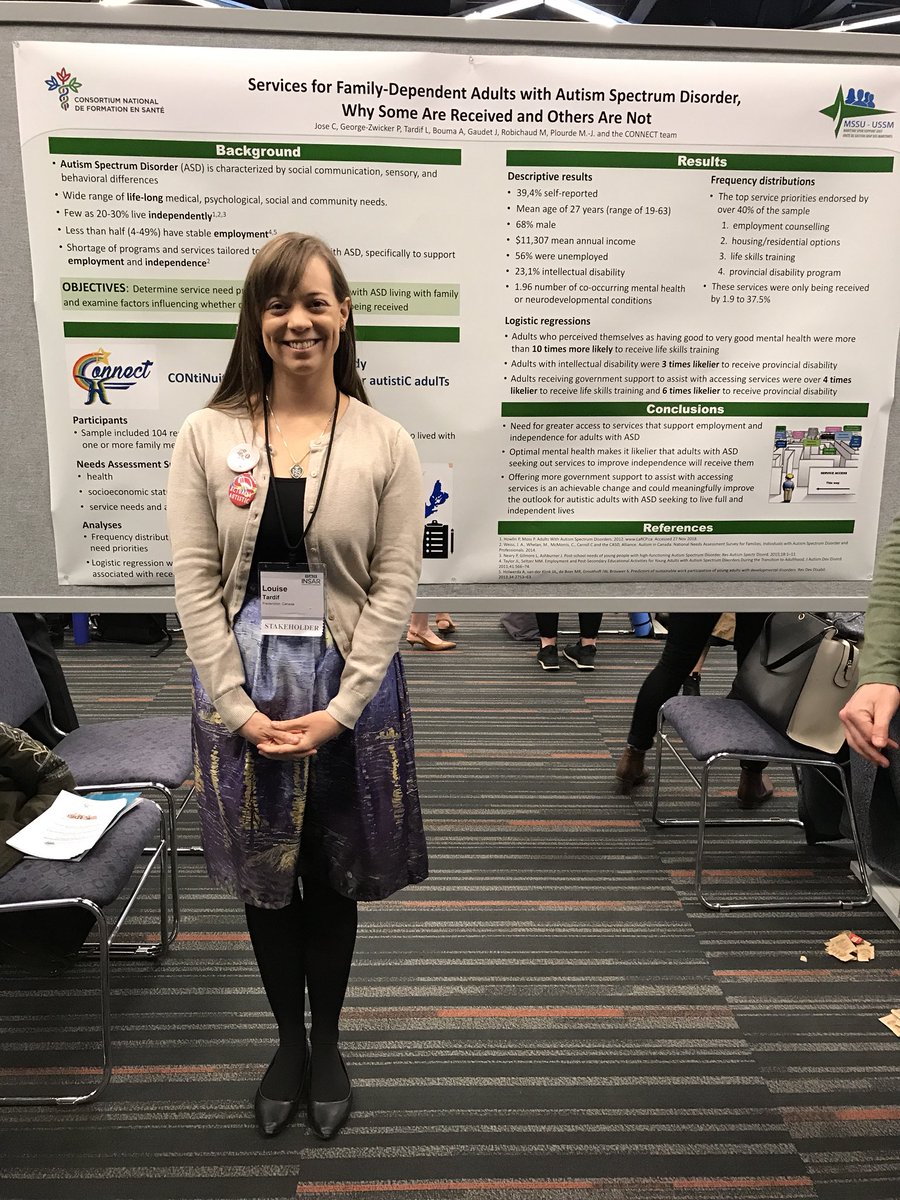
Self-advocate Louise Tardif, presenting a group poster on 
Services for Family-Dependent Adults. Photo © Jon Adams.
[image: A white person with long straight brown hair
with bangs, standing in front of a study results poster.]
And Mr. Robison's five percent estimate doesn’t include the autistic researchers who aren’t officially "out," from either explicit or implicit discouragement from their teams and institutions about disclosing their neurostatus:
So, all, please check out these Autism Acceptance guidelines from The Autistic Self Advocacy Network, and share them liberally with your peers, teams, and organizations.

[*sound of needle being dragged across a record*]

As for the conference programming itself, that was an exercise in sheer FOMO terror. (If you want to experience delayed overwhelm, you can still look through the conference program and abstract book [PDF]). We tried to hit as many sessions as we could, but still missed Sarah Hampton on Autistic Mothers’ Wellbeing during Pregnancy and the Postnatal Period; Dr. Lisa Croen on SSRIs and pregnancy (no link to autism, people!); Dr. Josephine Blagrave, Dr. Emily Bremer, and Dr. Andrew Colombo-Dougovito on caveats, barriers, and best practices for physical activity for autistic people—and even sometimes missed crucial nuggets in panels we did attend, e.g.:

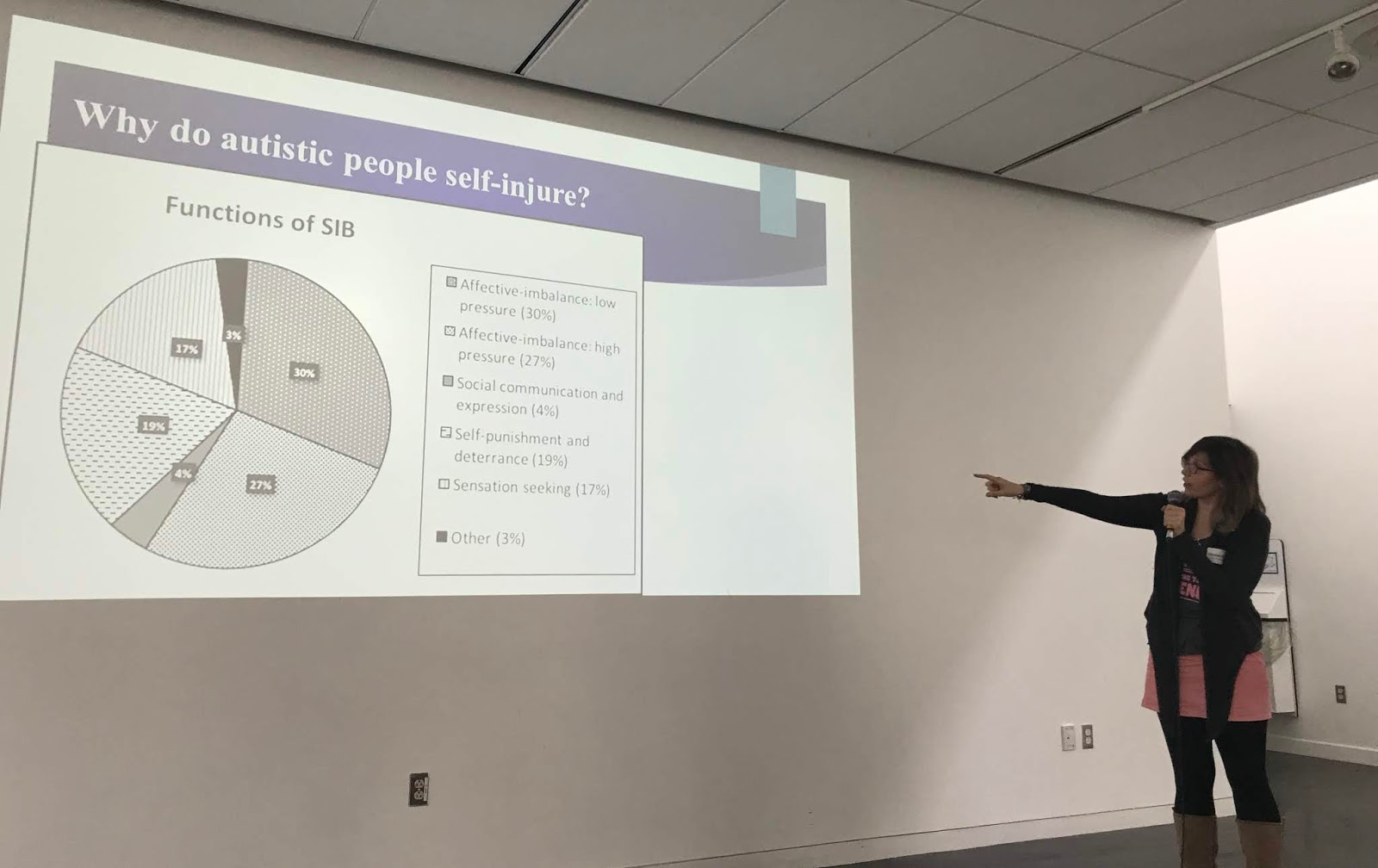
Here's what we did attend: Dr. Sarah Cassidy and group's excellent pre-conference session on autism and mental health (we live tweeted much of it, but it was also recorded in its entirety, so hopefully we will be able to share more about it soon). We were impressed by everything we saw, including Dr. Christina Nicolaidis's presentation of Dora Raymaker's work on autistic burnout, and Dr. Rachel Moseley, whose work on self-injury in autistic people without intellectual disability is sobering—so definitely watch out for our forthcoming interview with Dr. Moseley.

Dr. Rachel Moseley during her presentation on autism and self-injury
[image: White woman with glasses and long dark hair, speaking at a session,
and pointing at a projected slide about reasons autistic people self-injure.]
The INSAR press conference, aside from announcements about wanting the meeting to be a redo of its biomedical sciences origin story, contained exciting and useful research fom Dr. Olivia Veatch on sleep disturbances (not sleeping is bad for all humans, and so, yeah, it's bad for autistic people too), and Dr. Ruth Ann Luna on gut and microbiome issues (we are finally seeing research about co-occurring conditions as separate health issues with autistic-specific expressions, rather than as "treatable" symptoms of autism. This is a relief). We interviewed Dr. Luna, and that article is coming soon too.

One of the highlights of the conference for us was AutINSAR, a conversation between autism researchers and/or autistic community members, both in person and on Twitter, which we co-hosted for the third year in a row. AutINSAR was rollicking good fun with excellent points made by all, and so heavily attended IRL that people had to sit on the floor around the perimeter of the room. It takes a while to compile Twitter chats into usable formats, but rest assured a full summary is coming.

The IRL #AutINSAR crew
Back row: Emily and Manuel Casanova, Jon Adams, Bret Heasman, Sue Fletcher-Watson, Anne Fritz,
Cat Hughes, Aaron Bouma, Bethan Davies, Corina Becker, Stephanie Vreeland, and Steven Kapp
Center row: Sara Luterman, Christina Nicolaidis, Lorcan Kenny, Christine Jenkins,
and Louise Tardif. Front: TPGA editors Shannon Rosa & Carol Greenburg
[image: Crowd of neurodivergent people posing in the corner of the INSAR press room.]

John Elder Robison, reigning over the Stakeholder's luncheon
[image: A tall white man with short silver hair and glasses, 
speaking at a podium, wearing a red paper crown.]
The annual Stakeholder's luncheon was also useful. John Elder Robison was emcee, reminding us about shared community goals and the productive things that can happen when people work together. There were tables and tables of autistic people in proud solidarity, along with parents and other family members (we had at least two siblings at our table). I was glad some high-support individuals were there too, and was not the only person who appreciated some of the autistic attendees' verbal stims, as in my case they reminded me of my son, whom I hadn't seen for a few days. Of the speakers, the most bracing was Dr. Vikram Patel (who also gave a keynote), who reminded us that on a global scale most autistic people have no supports whatsoever.

One table of neurodiverse good company at the INSAR Stakeholder's luncheon.
[image: Nine people of diverse races, autism affiliations, and neurologies:
Back row: Carol Greenburg, Kyle DeCoste, Dr. Deb Karhson, Fernanda Castellon,
Sara Luterman, and Stephanie Vreeland.
Front row: Corina Becker, Elliott Keenan, and Dr. Steven Kapp.]
Dr. Patel's message was a reminder of why we do what we do at TPGA: We aim to generate as much useful and freely available autism information as we can, and get it to people who need it, regardless of what other supports they may have. And even though our resources are still mostly in English, we are open to translating and adapting them for other communities. Ask us!

During the main conference, we attended and live-tweeted several sessions: Co-Morbidities (co-occurring conditions like anxiety, depression, and executive functioning difficulties), Health and Well-Being in Transition-Age Youth and Adults, and Cultural and Structural Factors Underlying Diagnostic and Service Disparities Among Racial/Ethnic Minority Children in the U.S.

We also attended and published highlights on Learning How to Prevent Suicide in Partnership with Autistic People and Their Allies, which featured a pointed and moving talk from autistic artist Jon Adams. The Special Interest Group (SIG) on Gender, Sexuality, and Romantic Relationships addressed real-world concerns, and I particularly welcomed the section on supporting people with intellectual disabilities. We also appreciated the SIG on Autism and Related Disorders in the Context of Humanitarian Emergencies, which included the reminder that we cannot merely translate autism materials; we have to make them culturally-specific and -informed.

All the very practical but non-biomedical sessions we attended were popular, and some, like the Co-Morbidities sessions, had attendees lined up against the walls and sitting on the floor despite the room having hundreds of seats. This means attendees are voting with their feet (and butts). I'd like to think the INSAR board can't ignore how much INSAR attendees want to see quality of life-attuned research.

I also hope the INSAR board takes note that, as Dr. Sue Fletcher-Watson reported, dismissing autistic accommodations at the meeting itself is uncool. Last year the conference tried to promote flappause, AKA flapping one's hands instead of applause, so as not to assault those with auditory sensitivities (i.e., a large section of the autistic population). This year year the board backed off due to non-autistic pressures, and said flappause was a personal choice. I think this was an [expletive] move at an autism conference. Autistic attendees weren't pleased, and flappause continued to happen among increasingly sheepish applause:

We need to increase autistic accommodation at INSAR, not reduce it. Having a sensory/quiet room is a good start, but the poster sessions were still sensory hell, and many autistic attendees publicly reported having a tough time navigating the conference in general. And we know the INSAR board is aware of these issues, as board member John Elder Robison is publicly soliciting, listening to, and taking autistic concerns seriously.
So those are my takeaways from INSAR 2019: Oodles of solid content and autistic representation, despite conference organizers not entirely in touch with the most ethical motivation for autism research: to figure out best practices for helping and supporting the autistic people and their families who are already here, already struggling, and who deserve the best quality of life possible. Hopefully the INSAR board will start listening, with results reflected in next year's 2020 conference in Seattle.

We're interested to hear your take on INSAR 2019.

----

*Disclosure: Editors Shannon Rosa and Carol Greenburg have written for Spectrum Magazine.
Share:

The Importance and Power of Autistic Self Diagnosis

White person with blue eyes and a Freddie Krueger sweater taking a selfie in a mirror,  except a smaller circular mirror is inverting their face where their head would usually be.
Image © Stig Andersen | Flickr / Creative Commons
[image: White person with blue eyes and a Freddie Krueger sweater taking a selfie in a mirror,
except a smaller circular mirror is inverting their face where their head would usually be.]

Solveig Standal

We autistics need to have a serious talk about autism and self-diagnosis: what self-diagnosis means, and what effects it will have on us when inevitably both autistic and non-autistic people attempt to gatekeep our own autistic identities.

Ultimately, we know that it’s not autistic people who dictate who we allegedly are and what is allegedly best for us. Neurotypicals continue to dominate the conversation and speak over autistic voices, which ultimately reinforces a pathologizing viewpoint about us, and centers around the idea that somehow we fundamentally cannot speak for ourselves, purely because of our neurology.

The medical community continues to ignore people who do not fit the white cisgender male stereotype of autism—something that more closely resembles the cultural images of Rain Man or Sheldon Cooper. The medical community, as well as charities run on our behalf by non-disabled people, frequently overlook autistic girls and people of color. In the United States, the CDC does not even publish prevalence rates of autism in adults. Effectively, this means that the needs of most autistic people continue to be ignored, and the accommodations that are provided have a tendency to drop off as we reach adulthood.

We know what it’s like to see autism charities run by neurotypicals, whose primary focus is to paint a picture where we are the burdens that they must endure. At best, we are inspiration fodder intended to make neurotypicals feel better about themselves. At worst, we are portrayed as the driving wedge that ruins otherwise-healthy marriages. We are portrayed as highly disruptive, problematic, unteachable. We are portrayed as literal puppets, and given no autonomy whatsoever.

We know what it’s like to have our needs constantly ignored by the people who are supposed to be supporting us. Personally, I have sat in countless meetings centered around my disability accommodations in public school, where teachers and counselors discussed my situation as if I were not even in the room. Where so many people were very eager to tell me who I was, and what I needed, and how I felt, and where they all seemed to insist that they knew me better than I could possibly ever know myself. And as hard as things were for me, I know I would have been abused even worse if I were not white. Racism and police brutality is an inextricably critical part of understanding the dynamics of abuse we face every day.

I grew up in the 1980s in a very rural setting, and our access to information about autism was extremely limited. One of my earliest memories was a television news special about autism, where they asked questions about whether or not we were really people inside, or just walking automatons. At a later date, my parents were interviewed about me. I very distinctly remember the news channel interviewer describing the "emptiness" in my eyes, as if there was nobody inside of me. As if I were not a real person.

This was also during a time where Bruno Bettelheim and Andrew Wakefield’s beliefs were so widespread; they argued that autism was caused by vaccines, or by cold and unloving mothers. Self-proclaimed autism professionals preyed on parents of autistic children, demanding them to go to extreme measures in false hopes that they could cure us of our autism. They also pressured parents into therapies that were designed to make us look less autistic, probiotic diets, gluten-free diets, and more. One doctor, after spending less than five minutes with me, suggested that I should immediately be institutionalized. Finally, seeing no other options, my parents contacted the only autistic self advocate they knew of—Dr. Temple Grandin.

Dr. Grandin wrote back and explained autism to my parents in a way that only an autistic person could. She explained to them how I was not broken, I didn't need to be fixed, and I didn't need a cure. Ultimately, the best thing for them to do for me was to learn to accept me for exactly who I am, and focus on improving quality of life as best they could. And because of her lived experience as an autistic woman, she was able to impart better knowledge to us than all the other medical professionals put together. It was this step—connecting with another autistic person who had first-hand experience of what being autistic was like—that resulted in a bigger, much more profound improvement in my life than years spent with neurotypical professionals.

Many years later, as an adult, I came to realize that I needed to be able to emotionally process everything that happened to me. I needed to find a better understanding for myself in terms of what it means to be autistic, based on my own experiences—not based on what the "experts" see from the outside. I knew the only way to do this was to find other autistic voices to compare notes with. It started out by finding books written by autistic authors like Loud Hands, finding the Autistic Self Advocacy Network, and eventually making my way onto online autistic communities through Twitter.

I have found solace and comfort within our autistic community. I found other autistic people with common experiences and understanding of what it really means to be autistic… and I found people with substantially different experiences and understandings, too. I found a place where my interests aren’t looked down on.

This is a place where autism isn’t described in clinical terms with symptoms and conditions and treatment plans and other pathologizing things. Instead, we are a community of self-advocates who are fighting hard to claim our place as the real experts of what it means to be autistic. As the real experts of autism, we are in a better position to help others recognize their own autistic identities, and we’re in a better position to support them as they figure out what that means to them. In doing this, we are shifting away from a pathologizing clinical narrative that describes us as broken, and moving towards one that allows us to celebrate who we are and recognize our own strengths and our own needs.

Self diagnosis, at its core, is all about recognizing our own neurodivergence and reclaiming our role as the experts in our own lives. Understandably, there are limitations to what we can do with a self diagnosis. We cannot write our own prescriptions for medication, and we would not qualify for the kind of public assistance that requires a formal diagnosis. Self diagnosis does, however, give us better access to that autistic community support I was talking about earlier. It strengthens our network with other people who have shared experiences with us. Self-diagnosed people can access tips on what to expect from those of us who have gone through the formal process, weigh the costs and benefits of a formal diagnosis, and decide whether or not to pursue one in the first place.

Despite all this, there is a movement to restrict autistic community to those who receive a formal diagnosis, and this becomes a problem for a number of different reasons. First, so many of us don’t even know to pursue a formal diagnosis until we recognize in ourselves that we might be autistic, or others start to point things out to us. The process of self-discovery then takes time, and it only stands to benefit when people around us believe that we probably are actually autistic.

Yes, ultimately some of us will come to realize that they are not really autistic, but the exploration still helps them find answers about themselves, and no one is harmed in the process. However, when we deny someone’s autistic identity, we shut them out of the whole process, deny them access to the tools they need to better access the health care system, and potentially deny them their formal diagnosis altogether.

When we deny the validity of self diagnosis, we fail to recognize how broken health care systems can be. We effectively restrict our support to those privileged to afford a formal diagnosis. We ignore the fact that doctors notoriously ignore the needs of patients who aren’t white cisgender males. We pretend that autistic people of color are seen as potential threats who are sent into the juvenile justice system, and not seen as neurodivergent students with accommodation needs that are being unfulfilled. And worst of all, when autistic people find themselves neglected, ignored, and belittled by the very professionals who are supposed to be supporting them, they are neglected, ignored, and belittled by their neurosiblings as well. This cannot be allowed to happen.

As we continue to claim our rightful place in leading conversations and crafting policies about autism, we need to remember that self diagnosis is one of our strongest assets. We need to remember our own process of self-discovery and everything that we struggled with along the way. We need to ensure that future generations of autistic people do not have to suffer through the things we suffered through, because it’s the right thing to do.
Share:

Authoring Our Own Lives: How Autistics and the World Benefit from Auti-Biography

Maxfield Sparrow
unstrangemind.com

l.
Photo © barbara w | Flickr/Creative Commons
[image: Hands on a typewriter keyboard, at a sunny wooden desk,
next to a drink on a crocheted white doily, amidst some plucked green leaves.]
The last decade has seen a blossoming of blogs, articles, books, and documentary films about autism, authored by actually Autistic people. This is an exciting time of growth for Autist-created content about autism, and I want to encourage all Autistic people to document their lives: whether in a private journal, or to share with the public.

There are great personal and community benefits that come from Autistic people writing about our lives—especially when we write about emotions, victories, and challenges and not just the factual events by themselves, although any autobiographical writing is helpful to the writer as well as to others if they decide to share what they’ve written.

Michel Foucault, the postmodern philosopher, wrote in Technologies of the Self:
“Writing was also important in the culture of taking care of oneself. One of the main features of taking care involved taking notes on oneself to be reread, writing treatises and letters to friends to help them, and keeping notebooks in order to reactivate for oneself the truths needed.”
Centering the Narrative - How Writing About Your Life Benefits You

There are many benefits to writing about your life, even if you choose not to share that writing with anyone else. Possibly the biggest benefit of writing about your life is that you finally get to be the center of your own story. So many of us grow up with other people defining us, and telling us who we are, and what is expected of us. Writing about your life might be the first time that you get to sit in the captain’s chair of your own life.

You are also the expert in your own life. Writing about your life, and exploring your emotions around things you have done, and things that have happened to you, helps you to see how much more you know about your life than other people. Or, just as importantly, you may not yet be the expert in your life, but writing about yourself helps you to become that expert. Many people find that writing the stories of their life helps them to see patterns, and discover cause-and-effect they hadn’t been aware of before.

Allowing other people to “invent” our life stories for us leads to problems when those explanations do not accurately depict our lived experience, as White and Epston discuss in their book, Narrative Means to Therapeutic Ends. Writing our own stories “challenges the boundaries” between what the authors call “local knowledge” and “expert knowledge.” “Expert knowledge,” according to White and Epston, belongs to the person who owns the vocabulary to describe a subject. An example they give on page 189 of their book is how medical professionals “transcribe” the language of a patient, for example, changing “feeling miserable” to “displays low affect.” “Eventually, the patient’s experience is not recognizable,” they tell us. Writing about our own lives is a form of “retranscription” that takes back our lives and experiences from others, putting our lived experience in our own words, and thereby placing or reinstating us as the experts on our own lives.

Every piece of your life’s journey has worked together to make you the person you are today. When you write about your journey and how it has affected you, you uncover and clarify your values and priorities. It might sound illogical, but in documenting who you are, you discover who you are. Seeing things written down on paper or in pixels on a screen can help you to see that you have ideas and experiences of value to yourself and others. Even if you never show your writing to someone else, documenting your observations about events in the world and in your life helps you to feel accomplished with a sense of having made a mark on the world. What’s more, re-visiting your past with the wisdom you have gained through the years can help you to make sense of things that might have seemed a meaningless jumble before. Writing your life stories helps you find more meaning in life and uncover your own personal “laws of life.”

Writing your feelings and history can be cathartic and therapeutic. It can give you a safe place to address your traumas and work toward healing them. Many of us who have been through therapy have found the standard pace too invasive and emotionally overwhelming. When using autobiographical writing to uncover and work through traumas, you get to set the pace of disclosure.

As Rasmussen and Tomm noted, “Perhaps there is no other system of psychotherapy in which the client has so much control over the rate, depth and intensity of his or her personal therapeutic work.” In her book recommended later in this article, Bolton said, “Writing is a kind and comparatively gentle way of facing whatever is there to be faced. You can trust it to pace itself to your needs and wants rather than to anyone else, such as a therapist. It can be private until you decide to share it.”

Not only can writing your stories help you move from victim to survivor to thriver, but there is documented scientific evidence that writing about your life in an emotionally expressive way improves your health, from strengthening your immune system to improved outcomes in asthma and rheumatoid arthritis.

While writing traumas can be intense, you can also write about other times in your life. It can be fun to write about the people, places, and feelings that have been positive for you; and while you are doing that, you will also be developing your writing skills. Everyone’s writing has room for improvement, and strong writing skills help us in a wide range of life activities whether communicating with friends, with employers, with clients, with bureaucrats, and so on.

Finally, all of the above benefits: getting to know yourself better, feeling more competent and in charge of the narrative of your life, addressing and resolving traumas and other problems, reminiscing about the good times, and improving your skills can lead to an increased sense of peace and wholeness overall.

There are a couple of good books about exploring your life through journaling that you may find helpful in this journey:

Writing to Heal: A Guided Journal for Recovering from Trauma and Emotional Upheaval by James W. Pennebaker, Center for Journal Therapy Inc. (2004)
Dr. Pennebaker is a researcher at the University of Texas in Austin and his work centers around studying the benefits of journaling. Much of the medical research cited in this article comes from  Pennebaker. 
Dr. Pennebaker’s website: liberalarts.utexas.edu/psychology/faculty/pennebak
The Therapeutic Potential of Creative Writing: Writing Myself by Gillie Bolton, Jessica Kingsley Press (1999)
While Dr. Pennebaker comes at journaling from a hard science perspective, Dr. Bolton comes at it with equal rigor but a more humanities-based perspective. Bolton’s book can be used by either therapists or individuals and does much of what Pennebaker’s book does, but some readers/writers will prefer Pennebaker’s approach and others will prefer Bolton’s. 
Dr. Bolton’s website: http://www.gilliebolton.com
Other resources to consider:


Blazing a Trail - How the Community Benefits When You Share Your Life Writing With Others

It takes a lot of courage to share your life stories with others, and you must never feel like you have an obligation or duty to do so. There is so much benefit to just writing about your life for yourself. Even though I am about to talk about the benefits that can come from sharing your life, do not feel pressured by anything I say. Your life is yours, and part of taking charge of your life through writing about it is deciding whether anyone else should see what you’ve written or not.

Sharing emotional stories of your life makes you vulnerable, so you should think carefully about how the sharing will impact your life, your job if you have one, or your future chances of getting a job. Sometimes sharing life stories can attract bullies who use our openness to try to make us feel bad about ourselves. Sometimes people will read your stories and decide you aren’t the kind of person they want to be friends with. I could tell you that those people don’t deserve your friendship anyway, but that doesn’t take away from the pain you will feel at seeing people you thought were your friends pulling away from you.

Only you can decide whether it is worth it to you to take the risk of exposing your personal stories. While sharing your stories can be tremendously helpful to the world, we live in a world of seven billion people, which means there are at least seventy million Autistic people of all ages, genders, nationalities, and ability levels in this world. If even 0.1% of the world’s Autists decide to write or speak about their lives and make that writing public, that’s seven thousand people around the world, writing from a first-hand perspective about their Autistic lives!

Of course your voice is unique and only you can say the things that you can say. And as poet Allen Ginsberg said, “It’s what we least want to share that the world is bleeding to hear.” Your voice and your life matter so much! But with potentially thousands of other Autists out there writing and speaking about Autistic life, you must never feel that you have to do or say what you feel unsafe doing or saying. Your life is yours alone.

That said, there are ways that sharing a life story can benefit other Autists and the rest of the world. The biggest benefit is getting the voices of the experts out there. As I said, you are the expert on your life and Autistic people, collectively, are the experts on Autistic life. No single one of us can define and embody autism completely alone, but the more voices are out there, the bigger and fuller the picture of autism we create together.

Have you noticed that we can talk about some aspect of being Autistic over and over for years before someone finally conducts a research project and adds what we have been saying to the body of scientific knowledge? We get frustrated when that finally happens and so many of us will say, “all they had to do was ask us.” But that’s not how science works. In fact, the research most likely happened because we were all talking about that aspect of our lives. The things we say today in our books and articles and blog entries are tomorrow’s science, because the scientists listened to us and chose which questions to address based on the things our community had been saying.

When we share our stories with the world, we educate the world about our experiences and our needs. This education we offer helps the world meet our needs better. It helps parents understand their Autistic children better. It helps government organizations steer policy, and ADA centers shape available school accommodations.

Writing about our lives and sharing that writing helps to dispel rumors and stereotypes about Autistic people. How many of us have written about empathy? We talk about our empathetic feelings, we talk about not always knowing what’s going on with others but feeling for them when we do know. We talk about the measures we take to avoid hurting other people’s feelings. We care about writing content notes and trigger warnings to help take care of other people’s feelings and traumas. We stress the importance of image descriptions because we care about whether Blind people are included or not. We share the evidence that we do have empathy even when it doesn’t always look the same as most people expect empathy to look.

Sharing our writing leaves a legacy for future generations, both Autistic and not, documenting the struggles of our times.  When we write about our lives we are creating a time capsule in words that can be opened any time in the future, near or far in time from today. The world will look different some day. I hope that there will be more understanding and acceptance for us in the future. That means that the things we struggle with and the battles we fight together in generations to come will be different from the challenges and goals we face today. Writing about our lives now will give future generations something to look back on. We are creating history with our words today.

Not only can writing our traumas help us to heal them, but sharing our traumas can help others to heal. When we write about our challenges and struggles and talk about how we solved problems or came to a place of increased peace and self-acceptance, we become a role model for others who are going through similar challenges and struggles. Others can learn from our process and feel less alone with the heavy burdens they carry.

Even in smaller life struggles, we give others tips and tricks. Years ago, Joelle Smith had a list of tips on her web site and I learned the value of making laminated lists of routines. She said she laminated it to be able to write on the list with a dry erase marker. So, for example, if she was going to have blood drawn the next day, she could write “wear short sleeves” on her morning routine list. It’s just a little life story and it doesn’t share a deep trauma (though some of her other writing does) but it has stuck with me for years and helped me so much. Our life stories do not have to be traumatic or intimate to have a deep impact on others.

When we share our life stories we give others courage to share their life stories as well. Someone has to go first and often that act is a trail blaze, encouraging others to share their experiences on the same topic as well. I have noticed over the years that blogs written by Autistic people often converge on the same themes as a thought travels through the community and different writers share their own take on it. These blog posts are not repetitive or redundant because each person brings a fresh perspective to the issue with new thoughts, feelings, and experiences on the same topic. Those who have not yet shared any life writing in public are heartened and empowered by seeing others sharing personal stories. Many observers eventually become contributors themselves.

The healing power of shared stories is especially potent among those who have been disempowered, demoralized, or disenfranchised. In Bolton’s book, she writes about the power that comes from writing. “[Therapeutic writing is] for patients and by them rather than being done to them. Too much medicine is diagnosis from the outside and having treatments done to the patient.” Autistic people are far too familiar with being medicalized and treated. Writing about our own lives puts us in charge and re-frames our lives from our own perspectives, something Nick Walker emphasized in his important essay about shifting from the pathology paradigm to the neurodiversity paradigm: Throw Away the Master’s Tools.

Bacigalupe wrote about the great importance of personal writing, calling it “relevant to discussions about issues of social justice.” He talked about the empowering, inclusive nature of sharing writing from people who are (as Wright and Chung put it when discussing Bacigalupe’s work), “inherently subject to discrimination and oppression” with those in positions of power. Bacigalupe writes, “Writing and written text constitute and actively shape our lives, defining our identities and location in the larger social context.”

Whether these stories are shared in books, scripts, articles, or blog entries, they open the way for a dialogue in the community about the issues raised in writing. Autistic book clubs, movie nights, Twitter chats, Facebook forums, and blog comment sections are great places for people to take in autistic words and give back to discussions about aspects of our lives and being that run quite deep. Sharing autobiographical writing helps to build community with shared references and connection over linked issues.

Whether you write your life or not, whether you share that writing or not, these are very personal decisions that only you can make. But know that there is benefit to you if you choose to write about your life and benefit to the world if you feel safe and good about sharing your writing with others.
Share: