Shannon Rosa
Senior Editor
The TPGA team attends INSAR, the annual meeting of the International Society for Autism Research, annually and has done so for eight years. We participate as journalists covering important autism research for our community, and also from our combined personal investments as parents of high-support autistic teens, autistic self-advocates, and autism professionals.
I found INSAR 2019 to be the most progressive annual INSAR meeting since I first started attending in 2011, going by TPGA's priorities of spotlighting research addressing the health and well being of existing autistic people, centering improved autistic quality of life as an optimal outcome, and increasing and acknowledging participation of autistic people themselves. I also appreciate seeing an increasing emphasis on autistic people and their families' day-to-day under-recognized concerns, including co-occurring conditions like GI issues and sleep disturbances, practical considerations of transitions to adulthood, suicidality and other mental health matters, physical activity, and tailoring supports and outreach for low income and/or racially diverse communities.
Most researchers we talked with and listened to seemed to understand that, in undertaking autism research, they are de facto advocates for the underserved and actively marginalized autistic and autism communities. I appreciate their work, as well as their solidarity with INSAR's autistic attendees, and was not alone:
Yet the things I was pleased about at the conference happened despite, not because of, the INSAR powers-that-be. While increasing numbers of conference researchers and presenters recognize that autistic people and their families need all the autism research we need, this year the INSAR board announced it was trying to "restore balance," and de-center non-biomedical autism research.
Why? Politics. We were told the reason was lobbying by SFARI, the Simons Foundation Autism Research Initiative. SFARI prefers the meeting as originally conceived back in 2001: neuroscience-based, and in keeping with SFARI's traditional medical model, deficit-defined approach to autism. While Simons efforts don't dominate INSAR funding, the foundation is a major source of autism research funding. And, like many well-funded-and-connected entities, flexing their influence generally gets results.
Even when those results doesn’t make sense: Excluding or minimizing non-biomedical research at INSAR would unnecessarily limit good and useful autism research, because there aren't any other international autism research conferences of note. Plus, the Society for Neuroscience conference is still happening every year, and continues to have autism content. There's no rational reason to stop making space for as much diversity in research and researchers as annual INSAR conferences can shoehorn in, and, frankly, this "change is bad" approach seems like an ironically rigid and maladaptive move for an organization bent on eliminating or "treating" such traits in the autistic population.
Simons also funds Spectrum Magazine*, which covers autism research, and, in leading up to the INSAR conference, published two pieces titularly about "autism wars" and "tension," but which were really about why a lot of medical model approach people don't want to listen to or respect rights-based autistic advocacy. It seems disingenuous, or at least ill-informed, to highlight and promote arguments that autistic self-advocates—generally known for their dedication to social justice without regard for personal cost (a stance research bears out)—aren't trying to serve the greater good of their entire community. Now, as Spectrum is a Simons effort, I am aware that it is not realistic to expect the magazine to cover autism research in a non-deficit model way. And I certainly don’t mean to imply that the phalanx of Spectrum journalists who cover the annual INSAR meetings are bad people, but rather that they operate according to their mission, just as we do, and that when they get things right by autistic people, that tends to be the exception rather than the rule.
While part of the problem in medical model autism researchers' and journalists' deficits-only lens is a tendency to see autistic people as subjects rather than human beings with opinions and rights, as Sara Luterman noted,
It may be that this same communication gap was behind attempts to pit researchers and autistic people against each other during the conference:
And Mr. Robison's five percent estimate doesn’t include the autistic researchers who aren’t officially "out," from either explicit or implicit discouragement from their teams and institutions about disclosing their neurostatus:
[*sound of needle being dragged across a record*]
As for the conference programming itself, that was an exercise in sheer FOMO terror. (If you want to experience delayed overwhelm, you can still look through the conference program and abstract book [PDF]). We tried to hit as many sessions as we could, but still missed Sarah Hampton on Autistic Mothers’ Wellbeing during Pregnancy and the Postnatal Period; Dr. Lisa Croen on SSRIs and pregnancy (no link to autism, people!); Dr. Josephine Blagrave, Dr. Emily Bremer, and Dr. Andrew Colombo-Dougovito on caveats, barriers, and best practices for physical activity for autistic people—and even sometimes missed crucial nuggets in panels we did attend, e.g.:
Here's what we did attend: Dr. Sarah Cassidy and group's excellent pre-conference session on autism and mental health (we live tweeted much of it, but it was also recorded in its entirety, so hopefully we will be able to share more about it soon). We were impressed by everything we saw, including Dr. Christina Nicolaidis's presentation of Dora Raymaker's work on autistic burnout, and Dr. Rachel Moseley, whose work on self-injury in autistic people without intellectual disability is sobering—so definitely watch out for our forthcoming interview with Dr. Moseley.
The INSAR press conference, aside from announcements about wanting the meeting to be a redo of its biomedical sciences origin story, contained exciting and useful research fom Dr. Olivia Veatch on sleep disturbances (not sleeping is bad for all humans, and so, yeah, it's bad for autistic people too), and Dr. Ruth Ann Luna on gut and microbiome issues (we are finally seeing research about co-occurring conditions as separate health issues with autistic-specific expressions, rather than as "treatable" symptoms of autism. This is a relief). We interviewed Dr. Luna, and that article is coming soon too.
One of the highlights of the conference for us was AutINSAR, a conversation between autism researchers and/or autistic community members, both in person and on Twitter, which we co-hosted for the third year in a row. AutINSAR was rollicking good fun with excellent points made by all, and so heavily attended IRL that people had to sit on the floor around the perimeter of the room. It takes a while to compile Twitter chats into usable formats, but rest assured a full summary is coming.
The annual Stakeholder's luncheon was also useful. John Elder Robison was emcee, reminding us about shared community goals and the productive things that can happen when people work together. There were tables and tables of autistic people in proud solidarity, along with parents and other family members (we had at least two siblings at our table). I was glad some high-support individuals were there too, and was not the only person who appreciated some of the autistic attendees' verbal stims, as in my case they reminded me of my son, whom I hadn't seen for a few days. Of the speakers, the most bracing was Dr. Vikram Patel (who also gave a keynote), who reminded us that on a global scale most autistic people have no supports whatsoever.
Dr. Patel's message was a reminder of why we do what we do at TPGA: We aim to generate as much useful and freely available autism information as we can, and get it to people who need it, regardless of what other supports they may have. And even though our resources are still mostly in English, we are open to translating and adapting them for other communities. Ask us!
During the main conference, we attended and live-tweeted several sessions: Co-Morbidities (co-occurring conditions like anxiety, depression, and executive functioning difficulties), Health and Well-Being in Transition-Age Youth and Adults, and Cultural and Structural Factors Underlying Diagnostic and Service Disparities Among Racial/Ethnic Minority Children in the U.S.
We also attended and published highlights on Learning How to Prevent Suicide in Partnership with Autistic People and Their Allies, which featured a pointed and moving talk from autistic artist Jon Adams. The Special Interest Group (SIG) on Gender, Sexuality, and Romantic Relationships addressed real-world concerns, and I particularly welcomed the section on supporting people with intellectual disabilities. We also appreciated the SIG on Autism and Related Disorders in the Context of Humanitarian Emergencies, which included the reminder that we cannot merely translate autism materials; we have to make them culturally-specific and -informed.
All the very practical but non-biomedical sessions we attended were popular, and some, like the Co-Morbidities sessions, had attendees lined up against the walls and sitting on the floor despite the room having hundreds of seats. This means attendees are voting with their feet (and butts). I'd like to think the INSAR board can't ignore how much INSAR attendees want to see quality of life-attuned research.
I also hope the INSAR board takes note that, as Dr. Sue Fletcher-Watson reported, dismissing autistic accommodations at the meeting itself is uncool. Last year the conference tried to promote flappause, AKA flapping one's hands instead of applause, so as not to assault those with auditory sensitivities (i.e., a large section of the autistic population). This year year the board backed off due to non-autistic pressures, and said flappause was a personal choice. I think this was an [expletive] move at an autism conference. Autistic attendees weren't pleased, and flappause continued to happen among increasingly sheepish applause:
We need to increase autistic accommodation at INSAR, not reduce it. Having a sensory/quiet room is a good start, but the poster sessions were still sensory hell, and many autistic attendees publicly reported having a tough time navigating the conference in general. And we know the INSAR board is aware of these issues, as board member John Elder Robison is publicly soliciting, listening to, and taking autistic concerns seriously.
We're interested to hear your take on INSAR 2019.
----
*Disclosure: Editors Shannon Rosa and Carol Greenburg have written for Spectrum Magazine.
Senior Editor
The TPGA team attends INSAR, the annual meeting of the International Society for Autism Research, annually and has done so for eight years. We participate as journalists covering important autism research for our community, and also from our combined personal investments as parents of high-support autistic teens, autistic self-advocates, and autism professionals.
I found INSAR 2019 to be the most progressive annual INSAR meeting since I first started attending in 2011, going by TPGA's priorities of spotlighting research addressing the health and well being of existing autistic people, centering improved autistic quality of life as an optimal outcome, and increasing and acknowledging participation of autistic people themselves. I also appreciate seeing an increasing emphasis on autistic people and their families' day-to-day under-recognized concerns, including co-occurring conditions like GI issues and sleep disturbances, practical considerations of transitions to adulthood, suicidality and other mental health matters, physical activity, and tailoring supports and outreach for low income and/or racially diverse communities.
Most researchers we talked with and listened to seemed to understand that, in undertaking autism research, they are de facto advocates for the underserved and actively marginalized autistic and autism communities. I appreciate their work, as well as their solidarity with INSAR's autistic attendees, and was not alone:
I'm grateful for the connections and friendships of the many #ActuallyAutistic people and the many empathetic researchers that I've met over the past few days. It was lovely meeting so many of you in person. I'm cheering you on but miss many of you already. Until we meet again?— Louise Âû (Louise Tardif is at INSAR 2019!) (@au_louise) May 6, 2019
Yet the things I was pleased about at the conference happened despite, not because of, the INSAR powers-that-be. While increasing numbers of conference researchers and presenters recognize that autistic people and their families need all the autism research we need, this year the INSAR board announced it was trying to "restore balance," and de-center non-biomedical autism research.
Why? Politics. We were told the reason was lobbying by SFARI, the Simons Foundation Autism Research Initiative. SFARI prefers the meeting as originally conceived back in 2001: neuroscience-based, and in keeping with SFARI's traditional medical model, deficit-defined approach to autism. While Simons efforts don't dominate INSAR funding, the foundation is a major source of autism research funding. And, like many well-funded-and-connected entities, flexing their influence generally gets results.
Even when those results doesn’t make sense: Excluding or minimizing non-biomedical research at INSAR would unnecessarily limit good and useful autism research, because there aren't any other international autism research conferences of note. Plus, the Society for Neuroscience conference is still happening every year, and continues to have autism content. There's no rational reason to stop making space for as much diversity in research and researchers as annual INSAR conferences can shoehorn in, and, frankly, this "change is bad" approach seems like an ironically rigid and maladaptive move for an organization bent on eliminating or "treating" such traits in the autistic population.
Simons also funds Spectrum Magazine*, which covers autism research, and, in leading up to the INSAR conference, published two pieces titularly about "autism wars" and "tension," but which were really about why a lot of medical model approach people don't want to listen to or respect rights-based autistic advocacy. It seems disingenuous, or at least ill-informed, to highlight and promote arguments that autistic self-advocates—generally known for their dedication to social justice without regard for personal cost (a stance research bears out)—aren't trying to serve the greater good of their entire community. Now, as Spectrum is a Simons effort, I am aware that it is not realistic to expect the magazine to cover autism research in a non-deficit model way. And I certainly don’t mean to imply that the phalanx of Spectrum journalists who cover the annual INSAR meetings are bad people, but rather that they operate according to their mission, just as we do, and that when they get things right by autistic people, that tends to be the exception rather than the rule.
While part of the problem in medical model autism researchers' and journalists' deficits-only lens is a tendency to see autistic people as subjects rather than human beings with opinions and rights, as Sara Luterman noted,
…another issue may be non-autistic people's own communication deficits. We talked with Dr. Catherine Crompton, whose research on Information Transfer between Autistic and Neurotypical People brings quantification to Dr. Damian Milton’s Double Empathy Problem. Her study concluded that, while autistic people communicate well with each other, and non-autistics synch well with non-autistics, there are significant gaps in trying to communicate information between autistic people and non-autistic people. (We interviewed Dr. Crompton during the conference, so stay tuned for our report.)Someone asked me if I thought #INSAR2019 is supposed to be for scientists. It is. But autism researchers are not geologists, to paraphrase @aneeman. We’re not rocks. We talk back. If autism researchers don’t want to work with people, they should study something else.— Sara Luterman (@slooterman) May 3, 2019
It may be that this same communication gap was behind attempts to pit researchers and autistic people against each other during the conference:
Which is odd considering that many attending researchers are themselves autistic, and already often discriminated against, including having their expertise and experience met with skepticism—as James Cusack noted:A7 And of course, #INSAR2019's backlash, among autism researchers, against the idea that autism research spaces should even *attempt* to be inclusive of & accessible to autistic people shows how far we have to go here. #AutINSAR— Autistic Self Advocacy Network (@autselfadvocacy) May 2, 2019
INSAR needs to stop pushing back against an increased autistic groundswell, if for no other reason that, as INSAR board member and autistic advocate John Elder Robison noted, five percent of registered INSAR 2019 attendees were autistic self-advocates and/or researchers, and/or journalists. Five percent percent of 2200 people is, well, kind of a lot, and if autistic attendance keeps increasing without officially sanctioned, genuine inclusion, INSAR is going to find itself in a pickle.3. I get that I am different from other autistic people - particularly those with "complex needs". Yet some people feel the need to specifically explain that to me in a room full of people. I have been living and working with autistic people for 20+ years.— James Cusack (@jamcusack) May 7, 2019
 |
| Autistic researcher Dr. Jac den Houting with their poster on participatory research in Australia. [image: A white person with dark pulled-back hair and lip piercings, next to a study results poster.] |
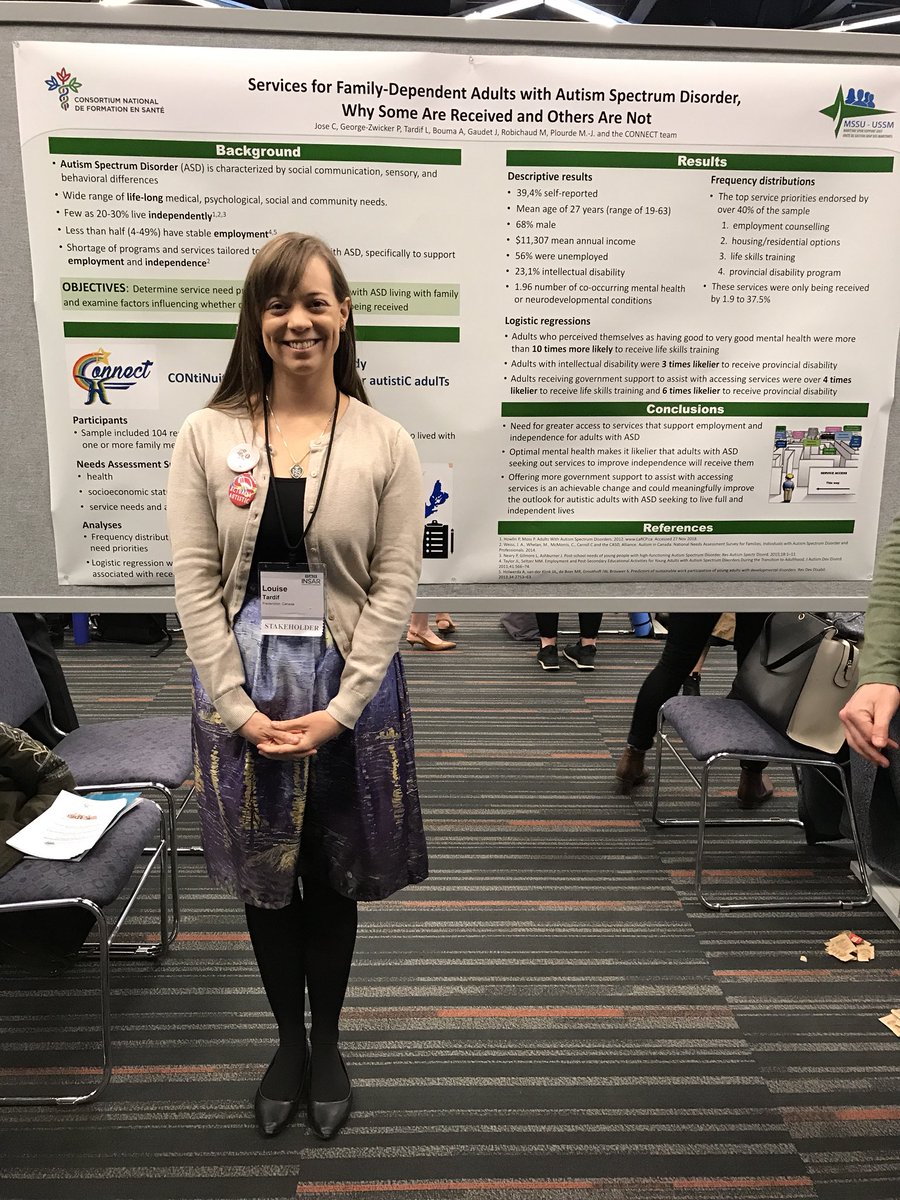 |
| Self-advocate Louise Tardif, presenting a group poster on Services for Family-Dependent Adults. Photo © Jon Adams. [image: A white person with long straight brown hair with bangs, standing in front of a study results poster.] |
So, all, please check out these Autism Acceptance guidelines from The Autistic Self Advocacy Network, and share them liberally with your peers, teams, and organizations.I’ve had research partners discourage me from talking about being autistic when I talk about my research on stigma and autistic college students. An advisory group I’m on doesn’t allow autistic researchers to present unless they don’t disclose to audience because “not objective”— Kayden Stockwell (@KaydenStockwell) May 4, 2019
[*sound of needle being dragged across a record*]
As for the conference programming itself, that was an exercise in sheer FOMO terror. (If you want to experience delayed overwhelm, you can still look through the conference program and abstract book [PDF]). We tried to hit as many sessions as we could, but still missed Sarah Hampton on Autistic Mothers’ Wellbeing during Pregnancy and the Postnatal Period; Dr. Lisa Croen on SSRIs and pregnancy (no link to autism, people!); Dr. Josephine Blagrave, Dr. Emily Bremer, and Dr. Andrew Colombo-Dougovito on caveats, barriers, and best practices for physical activity for autistic people—and even sometimes missed crucial nuggets in panels we did attend, e.g.:
In the #INSAR2019Panel on cultural diversity and barriers to diagnosis. A developmental pediatrician just let everyone know u don't need to wait for a pediatrician for a diagnosis. You can go to early intervention & THEY will be able to facilitate diagnosis & followup services.— the tiniest doomwook (@drdebah) May 4, 2019
Here's what we did attend: Dr. Sarah Cassidy and group's excellent pre-conference session on autism and mental health (we live tweeted much of it, but it was also recorded in its entirety, so hopefully we will be able to share more about it soon). We were impressed by everything we saw, including Dr. Christina Nicolaidis's presentation of Dora Raymaker's work on autistic burnout, and Dr. Rachel Moseley, whose work on self-injury in autistic people without intellectual disability is sobering—so definitely watch out for our forthcoming interview with Dr. Moseley.
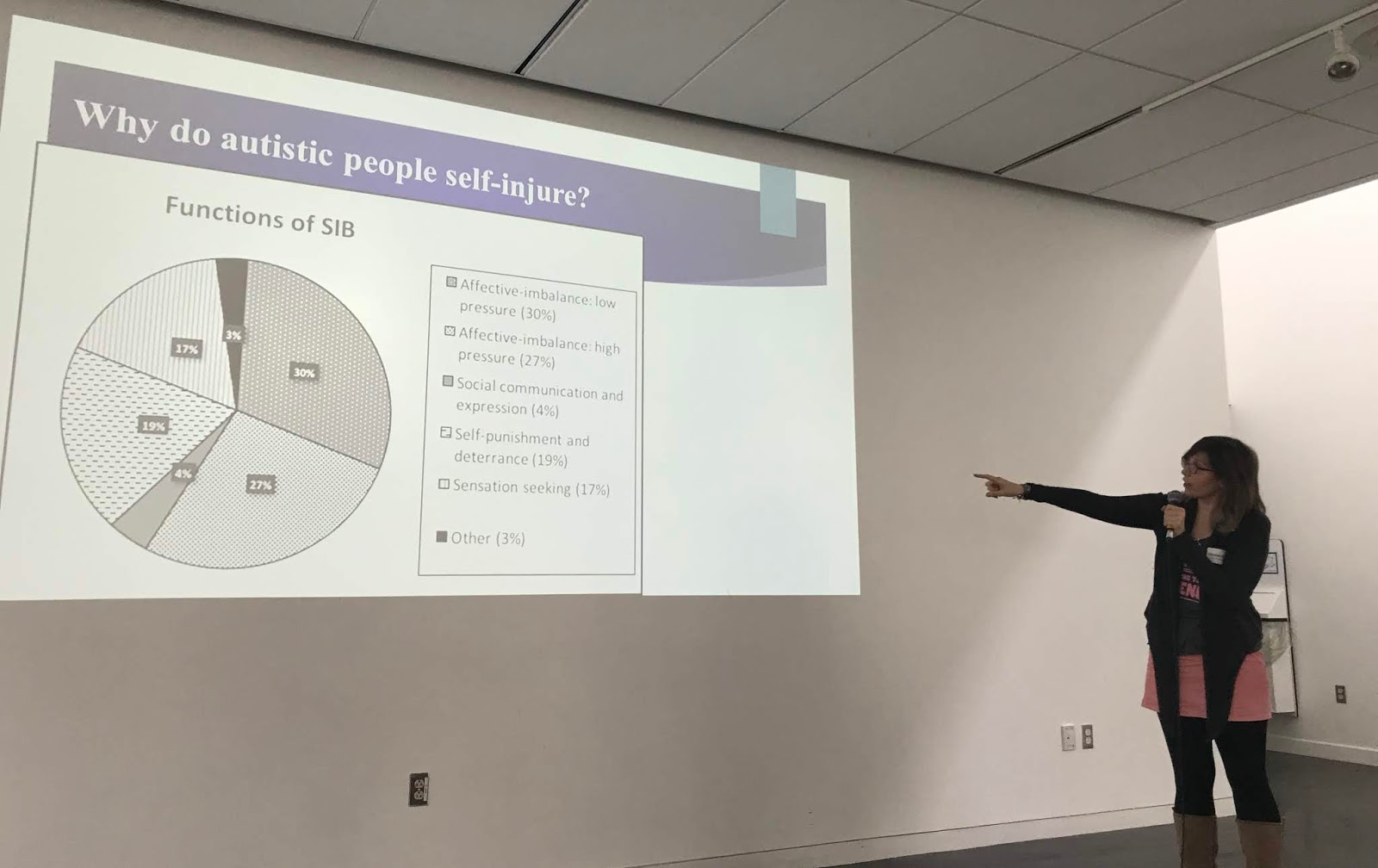 |
| Dr. Rachel Moseley during her presentation on autism and self-injury [image: White woman with glasses and long dark hair, speaking at a session, and pointing at a projected slide about reasons autistic people self-injure.] |
One of the highlights of the conference for us was AutINSAR, a conversation between autism researchers and/or autistic community members, both in person and on Twitter, which we co-hosted for the third year in a row. AutINSAR was rollicking good fun with excellent points made by all, and so heavily attended IRL that people had to sit on the floor around the perimeter of the room. It takes a while to compile Twitter chats into usable formats, but rest assured a full summary is coming.
 |
| The IRL #AutINSAR crew Back row: Emily and Manuel Casanova, Jon Adams, Bret Heasman, Sue Fletcher-Watson, Anne Fritz, Cat Hughes, Aaron Bouma, Bethan Davies, Corina Becker, Stephanie Vreeland, and Steven Kapp Center row: Sara Luterman, Christina Nicolaidis, Lorcan Kenny, Christine Jenkins, and Louise Tardif. Front: TPGA editors Shannon Rosa & Carol Greenburg [image: Crowd of neurodivergent people posing in the corner of the INSAR press room.] |
— aut Sarah (@Sarahmarieob) May 2, 2019
Ready and waiting for #AutINSAR
Last year it was the best part of the conference and a great participatory activity given the constraints of the conference cost and distance for many autistic people.
 |
| John Elder Robison, reigning over the Stakeholder's luncheon [image: A tall white man with short silver hair and glasses, speaking at a podium, wearing a red paper crown.] |
 |
| One table of neurodiverse good company at the INSAR Stakeholder's luncheon. [image: Nine people of diverse races, autism affiliations, and neurologies: Back row: Carol Greenburg, Kyle DeCoste, Dr. Deb Karhson, Fernanda Castellon, Sara Luterman, and Stephanie Vreeland. Front row: Corina Becker, Elliott Keenan, and Dr. Steven Kapp.] |
During the main conference, we attended and live-tweeted several sessions: Co-Morbidities (co-occurring conditions like anxiety, depression, and executive functioning difficulties), Health and Well-Being in Transition-Age Youth and Adults, and Cultural and Structural Factors Underlying Diagnostic and Service Disparities Among Racial/Ethnic Minority Children in the U.S.
We also attended and published highlights on Learning How to Prevent Suicide in Partnership with Autistic People and Their Allies, which featured a pointed and moving talk from autistic artist Jon Adams. The Special Interest Group (SIG) on Gender, Sexuality, and Romantic Relationships addressed real-world concerns, and I particularly welcomed the section on supporting people with intellectual disabilities. We also appreciated the SIG on Autism and Related Disorders in the Context of Humanitarian Emergencies, which included the reminder that we cannot merely translate autism materials; we have to make them culturally-specific and -informed.
I also hope the INSAR board takes note that, as Dr. Sue Fletcher-Watson reported, dismissing autistic accommodations at the meeting itself is uncool. Last year the conference tried to promote flappause, AKA flapping one's hands instead of applause, so as not to assault those with auditory sensitivities (i.e., a large section of the autistic population). This year year the board backed off due to non-autistic pressures, and said flappause was a personal choice. I think this was an [expletive] move at an autism conference. Autistic attendees weren't pleased, and flappause continued to happen among increasingly sheepish applause:
Another reminder about #INSAR2019 #autistic attendees and respecting sensory needs/rights: Flappause rather than applause is appreciated.— Thinking Person's Guide To Autism (@thinkingautism) May 2, 2019
And note: Flappause is not a “political" issue. Flappause is an accommodations, as well as a kindness and decency issue.#neurodiversity https://t.co/iBRsqUkwTE
We need to increase autistic accommodation at INSAR, not reduce it. Having a sensory/quiet room is a good start, but the poster sessions were still sensory hell, and many autistic attendees publicly reported having a tough time navigating the conference in general. And we know the INSAR board is aware of these issues, as board member John Elder Robison is publicly soliciting, listening to, and taking autistic concerns seriously.
So those are my takeaways from INSAR 2019: Oodles of solid content and autistic representation, despite conference organizers not entirely in touch with the most ethical motivation for autism research: to figure out best practices for helping and supporting the autistic people and their families who are already here, already struggling, and who deserve the best quality of life possible. Hopefully the INSAR board will start listening, with results reflected in next year's 2020 conference in Seattle.As #INSAR2019 wound down you offered suggestions to make #INSAR2020 more accessible to #actuallyautistic people. In this tweet I'd like to introduce Sara Jane Webb, @PBSLab_Webb chair of the 2020 Seattle meet. Let's work together to make this one the best @AutismINSAR yet— John Elder Robison (@johnrobison) May 6, 2019
We're interested to hear your take on INSAR 2019.
----
*Disclosure: Editors Shannon Rosa and Carol Greenburg have written for Spectrum Magazine.


