Showing posts with label anxiety. Show all posts

Meltdowns: How Autistic Humans Experience Crises

Sonny Hallett 
medium.com/@sonyahallett

This post is about what meltdowns feel like to me, what impacts they’ve had, and what I’m learning about them. Other autistic people may have very different experiences, but if you are autistic yourself, I hope you will find something relatable about my descriptions and illustrations, or something helpful or encouraging in the things I’m learning. If you’re not autistic, I hope this gives you some insight into some aspects of a different way of being, different ways that humans can experience crises, and how your reactions could help or hinder.

----

I’ve been thinking about autistic meltdowns lately, and how little they’re understood. Too much of what society hears about meltdowns, and what gets written, is about autistic kids, their experiences related by parents and professionals. Of course, many autistic people have also talked about their meltdown experiences very eloquently, but as with so many aspects of being autistic, our lived experiences are still very underrepresented in dominant narratives.

I was diagnosed autistic as an adult, at 28. I had always experienced meltdowns and have vivid memories of them happening throughout my childhood, teens and 20s, but I never understood them, and neither did anyone around me. As I got older, these ‘outbursts’ became less and less acceptable and more alarming to others, so I learnt to hide them as much as possible—which was not always.

Now that I understand my meltdowns and their triggers better, I have observed the buildups to usually take two distinct forms: gradual or sudden.

[Click images to enlarge]

Image description: a five panel black-and white cartoon. Panel 1: Sketch of a white large feather on a black background. The tip of the feather is pointing at the lower left corner on a diagonal.  The caption at the top of the panel reads, in white, “Sometimes it builds up over time…” Panel 2: The same feather, its tip pointing at the top right corner, also on a diagonal. The caption continues, “a gradual increase in nervous ENERGY” Panel 3: Sketch of a black door marked “Pull” with a white frame. A person is reaching towards the door handle with their left hand. They are wearing a coat and fingerless gloves. Only their arm is visible.  The caption  continues, “Like STATIC in cold dry weather, a gradual shift from an irritating tickle to pinpricks of electricity”  Panel 4: the same person pulling their hand away from the door. Their hand is surrounded by small white lightning bolts, and a large white lighting bolt is drawn on the top of the page.  The caption continues, “To full-on JOLTING SPARKS” Panel 5: Sketch of bird flying in a cloudy sky at the top of the panel. The rest of the panel is sketched perpendicular to the sky.he panel is the same size as all the previous panels put together. There is a drawing of a loop of road on the far left side of the panel. There is a tangle of arrows and road signs on the right side of the drawing.  The caption finishes, “Sometimes it comes out of the blue… Perhaps from a SUDDEN CHANGE of plan, leaving everything confused and out of control.” In full, the caption reads: “Sometimes it builds up over time… a gradual increase in nervous ENERGY like STATIC in cold dry weather, a gradual shift from an irritating tickle to prinpricks of electricity to full on JOLTING SPARKS[.] Sometimes it comes out of the blue… Perhaps from a SUDDEN CHANGE of plan, leaving everything confused and out of control.”
[Image description: a five panel black-and white cartoon.
Panel 1: Sketch of a white large feather on a black background. The tip of the
feather is pointing at the lower left corner on a diagonal. 
The caption at
the top of the panel reads, in white, “Sometimes it builds up over time…”


Panel 2: The same feather, its tip pointing at the top right corner,  also
on a diagonal. The caption continues, “a gradual increase in nervous ENERGY”


Panel 3: Sketch of a black door marked “Pull” with a white frame. A person
is reaching towards the door handle with their left hand. They are wearing a
coat and fingerless gloves. Only their arm is visible. 
The caption  continues,
“Like STATIC in cold dry weather, a gradual shift from an irritating
tickle to pinpricks of electricity”


Panel 4: the same person pulling their hand away from the door. Their hand
 is surrounded by small white lightning bolts, and a large white lighting
bolt is drawn on the top of the page. 
The caption continues,
“To full-on JOLTING SPARKS”


Panel 5: Sketch of bird flying in a cloudy sky at the top of the panel.
The rest of the panel is sketched perpendicular to the sky. The panel
is the same size as all the previous panels put together. There is a
drawing of a loop of road on the far left side of the panel. There is
a tangle of arrows and road signs on the right side of the drawing. 

The caption finishes, “Sometimes it comes out of the blue…
Perhaps from a SUDDEN CHANGE of plan, leaving everything
confused and out of control.”


In full, the caption reads: “Sometimes it builds up over time…
a gradual increase in nervous ENERGY like STATIC in cold dry
weather, a gradual shift from an irritating tickle to prinpricks of
electricity to full on JOLTING SPARKS[.] Sometimes it comes
out of the blue… Perhaps from a SUDDEN CHANGE of plan,
leaving everything confused and out of control.”]

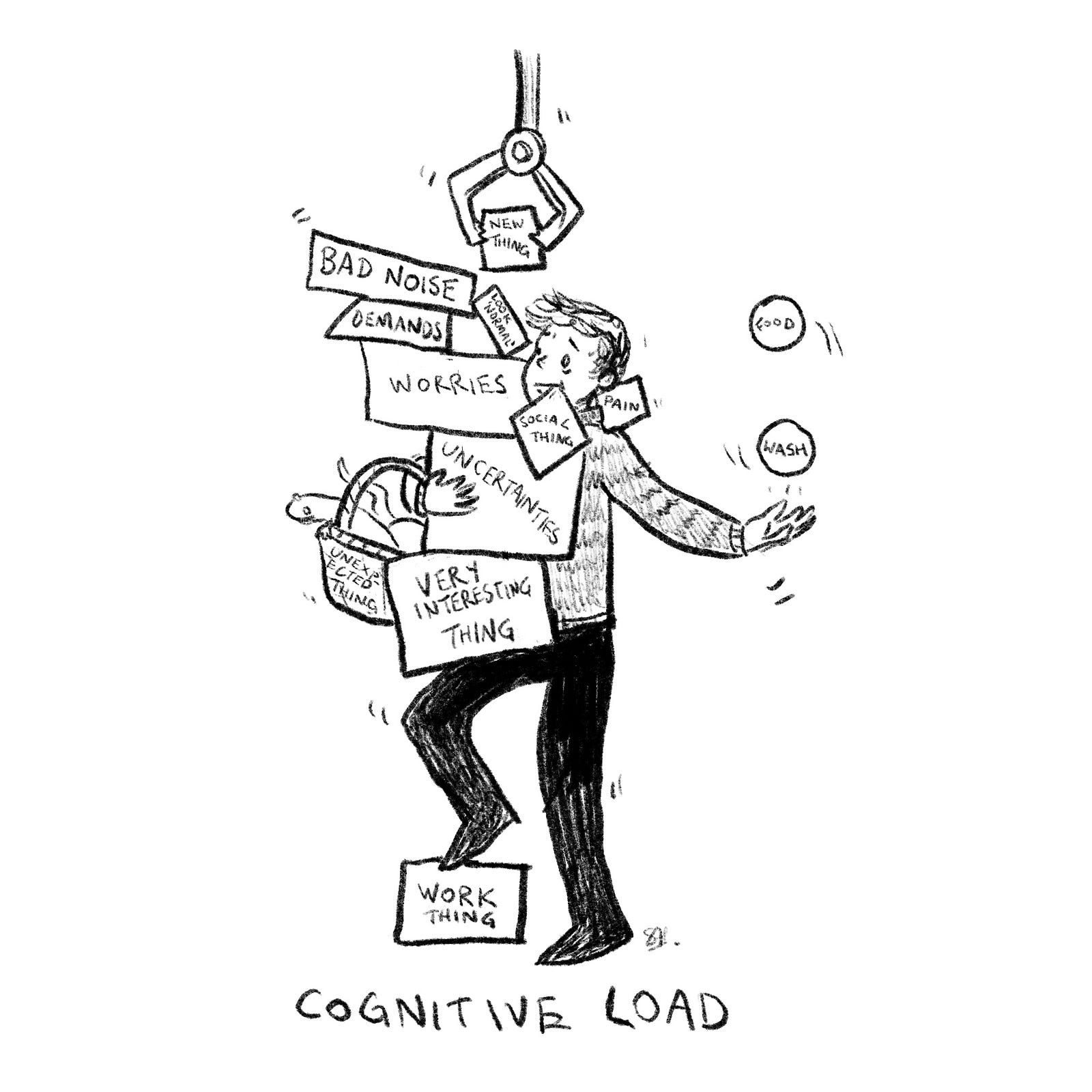
Whatever the type of buildup, I think it is always a reaction to depleting cognitive load, or in other words, too much stuff taking up my brain’s processing capacity, until it’s overwhelmed. In the case of a sudden change, the unexpected thing, which might be fairly trivial, hits me like a tsunami. All my resources are taken up trying to readjust to the new situation — whether it’s making new plans, figuring out how I feel about it, how to react, etc. This doesn’t actually mean that I’m necessarily bad in a crisis. In fact, many of the crises that happen have clear procedures to follow, or they might be things I’ve made contingency plans for. It’s the things I haven’t had a chance to script for or plan out internally that can throw me.

The gradual buildup kind can bring lots of different factors into play. Everything that happens in a day, from needing to eat, dress myself, and walk the dog; to projects for work, social demands, other uncertainties or worries, and illness or pain… all of these take up some of my diminishing resources. It can therefore take a fairly trivial thing to bring them all crashing down.


Image description: drawing of a person looking towards the top right of the window. They are wearing a fuzzy sweater and black pants and shoes, and is perched with one shoe on a rectangle blocks labels “WORK THING.” They are juggling two balls, one labeled “FOOD” and one labeled “WASH,” in his left hand. They are balancing a diamond block labeled “PAIN” on their left shoulder. On  their right side, they are balancing a pile of differently shaped blocks on their thigh and holding them in place with their right hand. The blocks are labeled in all caps, from top to bottom:      •Bad Noise      •Demands     •Look “Normal”     •Worries     •Social Things     •Uncertainties      •Very Uninteresting Things A crane is depositing a square block labeled “NEW THING” on the top of the pile. Finally, the person is also holding a basket full of snakes in the crook of their left arm. The image is captioned “COGNITIVE LOAD.”
[image description: drawing of a person looking towards the top right of the window. They are wearing a fuzzy sweater and black pants and shoes, and is perched with one shoe on a rectangle blocks labels “WORK THING.” They are juggling two balls, one labeled “FOOD” and one labeled “WASH,” in his left hand. They are balancing a diamond block labeled “PAIN” on their left shoulder. On  their right side, they are balancing a pile of differently shaped blocks on their thigh and holding them in place with their right hand. The blocks are labeled in all caps, from top to bottom: 
    •Bad Noise 
    Demands
    Look “Normal”
    Worries
    Social Things
    Uncertainties  
    Very Uninteresting Things
A crane is depositing a square block labeled “NEW THING” on the top of the pile. Finally, the person is also holding a basket full of snakes in the crook of their left arm. The image is captioned “COGNITIVE LOAD.”]
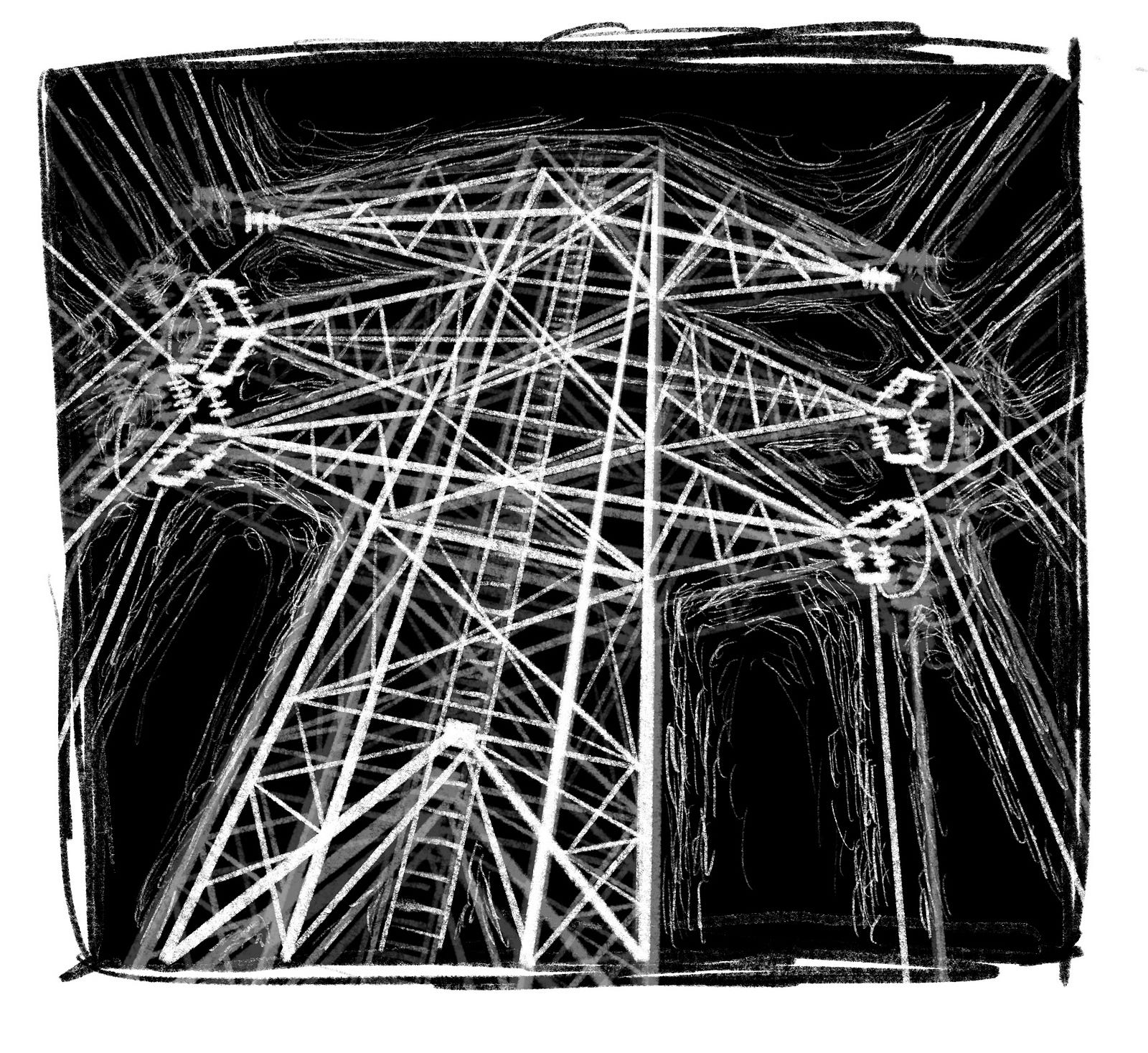
These days, I know that I’m running dangerously low on resources when I start finding everything much harder to do and filled with anxiety, including normally very simple tasks like remembering to eat or choosing what to wear in the morning. I also feel it physically: a gradual buildup background hum, like being under high-voltage pylons. The growing buzz also makes me much more sensorily sensitive: noises I’d normally tolerate become increasingly painful, textures freak me out all over the place, my whole body tenses up.

Image description: a drawing of a white transmission tower on a black background.
[Image description: a drawing of a white transmission tower on a black background.]

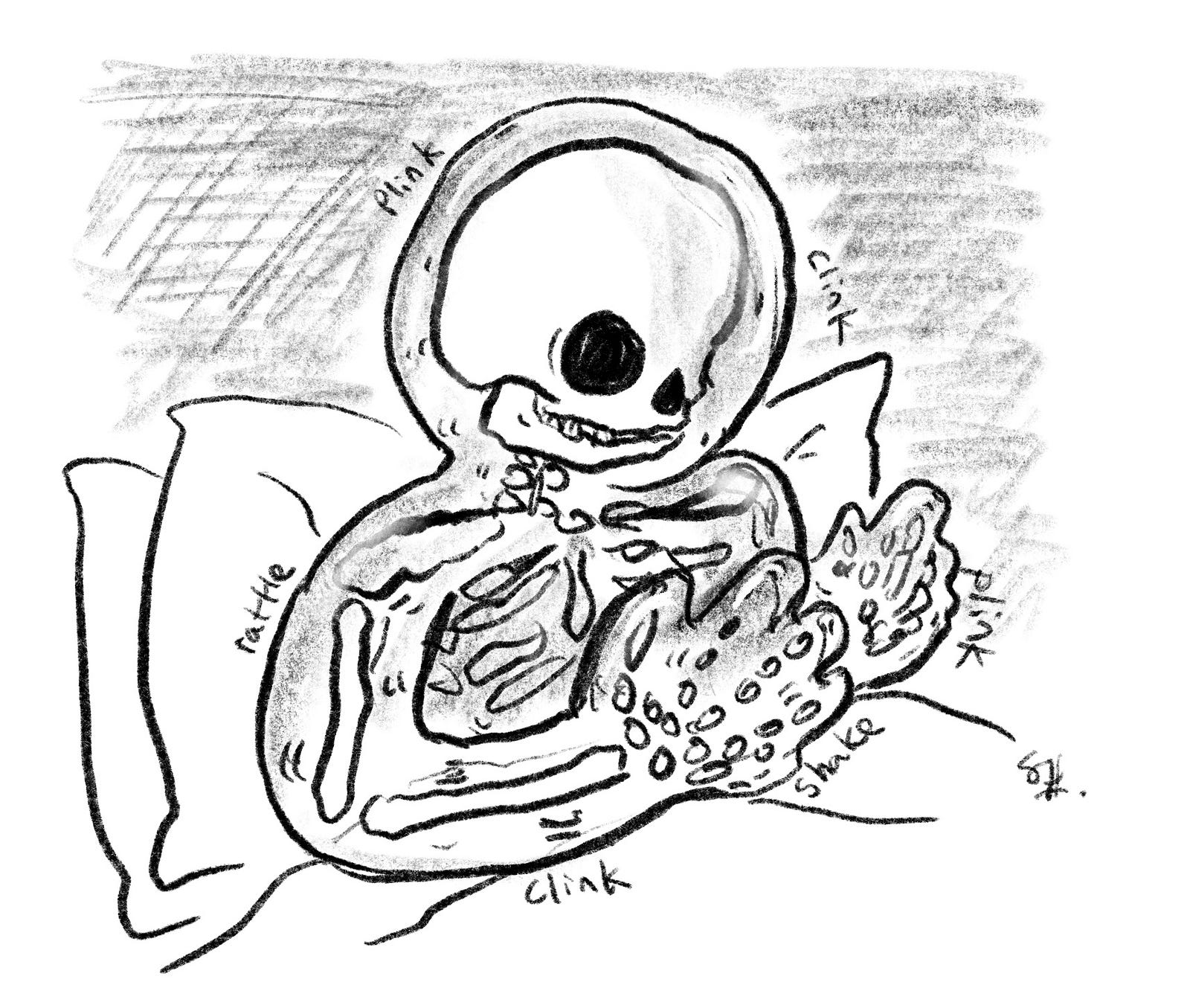
On days like these, I wake up feeling like my bones have been vibrating in my body all night. The energy makes me want to move about and fidget and shout to shake it out, but also fills me with a deep and draining exhaustion.

[Image description: sketch of a body sitting in bed with its skeleton visible. The body is
sitting with its back to a pile of pillows and its legs tucked are under a blanket.
The skeleton is holding its hands in front of its face. The words “plink,” “click,”
 “shake,” “plink,” and “rattle” are written clockwise around the outside of the body.]

In those moments, every additional demand exacerbates and prolongs the pressure. Sensory stuff, decisions I need to make, other people to worry about, or being in public and needing to hide. I might still be able to put off some of the ‘explosion’, but at the expense of things being much more explosive later. The buildup of energy feels like unbearable pressure in my whole body. I need to move or yell or cry. I need to hit things, I need to feel physical pressure or pain so that I can be sure my body isn’t fragmenting.

separated by a long diamond.  In the first section is a drawing of a white palm. The section is captioned “My edges feel fuzzy, like I’m drifting apart.”  The second panel has a drawing of the same hand in a first. It is captioned, “Perhaps that’s partly why…” The third panel contains a drawing of a fist slamming into the bottom of the square, cracking the surface below it. Above the first is  a large, a jagged semi-circle, showing that the fist was slammed down with great force.  The caption finishes, “…I feel like I need to SLAM them back into place.  In full, the caption reads, “My edges feel fuzzy, like I’m rifting apart. Perhaps that’s partly why… …I feel like I need to SLAM them back into place.”]
[Image description: a black square divided into 3 sections split diagonally:
right triangles at the top and and the bottom, separated by a long diamond.

In the first section is a drawing of a white palm. The section is captioned
“My edges feel fuzzy, like I’m drifting apart.” 

The second panel has a drawing of the same hand in a first. It is captioned,
“Perhaps that’s partly why…”

The third panel contains a drawing of a fist slamming into the bottom
 of the square, cracking the surface below it. Above the fist is a large,
jagged semi-circle, showing that the fist was slammed down with great force. 

The caption finishes, “…I feel like I need to SLAM them back into place. 
In full, the caption reads, “My edges feel fuzzy, like I’m rifting apart.
Perhaps that’s partly why… …I feel like I need to SLAM them back into place.”]

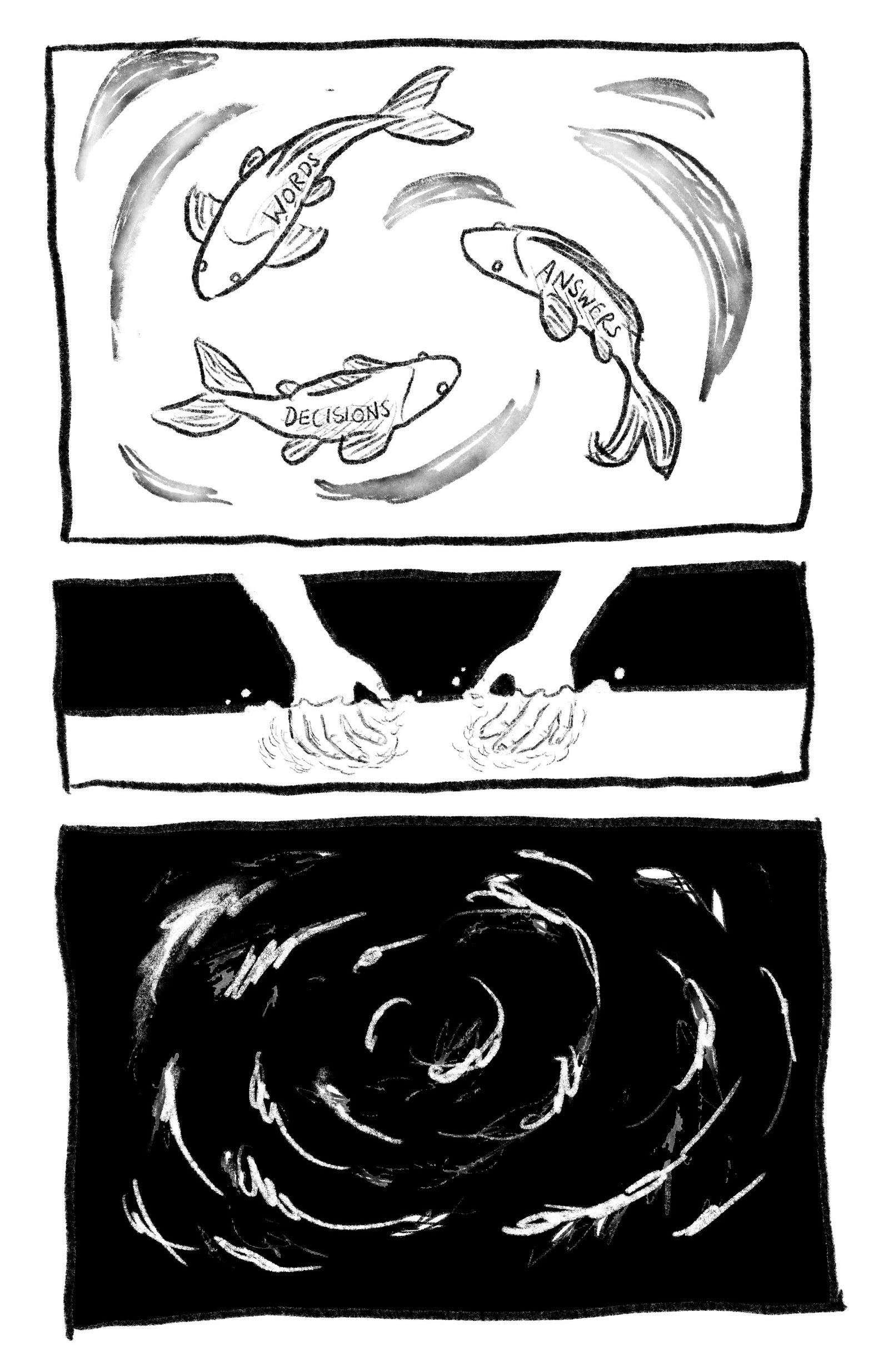
Amidst all this, I have a pretty clear inner voice narrating and observing everything that’s happening, but very diminished in its ability to be in control or make decisions. I can just about make some small judgments about what not to flail at, for example (other people, pets, breakable things), but making more complicated decisions, responding to questions, or even talking can feel overwhelmingly difficult. Trying to chase down my thoughts or words can feel like trying to grab fish in a pond with my bare hands. I need time and quiet to calm down before I can think properly, and every new demand is just prolonging how long that will take.

Image description: a series of 3 sketches.  Sketch 1: three small fish swimming counterclockwise in a circle. The fish are labeled “WORDS,” “DECISIONS,” and “ANSWERS.” Sketch 2: two white hands reaching into a pool of water.  Sketch 3: a spiral of white scribbles on a black background.
[Image description: a series of 3 sketches. 
Sketch 1: three small fish swimming counterclockwise in a circle.
The fish are labeled “WORDS,” “DECISIONS,” and “ANSWERS.”

Sketch 2: two white hands reaching into a pool of water. 
Sketch 3: a spiral of white scribbles on a black background.]

As an pre-diagnosis adult, my meltdowns were one of the most obvious ‘different’ things about me that I was scared of, and didn’t understand. The feeling of overwhelm can be such that I felt like I would do almost anything to make it stop, even if it meant self-injury or breaking things around me. I also worried that I might hurt other people, and the fear and worry my meltdowns elicited in people when they did see them (and they were often people I felt safe around) made me worry that I was dangerous, or bad, or seriously broken in some way.
The fact is that while my actions are normal for an autistic person, most non-autistic people don’t know how to react, and may find it alien and alarming due to a lack of understanding. I often think about how people familiar with panic attacks know that they are not an emergency, that they feel worse than they really are, and learn not to panic.

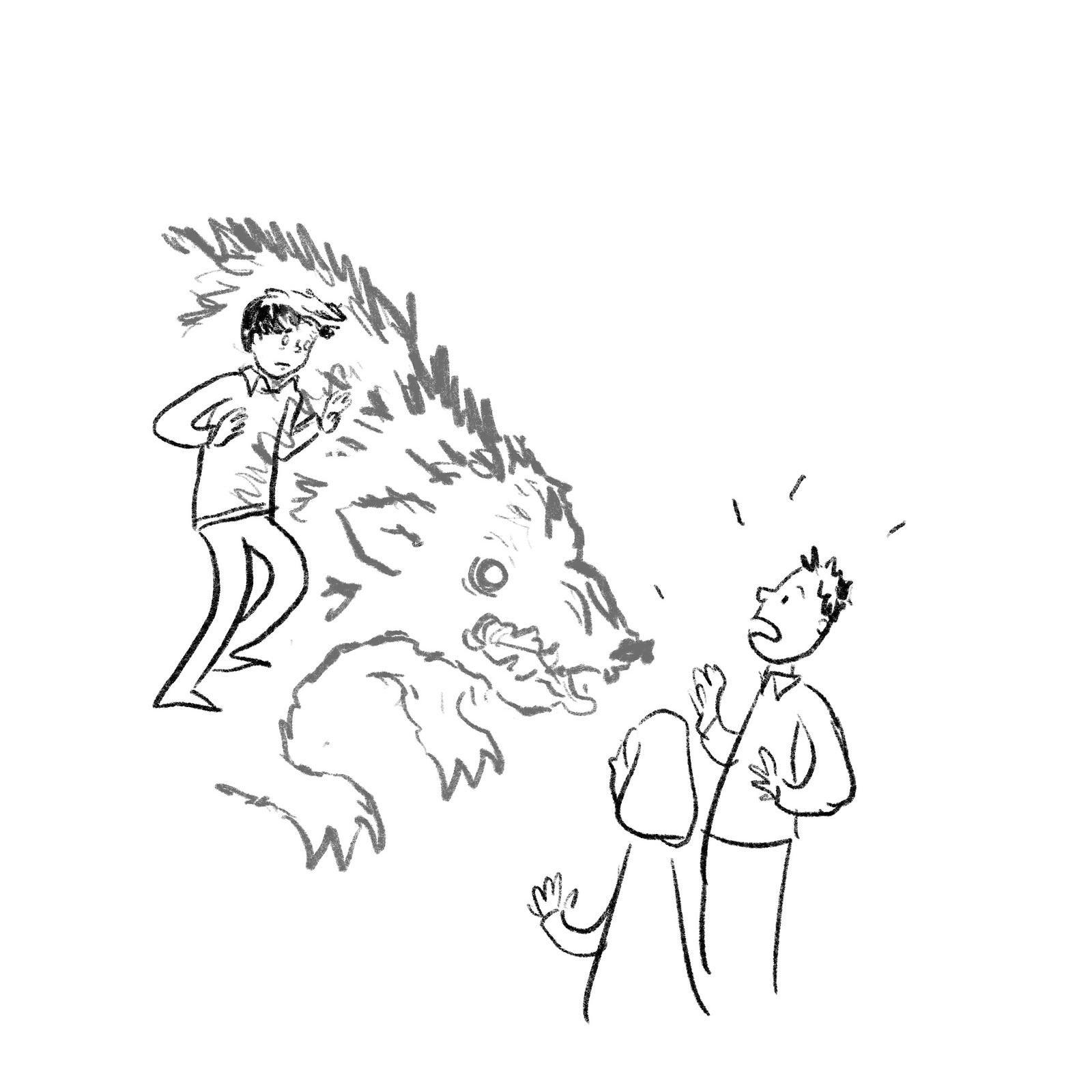
Over the years, I’ve encountered a number of people's reactions to me while I'm in meltdown or near-meltdown: from fear that I was going to be violent or concern that I was having some kind of mental breakdown, to worry that I lacked capacity for making decisions (one ex used to say that those times, and times when I expressed intense joy, made him worry that I didn’t have the ‘mental capacity’ to consent to being in a relationship as an adult). I’ve been told that I am overreacting and need to stop crying, when it’s not in my control, I’ve known people to get angry and tell me I’m ‘acting out’ for attention, and I’ve seen people panic and edge away from me, making me feel like I am some kind of wild animal that they think needs to be contained.

Image description: a person with a frightened expression inside  an angry bear. The bear is snarling at two people in the right  bottom corner. The person on the right is also terrified.
[Image description: a person with a frightened expression inside
an angry bear. The bear is snarling at two people in the right
bottom corner. The person on the right is also terrified.]

I remember a particularly turbulent time in my teens, going to a Samaritans drop-in, desperate for help with the feelings building up inside me. The well-intentioned volunteer didn’t understand what was happening with me, and my frustration and fear at not being able to communicate, plus her suddenly grabbing my hands in an attempt to comfort me, tipped me over into a full-on meltdown. I remember hiding behind the chair trying to get as far away from her as possible, and hitting the chair, the floor, myself. I remember seeing her back away in alarm and panic, call two more people into the room, who quickly escorted me out of the building.
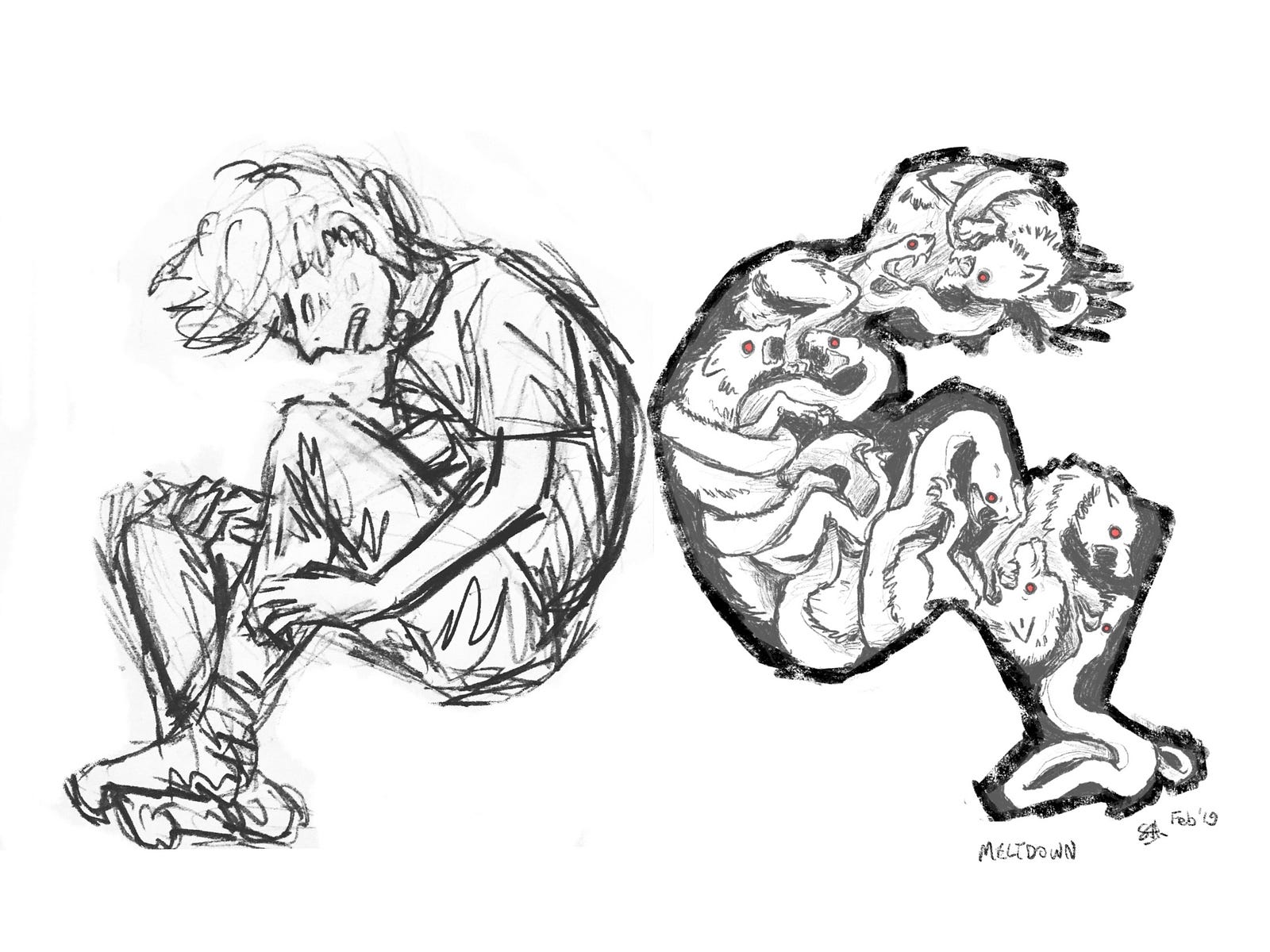
Another time, I was in a French lesson at school. It was a hot summer day, the windows were painted shut, the teacher was behind on the exam syllabus, and was making up for it by simultaneously playing us ‘accelerated learning’ tapes, making us finish written work, and sorting out individual paperwork by calling students up to the front. The heat and noise and fractured focus closed in on me more and more. I remember the walls spinning and my breath getting short and panicky. Nothing was making sense and all my senses hurt. I was trying to focus, but my thoughts felt like they were only slowing down, and I couldn’t filter anything out: the unpleasant texture of my school uniform, the tinny tape speakers, another student dropping a pencil…

Image description: two people sitting back to back. The person on the right has their knees up to their chest and their arms wrapped around themselves. They have an anguished expression on their face. The person to the left is the same shape and size, but is filled with white snakes and hyenas with red eyes screaming at and fighting with each other.
[Image description: two people sitting back to back. The person on the right
has their knees up to their chest and their arms wrapped around themselves.
They have an anguished expression on their face. The person to the left
is the same shape and size, but is filled with white snakes and
hyenas with red eyes screaming at and fighting with each other.]

I felt like a huge force was overwhelming me and I couldn’t stop it: suddenly I got up from my seat, violently, ripped up the paper in front of me in handfuls, and screamed, “THIS IS MAD WE CAN’T WORK LIKE THIS.” I don’t remember anything after that, possibly, except stunned silence and me sobbing. The next day my form tutor said, “I heard you had a funny turn in your French lesson.” I couldn’t explain it, and it wasn’t brought up again asides from by other kids, some of whom would yell, “THIS IS MAD WE CAN’T WORK LIKE THIS!” at me for the rest of my time at that school. I’m still not sure if it was all teasing to be honest, as I think no one else in that class was having a good time that day either.
Some years later, at university, a good friend who used to regularly pop round to my room in the dorms came by after I messaged her saying I was having a tough time. I was under the desk, squeezed in as tightly as I could. I don’t remember what else I was doing but I do remember the expression on her face, and her quickly leaving. We weren’t so close after that.

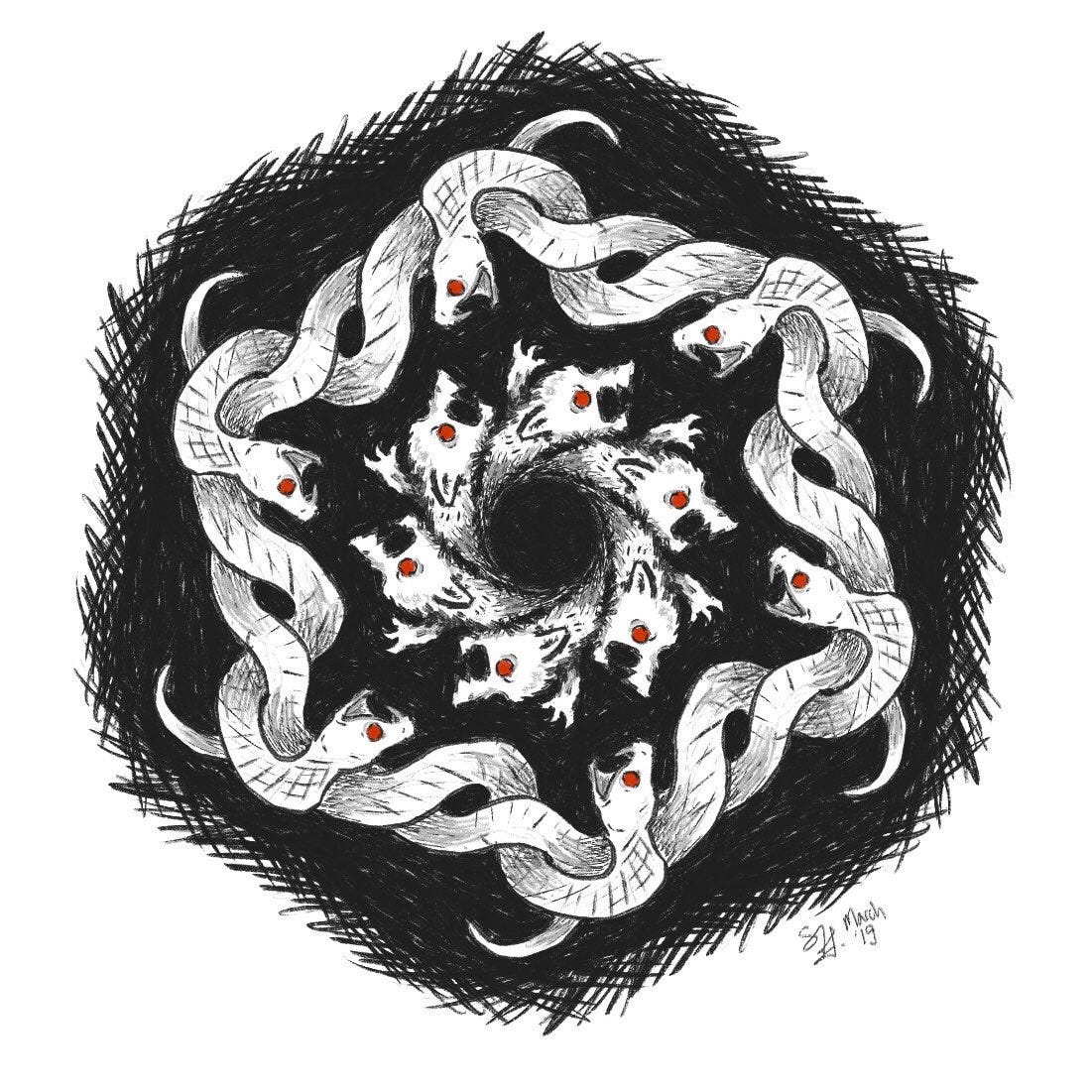
Image description: a loop of overlapping white ferrets with red eyes surrounded by a larger loop of snakes, their bodies wound together. The snakes and ferrets are snarling at each other.
[Image description: a loop of overlapping white ferrets with red eyes
surrounded by a larger loop of snakes, their bodies wound together.
The snakes and ferrets are snarling at each other.]

Learning that I am autistic, and understanding more about what that means for me, made me realise that meltdowns are a normal part of autistic experience. I’m not dangerous, it’s not a sign of some kind of terrible mental deterioration or break from reality — it’s just a response to stress and overwhelm. Don’t get me wrong, meltdowns are still deeply unpleasant, but there is less fear of the unknown attached to them, about what could possibly be happening. I can start to work on learning what my triggers are, when they might be imminent, how to prevent things from escalating, and what I need in those situations.
The fact that I can start to figure these things out for myself, with the help of the brilliant autistic community, as well as great allies and mentors, now means that I am also starting to learn to communicate what I need more clearly to others. 

Taken in isolation, meltdowns are unpleasant, exhausting, frustrating, sometimes even frightening, but they are also self-limiting. Knowing this, and why they happen, means that to me they really aren’t so much of a big deal in the grand scheme of things any more — I’m going to have them now and then, but that’s ok. The things I still worry about relating to meltdowns are almost all to do with the long-term repercussions of what might happen if I have a meltdown, or start getting close to one, around other people.

It seems like a pretty difficult responsibility that society places on us, as autistic people, to often have to do a lot of clear and coherent educating for our own safety, and to reassure others, just when we’re feeling at our least clear and coherent, and are in most need of reassurance ourselves. There are far too many examples of autistic people being arrested or sectioned, let alone reprimanded or ostracised, for having a reaction to difficulty and stress that is normal to our way of being, but not nearly well enough understood by others.

Following a meltdown that others have witnessed, I’m usually stuck endlessly replaying their reactions, worrying about what they might think, whether they are angry or scared or think less of me, dealing with any consequences that may have come from it. But more and more people are also starting to understand. There are several people in my life now, autistic and non-autistic, who I feel safe to be stressed around, even if I feel like a meltdown might be imminent. Times when I haven’t been ok around these people, they have offered the calm and reassurance I needed, and not thought differently of me, and as a result I’ve not been left trapped so much in loops of guilt or worry. Those meltdowns don’t linger as memories of significantly horrible events the way the ones I described earlier do.

Meltdowns are just one piece of autistic experience — an unpleasant and sometimes very difficult one, sure, but the hypersensitivity to sound and touch I feel when stressed is also the hypersensitivity that allows me to get so much joy out of the world when I’m excited. The energy and buzz that can make me writhe and flail in frustration is similar in feeling, in some ways, to the positive energy and drive I get when I’m really getting into a project, or about to do some enthusiastic public speaking. The electricity and anxiety that is part of the experience of being me (and autistic) is powerful, and can be scary, but is also what adds so much richness and focus to my world. I’m excited by how much we can all learn about different ways of being and experiencing, how to support each other, and what this diversity can add to the things that we all do.

----

A version of this essay was previously published at https://medium.com/@sonyahallett.

Images © Sonny Hallett.

Image descriptions by Sara Liss.


Share:

Starting Points for Understanding Autism

Oolong
oolong.co.uk

Photo courtesy the author
[image: Photo (light-painting) by the author: a spectral outline
around a hand and arm, raised as if to flap.]
I believe that the best way to understand autistic minds is in terms of a thinking style which tends to concentrate resources in a few interests and concerns at any time, rather than distributing them widely. I wrote in some detail about how this explains the observed features of autism in Me and Monotropism: A Unified Theory of Autism. Here, I want to distill what this means for living and working with autistic people, expanding on the six starting points for understanding autism that I identified in ‘Theories and Practice in Autism.’

I’m writing in the first person here, as a late-identified autistic adult who has worked and talked with many other autistic people in various contexts over many years. I believe that everything I describe here is a common experience for most people on the spectrum, but not necessarily universal. Many will be shared to various degrees by some non-autistic people—there are very interesting questions about the extent that different thinking styles overlap; brains really are very diverse, and psychological classification is a messy business. References, reviews of research and further resources for each section appear at the end.

1. Coping with multiple channels is hard

This can be sensory channels or other information streams.


This shows up in many ways; some of the most obvious ones are social. If my attention is focused on something else, I may not be able to take in what you’re saying. If I’m focusing on what you’re saying, I may not be able to do anything else (or I may need to do something else to absorb excess attention).

Most people assume there are multiple channels of communication going on in any conversation: words, tone of voice, gesture and eye contact. They also assume an ability to hold various other things in mind while talking: social context, social rules, relevant background facts. This works most of the time, for most people, but causes endless confusion in conversations between autistic and non-autistic people. Be prepared for misunderstandings where someone missed out on one or more of the channels you thought were conveying information.

Be aware that autistic communication styles tends to be different, too, for much the same reason. We are expected to maintain multiple channels of communication in socially acceptable configurations at all times, despite missing a lot of non-verbal cues throughout our lives. It often takes conscious effort to emote ‘appropriately’, display expected body language and suppress urges to regulate ourselves with motions people might find weird… all while trying to make sure not to say anything daft. Learning to do all this can be a valuable social skill, but it takes a lot out of a person, and it just doesn’t always work. If you want someone to be able to relax, they need to be able to feel comfortable being themselves—even if that looks odd to you. Learn to read our body language as best you can, but be aware that most people often get it wrong.

2. Filtering is tricky and error-prone

Sometimes I can’t tune things out, other times I filter them out completely.


Filtering is an active process, and it becomes much less effective when our resources are consumed elsewhere. That means our filters tend to be at their wonkiest when we’re worn out or having to keep up appearances. Any work done filtering out unwanted stimuli leaves less energy over for anything else.

Being unable to filter can be intensely uncomfortable, especially if it’s keeping you from something you want to focus on. Please take care of the sensory environment: too much noise and clutter and stimulation can be exhausting, painful and impossible to work with. Sometimes it helps a huge amount to be able to spend some time in an environment where we can control our sensory input, and not have to filter anything for a while.

Some of the most satisfying, relaxing and productive times are when we can enter a flow state, our attention completely absorbed in an activity. At those times, we may filter out almost everything else. If we can’t get rid of enough distractions to begin with, it becomes impossible to enter that state.

3. Changing tracks is destabilising

Task-switching is hard, and new plans take work.


It takes time and effort to get going, to change direction, or to stop. In other words, autistic thought tends to have a lot of inertia: it resists a change in state.

This can be great for working through complex logical puzzles, learning large collections of facts or just getting intensely absorbed in anything, but it can be very inconvenient all the same. Pulling all our tendrils of thought out of one thing and directing them towards another takes much longer than it does for a lot of people, and sometimes it’s hard to make them go where we want them—let alone where other people want them. Give us warnings, give us time, let us recover.

Don’t expect an instant transition from one thing to another, especially if it’s unexpected. It’s hard enough changing tracks even when we know what’s coming. A sudden change of plans means we have to completely reset and work out how to deal with everything about the new circumstances.

4. I often experience things intensely

Usually things that relate to my concerns and interests.


When my attention is fully focused on something, my brain seems to throw everything it can get at that thing. I credit this with my senses often seeming to be more intense and detailed than most people’s. I seem to get more than most people out of being absorbed in my interests, in general; I think this relates, again, to flow states.

On the other hand, unexpected input sometimes really shakes me. This might be something sudden, or just something that doesn’t seem to fit; either way, I can’t ignore it. It’s been suggested that the main difference with autistic brains is that they just have their ‘surprise’ setting turned right up; I wonder if our tendency towards intense surprise comes from having fewer interests or filters active at any given time, and finding the unexpected more jarring because of the intensity of our focus.

Incidentally, one of the side-effects of being surprised a lot is that you do sort of get used to it. I’ve often known autistic people to seem less surprised by things other people seem shocked by.

5. I keep looping back to my interests and concerns

It’s hard to let things drop.


It’s in the nature of interests and concerns that you loop back to them. If you’re interested in something, things are likely to pull your attention back to thinking about it. Monotropic minds tend to get pulled back to the same loops of concern again and again, especially when they have unresolved questions. People are terribly confusing, so we often have lots of unanswered questions. Sometimes a question might have been adequately answered really, but it still doesn’t quite feel like it, so we need to ask anyway. Other times, people are just impossible to predict, and there is no way to lay those worries to rest. These things can haunt us for years, and carrying them around can really sap your energy.

Still, I like how things are so interesting. Fascination is a fun thing, and I’m glad people have hardly ever tried to talk me out of my fascinations. I like working stuff out, and learning new things, but I also like to just get lost in things sometimes. Sometimes people are baffled by the sorts of things I like to do and learn, but really it’s their loss.

6. Other things that drop out of my awareness tend to stay dropped

I may need reminders.


I really need some kind of system to make sure things I’m supposed to think about come back to my attention. It’s so hard keeping tabs on lots of things at once, I’m bound to drop some of them if I don’t get reminded at the right time. This is complicated by the fact that if I’m in the middle of something, I really don’t want to let myself get pulled out of my attention tunnel for anything I can possibly put off.

This means there are all sorts of things other people might expect me to be thinking about, which I might not be unless I’m getting the right prompts. That includes things I genuinely care about, by the way; I hope nobody assumes I’m indifferent to things just because I fail to think about them. I just have so much else going on in my head!

----

I understand all of these features as manifestations of a monotropic thinking style: the more a brain concentrates its resources in a few interests and concerns, the more we should expect these to be true. Other theories can predict and explain many of the same features (see below) but I’m not sure that any other single theory leads us to all of the same predictions.

All of these taken together add up to a world that can be very difficult to deal with. It is no wonder so many autistic people experience so much anxiety, confusion and overwhelm. Our capacity for joy and focus can be some compensation for this, but it is often difficult to navigate a world dominated by people with relatively typical brains. If people can’t or won’t understand and accommodate our needs, problems accumulate. Discomfort can get ramped up higher and higher, until we have to escape or else we’ll melt down or shut down. This can last for a long time, and it is so often avoidable. I hope what I have described gives you some good starting points for working out how.

With the right strategies and understanding in place, most autistic people can thrive. Without them, life can be incredibly difficult, and much of what we have to give to the world gets lost. I wouldn’t change very much about my brain — I mostly like being who I am. I would, however, like to change many things about this world and how it deals with people who think differently.

----

If any of this helps you make sense of things, or changes how you relate to autistic people you know, I would love to hear about it. More important than that, please let me know if there’s anything here that doesn’t ring true for you! These ideas are being actively developed, by myself and others. There may be things we are getting wrong, and there are certainly things we haven’t fully worked out yet. One of the things I am especially interested in working out is what this all means for teachers, and I may soon produce a tailored version of this piece augmented by examples from educational practice.

Research, References, Resources


There is empirical work to be done to establish how well most autistic people feel these descriptions apply to them—beware anecdata, and all that. So far the best direct evidence for Monotropism as a theory of autism is probably Julia Leatherland’s unpublished PhD thesis, Understanding how autistic pupils experience secondary school, which found that Monotropism accounted for more of pupils’ reported experiences than any other single theory. I believe the basic features I describe here are all well-supported both by psychological research and the accounts of autistic writers, but Monotropism as a theory is still crying out for experimental work.

Notes for each of my starting points follow.


  1. Although it took until DSM-5 for perceptual differences to be included in diagnostic criteria, difficulty dealing with multiple sensory streams is attested since early autism research. Lovaas et al were not the first to record it in 1971, and see Marco et al (2011) for a systematic review. Mongillo et al (2008) found that difficulties with speech processing—perhaps unsurprisingly—were associated with social difficulties, and includes the fun fact that autistic people are much less susceptible to the McGurk Effect.
  2. It is well known that filtering is an active cognitive process, keeping the conscious mind from being overwhelmed with too much data. In the Predictive Coding model of the mind, much of what our brains do can be seen as filtering: non-conscious processes work on predicting the input coming in, and only what they fail to predict makes it through to conscious awareness. See Friston & Kiebel (2009) for a technical account, and Van de Cruys et al (2014) for more on the idea of autism as being a manifestation of excessive surprise. Karl Friston’s video on embodiment and Andy Clark’s book Surfing Uncertainty are both excellent introductions to this general approach to cognition, with a bit about how it currently seeks to account for autism.
        It seems natural to expect filtering to take energy, in the sense of both requiring and exhausting cognitive resources. So far I have only found research exploring the former, and not in an autism-specific context: Drummond et al (2012) found that sleep deprivation reduces visual filtering ability; Hasson et al (2013) found that a combination of emotional exhaustion and stress reduced tolerance for loud sounds.
        The National Autistic Society has a pretty good page on autism and the senses in general. On flow states in autism, see Milton (2017) and this video, also by Damian Milton.
  3. This is normally talked about as an aspect of executive function, which has been extensively studied with reference to autism—see e.g Hill (2004), and occasionally posited as an underlying explanation for all autistic cognition—see Russell (ed.) (1997). As I wrote in Autism and Executive Functions, I find it unconvincing as an overall theory of autism, and a bit of a blunt instrument for describing particular difficulties, but it remains an important idea.
  4. Intense experiences are at the very heart of the Intense World theory of autism (Markram et al 2010) which has important points in common with the Monotropism account. Its proponents are oddly reliant on a rodent model of autism, however, and see Remington & Frith (2014) for some very cogent criticisms, including the fact that unlike monotropism, it only seems to account for hypersensitivity in autism, where hyposensitivity is also commonly reported. Mottron et al (2006) write of enhanced perceptual functioning in autism, backing up the impression of sensory input often being both richer and more detailed in autistic people.
  5. Despite ‘restricted’ interests being a feature of accounts of autism going right back to the beginning, the nature and role of autistic interests has been chronically under-researched, and is very poorly accounted for by most theories of autism. However, see Grove et al (2018) for a study demonstrating the shock finding that pursuing their passions is a positive thing for autistic people’s wellbeing. The focused interests of autistic people are often called ‘special interests’, which is fine as long as you think along the lines of Special Interest Groups in tech, but not so much if you think of them as some weird, incomprehensible autistic thing, probably best suppressed. Mostly I prefer the term ‘passion.’
        On the anxiety front, Wigham et al (2014) found intriguing links between anxiety and repetitive behaviours. Both can be seen through the lens of perseveration, as can the way we keep returning to our interests. The idea that autistic anxiety is often associated with social difficulties is well studied—see e.g. White and Robertson-Nay (2004).
  6. This is another thing that’s usually discussed under the heading of ‘executive dysfunction’, not all that informatively. Mazfinch on Twitter has a handy list of possible reminder systems.

Acknowledgements


My partner Sonny Hallett has contributed greatly to my thinking about all this, and coined the useful phrase ‘loop of concern.’ That’s also them in the photo at the top wearing an excellent dinosaur jumper. The underlying concepts were largely formulated by my mother Dinah Murray, with Mike Lesser and Wenn Lawson. Damian Milton, Nick Chown and Richard Woods have all also contributed notably to my understanding.

----

This essay was previously published at Medium.
Share:

#AutisticWhileBlack: Diezel Braxton And Becoming Indistinguishable From One's Peers

Kerima Çevik
theautismwars.blogspot.com

The author's idea of what displaying autism positivity looks like
[Image: a Black woman over 50 with braided gray hair wearing
Neurodiversity 3.0 by ThinkGeek, a black T-shirt with a world globe
 design on the upper chest area in the shape of a human brain,
colored in physical map fashion i.e., water is colored light blue
 and land masses green, clouds white, looking to her left
 over bent wire-rimmed glasses in that way that mothers look at
 their children when an outrageous behavior has just ensued.]
There is an article in a paper called The Daily Net, about singer Toni Braxton's 16-year-old son Diezel working as a professional model for the past two years. The article refers to him as "formerly autistic." It goes on to say he has, "fortunately, moved past" autism and is now a celebrity himself.

Apparently, when her son was thirteen, Ms. Braxton was told he no longer met the criteria for autism. According to the article, she goes on to say:

“I am one of the lucky parents. Early diagnosis changes everything. I will tell you this. I will shout it from the rooftops. My son Diezel is off the spectrum. Off the spectrum being autistic.”

I beg to differ. There is no cure for autism.

Autism is a neurological divergence that doesn't just go away. One doesn't "move past" the wiring of a brain that has obvious neurological and physical differences. Calling current interventions for autism "treatments" is a misnomer that confuses parents. These interventions do not cure autism. They suppress visible signs of neurodivergent minds, forcing a type of behavioral code-switching that allows an autistic person to appear to navigate the world around them, such that they blend in with nonautistic peers.

This is not a cure. The price paid when forced training in compliance and the suppression of coping mechanisms is pursued—instead of investigating and addressing the root causes of coping mechanisms and misunderstood behaviors—may later manifest later in "formerly autistic" adults as mental health challenges, and PTSD.

A parental demand that Diezel should not display any sign that he is autistic has been issued for public consumption, from a mother who has no understanding of being autistic—except to view her son's brain as an enemy he must fight, and defeat. Is telling your adult son to hate his own brain, and how it works, a good thing? This sounds more like the very definition of how internalized ableism happens.

Toni Braxton would not tell her son that his melanin and hair are abhorrent things that he must combat and chemically suppress so he can be "indistinguishable from his white peers." I wonder why its okay to tell him to hate the nature of his own neurology? Most of the innovations, discoveries, and creative artistry in this world came from neurodivergent minds. Nina Simone was bipolar, as were many other great musicians. Many creative people are autistic. Presumption of a cure when the symptoms of a divergent mind are no longer apparent deprives neurodivergent individuals of their future rights to critical mental health, and other supports they may need to access going forward.

It is truly harmful to hold up an autistic teen and call him "formerly" autistic. If he has trauma, anxiety, or any future issues, his own mother's insistence that his lifelong disability is gone might lead him to hesitate in seeking help, to feel inadequate, to feel unable to request critical accommodations and supports that might significantly improve the quality of his life—or save it.

Diezel is the son of a celebrity, so his life is at this moment might appear significantly better than that of his African American peers. But this path of using an incorrect term for his becoming indistinguishable from his peers is dangerous to our community, and wrong.

Toni Braxton's type of rhetoric, along with parading her teen son around as inspiration porn, could have other parents exerting increased pressure on their own offspring to be "formerly autistic"—and if those young people have a degree of disability that makes becoming indistinguishable from their peers unrealistic, it could irrevocably harm them.

The author's idea of an autism positive autistic male model. 
With permission, and yes, we have matching Neurodiversity 3.0 
t-shirts. He is wearing his, bought deliberately 
large because the collar would disturb him otherwise.
 The photo matters because it defies professional
assessments of his degree of disability.
 He is facing me while I'm photographing him,
 he's looking right at me, and he's sending a
kiss in my direction. 
[Image of a multiracial teen with curly hair
at a table in a black t-shirt with a
drawing of a human brain
colored to look like a physical map of the world
 with the word Neurodiversity in all caps
 and green lettering beneath it.
A refrigerator can be seen in the background as
can parts of a sitting room behind him. © Kerima Cevik]
The crushing element of structural ableism, which breeds internalized ableism when nurtured by this type of parental gaslighting, may have emotional consequences at a later time in Diezel's life, and that truly concerns me. His mother clearly hates the autism label, and views autism in the same way she views the Lupus diagnosis she carries. I wonder how this has informed his identity and his sense of self-worth? I wonder if Diezel has been assessed for conditions like prosopagnosia, synesthesia, or auditory processing disorders? Has he been tested for Ehlers-Danlos Syndrome (EDS)? These common autism traits and co-occurring conditions are rarely tested for, or addressed, in African American autistic populations.

As African Americans, we are forced to code switch, to suppress African American Vernacular English (AAVE) and cultural differences that make us who we are—unless those differences in language and manner have already been culturally appropriated. Ebonics is still deliberately treated as something less than acceptable. It is still a major issue when natural hair is worn to school, or work. It is still a risk when AAVE is used in traditional work settings, or public spaces. The suppression of Black identity that necessitates code-switching to gain employment perpetuates structural racism. This type of racism has been exposed, deconstructed, and understood to be harmful. We now insist on being ourselves, and this has direct positive effects on the acceptance of our own Black identities. This reduces internalized racism and has created an entirely new generation of young Black activists who are able to continue to fight for the basic human rights we deserve as African Americans.

Toni Braxton's celebrity, and her wrongheaded understanding of autism, have been used for years to muddle the African American community's attitudes about autism. She allowed herself to be used to present autistic brains as things to be eradicated, and this is unacceptable. Her attitude sets up a dangerous mentality that is unsustainable, as you cannot eradicate your child's brain.

Braxton has been vocal and public in her portrayal of autism as a disease to be suppressed and defeated, rather than as a lifelong disability, and this has had a devastating impact on how our people view their own autistic children. We have a disproportionate number of autistic high school graduates who could succeed in college with the understanding that supports exist to help them navigate university life on every college campus. Our community views autism as a mark of shame, an embarrassment, and celebrity parents like Ms. Braxton continue to be instrumental in perpetuating these attitudes of ableism that hold multitudes of autistic youth back, when her intention appears to give our people some sort of hope and inspiration.

It is time to make the harm Braxton is causing clear, and speak up for the sake of so many autistic young adults and teens who live with self-loathing in part because of celebrity parents who inadvertently gaslight them with the attitudes that the things that make a young person autistic must be code switched off, suppressed—and who they really are must be either hidden away, or eradicated.

The average life expectancy of an autistic person is 36. I would argue that what makes navigating this world as an autistic person so risky is not just being autistic; it is the way every layer of society bakes ableism into the structure of autistic lives, such that from childhood to adolescence it becomes internalized, and increases risks of harm. We parents have to stop contributing to this cycle of loathing and alienation with misinformation, myths, and false narratives. It's time we understand the impact that our words and actions have on our children, and on the entire autism community.

I can't keep Toni Braxton from misinforming the public about her opinions on autism or her son. I can't keep her from continuing to speak about him without him, although he is now a celebrity in his own right and supposedly capable of speaking for himself. But what I can do is point out what is wrong about her behavior, and the damage it is doing. What we can all do is recognize what Braxton is doing, and not pave the road to autism hell by allowing ourselves to be led by celebrity or personalities. We need to seek peer-reviewed factual knowledge of what autism is, and understand how we can facilitate a better life for our children, by arming them with accurate, empowering facts.
Share:

Autism and Addiction: A Problem with Deep Roots

Take the red pill
Photo © Taston | Flickr / Creative Commons
[image: A white person's hand reaching for a blister pack of red & blue pills]

Maxfield Sparrow
unstrangemind.com

Autistic people stereotypically don’t drink alcohol, or take drugs. We love clear boundaries and rules, so we don’t do anything illegal. We’re generally less susceptible to peer pressure. And everyone knows drinking is a social activity, so obviously autistic people wouldn’t even drink, let alone become alcoholics. Right?

Wrong.

Not only do some autistics drink and/or use drugs, but we risk addiction as well. The roots of autistic people's addiction can go all the way back to childhood, so it’s very important to think about how we are raising autistic children today—if we want to help them avoid the pitfalls of addiction in the future.

Why Do Autistics Drink and/or Use Drugs?


This question is easy to answer. Ask any autistic person—even those who don’t drink alcohol or use drugs—and they will probably answer off the top of their head: Mind-altering substances lower inhibitions, helping people get past shyness or anxiety. It’s a form of self-medication. Alcohol and some kinds of drugs can also numb senses, which some autistics with painful sensory issues can find soothing.

Additionally, some autistics find their first circle of friends within a drug culture. This was the case for me. I was friendless through high school, but when I started meeting people who smoked cannabis I found it much easier to make friends with them. Many of them also used psilocybin and LSD, so they were used to being around people with much weirder behavior than mine. That first circle of friends even had a method to help me through intense emotions: they’d break out the cannabis, and we’d all smoke until we were happy again—or at least too stoned to remember why we weren’t.

A 2014 research article  in the Journal of Alcoholism and  Drug Dependence relates a case study of a 14-year-old girl with Asperger’s, Sarah, who had an experience similar to mine. Sarah’s parents were unaware of how deeply she had gotten involved in a drug community until she was arrested for selling drugs. It turned out drug dealers had been taking advantage of Sarah, both sexually and as a drug courier. The article says, “She confessed in a very naive manner that she thought these were her first real friends and would do anything to be their friend.”

We autistics may be more resistant to peer pressure, but our social isolation and craving for community can still make us vulnerable to manipulation by others. I was lucky that the social circle of drug users I first fell in with was not so malicious and self-serving as the one Sarah fell in with, but that’s all the difference in our experiences was: luck. Quite easily my story could have gone the way hers did. I was every bit as vulnerable as she was.

Why Do Autistics Have a Higher Risk of Addiction?


According to American Addiction Centers and a Washington University School of Medicine study, autistics are less likely to try alcohol and drugs at all—but those of us who do have a much higher risk of addiction than the general population. A Swedish study found an autism diagnosis doubles the risk of addiction. The 2014 Dutch research article I mentioned earlier conducted a survey of patients in a rehab facility. Using the latest diagnostic criteria, they evaluated 118 patients for autism and found that 6.7% were clinically diagnosable. Compare that to the 1% to 2% of the general population that is diagnosed or diagnosable as autistic, and it suggests that we autistics are over three times as likely to have addiction problems. If you then consider the lower overall usage rates among autistic people, that increased percentage represents a massive leap in addiction risk.

I think there are two big factors at play here: The first should be obvious from the stories in the last section: social acceptance. If we have never had friends and suddenly people are accepting us, “weird and all,” so long as we are drinking (or smoking or snorting or injecting) with them, we’re more likely to spend a lot of time drinking (smoking, snorting, etc.) so that we can spend more time enjoying that social acceptance. The more time we spend in a bottle, the more likely we are to get hooked.

The other factor is a potential biological predisposition for addiction. I don’t want to go too far down that rabbit hole, but you can look at a study that found autistic genetics were more common among both humans and mice who voluntarily drank excessive amounts of alcohol, as well as reading more about the structural differences in autistic brains involved with lower impulse control and disruptions of the dopaminergic regulatory circuits—both neurological traits more likely to contribute to addiction.

What Makes Traditional Rehab Programs a Poor Fit for Autistics?


In a nutshell, almost everything. Rehab programs tend to use group dynamics as part of the treatment. Patients are encouraged to bond, and to help one another through the process. These expectations are unfair to many autistics, who tend to get singled out for social non-conformity, to self-isolate, or get rejected by the group. This affects treatment for autistics who cannot access the model in use.

Another case study in the Dutch article is that of Peter, a 20-year-old undiagnosed autistic. Peter couldn’t complete a task in time for his rehab group therapy session, and then had a meltdown when a staff member interrupted his work. Because he broke windows and threatened a nurse, Peter was kicked out of the inpatient program. When he returned to the outpatient clinic, staff looked more closely and realized Peter was autistic. When the rehab center changed their approach—taking autism into account and changing their behavior to accommodate Peter’s needs—he became cooperative and easy to work with, rather than frighteningly unpredictable and angry.

What Should Autistic-centered Rehab look like?


While the need for autistic-understanding rehab programs is currently largely unmet, some facilities and programs are starting to appear. American Addiction Centers suggests individualizing the program by getting to know the autistic person’s strengths and weaknesses, and giving them opportunities to work alone as well as in groups. Educate staff better about autism. Set a pace that works better with the autistic person’s needs. Use a variety of teaching methods to mesh better with minority learning styles.

Foundations Recovery Network emphasizes the importance of autism acceptance. “The goal isn’t to change these people, but to help them live comfortably within their own skin, so they won’t be tempted to lean on drugs and alcohol instead.” In fact, their program sounds like just what I needed when I first learned about my own autism, even though I wasn’t grappling with addiction issues at that time:
“We don’t attempt to label, brand or otherwise stigmatize people who have Asperger’s syndrome or addictions, but we do try to help people accept their conditions and limitations, so they won’t use harmful substances to mask their pain. The work is hard but it can be quite rewarding, and it could lead to a completely different kind of life for people who have always struggled to connect, to collaborate and to heal.”
But the “innovation” of seeing a person as a unique individual and shaping their treatment program to fit them rather than trying to squash them into the shape of a one-size-fits-all program shouldn’t stop with helping autistic addicts. Every human being is unique. I often feel like the entire notion of “neurotypical” is just smoke and mirrors because every brain is different so how could there possibly be a “default brain type”? Neurotypical is more like a concept that some people’s experience is more in alignment with rather than an accurate descriptor for any single human being.

So let’s reform rehab programs all the way: not just making them autistic-friendly but friendlier to all types of human beings. Autism and addiction creates a “perfect storm” in which two human experiences that are grossly misunderstood and regularly mistreated co-occur. Author Maia Szalavitz, author of Unbroken Brain: A Revolutionary New Way of Understanding Addiction, expressed this beautifully when she said, “with any other psychological or developmental or neurological condition, we’d recognize that human beings are unique individuals.” This intersection of harm suggests that those of us who care about the abuses enacted against autistics in the name of treatment should care about similar abuses against those suffering addiction (and vice versa).

What Can We Do to Stop Addiction Before It Starts?


While there is a strong case for addiction being wired in genetically/neurologically*, author Johann Hari has been spreading the word in the last few years that “the opposite of addiction is connection.”

In his Ted Talk, “Everything You Think You Know About Addiction is Wrong,” Hari talks about the famous cocaine-drinking lab rats. We’ve all heard of them: the rats are offered plain water and cocaine-laced water and they drink so much cocaine they end up killing themselves. But no one until recently had thought of offering the rats an enriched environment. When the rats had a fun cage filled with toys and things to explore, including other rats to socialize with, they still drank cocaine from time to time, but in moderate amounts rather than lethal doses.

I think this is what makes autistics so vulnerable to addiction (as well as many other unfortunate life outcomes): the difficulty we have in connecting with other people. I know I might sound like a broken record, but yet again we see an issue that points back to the importance of autism acceptance. When autistics are encouraged to accept, love, and celebrate who they are, breakthroughs occur. When the people surrounding autistics show acceptance and provide a safe space, allowing autistics to drop their social masks and live more authentically, breakthroughs occur.

Every step toward true autism acceptance is a step away from addiction and a step toward healing.

----
*Alastair Mordey, programme director at The Cabin Addiction Services Group, writes that 40% to 60% of addiction cases come down to genetics, saying, “The actual ‘disease of addiction’ almost always pre-exists actual drug use, which may seem illogical. However, that is only because the word addiction is an inaccurate term we use to describe the second part of the illness, the behavioural part.” 
Share:

Why Do So Many Autistic People Flap Our Hands?

Maxfield Sparrow
unstrangemind.com


[image: rainbow colored hands in silhouette,
upraised and reaching out with joy.]
The saying goes, “if you’ve met one Autistic person, you’ve met one Autistic person.” That was really hammered home for me today as I watched a short video in which an Autistic man explains why Autistic people flap our hands … and pretty much nothing he said matched up with my own experience. A few of the things he said even bothered me.

My intention is not to erase what he said, however. His view of why he used to flap his hands is just as valid as my view of why I still flap my hands. There are many ways of being Autistic.

(Since the video was not captioned, I took the time to make a transcript of it for those who can’t hear or understand it. That was fortunate as the original video was removed from YouTube.) The video explains,
“It comes down to repetition. When we, as people with Asperger’s, are in a really unknown situation or we’re in a situation where there’s a lot of anxiety […], there’s a lot of stress, the way that we manage that, is because generally it’s overwhelming we do repetitive motions, because then we at least know, hey, if I do this I have complete control over it. And I know that whatever I do, I have complete control and it’s going to happen the same time every time. Therefore, I get a little bit of comfort from it.”
This does not even begin to describe why I flap my hands or make other “Autistic movements.” Yes, I flap in stress. I flap in overwhelm. I flap when I get hurt. The video presents hand flapping as if it only occurs as a result of stress or anxiety, however, and that is not at all true for me.

I flap my hands when I am happy. I flap them when I am content. I flap them a lot when I get excited about something. I have as many different ways of flapping and twisting and ruffling and fluttering my hands as I have emotions and emotional combinations that wash over and through me. My hands are like barometers of my emotional climate.

There are plenty of things I do to try to increase the amount of control in my life, but flapping my hands is not really one of those things. I don’t flap my hands to have something reliable and constant in my life. I fill that need with other things, like small stuffed animals I carry in my pocket or ritual ways of doing certain things. For example, there is a little ritual to how my boyfriend and I say good night in the evening and that ritual comforts me, gives me a sense of stability and predictability in my life, and helps me to make the transition from visiting with him to being alone again. I do other things like always removing the ice cube trays from the freezer in the same order, always putting the same number of ice cubes in my glass, always walking or bicycling the same route to get places, always brushing my teeth for the same number of minutes every night, and so on.

These things serve my need to have a predictable, orderly world that is under my control as much as possible. The more I am able to feel a sense of control over my life, the calmer and happier I am. I suspect this is true for most or all people, but it is quite extreme in my case. Something small, like not getting my usual seat, or having the water turned off for twenty minutes in my apartment building in the middle of the day with no warning, can make me feel like my world is coming to an end.  I am always fighting back the forces of chaos. But I do not wage this war with hand flaps.

The most common reason for me to flap my hands is that I am very happy and excited about something. My boyfriend told me that he loves to see my hands flap because there is a lovely joy that goes along with it that is fresh and appealing, without guile or artifice. If I recall correctly, he used the word “childlike” and meant it in a beautifully loving and respectful sense. Over the month of December, we went through a Jacquie Lawson advent calendar together every morning right after having breakfast together and he got to see lots of hand-flapping on the days when the calendar surprise was a steam locomotive or a peacock spreading his bright tail feathers, or a mansion kitchen staffed entirely by giant teddy bears.

I’d see these things that made me really happy and excited and there would go the hands. By the time I was aware that I was flapping my hands, they’d already been going wild all on their own without my awareness. My hand flapping is so often an expression of sheer, unadulterated joy—pretty much the exact opposite of what is being taught in the video, when Asperger Experts says, “it’s basically a giant signal saying, “hey! I’m not comfortable right now. Things are too much pressure or too much, just, overwhelm of sensation to the point that I need to do something to feel better about it.”

Yes, I can feel pretty overwhelmed by joy! But the kind of flapping I do when I’m not comfortable and suffering is another kind of hand flap. It’s a whole language of flaps and twists and shifts and strokes and claps. My hands speak my emotions so clearly, but only to those who are willing to learn what they are saying. My hand flapping is not a single message of suffering. It is a multi-faceted expression of my complex and beautiful emotional life.

As an alexithymic, I’m not usually aware of my emotions. So I even watch my own hands flapping away to help me understand what emotions I’m experiencing. I am “blind” to my emotions—I have emotions, usually very strong ones, but I am unable to know what I am feeling so I have to play detective and watch my body for clues.

My hands are always telling me what I am feeling. Without my hand flaps, I would not be anywhere near as connected to my inner life. Without my hand flaps, I would struggle so much more every day, just trying to understand what my body and spirit were experiencing. My hands are my teachers and they educate me about my deepest self every day.

While I feel as if my three-dimensional experience of hand flapping is described in a very one-dimensional way in the video, that’s not what really bothered me about the message. I was bothered by the way hand flapping was presented as something bad, undesirable, ridiculous looking, and mainly restricted only to small children. The video admitted that hand flapping is necessary, but presented it as something annoying and embarrassing that should be substituted as quickly as possible with something less visible, like repetitive thoughts:
“You shouldn’t just try to stop it because then they’re just going to find some other way of gaining comfort. […] All of a sudden, they might gain a tic, like [clicks tongue several times] and then that’s just even more annoying.”
No.

You shouldn’t try to stop hand flapping because it is part of who we are. Would you like it if everyone were trying to make you stop smiling? Or tucking your hair behind your ear? Or putting your sunglasses on top of your head? Or crossing your legs when you sat? That is what people are doing to us when they try to make us stop flapping our hands: they are trying to force us to stop moving in ways that are natural, healthy, and comfortable to us.

(And when I say “we” and “us,” I mean those of us who do flap our hands or otherwise naturally move in different ways from the rest of society. Not all Autists move in the same ways and that includes the fact that not all of us rock or flap or spin (although the vast majority of us do) so don’t assume someone is not Autistic because you don’t see them moving in different ways. Or they speak. Or hold a job. As I always say, there is no one way of being Autistic.)

The Asperger's Experts video presents hand flapping as a necessary evil—something that is annoying but has to be tolerated because we do it to soothe anxiety, and might end up doing something even more annoying if we’re forced to stop. In my opinion, hand flapping is a fundamental manifestation of the native nervous system of those who flap. It is how we are built, it is what we do. The focus should not be on whether it “might look ridiculous” or whether it’s better to “[transition] into listening to the same song over and over again, [or]  say the same thing in [one’s] mind over and over again.” the focus should be on building a society that understands that we don’t all move our bodies the same way and that’s okay.

“You know, you don’t see many people that are forty doing this [waves hands].” I am fifty and I flap my hands. Many of my friends who flap their hands are older than me. I know people in their twenties, thirties, forties, and fifties who flap their hands and even someone in his seventies who flaps his hands. It’s okay to move differently from others. It’s okay to have a different neurology and it’s okay to be who you are.

There is a much worse risk that comes from trying to suppress hand flapping than developing an “annoying tic.”

When I was a child, I felt like there was no place that was safe, no place where it was okay to be who I am, no place where I could just relax and be myself. Everybody was trying to give me the advice of “just relax and be yourself,” but when I would actually do that, I would be yelled at, criticized, punished, bullied. I lived in fear and anger because nothing I did, no matter what, was ever right or good enough. At school, I was bullied by the students and even by many of the teachers.

At home, I was blamed for the bullying and told I was bringing it on myself. In a misguided attempt to shape me into someone who would not deserve to be bullied so much, all my mannerisms and stims and quirks were under attack. I felt like I was constantly picked apart for behaviors like walking on tiptoe, clearing my throat, flicking my fingers, spinning around, talking too loudly, grunting instead of talking, and so on. I spent … wasted … so much energy and focus on trying to make my body and face and voice do all the proper things. But no matter how hard I tried, I kept always doing something wrong, and getting called out for it.

As a result, I was filled with so much anger toward everyone around me and so much self-loathing. I felt like nothing I did was ever right and I had no place to relax – school was filled with bullies and home was filled with picking apart my stims. I grew to hate everyone and often would lose myself in bitter daydreams with imagery I don’t care to re-visit now. My whole life was torment and I was in agony. This is the reason to let Autistic people be, not the fear that they might develop new behaviors that are even more annoying to the people around them.

The Asperger's Expert video’s reason for tolerating hand flapping was all about what makes other people feel okay or uncomfortable and had almost nothing to do with what the Autistic person wants and needs. Hand flapping almost had to be defined in that very one-dimensional manner, because if hand flapping is nothing but a comfort for excruciating anxiety, it is easier to decide to tolerate the “annoying” and “ridiculous” behavior, but if hand flapping is something that can be a sign of happiness as well as of more difficult emotions it’s harder to justify allowing people to be “annoying” just because they are happy.

But the problem is not with the hand flapping. The problem comes when the decision has been made that hand flapping is annoying or weird and not natural and adorable (which happens to be how it appears to me. I love to see people hand flapping! It makes me happy to see someone making a happy hand flap.)

The makers of the video may be Asperger’s Experts, but they are most surely not Maxfield Experts, because I’m not at all like what was portrayed in that video and I have many Autistic friends who are similar to me. Of course some Autistic people must resemble the portrait that was painted by the educational video purporting to explain hand flapping because that is how those two young men experienced their own Autistic movements. I don’t want to erase their voice when raising mine. But I also want to make sure their message is not the only one available to people.

So, as I said, the lesson here is that if you’ve met one Autistic person, you’ve met one Autistic person. There is not just one way to be Autistic. I’m sure the makers of the hand flapping video were expressing the truth about what being Autistic is like for them. Just be careful to remember that no one (including me!) speaks for all Autists. It is a pretty safe bet that there are also Autists out there who aren’t like the description in the video but aren’t like me, either.

So when you see someone flapping their hands, don’t make assumptions about what it means. There are some meanings that are more likely and some that are less likely, but better than guessing—better even than statistically-backed guessing—is getting to know the individual Autist and learning what hand flapping means for them.  Engaging with humans is almost never a one-size-fits-all scenario. We Autists are individuals; it’s good to learn general autism data, but “at the end of the day” there is no substitute for learning the language, including the body language, of the special person in your life. Or of yourself, if that’s how it’s all playing out for you.

But no matter what the flaps mean where you are, I do hope you will take one thing seriously that I said: don’t hate on the flaps, don’t be afraid of them, don’t judge them so harshly. Learn to live with the hand flaps because they are a good and useful thing for Autists, no matter what purpose they serve for each individual Autistic person. And, who knows: if you don’t already, there may come a day when you begin to see the beauty in hand flaps. Hand flapping and other Autistic stims are quite exuberant and lovely if you remember that they are a person’s heart and spirit made visible in time and space for all to behold.

(Note: A version of this post was published at unstrangemind.com in 2014.)
Share: