Showing posts with label executive functioning. Show all posts

Starting Points for Understanding Autism

Oolong
oolong.co.uk

Photo courtesy the author
[image: Photo (light-painting) by the author: a spectral outline
around a hand and arm, raised as if to flap.]
I believe that the best way to understand autistic minds is in terms of a thinking style which tends to concentrate resources in a few interests and concerns at any time, rather than distributing them widely. I wrote in some detail about how this explains the observed features of autism in Me and Monotropism: A Unified Theory of Autism. Here, I want to distill what this means for living and working with autistic people, expanding on the six starting points for understanding autism that I identified in ‘Theories and Practice in Autism.’

I’m writing in the first person here, as a late-identified autistic adult who has worked and talked with many other autistic people in various contexts over many years. I believe that everything I describe here is a common experience for most people on the spectrum, but not necessarily universal. Many will be shared to various degrees by some non-autistic people—there are very interesting questions about the extent that different thinking styles overlap; brains really are very diverse, and psychological classification is a messy business. References, reviews of research and further resources for each section appear at the end.

1. Coping with multiple channels is hard

This can be sensory channels or other information streams.


This shows up in many ways; some of the most obvious ones are social. If my attention is focused on something else, I may not be able to take in what you’re saying. If I’m focusing on what you’re saying, I may not be able to do anything else (or I may need to do something else to absorb excess attention).

Most people assume there are multiple channels of communication going on in any conversation: words, tone of voice, gesture and eye contact. They also assume an ability to hold various other things in mind while talking: social context, social rules, relevant background facts. This works most of the time, for most people, but causes endless confusion in conversations between autistic and non-autistic people. Be prepared for misunderstandings where someone missed out on one or more of the channels you thought were conveying information.

Be aware that autistic communication styles tends to be different, too, for much the same reason. We are expected to maintain multiple channels of communication in socially acceptable configurations at all times, despite missing a lot of non-verbal cues throughout our lives. It often takes conscious effort to emote ‘appropriately’, display expected body language and suppress urges to regulate ourselves with motions people might find weird… all while trying to make sure not to say anything daft. Learning to do all this can be a valuable social skill, but it takes a lot out of a person, and it just doesn’t always work. If you want someone to be able to relax, they need to be able to feel comfortable being themselves—even if that looks odd to you. Learn to read our body language as best you can, but be aware that most people often get it wrong.

2. Filtering is tricky and error-prone

Sometimes I can’t tune things out, other times I filter them out completely.


Filtering is an active process, and it becomes much less effective when our resources are consumed elsewhere. That means our filters tend to be at their wonkiest when we’re worn out or having to keep up appearances. Any work done filtering out unwanted stimuli leaves less energy over for anything else.

Being unable to filter can be intensely uncomfortable, especially if it’s keeping you from something you want to focus on. Please take care of the sensory environment: too much noise and clutter and stimulation can be exhausting, painful and impossible to work with. Sometimes it helps a huge amount to be able to spend some time in an environment where we can control our sensory input, and not have to filter anything for a while.

Some of the most satisfying, relaxing and productive times are when we can enter a flow state, our attention completely absorbed in an activity. At those times, we may filter out almost everything else. If we can’t get rid of enough distractions to begin with, it becomes impossible to enter that state.

3. Changing tracks is destabilising

Task-switching is hard, and new plans take work.


It takes time and effort to get going, to change direction, or to stop. In other words, autistic thought tends to have a lot of inertia: it resists a change in state.

This can be great for working through complex logical puzzles, learning large collections of facts or just getting intensely absorbed in anything, but it can be very inconvenient all the same. Pulling all our tendrils of thought out of one thing and directing them towards another takes much longer than it does for a lot of people, and sometimes it’s hard to make them go where we want them—let alone where other people want them. Give us warnings, give us time, let us recover.

Don’t expect an instant transition from one thing to another, especially if it’s unexpected. It’s hard enough changing tracks even when we know what’s coming. A sudden change of plans means we have to completely reset and work out how to deal with everything about the new circumstances.

4. I often experience things intensely

Usually things that relate to my concerns and interests.


When my attention is fully focused on something, my brain seems to throw everything it can get at that thing. I credit this with my senses often seeming to be more intense and detailed than most people’s. I seem to get more than most people out of being absorbed in my interests, in general; I think this relates, again, to flow states.

On the other hand, unexpected input sometimes really shakes me. This might be something sudden, or just something that doesn’t seem to fit; either way, I can’t ignore it. It’s been suggested that the main difference with autistic brains is that they just have their ‘surprise’ setting turned right up; I wonder if our tendency towards intense surprise comes from having fewer interests or filters active at any given time, and finding the unexpected more jarring because of the intensity of our focus.

Incidentally, one of the side-effects of being surprised a lot is that you do sort of get used to it. I’ve often known autistic people to seem less surprised by things other people seem shocked by.

5. I keep looping back to my interests and concerns

It’s hard to let things drop.


It’s in the nature of interests and concerns that you loop back to them. If you’re interested in something, things are likely to pull your attention back to thinking about it. Monotropic minds tend to get pulled back to the same loops of concern again and again, especially when they have unresolved questions. People are terribly confusing, so we often have lots of unanswered questions. Sometimes a question might have been adequately answered really, but it still doesn’t quite feel like it, so we need to ask anyway. Other times, people are just impossible to predict, and there is no way to lay those worries to rest. These things can haunt us for years, and carrying them around can really sap your energy.

Still, I like how things are so interesting. Fascination is a fun thing, and I’m glad people have hardly ever tried to talk me out of my fascinations. I like working stuff out, and learning new things, but I also like to just get lost in things sometimes. Sometimes people are baffled by the sorts of things I like to do and learn, but really it’s their loss.

6. Other things that drop out of my awareness tend to stay dropped

I may need reminders.


I really need some kind of system to make sure things I’m supposed to think about come back to my attention. It’s so hard keeping tabs on lots of things at once, I’m bound to drop some of them if I don’t get reminded at the right time. This is complicated by the fact that if I’m in the middle of something, I really don’t want to let myself get pulled out of my attention tunnel for anything I can possibly put off.

This means there are all sorts of things other people might expect me to be thinking about, which I might not be unless I’m getting the right prompts. That includes things I genuinely care about, by the way; I hope nobody assumes I’m indifferent to things just because I fail to think about them. I just have so much else going on in my head!

----

I understand all of these features as manifestations of a monotropic thinking style: the more a brain concentrates its resources in a few interests and concerns, the more we should expect these to be true. Other theories can predict and explain many of the same features (see below) but I’m not sure that any other single theory leads us to all of the same predictions.

All of these taken together add up to a world that can be very difficult to deal with. It is no wonder so many autistic people experience so much anxiety, confusion and overwhelm. Our capacity for joy and focus can be some compensation for this, but it is often difficult to navigate a world dominated by people with relatively typical brains. If people can’t or won’t understand and accommodate our needs, problems accumulate. Discomfort can get ramped up higher and higher, until we have to escape or else we’ll melt down or shut down. This can last for a long time, and it is so often avoidable. I hope what I have described gives you some good starting points for working out how.

With the right strategies and understanding in place, most autistic people can thrive. Without them, life can be incredibly difficult, and much of what we have to give to the world gets lost. I wouldn’t change very much about my brain — I mostly like being who I am. I would, however, like to change many things about this world and how it deals with people who think differently.

----

If any of this helps you make sense of things, or changes how you relate to autistic people you know, I would love to hear about it. More important than that, please let me know if there’s anything here that doesn’t ring true for you! These ideas are being actively developed, by myself and others. There may be things we are getting wrong, and there are certainly things we haven’t fully worked out yet. One of the things I am especially interested in working out is what this all means for teachers, and I may soon produce a tailored version of this piece augmented by examples from educational practice.

Research, References, Resources


There is empirical work to be done to establish how well most autistic people feel these descriptions apply to them—beware anecdata, and all that. So far the best direct evidence for Monotropism as a theory of autism is probably Julia Leatherland’s unpublished PhD thesis, Understanding how autistic pupils experience secondary school, which found that Monotropism accounted for more of pupils’ reported experiences than any other single theory. I believe the basic features I describe here are all well-supported both by psychological research and the accounts of autistic writers, but Monotropism as a theory is still crying out for experimental work.

Notes for each of my starting points follow.


  1. Although it took until DSM-5 for perceptual differences to be included in diagnostic criteria, difficulty dealing with multiple sensory streams is attested since early autism research. Lovaas et al were not the first to record it in 1971, and see Marco et al (2011) for a systematic review. Mongillo et al (2008) found that difficulties with speech processing—perhaps unsurprisingly—were associated with social difficulties, and includes the fun fact that autistic people are much less susceptible to the McGurk Effect.
  2. It is well known that filtering is an active cognitive process, keeping the conscious mind from being overwhelmed with too much data. In the Predictive Coding model of the mind, much of what our brains do can be seen as filtering: non-conscious processes work on predicting the input coming in, and only what they fail to predict makes it through to conscious awareness. See Friston & Kiebel (2009) for a technical account, and Van de Cruys et al (2014) for more on the idea of autism as being a manifestation of excessive surprise. Karl Friston’s video on embodiment and Andy Clark’s book Surfing Uncertainty are both excellent introductions to this general approach to cognition, with a bit about how it currently seeks to account for autism.
        It seems natural to expect filtering to take energy, in the sense of both requiring and exhausting cognitive resources. So far I have only found research exploring the former, and not in an autism-specific context: Drummond et al (2012) found that sleep deprivation reduces visual filtering ability; Hasson et al (2013) found that a combination of emotional exhaustion and stress reduced tolerance for loud sounds.
        The National Autistic Society has a pretty good page on autism and the senses in general. On flow states in autism, see Milton (2017) and this video, also by Damian Milton.
  3. This is normally talked about as an aspect of executive function, which has been extensively studied with reference to autism—see e.g Hill (2004), and occasionally posited as an underlying explanation for all autistic cognition—see Russell (ed.) (1997). As I wrote in Autism and Executive Functions, I find it unconvincing as an overall theory of autism, and a bit of a blunt instrument for describing particular difficulties, but it remains an important idea.
  4. Intense experiences are at the very heart of the Intense World theory of autism (Markram et al 2010) which has important points in common with the Monotropism account. Its proponents are oddly reliant on a rodent model of autism, however, and see Remington & Frith (2014) for some very cogent criticisms, including the fact that unlike monotropism, it only seems to account for hypersensitivity in autism, where hyposensitivity is also commonly reported. Mottron et al (2006) write of enhanced perceptual functioning in autism, backing up the impression of sensory input often being both richer and more detailed in autistic people.
  5. Despite ‘restricted’ interests being a feature of accounts of autism going right back to the beginning, the nature and role of autistic interests has been chronically under-researched, and is very poorly accounted for by most theories of autism. However, see Grove et al (2018) for a study demonstrating the shock finding that pursuing their passions is a positive thing for autistic people’s wellbeing. The focused interests of autistic people are often called ‘special interests’, which is fine as long as you think along the lines of Special Interest Groups in tech, but not so much if you think of them as some weird, incomprehensible autistic thing, probably best suppressed. Mostly I prefer the term ‘passion.’
        On the anxiety front, Wigham et al (2014) found intriguing links between anxiety and repetitive behaviours. Both can be seen through the lens of perseveration, as can the way we keep returning to our interests. The idea that autistic anxiety is often associated with social difficulties is well studied—see e.g. White and Robertson-Nay (2004).
  6. This is another thing that’s usually discussed under the heading of ‘executive dysfunction’, not all that informatively. Mazfinch on Twitter has a handy list of possible reminder systems.

Acknowledgements


My partner Sonny Hallett has contributed greatly to my thinking about all this, and coined the useful phrase ‘loop of concern.’ That’s also them in the photo at the top wearing an excellent dinosaur jumper. The underlying concepts were largely formulated by my mother Dinah Murray, with Mike Lesser and Wenn Lawson. Damian Milton, Nick Chown and Richard Woods have all also contributed notably to my understanding.

----

This essay was previously published at Medium.
Share:

Parents, Do Not Infantilise Your Teenage and Adult Disabled Children

Finn Gardiner
expectedly.org

Photo © G_Jewels | Flickr / Creative Commons
[Image: Black infant in a wooden high chair,
being spoon-fed by an off-camera adult.]
If you’re a parent of a teenage or adult child with a disability, it’s important to avoid infantilising them.

What is infantilisation? It’s treating people who are no longer children like children in a way that restricts their ability to be fully integrated with their age-peers. It’s talking to them in a condescending voice, dismissing their ideas and opinions, acting as though you will always understand them better than they understand themselves, or going out of your way to shield them from everything you think may be even slightly dangerous.

Infantalisation is treating your child as though they will always be a child, whether they’re five, fifteen or thirty-five.

Infantilisation is different from recognising that disabled people have support needs. That’s part of what being disabled means: being at a relative disadvantage compared to non-disabled people because we require specific supports to help us live within the community, whether that disadvantage is related to physical health, cognition, mental health, sensory processing or perception, mobility, or something else people find disabling.

It doesn’t matter what kind of disability your child has, whether chronic illnesses and intellectual, mobility, psychiatric, learning, developmental and sensory disabilities, or a combination. People with all kinds of disabilities deserve to be taken seriously and treated with respect.

A teenager or an adult with an intellectual or developmental disability is still a teenager or an adult. Accommodating the support needs of an autistic 17-year-old or a 30-year-old with Down syndrome does not mean that you should treat them as though they’re younger than their actual age. You can support people without condescending to them.

Disabled teenagers and adults are just that: teens and adults. Teens and adults may be interested in relationships, sex, college/university, dating, alcohol, parties, mature subject matter in films, TV or books, and other activities and experiences that other people their age are interested in. Pretending that disabled teens and adults don’t have these interests does them a disservice.

If you don’t recognise your teen or adult child's autonomy, they may seek out predatory people who pretend to respect them, but who may lead them into danger because you didn’t talk to them about sex or drugs or relationships or realise that they, like other people their age, may want to try things out.

I’ve seen other disability activists, like Cal Montgomery, talk about allowing disabled people the right to experience ‘dignity of risk,’ or allowing them to try new things and potentially fail at them or learn from their mistakes. I think that’s important. Young people of all ages should have the opportunity to learn what works and what doesn’t work for them.

I understand the desire to protect one’s children from harm. If I had children I would want to avoid them from being harmed, too. Unfortunately, you can’t always control what happens to people throughout the lifespan, as much as you may try. The inherent uncertainty of life requires that parents allow their children to adapt and respond to that uncertainty. There is no such thing as a permanent cocoon, and you’ll find that your teenage or adult child is probably more resilient than you may expect. We deserve the right to try.

Infantilisation is very familiar issue to me. I myself have a developmental disability and my parents—my father in particular—infantilised me as a teenager and as a young adult. I wasn’t allowed to do what many of my peers were allowed to do; my parents claimed that I ‘wasn’t ready’ for many of the things everyone else my age seemed to be allowed to do, like going to school dances. My parents restricted what I read, thinking that I wasn’t mature enough to handle heavier themes in books, TV and films despite encountering similar subject matter in my assigned readings at school. They would force me to attend church even when I’d told them clearly that I was no longer religious; they justified this by claiming ‘in our house, we serve the Lord,’ even though I was only going through the motions of practising Christianity.

I was also a legal adult when this happened; I didn’t tell my parents explicitly that I was no longer Christian until I was eighteen. The appearance was what mattered, even if it was clear my beliefs had changed. When I was nineteen years old, my parents installed parental controls on my Windows account. (I found a way to disable them a few days after they installed these controls without their noticing, but that doesn’t excuse the fact that they still treated me like a small child even though I was an adult.) I was old enough to vote. In fact, I had voted when I was eighteen; I distinctly remember being eager to vote against George W. Bush in 2004.

My parents didn’t always give me the right to try, or if they did, they would do it begrudgingly and blame me if whatever I tried didn’t work out, instead of listening to me and working with me to identify strategies that did work for me. For them, supporting me meant controlling me.

I should also add that recognising that your teenage or adult child with a disability is, in fact, a teenager or an adult is different from using their age as a weapon against them. You can respect their autonomy and recognise that they may need support in certain areas. Just because somebody struggles with housework and certain kinds of planning, as I do, doesn’t mean that you can tell me ‘why, you’re 32! If you want to be treated like an adult, you should be able to muster up those non-existent executive functioning skills!’

Yes, I’m an adult. That doesn’t mean that I don’t have support needs. Rather, it means I should be able to share what my support needs are, and direct the means by which I receive support. Autonomy in adolescence or adulthood is about being able to make decisions about one’s own life and enlisting support to make those decisions and implement them. It is not about having to do every single thing by yourself if your disability prevents you from doing so.

Again, teenagers and adults with disabilities are still teenagers and adults. We have the right to make decisions about our lives and receive support to help us make and carry out those decisions. Having a disability doesn’t mean we’re children, or that we don’t have the right to learn by trial and error. We should be allowed to learn and grow from our experiences.

Your children are not an extension of you; they’re autonomous human beings who will eventually develop their own goals and priorities in their lives that may or may not coincide with yours. Your job is to help guide and support them, not to use them as proxies for your own desires. Respecting disabled people’s autonomy helps us live healthier, more fulfilled lives.
Share:

An Autistic Burnout

Content note: This post discusses suicide and suicidal ideation (thinking about suicide).

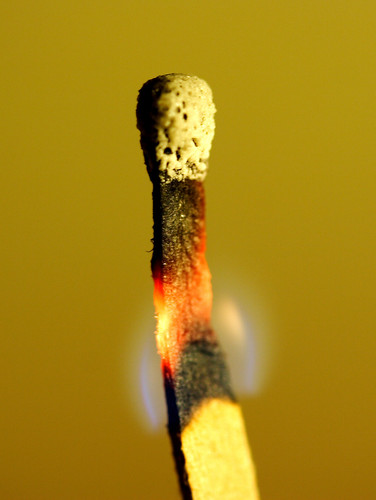
flame
Photo © Lee | Flickr/Creative Commons
[image: Photo of end-stage burning match.]
Kieran Rose
www.theautisticadvocate.com

I've struggled massively with writing this.

It's ironic really.

It's taken me six weeks to start writing an article about Autistic Burnout, because I'm going through Autistic Burnout...

If you saw someone going through Autistic Burnout would you be able to recognise it? Would you even know what it means? Would you know what it meant for yourself if you are an Autistic person?

The sad truth is that so many Autistic people, children and adults, go through burnout with zero comprehension of what is happening to them, and with zero support from their friends and families.

If you're a parent reading this, I can confidently say that I bet that no professional, from diagnosis, through any support services you're lucky enough to have been given, will have mentioned Autistic Burnout or explained what it is.  If you're an Autistic person, nobody will have told you about it either, unless you've engaged with the Autistic community.

Autistic Burnout is an integral part of the life of an Autistic person. It affects us pretty much from the moment we're born to the day we die, yet nobody, apart from Autistic people really seem to know about it.

I had some parents come to see me. It was just a chat, their little boy was struggling in school, and they were looking for some advice. Somehow we got onto talking about my own experiences at school, then onto my suicide attempt at fourteen (which I describe in graphic detail in How to hide your Autism and An Autistic Education). My story was horrifying enough to them, I imagine—but I think what horrified them most was what had led me to place in the discussion: They'd never heard of Autistic Burnout.

When I described to them what autistic burnout is, they actually recognised a recent episode where it had occurred with their son. And the more they looked back at his life, the more they started to recognise a pattern; they started to see how life for an Autistic person is really a series of peaks and troughs. They now see how frequently he has been through burnout, and how they had pushed him to keep going through each episode, unwittingly, when he had no way of communicating what was happening to him.

So, what is Autistic Burnout?

Firstly, you may have heard of something called Autistic regression. Autistic regression, which in itself is a horrible name and a terrible descriptor, is often described around the time a child is diagnosed, or as the reason to seek diagnosis.

A parent may describe the child as losing some or all of their verbal communication ability, for any person of any age they may appear more 'typically Autistic.' As a child, milestones they had passed—walking, toileting, verbally communicating, may revert back to a pre-milestone position. The name Autistic Regression is completely wrong, though, as it does not take into account that it can be—and is often—temporary, and it is part of the ebb and flow of Autistic life, caused by the impact of society and the environment the person lives in, and it is not a permanent return to a former or less developed state, as many would have you believe.

There are, in my opinion two distinct types of Autistic Burnout that feed into each other.

The first is often termed Social Burnout. This is a frequent occurrence: where just your day, just living, talking to people, being assaulted by senses, exhausts you to the point where you can only collapse in a heap at the end of the day, or at the end of the week, depending on your constitution (remember this won't be identical for everyone, but it certainly will be similar). This can happen at any stage, from infancy through old age.
The bell rings for the end of the school day, the children are filing out of school, so I duck out into the woods and light a cigarette.

I need the noise muted and filtered; the wind does that, carrying the hubbub of the end of day away from me—I'm an expert at this by now, staying downwind of noise. My whole body is tired, lead boots weighing me down, my brain slowed distinctly, reactions are slack.

A day of talking and socialising—Conversations with adults and children, timetabled and spontaneous. Running the conversational scripts in my head to full capacity all day long. 
Surrounded by noise; screaming children in the playground, shouting children, singing children, musical instruments, banging and clashing, the general commotion of the classroom; and over the top, the dumpf-dumpf-dumpf of my heart in my ears and in my chest. 
The strip lights overhead, flickering constantly in pulsing waves, each one shooting through my eyes and down through my body; I can physically feel each pulse humming and vibrating. 
A vast array of colours and patterns on the brightly coloured walls, covered with brightly coloured work. The sun glaring through forty year old, grimy windows, diffracted around the room, while a billion dust particles dance captivatingly, confusing my already overwhelmed eyes. 
And over the top of it?

Masking.

Suppressing my reaction to all of this, the urge to scream and scream and scream till I explode—wanting it all to go away. My face is still, good eye contact made, no matter how much it hurts, being touched constantly, leaving my skin feeling like it has been repeatedly pressed by a molten hot branding iron. 
It's not over yet though. 
Three quarters of an hour of tidying and prep for the next day and it's time to leave. I get a lift with a colleague as the buses are so infrequent, so I have to maintain conversation. My colleague is lovely though and can generally sense somehow when I can't speak, and a ten minute car journey often passes in a vaguely comfortable silence. It's sometimes like a tiny piece of decompression time before i get home. 
When I get home there's nobody there. Sometimes turning the key in the lock is the hardest thing to do, it's so heavy. The weight of the bag on my back pulling down.  My lead boots heavier and heavier. 
I get through the door and drop my bag. I crawl and stumble up the stairs and make it to the bedroom, collapsing on the bed without even the energy to remove my shoes, my eyes are heavy, exhaustion pulling my lids shut. 
Several hours later when Michelle comes home, she finds me and wakes me. I have enough energy to make it through the evening, just. My conversation is muted though, like when someone asks a child what they did at school and they reply with 
"Nothing." 
I want to respond, I want to engage, but I have neither the ability or the energy.
I'm 26 and I've been doing this for as long as I can remember, practically every day the same.  
The days when i can't do it, when I can't collapse in a heap, the worse it is the following day... 
Three years diagnosed and I have no idea what is going on, this is my normal.
Can you imagine this, day in and day out—this is just everyday life, and this was pre-me having children. I've got three children now and they are the light of my life, but how they have impacted my ability to recover day after day is immense. I could no longer collapse—I didn't have the capacity.

The responsibility of having one, then two, then three children led me to have to Mask and suppress even more, fight through and resist the extreme, overwhelming shutdown my brain and body wanted to go into.

This has become a sick joke to me.  When people message me and ask me how I am, my response is:

Image courtesy the author
[image: Graphic of a computer error message: A white rectangle with an
icon representing a "sad" page at the top, followed by dark gray text
reading, "Unable to connect to the proxy server", followed by smaller
underlined gray text representing a link, reading, "Details".]

Autistic Burnout is exactly that;  The shutting down of mind and body.

If you've ever had a problem with a computer and it's had to go into safe mode, that would describe what happens to the brain: it runs on limited function, not all services are available, and its access to the Internet (my Rolodex, as I described in The inside of Autism: The world inside my head) denied and unable to connect. No little white bars to indicate how strong or weak the signal is, because it's just not there.

Physically I often imagine this as the need for hibernation, where the body effectively stops all but the most important functions, the heart rate slows, and breathing distributes evenly and slowly, hovering on the precipice between sleep and death.

Except through this all, you are awake and expected to function, expected to get on and live your life, so you repeatedly go back and do the same things over and over again, put yourself through the exact same scenarios that caused you to feel like this in the first place, rinse and repeat.

Another aspect of this is that Autistic people, for some reason, possibly related to Masking and wanting to fit in, can be incredibly eager to please. Part of that eagerness, especially for those who don't fully fill the Pathological Demand Avoidance profile, is often an inability to say "No" to people.  So we take on more and more, we allow our plates to get fuller and fuller, our anxiety heightens, our sensory processing becomes more difficult to maintain, our Executive Functioning abilities spin out of control and again this attributes to burnout. We often aren't terrific at juggling plates.

Jeanette Purkis, who is an Australian Autistic, an absolutely wonderful writer and a Member of my network organisation, The Autistic Cooperative, has written an excellent piece called "‘Too Nice’: Avoiding the traps of exploitation and manipulation." In it, Jeanette says:
"There is an actual concrete reason that we tend to be taken advantage of and it starts with the difference in communication between autistic people and neurotypical people. Autistic communication is generally on one level. We are honest, up front, and do not often do things like manipulation and deceit. We generally do not lie—although many autistic people are capable of lying if they feel the need—but usually it doesn’t come naturally. 
Neurotypical people (or ‘allistics’ if you prefer) operate differently in how they communicate. Their communication tends to happen on more than one level. It can be seen as the difference between visible light and infrared light. If you can only see visible light then it is hard to imagine what infrared looks like, even if you are aware it exists."
These differences are not visible to an unaware or undiagnosed Autistic person, so it leads not only to the full plate, but offers up the Autistic person to all levels of potential abuse and manipulation through compliance. I could talk right now about Behavioural Therapies such as Applied Behavioural Analysis (ABA) or Positive Support (PBS) and how they take advantage of the Autistic being eager to please and open to manipulation, but I'll save that for another day.

I mentioned in An Autistic Education, about the fallacy of parents repeatedly sending their children into school, making the same mistake over and over again, watching their child crumble before their eyes, yet unable to break the cycle even though they can see what is happening to them: 

You have to go to work, as much as you have to go to school.

Society demands it.

Society demands compliance.

Autistic people are doing the very same thing. We repeat processes constantly which wear us down mentally and physically constantly, each day, without a break. Some undiagnosed people unwittingly develop strategies to cope with this, the Mask again, rearing it's head, but it all catches up eventually.

And all because we're made to think that we have to. 

This is what people do...

Society demands it.

Society demands compliance.

As I mentioned earlier, burnout covers all age groups. Autistic babies suffer Social Burnout as much as children or adults. Babies who do not wish to be touched, babies who are forced into eye contact, babies who are picked up and manhandled, babies who have even less of a filter than Autistic children or adults to block out the overwhelming sensory sensations they are put through.

So, if this is the every day normal for an Autistic person, to one degree or another, from birth to death, what happens after an extended period?

The second type of Autistic Burnout.

You crash, and you keep crashing.

If you imagine everything that I have described above, the shutting down of mind and body, but imagine it occurring over a period of weeks, or months, or even sometimes years.

This is extreme Autistic Burnout. It's usually the result of the day-to-day overwhelm combined with an event or trauma, or typically the weight of life building to a point where the Autistic person has to cease to function.

When I was fourteen, my Autistic Burnout was triggered by a combination of things. I'd reached the end of my tether with school—I just couldn't hack it any more, couldn't hold in the pain it was causing me any more. I was in a constant state of sensory overwhelm; I was isolated, confused and didn't know what was happening.

My Grandfather had recently died too—which was a massively life-changing event for me. 

I've mentioned that touch burns me? 

Well at that point, the only person on the planet who could touch me without it hurting was my Grandfather. Albert Ferguson was the kindest, cuddliest man I have ever known. I remember my eldest sister (who is also Autistic) and I were forever clambering over him, rubbing his shiny bald head, breathing in the smell of his tobacco and 'two fingers' of single malt whiskey. I'd lay there silent in his lap for hours while he'd regale me with regimental details, battalion names, and numbers from his time in Burma during World War II—and days later he'd test me on those details, delighted when I remembered them correctly.

When he died he left a huge gaping cavity in my heart and my mind. 

One of the worst parts was that he was hospitalised for a long time before he died—months—and I was not allowed to see him. I was desperately sad that he'd gone, but I also incredibly aware that now I had nobody to touch or be touched by. I resigned myself to a life of pain at that point, could not conceive that I would ever find anyone else who wouldn't physically hurt me.

So this combination of grief and sadness, along with the overwhelming confusion of not knowing what was 'wrong' with me, why I couldn't really connect with anyone, why people singled me out or played tricks or used me, of what the hell was wrong with me and why I just kept hitting this wall over and over again, was what led me to crash and burn out. My physical body and mind started shutting down. I could feel each system in my body closing off as gravity got heavier than it had ever been. I didn't know what to do, did not understand what was happening to me, and I had no way to communicate this.

It was like a switch had gone off, my verbal ability to convey what was going on in my mind and body was gone.

I did not want to die, I've never wanted to die.

I needed to step out. 

I needed to remove myself from the environment and take myself elsewhere;  I needed to escape.

But the only way I knew how to do that was to die. So I tried.

And what I was feeling was not depression, I know that now. 

Some researchers are starting to listen to Autistic people and are starting to recognise that clinically, Autistic Burnout shares a similar presentation to Depression, but is a completely separate thing. They are seeing how Masking, or Social Camouflaging has a distinctive lead-in to the high autistic suicide rate, and also ties into other mental health issues that are identified—sometimes wrongly—in Autistics, and also how a lack of Autism Acceptance plays a huge part in mental health too.

The lack of distinction between Autistic Burnout and Depression; In fact the lack of recognition of Autistic Burnout at all, outside of the Autistic Community, has caused many problems for Autistic people. Many who have been identified as depressed have been and still are being put in psychiatric units, psychiatric care, drugged and then have developed Mental Health issues—when really what they needed was major sensory withdrawal/stimulation (depending on the person), acceptance, understanding and rest.

I'd been taken to the doctor multiple times by my Mum, and had been on various types of antidepressants from the age of twelve, which, looking back, is actually quite disturbing—but probably indicative of a time where so little publicly and medically was known about mental health, let alone Autism.

I cannot emphasise enough how important it is to make the distinction that Autistic Burnout is a separate thing from Depression and how important it is that Autistic Burnout starts being recognised and addressed in Society.

None of this is meant to imply that an Autistic person cannot be depressed—that is not the case at all.

Along with the things that cause anybody to be depressed, prolonged burnout can definitely lead to a depressive state, as indeed can a lack of Acceptance. It is hard for that negativity to not be absorbed, especially by people who are emotional sponges and highly reflective of the emotional state of people around them.

This is also definitely not to say that a suicide attempt comes along as part of the package of Autistic Burnout, because it doesn't always. I've had periods of intense burnout where I haven't taken that measure. It is however indecently common amongst teenage Autistics diagnosed or undiagnosed; and those who are diagnosed Autistic later in life.

Recent studies show that prevalence of Suicide attempts amongst Autistic people stands at 35% of that population, with suicidal idealisation at 66%. We also know that approximately 10% of all suicides are by Autistic people—bearing in mind we only make up 1% of the population, supposedly. I would hazard that the rate is higher in reality.

I'll talk a little more about suicidal idealisation later.

***

Extreme burnout comes fairly regularly during an Autistic's life, and there is a school of thought amongst the Autistic Community that when Autism first becomes 'apparent' to parents who don't know what they are looking for and have zero frame of reference—you know, the old "They were a perfectly normal toddler, then they had their MMR..." that the child is undergoing Autistic Burnout, and that their apparent "Autistic Regression" is because they have had some kind of event—starting nursery, going to school, home life changes, something sensory—it could be anything for each individual child, some major (to them) change that has overwhelmed them to the point that their Mask (which starts establishing itself very early on) has completely dropped off.

The Mask coming off is exactly what happens during the Autistic Burnout period. Your Autistic traits become more obvious as your brain goes into Safe Mode. You may become more inflexible, your ability to 'mock' making eye contact may disappear completely, your ability to socialise may be drastically reduced or go completely, you may sleep more, want to be on your own more, and bury yourself. Life just gets significantly harder and gravity, as I mentioned before, just pulls you down more and more.
I've left my job. 
Well, my job has left me. 
I was happy there once, for a long time. Then the rumbles of change started, people losing their jobs, major restructure. 
My performance dips, I grow tardy and try to cover it up.  It's halfheartedly noticed and commented on, which just makes my anxiety worse, everyone really is too worried about their own jobs though. 
I spend day after day not doing anything, other than pretending to work, because I'm not coping. My life is spiraling out of control and all I can think about is the look of horror on my Wife's face when I tell her I'm jobless. 
The lack of communication, the vague realisation that the people you work with, the people who have actually helped make life feel sort of good over the last few years are my competition now. All of a sudden it seems like everyone is Autistic, nobody makes any eye contact with each other. 
My replacement, from elsewhere, sits opposite me, I'm to train him. 
I'm offered my job, but a long way away. It feels like the final slap in the face. They know I'm Autistic, they know I have Meniere's disease and can't go that far on the bus—what'll be a two hour journey every morning and night. 
I walk out. I ride the bus home. I go to bed. 
I don't know what to do.
Then the click. The flick of the switch. I feel it deep inside me. I recognise it with abject horror, i remember the feeling. I remember the lack of self control. My mind goes into Safe Mode. 
What to do? How do I explain this to Michelle. I clutch at my throat and my words are gone. 
They come back a time later and I'm able to tell her. 
The horror I imagined was there.

But also love, so much love in those deep brown eyes.

I was safe in them. The only eyes I've ever been able to look at.

Eyes I can distinguish the patterns in and lose myself in.

I clutched her tight and the Mask dropped off.  
I heard it slide to the floor and crack in half.
The next few months were like wading through treacle, physically, mentally, and emotionally—but equally I was wound tight as a spring. My sensory sensitivity was incredibly heightened, I couldn't tolerate noises, smells, too fast movement, anything really.

Doing the simplest of things exhausted me, and still at that point I had no real understanding of what was happening to me. I was an Autistic man on anti-depressants for the umpteenth time of my life, completely not depressed, but not knowing how else to explain it.

The truth is, I was relieved not to be at work—it gave me the opportunity to switch off, which I needed, desperately. Had it not happened I think I may have looked at the suicide option again.

As it was around nine months later I started to wake up again—my mind and body felt more alert than they had in years. 

Michelle and I have talked extensively about that period, and the period after. and she sees the difference in me. She recognises that I Masked an awful lot with her from the moment we met, despite my attempts not to, and doesn't see it as me lying to her; she understands that I was doing what I did to survive, and often unconsciously.

My period of burnout saw me unable to function really at all. I was kind of a vaguely absent father—there, but going through the motions, rather than actively engaging.

We struggled financially, I started proceedings for constructive dismissal, but was so crushed and lethargic, and the proceedings were through a Council process which was massively bent in the Council's favour, so we gave up.

I can honestly say that those months were tortuous. We came within a hairs-breadth of losing our home. I expected Michelle to ask me to leave and wouldn't have blamed her if she did. But somehow we came through it and I came out of it.

I came out as someone desperate to know what had happened to me. The pieces were falling into place that there must be a better way, there must be reasons.

So I turned online and found Autistic people. I started talking and learning, realising that ideas and narratives that had been floating around in my head actually existed and had names—things like Neurodiversity.

I found the Autistic community.

I stumbled into this world; metaphorically, my eyes shielded by my arm from the glare of Autistic gold shining back at me.

I've not looked back since.

***

I said earlier I wanted to talk more about Autism and Suicide. 

Sadly the two seem to go hand in hand.

But not all suicide amongst Autistic people is directly attributal to Depression, because not all Autistic people are depressed, as I mentioned before.

Earlier I touched upon my experience at fourteen and explained how it was less an attempt to end my life and more being backed into a corner and it being the only way to get away from the situation I found myself in.

Anecdotally, I have talked to a significant number of Autistic people about this (a few hundred) and have found that their experiences matched my own—not only in the 'why' they had attempted suicide, but also in that, like me, they are pretty much constantly thinking about ways they can do it.
The noise of the traffic is too great. 
The cars are screaming past, one of those motorbikes that sound like giant broken hairdryers is gunning its engine unnecessarily. 
The sun is glaring down upon me, the warmth is nice but the light is too bright, too strong and I don't have my sunglasses. 
A throng of people are walking round, I'm like a rock in a river with the current parting round me, but I'm being buffeted and jostled, my body is burning. 
Somehow I'm forced to edge of the street, right to the curb. 
My head is spinning, eyes feel like they're vibrating in my skull, my teeth hurt, everything is building and rising. I look up the road and see a bus coming, no chance of it slowing. 
I step in front of it. 
The world falls silent, everything slows. The bus coming towards me in slow motion, blurred with movement, feet away, inches away, the look of realisation dawning on the driver's face as he sees me, contorting into fear and horror. 
A glance back over my shoulder at the oblivious people, heads down, intent on their journey, not noticing the person about to dissolve into peaceful oblivion. 
Stepping out. 
I close my eyes, my arms open wide, embracing the stillness about to come, a world of soothing dark, comforting silence. 
I can feel the roar of the wind, the roar of the engine comes, the world kicks into normal speed and... 
I'm back on the pavement, jostled and bustled, ears assaulted with noise as the bus speeds past me.
I do this all the time and so do so many Autistic people.  Stepping into traffic, jumping off of things, taking pills, all manner of things.  It ebbs and flows, depending on what your are doing or where you are.

These are not intrusive thoughts, as such. It's almost like they are deviations on a path, where in one world you make the choice to step out and in the other you don't, but you bear witness to both those paths at once, for just a few moments—the intensity of the situation allowing you to witness a shearing of worlds, of universes, where in one you die and in the other you carry on.

We generally don't want to die.

We want to escape.

We want to step out.

The world is an overwhelming place for us—it doesn't have to be, but the way it's set up with colours, noise and lights and people and expectations makes it so.

We lose ourselves in repetitive behaviour, we Hyperfocus, we Stim, we become different characters or act as animals, we script conversations, we withdraw, we hide in worlds inside our heads, we close ourselves off, or equally sometimes explode outwards, we Mask—all in an effort to endure this world we live in, to survive, to find balance with ourselves internally and externally and also, to hide who we we are—to make Non-Autistic people accept us, because we don't find acceptance as ourselves.

This is why we burn out.

***

The warning signs of Autistic Burnout are actually quite easy to spot if you know what to look for, either from an external point of view, as an observer, or loved one or internally, from an Autistic self's point of view:
  • A growing lethargy
  • An increase in irritability
  • An increase in anxiety
  • An increase in over-sensitivity to sensory information
  • A dramatic decrease in sensitivity to sensory information
  • Heightened Auditory processing disorder
  • A decrease in verbal language
  • A decrease in text language
  • An increase in Shutdowns and heightened withdrawn state
  • An increase in the frequency and severity of Meltdowns
  • A diminished ability for the person to self-regulate their emotional state
  • The slowing down of the thought processes
  • Brain fog
  • Memory loss 
  • A decrease in your ability to effectively communicate what you want 
  • A decrease in motivation
  • An inability to generate momentum of body and of action
  • An increase of rigidity, narrowing of thinking
  • A feeling like your vision is tighter or narrower
  • Extreme forgetfulness
  • Extreme overwhelm
  • A massive increase in guilt
  • An increase in Executive Dysfunction
  • An increase in Demand Avoidance
(If you think there are more, feel free to add them in the comments.)

Can you see why Autistic Burnout is often mistaken for Depression?

Run through that list again and apply each of those thing to, firstly, a child. 

Say, one who is ten years old or younger.

How would the symptoms of autistic burnout present? You got it: Bad behaviour, defiance, lack of compliance, willful disobedience, withdrawal, self-harm, depression. Especially, if you consider that any child—across what is a huge age range—is likely unable to be able to express or communicate any of those things effectively—if at all—or why they feel the way they do, or even how they feel the way they do, especially if they are Autistic.

If you consider a teenager, who has a mess of hormones running through them, who is acutely aware of how much they stick out like a sore thumb, whose growing self-awareness—their very sense of self—is being fractured by a combination of everything they are going through in day-to-day life and everything on that Autistic Burnout warning signs list; how does it present? Bad behaviour, defiance, lack of compliance, willful disobedience? Or if they withdraw completely, they're described as Moody, as an extreme Teen, they lock themselves away and become more withdrawn, less social, less able to function. Through it all they are still unlikely to be able to communicate any of this.

Now apply both those scenarios to an Autistic person who is undiagnosed. From the outside looking in, they are behaving 'badly,' 'acting out,' or they are depressive, or angry, so they are drugged and Therapised, or treated to such delights as PBS or ABA to 'improve' their behaviour,' or they're just left to get on with it and kill themselves, or get caught in a cycle of self-harm, or get wrapped up in short bursts of highs to make them feel better, as in drugs or criminal behaviour, as they fight against themselves and how they are feeling—or all of those things.

It sounds drastic doesn't it? 

Yet it's happening every day. 

Mostly because people do not know or understand 'why.' There are a myriad of reasons so many Autistic kids (diagnosed and undiagnosed) are in the young offenders system, and then further on, Autistic adults in the Prison system.

***

So what can we do to to ward off Autistic Burnout and what can we do to mitigate it once we're in it?

Firstly, acknowledging and accepting that Autistic Burnout is a thing, and you or your child will go through it—Social Burnout pretty frequently, and Extreme Burnout at least a few times in you or their lives.

On a basic level, allowing periods of withdrawal, or decompression time at the end of the day, or even throughout the day can make a big difference. Time where the child can effectively take time to process what has happened throughout the day, shut off external sensory stimulation and basically be inside their own head for a period of time. You may also find that this helps with the level of and freqency of Meltdowns that occur. Especially if you or your child Mask and do the "Coke bottle" thing of bottling up everything all day and exploding at home.

Adults and children both need to proper time to withdraw. So even at Social events or Social Situations, having an escape plan is vitally important. A reason to leave, either completely or temporarily, a quiet space or bolt-hole to enable whoever it is to just have some time away from people.

It's really important to recognise also, that after significantly stimulating or potentially overwhelming events or periods, that the person may need a day or two off of work or school. This may not be realistic, but it is effective. Allowing this decompression time is incredibly important. It allows the Autistic brain and equally the senses, an adjustment period to reestablish whatever the person's brain or body considers normal parameters. 

If the person is of school age, then it will definitely depend on your relationship with the school and how frequently they need decompression days, but my philosophy is generally that my child's mental and physical health is more important than a day at school—if they need a decompression day, they take it. 

If I need to be fined by the school, then so be it, but I'd love to see someone try.

Work may be a little more difficult but, again, it depends on how good a relationship you have with your workplace. If for some reason you can't take a day, then taking as much free time to yourself as you can, with as minimal mental and sensory stimulation as possible is the best you can do. It won't be enough forever though.

Once you're in burnout, you need to learn to recognise and accept that you are in burnout. 

There isn't a huge amount you can do beyond throwing away that Mask as soon as possible and taking as much space as you can get with as minimal sensory input as possible. Some people find that doing hands on tasks helps them; others go for long walks, or immerse themselves in books and films.

Sometimes it drags on and on, sometimes you can see it coming and not be able to stop it.

The period I'm in now was triggered by me, if I'm totally honest.

Autism Awareness week in the UK was, this year (2018), incredibly busy for me and so was the week preceding it.

I established a working relationship with the North East Autism Society earlier in the year and they asked if my family could be their campaign—so, hours of filming, I blogged everyday, I made videos for the first time, spoke on various radio stations, we featured across several newspapers five or six times over the course of the week, plus I also had a trip down to London for the launch of the Westminster Autism Commission report on harmful interventions, plus had to respond to the hundreds of Tweets, Facebook Comments, messages and emails that were thrown at me.

All in all I threw myself into the whole week.

If you've gotten this far down this article, you can probably imagine by now what I felt like after all that. I have written the majority of this article in one day, for the last six weeks since Autism Awareness Week, I've written nothing, not a word.

As I said at the beginning, the irony being that I wanted this to be about burnout, yet didn't have the strength to write a thing.

***

The biggest thing of all you can do to prevent, or at least mitigate burnout, is to start identifying what you do when you Mask and stop.

Even just little things like eye contact, which so many of us do, or at least pretend to do.

Allow yourself not to be sociable if you don't want to be.

Give yourself permission to duck out of situations you can't cope with instead of pretending you can.

Got something important to do? 

Cut out as much of the other crap as possible—give yourself a break, go hole up in a cupboard under a blanket for a few hours, or alternatively, if you are able, go and run or cycle really, really fast (sometimes the wind rush can literally help clear away the cobwebs because so much sensory information is cut out).

A big sensory break every few days, or weeks, coupled with smaller sensory breaks throughout the day could make the world of difference to your life, or the life of your loved one.

The biggest thing of all you can give yourself, or your loved one, is time.

I've experienced Extreme Burnout probably four or five times in my life, lesser burnouts a significant number more, and social burnout pretty much daily. The biggest thing that has helped me avoid and mitigate burnout is learning about myself, and the way I have done that is by connecting with the Autistic Community.

I have learnt to understand the 'why' of why I react to certain things in certain ways, I've learnt to understand 'how' to best avoid certain situations or to shield myself from them with Masking.  I've been supported into learning how to Accept myself and shuck off, to a certain extent what has been thrown at me.

Autistic people have the tendency to want to pull people together because of their similarities, not push them apart because of their differences; we are accused of wanting to be solitary, of not wanting to be around people, when we have one of the strongest Communities I have ever witnessed.

The Autistic community is there waiting to be accessed by Autistic people and their families alike; a font of deep knowledge, a library of cross-referenced and correlated information about Autism, that you will not find coming from an Autism 'Expert' or 'Professional' and you will certainly not find in the DSM 5 or ICD 10/11.

Autistic Burnout is one of those things you will not learn about from Professionals, yet Autistic Burnout leads to death. How horrifying is that?

So please, play your part today and help yourself, or your Autistic loved one to recognise it and take appropriate steps to stop it.

Help save a life.

I'm coming out of my burnout period. I feel like mentally and physically the fog is lifting—I'm starting feel like gravity is slightly less effective than it has been, I'm still exhausted and have been sleeping sometimes 14 hours a night—which is bizarre for the person who has spent his whole life averaging four to five hours a night, and actually has made me more tired than refreshed I think!

I know the burnout is coming to an end because I'm writing again. It's taken me six weeks of staring at a computer screen and writing nothing. Yesterday I wrote most of this in about three hours. I'm on an upward trajectory again and it feels good. Still not quite there though, my Executive dysfunction is still playing merry hell—I've been tinkering with this essay now for five days!

Sometimes knowing what you are experiencing makes the experience less frightening and easier to manage, and offers you a level of control over the situation. Expecting that burnout will happen helps too.

If society changed to accommodate Autistic people, our lives would be a lot easier. Instead though, for the most part we are still expected to change ourselves completely or play catch up—so if there are ways where you can make your life easier, and not damage yourself in the process as with Masking, then I recommend you do them. There is rarely support for this, except from Autistic people, or if you're lucky enough to have understanding family—so self-care is your priority.

A key thing to remember here, because there are proponents of a theory that much of what is identified as Autism is actually the descriptor to a response to lifelong trauma, and I know that much of what I write here could be seen to be backing up that theory:

As a disclaimer: That theory could not be further from the truth. Trauma does play a huge part in the the Autistic upbringing and life, but that feeds into Anxiety. Autism itself is determined by Neurology. Our Neurological functions are different from birth, our brains work differently. Trauma does not play a part in shaping our basic Neurology; trauma plays a part in shaping our personalities. Autism is Autism.

Autistic Burnout is real. It exists.And it plays a huge part in taking our lives.

Repeated short term burnout is completely unsustainable and has huge long-term implications.

So please, whatever you do, take care of yourself.

Kieran.

***

Some other links about Autistic Burnout:

The wonderful Amythest Schaber: What Is Autistic Burnout?

The brilliant Ryan Boren: Autistic Burnout: The Cost of Coping and Passing

The excellent Judy Endow: Autistic Burnout

----

SUICIDE RESOURCES

Anyone who is feeling suicidal may receive immediate help by logging onto Suicide.org or by calling 1-800-SUICIDE. Suicide is preventable, and if you are feeling suicidal, you must get help. So please visit Suicide.org or call 1-800-SUICIDE immediately. Please also know that you are not alone.

MHAutism, which focuses on mental health for autistic people, has developed a Safety Plan, which allows those who are vulnerable to plan for when and if they experiencing suicidal thoughts, and also to record information to help other people provide supports.

For autistic people seeking specifically autistic perspectives, please read our archive posts below. While aimed towards younger people, they discuss getting through the kind of tough times familiar to autistic people of any age who have been conditioned into negativity:
----

A version of this article was previously published at www.theautisticadvocate.com. 
Share:

Autistic Commonality and the Illusion of “Quirky”

Emily Paige Ballou
chavisory.wordpress.com

Some people insist on describing the autistic spectrum as ranging from the non-speaking and very profoundly disabled, to the “just quirky.” Or, during discussions about the need for acceptance and accommodation, the same people might tell autistic self-advocates, “That may be fine for autistic people like you who are just quirky, but you're not like my child.” Some of those same people even insist that autistic people who are “just quirky” should probably have a different label than 'autism' altogether.

Meanwhile research shows "camoflauging" influences autistic suicidality
[image: Screenshot of a tweet. The icon and user name are blurred. The tweet
reads, "If u can"disguise" your autism then imo u cannot possibly have autism.
#NeedRealDiagnoses #SuckItGroupingEveryoneUnderOneLabel
#FocusOnObjectiveReality"]
But I actually wouldn’t mind if the word “quirky” were to disappear entirely from autism discussions, and take with it the dismissive and simplistic idea that autism is a condition with only two manifestations—the genuinely disabled, and the "just quirky."

Because no autistic person is “just quirky.”

Autism has specific diagnostic criteria. Though these criteria have changed and broadened since autism first appeared in the DSM in 1980, the more important changes leading to autism's diagnostic explosion hinge on discrediting outdated and invented prejudices about who can and can’t be autistic. At various times, it has been believed—implicitly or explicitly—that people who could not be autistic included adults, women and girls, people with intellectual disabilities, people without intellectual disabilities, people of color, children who ever spoke, children who toe-walked, people with ADHD, and people with virtually any other identifiable anomaly of brain physiology.

That is a lot of autistic people who were simply excluded from diagnosis by completely arbitrary factors having little to do with the nature of autism itself.

And while it is reasonable for people to debate about exactly what form autism diagnostic criteria should take, “quirky” has simply never been among those criteria.

No one is diagnosed with autism on the basis of being “just quirky.” That’s a characterization far more likely to be used to deny a diagnosis to women, girls, female-presenting and gender non-conforming people, as well as those who don’t fit other common stereotypes or more conventionally accepted presentations of autism.

When I’m talking about our need for acceptance and respect as autistic people, I am not talking about being quirky. While I do have traits that I suppose could fairly be considered “quirky,” like an affection for knee socks and collage art and eating breakfast food for dinner, those are not what I’m talking about when I’m talking about being autistic.

When I’m talking about the challenges posed to me by inertia and task-switching and significant motor planning issues, I’m not talking about being quirky.

When I’m talking about whole-body nervous system pain from sensory overload, I am not talking about being quirky.

When I’m talking about language processing differences that can leave me feeling like I’m speaking English as a second language compared with NT peers, and that I can command the physical and mental effort required for speech for a cumulative maximum of two hours per day under most circumstances without becoming physically ill, I am not talking about being quirky.

When people use “the voice” on me, treat me like I’m invisible, or grab things out of my hands at work, that doesn’t happen because I’m quirky.

And I’m sure not talking about being quirky when I describe being pushed into meltdowns by disruptions to my routines or expectations, or that I grew up to feel not even human or maybe not even real, because I had no other explanation for why I wasn’t like everyone else and everything was so hard.

When people don’t believe me when I say I can’t do something they think should be easy, I don’t think that’s because I’m quirky.

No, it’s because I’m autistic.

This doesn’t mean that I’m exactly like every other autistic person, but no person is exactly like every other person in a designated group, autistic or not. All humans, and all humans of various identity groups, have important commonalities as well as whole constellations of different abilities and challenges of varying intensity.

The DSM defines autistic people as having commonalities in social communication issues, restricted interests, repetitive behaviors, and impairments in adaptive living skills. Autistic people, and some of the better autism research starting to emerge, are like to consider those issues as resulting from core processing differences in how the brain governs factors like movement, sensory feedback, executive functioning, and atypical experiences of language.

What autistic people tend to share are those autistic commonalities. What is decidedly not the case is that autistic people with very profound support needs in every aspect of daily life have somehow been arbitrarily assigned to the same diagnostic label as people who are "only" socially awkward.

Autistic people are autistic because we display a common, distinctive pattern of observed challenges across a range of domains. While I think the DSM-5 currently does a poor job of conceptualizing the core features of autism coherently (and that probably contributes to much of this present confusion), many autistic people experience, and conceive of, those observed features as resulting from a deeper stratus of physical and cognitive experiences of the world.

And many of those perceptual experiences are described remarkably similarly by people all across the spectrum. This means that while the expression or “severity” of our challenges as autistic people may vary widely, but the underlying reasons for those challenges often prove similar.  That is why a person who lives with minimal support needs, holds down a job, and sounds “articulate” to your ears, may in fact have the very same disability as someone who needs a high degree of support, cannot speak, or whose movement differences are very apparent.

So, although, for instance, while Leo and I are very different in some important ways, the way his mom describes his physical intelligence and tactile engagement with the world is very familiar to me.

Mel and I are different in important ways, but when sie describes autism in terms of the ecologies of cliffs and valleys, that is very familiar to the way in which I actually experience it.

Julia and I are different in important ways, but when she describes what it’s like to see “someone who moves like you,” that is a feeling with which I am intimately acquainted.

I will never forget when, shortly after I’d been diagnosed and started connecting for the first time with both autistic and parent blogging communities online, the mother of a young man with very extensive verbal communication difficulties described instances when he would suddenly seem sad or even start crying, seemingly for no reason in his present circumstances she could discern or that he could describe. She was wondering whether it could be that he was simply in the grip of a memory so powerful that its emotional intensity was completely overwhelming.  And a whole chorus of about half a dozen autistic adult women—all of us able to communicate in writing, some of us with things like jobs and marriages—replied that yes, that’s something most of us had actually experienced.

An autistic person who has an autism diagnosis had a professional believe they should have that diagnosis for good reason. It’s not that misdiagnoses never happen, but—particularly for those who aren’t white and male or don’t conform to other stereotypes—it is not a particularly easy thing to convince a professional that one is autistic, without substantial proof. Autistic people are, troublingly, more likely to have professionals tell us they “don’t see it” if we’re into English literature or art instead of math or computer programming, or if we display emotion or empathy.

It’s okay to look at one autistic person and not necessarily understand how their experiences compare to those of another autistic person you know. It’s not okay to dismiss that first person's lived experience as having nothing to do with “real” autism simply because you don’t understand what autism is like for them.

In fact, listening to autistic people who have different experiences from the autistic people in your life might present a great opportunity to become more familiar with a wider variety of autistic experiences.

But please know: when I am talking about being autistic, I am not talking about being quirky. If you are, then we are not talking about the same thing.
Share: