Showing posts with label stress. Show all posts

Autistic Burnout: An Interview With Researcher Dora Raymaker

Dora Raymaker is a researcher, writer, and artist based in Portland, Oregon. She is co-director of the Academic Autism Spectrum Partnership In Research and Education (AASPIRE) with Christina Nicolaidis. AASPIRE is currently running a pilot study on autistic burnout and suicidal behavior. Autistic people have often talked about burnout, and it emerged as a major theme in their previous study on autism and skilled employment, but up to now, it has received limited attention from researchers.

Fergus Murray interviewed Dora for Thinking Person's Guide to Autism.

Photo courtesy Dora Raymaker
[image: Dora Raymaker, a white person with
curly shoulder-length red hair with one teal
lock, glasses, and a steady gaze.]
FM: Could you summarise what autistic burnout means to you?

DR: The question evokes for me the impacts of autistic burnout on my own life, like "it means feeling my abilities and successes slip away and being powerless to stop it..."

But I think it is more asking, "how would you define autistic burnout?" I think that's an important frame for the rest of the conversation. We're still a finalized-analysis away from coming up with a definition grounded in research, but a fair start at an operational definition might be, "A state of pervasive exhaustion, loss of function, increase in autistic traits, and withdrawal from life that results from continuously expending more resources than one has coping with activities and environments ill-suited to one's abilities and needs." In other words, autistic burnout is the result of being asked to continuously do more than one is capable of without sufficient means for recovery.

FM: There has so far been very little research on autistic burnout, although it is something autistic people have been talking about for a long time. Why do you suppose that is?

DR: Autism research, until fairly recently, has been mostly directed by non-autistic researchers, professionals, and family members whose priorities may be different from, or not fully inclusive of, the priorities of autistic people. Add on top of that a still-pervasive medical model of autism in the research world (disability as a disease to be cured, rather than disability as a divergence to be supported) which makes it even harder to get through the barriers between what we've been talking about wanting and what autism research is actually examining. This is a complicated topic I could probably spend the whole interview on, so I'll stop my geekery about it there, LOL.

Anyway, I'm hopeful that we'll have more research about autistic burnout (possibly disability burnout?) in the future. Autistic people have more voice in research than we used to, from the policy level to the participant level. Also I'm anticipating the surge of work into connected topics, such as camouflaging and mental health, will bring autistic burnout more into the awareness of the research community.

FM: How do you see the relationships between burnout and other experiences often reported by autistic people—meltdowns, shutdowns, sensory overwhelm, and catatonia?

DR: These other experiences are distinct states from burnout, but people report experiencing them far more often when also in a state of burnout. If we consider autistic burnout as a reduction in resources to cope with activities and environments that were already difficult—including by camouflaging and all the negative consequences of that—then it makes sense that a person would be left with less ability to tune out sensory stimulus, breathe through their trauma-reaction, or otherwise avoid the triggers for these other states. Nearly everyone we've spoken with in our research cited increased instances of these experiences as a consequence of the burnout.

FM: Have you been able to show what some effective strategies for coping with or avoiding burnout might look like?

DR: We asked people in our interviews what strategies helped them avoid or recover from burnout. We also looked at social media, where people have been sharing strategies. The community has also been compiling this information, and there are some good resources out there, like this guide from Autistic Women and Nonbinary Network (AWN). I recently did a talk at Seattle Children's Hospital on the research, and the slides from that talk also list a number of the strategies. You can get the slides here, and the talk should be available on YouTube at some point. Until then, it was recorded on Facebook, and you can view it there.

The tl;dr version: being accepted for who you are as an autistic person and supported by others, being able to act autistic and do things that fuel you (like engage in special interests), taking time off, and having a reduction in expectations to do things in the same way as non-autistic people are some of the primary things that help.

FM: Many autistic adults report that they only realised they were autistic (or only received professional help) after experiencing burnout. Some may have talked to specialists before this, and been denied a diagnosis because they were not seen as sufficiently impaired. Do you think it might help some people to avoid burnout, if it was easier to be formally identified as autistic without insisting that someone's autism must 'limit or impair everyday functioning'?

DR: Yes, absolutely. Even just realizing that you're probably diagnosable could be helpful, because it gives you access to community wisdom, and the strategies people use.

However, if the dynamic of autistic burnout really is related to spending more resources coping than one has, I'm not sure the real leverage in avoiding burnout resides with the autistic person alone. Especially because a number of the strategies people have to avoid or recover from burnout involve being able to act more autistic, being accepted as autistic, and getting support and accommodations--all things that require the cooperation of others. So we need to also be looking at ways to make neurodivergence more accepted and less stigmatizing, as well as ways for services to become more inclusive of supporting autistic people who appear to be "functioning well." Knowing you're on the spectrum, alone, isn't, in my opinion, going to fix this.

FM: Some have suggested parallels between autistic burnout and Chronic Fatigue Syndrome. Do you think this is likely to be a fruitful connection to explore in future research?

DR: I'm not a clinician and don't have interest in clinical research. However, there are clinicians like Christina on my research team. Her impression from descriptions of autistic burnout are that it's likely a different thing from CFS (although one could certainly be experiencing both), and that addressing autistic burnout directly is probably going to help more people than looking for a possible relationship between it and CFS. That said, it could be research for someone else with interest in that area to explore.

FM: You’ve completed the first stage of your study, interviewing ten autistic people about their experiences of burnout. Did any surprising themes emerge in these interviews?

DR: Since many of the people on our research team have been part of the Autistic community for years where autistic burnout is frequently discussed, I’m not sure that there were any particularly surprising themes to us. One of the themes that might be most surprising to the general public is that some things they might think are good for autistic people—learning to emulate mainstream social behavior, appearing to “overcome” autistic traits, things like that—may actually be hurtful in the long-term. I think it makes sense if a person thinks about it—if you were asked to pretend to be something you’re not constantly out of fear of negative, possibly life-threatening consequences, and it was very difficult to do, how long could you keep it up? I think it might surprise some people how close autistic burnout is in a lot of ways to professional burnout, or to caregiver burnout, or something else that they might have experienced themselves.

FM: You plan to develop tools to measure burnout in the second part of your study. How might you go about measuring something like that—and what sorts of uses do you foresee for it?

DR: Measurement is a whole field of research in itself. This study is using a mixed-methods approach to create a survey. That means first we’re doing this qualitative part to understand what ideas, or “constructs,” might need to go into a survey to measure autistic burnout. We’re putting together the symptoms of burnout that people talked about in their interviews, on the blog posts, in the community to create a draft of that measure. Then we’ll be trying the survey out with a small number of participants. They’ll take the survey, along with some additional surveys, and be able to give some written feedback. We can then run statistics on the results to start validating the measure. We can learn things like, does the survey contain the right constructs? Do the sections of the survey group together well? Is there an expected relationship between scores on the autistic burnout survey and another survey; for example do people with high burnout scores also have low self-efficacy scores (since people in our interviews talked about a loss of self-confidence when in autistic burnout)? These are all parts of validating a measure. Then we refine the measure and test again.

As far as uses, there are many. Two big ones related to the work I’m most interested in are: 1) It can be used to tell if someone is experiencing autistic burnout, which could then change how services or supports relate to that person; 2) If anyone creates an intervention, or a program of some sort, to help prevent or relieve autistic burnout, a measure will be needed to know if the intervention is working; in other words, you need to be able to measure it to know if you have changed it.

FM: What’s next for AASPIRE?

DR: A lot! We have multiple projects, including our ongoing work on issues such as healthcare and employment, and a new branch of AASPIRE starting up in Australia. You can visit aaspire.org to see some of what we’re up to. As far as the burnout research, the next steps after finishing up this study are 1) to publish papers in the academic and clinical literature to start getting the word out, and 2) to apply for new funding to further test the measure and begin exploring further how autistic burnout impacts people’s lives, so that we can start working toward creating an intervention to prevent or relieve it—as well as giving others tools to do the same.
Share:

The Protective Gift of Meltdowns

Maxfield Sparrow
unstrangemind.com

Photo © 2017, Maxfield Sparrow
[image description: a turtle in the middle of the road on a hot, sunny day.
His skin is dark with bright yellow stripes and his shell is ornate,
covered with swirls of dark brown against a honey-yellow background.
The turtle is rushing to get across the street and his back leg
is extended from the speed and force of his dash toward freedom.]
I hate meltdowns. I hate the way they take over my entire body. I hate the sick way I feel during a meltdown and I hate the long recovery time—sometimes minutes, but just as often entire days—afterward, when everything is too intense, and I am overwhelmed and exhausted and have to put my life on hold while I recover.

I hate the embarrassment that comes from a meltdown in front of others. I hate the fear that bubbles up with every meltdown. Will this be the one that gets me arrested? Committed? Killed?

Meltdowns, Like Shutdowns, Are Harmful But Necessary

We Autistic adults and teens put a lot of energy into figuring out what will lead to a meltdown and working to avoid those things whenever possible. Parents of younger Autistics also put a lot of energy and work into figuring these things out, both to try to keep triggering events out of their child’s life, and to try to help their child learn how to recognize and steer around those triggers themselves. Outsiders who don’t understand autism will make accusations of being overly avoidant and self-indulgent, and accuse our parents of spoiling and coddling us.

I have written about how shutdown can alter brain function in unwanted ways. Meltdowns also have their dangers, and can alter brain function over time. A meltdown is an extreme stress reaction, and chronic stress can damage brain structure and connectivity.

But meltdowns serve a purpose, just as another unpleasant experience that can also re-wire the brain if it continues chronically and unabated—pain—also serves an important and very necessary purpose.

Pain is an alarm system that helps us avoid bodily damage, and urges us to try to change something to protect our body. While pain is usually unwanted and something we seek to avoid, without pain we would not live very long because we would not have such a strong drive to eliminate sources of damage to our bodies.

Meltdowns are alarm systems to protect our brains.

That idea is so important I gave it its own paragraph. And I’ll say it again: without meltdowns, we autistics would have nothing to protect our neurology from the very real damage that it can accumulate.

So often, I see researchers and other writers talking about meltdowns as if they were a malfunction or manifestation of damage. I strongly disagree. It is easy for an outsider to view a meltdown that way, because all they see is an unpleasant outburst that makes their lives more unpleasant or difficult. They see someone who appears to be over-reacting to something that they don't consider such a big deal. They see someone "immature," someone who needs to grow up, snap out of it, or get a “good spanking” to teach them to behave.

When a person doesn’t themselves experience the hell of having a meltdown, that person can easily misunderstand and misjudge what it actually happening.

Meltdowns Are A Normal Response To Sensitivities

Let me ask you something (this is a thought experiment and you don’t have to actually do this, but you might understand me better if you follow along physically): Take your finger and poke the softer flesh on the inside of your thigh with it so that you are pressing the tip of your fingernail into your thigh. Don’t actually damage yourself! You’re just looking for a reference sensation. Poke it about as hard as you might press a button to ring someone’s doorbell.

If you have long, sharp fingernails that might have hurt a little bit (I hope you were careful. The goal here is not to injure yourself—just to create a physical sensation.) It was a quick poke, so it probably didn’t even leave a mark behind, no matter how long your fingernails are.

Now do the same thing to your gums, either above or below your teeth, in that area between your teeth and the inside of your lips. Oh! You couldn’t even poke it as hard, could you? (Do be gentle with your gums, please. I repeat, this is not about harming yourself. You don’t even have to poke yourself at all if you don’t want to. You know your thighs and gums.) You know, without lifting a finger, that I am telling you the truth when I say your gums are much more sensitive than your inner thigh.

And you are not “over-reacting” when you have more pain response in your gums than in your thigh, right? It’s easier to hurt your gums, so your reaction to the same stimulus is much more intense when it is applied to your gum than to your thigh. You are not self-indulgent or spoiled. You don’t need a good spanking to get over how sensitive your gums are. You just need to take extra care that things don’t poke you in the gums.

So what’s my point? If you are not Autistic—and even more so if you are pretty close to neurotypical —your neurological wiring is more like your thigh. Life pokes at you a lot, and you don’t even notice it. Much of life’s poking is fun for you. Some pokes are less recreational, but present satisfying challenges. So when you see an Autistic person having a meltdown you might not even recognize the pokes they have been processing all day long, because you as a non-autistic person don’t even feel them.

But our Autistic neurological wiring is more like your gums, except not even that predictable. Some of our senses may be “hyporesponsive,” and we need to stimulate them to be aware that they are even functioning. Some of us spin around, or pace in circles. Some of us move our hands or fingers in ways that make us feel better. Some of us blast loud music with a heavy bass and drum component to it. Some of us rock back and forth. Our wiring demands more input than the world’s regular pokes can give us.

Some of our senses are “hyperresponsive”  and we need much less stimulation. Life’s pokes are like fingernails grinding into our gums and we need to make it stop because we cannot bear the pain. Loud sounds or high-pitched sounds get to some of us. Others are overwhelmed by the struggle to understand speech when more than one person is talking at the same time. Some can’t stand textures of fabrics, or foods.

Most Autistic people I know experience a complex mixture of hyporesponsiveness and hyperresponsiveness. Most have some senses that are both hypo and hyper responsive, changing over time. I can’t give you any single idea of a sensory pattern for an Autistic neurology, because we each have our own combinations of needs.

Normal Human Variation Includes Variant Emotional Sensitivity Levels

But when it comes to meltdowns, it’s not just sensory input (or lack thereof) that will set off an Autistic’s neurological warning system and throw us into meltdown. What inspired me to write about this topic was reading something I had written last year, after spending a few months living in an emotionally abusive situation. The man I was living with figured out very quickly how to manipulate my compliance triggers; he even commented specifically on how easy it was for him to physically subdue me once he spotted the compliance “fish-hooks” that childhood had left embedded in me.

I’m not going to go into much detail about what he did, for the same reason I shy away from going into much detail about my decade of childhood therapy: I am working on removing those hooks from my flesh. The last thing I want to do is instruct others as to where those hooks are embedded, and how to use them to steer me like a puppet.

My only point in mentioning my abuse is that I realized—after the fact—that my meltdowns had been sending me a very clear message, one I should have heeded immediately. Instead, I did what I always do: I interpreted my meltdowns as a sign of how damaged I was, and how much I needed help to gain self-control. Most of my life, I’ve allowed lovers to convince me to try to medicate my meltdowns into submission. I hated those meltdowns, because they seemed to illustrate how flawed and awful I was. My thought process went like this: I melt down because I’m Autistic and meltdowns are frightening and horrible and who would want to be my romantic partner? I can’t blame people for treating me badly and wanting to get away from me, because look at these meltdowns!

My experience last year helped me to finally realize that I was looking at things backwards.

I don’t melt down because I’m Autistic.

I melt down because something in my environment is intolerable, and I am having a normal reaction of pain and/or anxiety. That pain can be from something physical, like an intolerable temperature in the room or a sound that is piercing my eardrums and making me nauseated. Or it can be something emotional, like internal feelings of frustration or external abuse.

Everyone has meltdowns. It’s not just an Autistic thing. But our wiring is different, just like the wiring is different between your thighs and your gums. Some things that make neurotypicals meltdown don’t bother me. A whole heaping lot of things that don’t bother neurotypicals make me meltdown terribly. I’m not deficient in some way; I’m wired differently.

Meltdowns Protect Us From Harmful Situations and People

One of the things I learned last year is that, even when I can’t recognize abuse because I have alexithymia, and even when I can’t recognize abuse because my compliance training is kicking in full-force, my body and nervous system will send me the message via repeated meltdowns.

What I wrote a year ago:
"If I have lots of shouting, freak-out, PTSD meltdowns when we spend time alone with each other, yes it’s an Autistic thing. But it also means you’re regularly doing something messed up. 
"An isolated meltdown could just be a random convergence of awful that has nothing to do with you, but if a pattern develops, you’re probably gaslighting me, mistreating me, abusing me, or generally taking nastily unfair advantage of that same Autistic neurology that makes me unable to recognize I’m being abused or mistreated until I see the pattern of meltdowns. 
"All my life I’ve been told, and believed, that losing my shit was a personal shortcoming I should work to overcome. 
"I now realize it’s actually my body/brain’s alarm system letting me know something’s seriously wrong in my life. Something bad that needs to be fixed, like yesterday, if not sooner. 
"I finally realized all this today. Everything suddenly connected. 
"And in an instant, I no longer hate my meltdowns. I think I might actually love them. They protect me.
So… I still do hate meltdowns. More specifically, I hate having meltdowns. They are hard on me, physically and emotionally. They are embarrassing, messy, frightening.

But I am grateful that my body has a way to tell me when I’m in a bad situation, even if my mind is not capable of figuring it out yet. I vow to respect and honor my meltdowns. This is not the same as excusing my behavior. This is not the same as giving myself free reign to do whatever, whenever.

I still want to do whatever I can to avoid having a meltdown. I still want to work on my ability to detect a meltdown on the horizon, and remove myself to safety before things go too far.

But I also vow to listen to my meltdowns and pay closer attention to my triggers. Meltdowns teach me what my nervous system can handle and what is too much for me. Meltdowns teach me how to take care of myself. Meltdowns teach me what my nervous system needs. Meltdowns highlight areas of my life that are not on track.

Sometimes my depression shows me that something is wrong in my life, but sometimes depression is just like a wildfire, burning out of control. The same is true of my anxiety. But I have learned that meltdowns are always highlighting something I need to address.

Meltdowns protect me. Some aspects of my neurology make me more vulnerable. Some remnants of childhood experiences leave me more vulnerable. Meltdowns fill that gap and send me messages about my life that can help me protect myself.

While I will never enjoy having a meltdown, I promise I will always value the protective gift meltdowns bring me
Share:

Why Do So Many Autistic People Flap Our Hands?

Maxfield Sparrow
unstrangemind.com


[image: rainbow colored hands in silhouette,
upraised and reaching out with joy.]
The saying goes, “if you’ve met one Autistic person, you’ve met one Autistic person.” That was really hammered home for me today as I watched a short video in which an Autistic man explains why Autistic people flap our hands … and pretty much nothing he said matched up with my own experience. A few of the things he said even bothered me.

My intention is not to erase what he said, however. His view of why he used to flap his hands is just as valid as my view of why I still flap my hands. There are many ways of being Autistic.

(Since the video was not captioned, I took the time to make a transcript of it for those who can’t hear or understand it. That was fortunate as the original video was removed from YouTube.) The video explains,
“It comes down to repetition. When we, as people with Asperger’s, are in a really unknown situation or we’re in a situation where there’s a lot of anxiety […], there’s a lot of stress, the way that we manage that, is because generally it’s overwhelming we do repetitive motions, because then we at least know, hey, if I do this I have complete control over it. And I know that whatever I do, I have complete control and it’s going to happen the same time every time. Therefore, I get a little bit of comfort from it.”
This does not even begin to describe why I flap my hands or make other “Autistic movements.” Yes, I flap in stress. I flap in overwhelm. I flap when I get hurt. The video presents hand flapping as if it only occurs as a result of stress or anxiety, however, and that is not at all true for me.

I flap my hands when I am happy. I flap them when I am content. I flap them a lot when I get excited about something. I have as many different ways of flapping and twisting and ruffling and fluttering my hands as I have emotions and emotional combinations that wash over and through me. My hands are like barometers of my emotional climate.

There are plenty of things I do to try to increase the amount of control in my life, but flapping my hands is not really one of those things. I don’t flap my hands to have something reliable and constant in my life. I fill that need with other things, like small stuffed animals I carry in my pocket or ritual ways of doing certain things. For example, there is a little ritual to how my boyfriend and I say good night in the evening and that ritual comforts me, gives me a sense of stability and predictability in my life, and helps me to make the transition from visiting with him to being alone again. I do other things like always removing the ice cube trays from the freezer in the same order, always putting the same number of ice cubes in my glass, always walking or bicycling the same route to get places, always brushing my teeth for the same number of minutes every night, and so on.

These things serve my need to have a predictable, orderly world that is under my control as much as possible. The more I am able to feel a sense of control over my life, the calmer and happier I am. I suspect this is true for most or all people, but it is quite extreme in my case. Something small, like not getting my usual seat, or having the water turned off for twenty minutes in my apartment building in the middle of the day with no warning, can make me feel like my world is coming to an end.  I am always fighting back the forces of chaos. But I do not wage this war with hand flaps.

The most common reason for me to flap my hands is that I am very happy and excited about something. My boyfriend told me that he loves to see my hands flap because there is a lovely joy that goes along with it that is fresh and appealing, without guile or artifice. If I recall correctly, he used the word “childlike” and meant it in a beautifully loving and respectful sense. Over the month of December, we went through a Jacquie Lawson advent calendar together every morning right after having breakfast together and he got to see lots of hand-flapping on the days when the calendar surprise was a steam locomotive or a peacock spreading his bright tail feathers, or a mansion kitchen staffed entirely by giant teddy bears.

I’d see these things that made me really happy and excited and there would go the hands. By the time I was aware that I was flapping my hands, they’d already been going wild all on their own without my awareness. My hand flapping is so often an expression of sheer, unadulterated joy—pretty much the exact opposite of what is being taught in the video, when Asperger Experts says, “it’s basically a giant signal saying, “hey! I’m not comfortable right now. Things are too much pressure or too much, just, overwhelm of sensation to the point that I need to do something to feel better about it.”

Yes, I can feel pretty overwhelmed by joy! But the kind of flapping I do when I’m not comfortable and suffering is another kind of hand flap. It’s a whole language of flaps and twists and shifts and strokes and claps. My hands speak my emotions so clearly, but only to those who are willing to learn what they are saying. My hand flapping is not a single message of suffering. It is a multi-faceted expression of my complex and beautiful emotional life.

As an alexithymic, I’m not usually aware of my emotions. So I even watch my own hands flapping away to help me understand what emotions I’m experiencing. I am “blind” to my emotions—I have emotions, usually very strong ones, but I am unable to know what I am feeling so I have to play detective and watch my body for clues.

My hands are always telling me what I am feeling. Without my hand flaps, I would not be anywhere near as connected to my inner life. Without my hand flaps, I would struggle so much more every day, just trying to understand what my body and spirit were experiencing. My hands are my teachers and they educate me about my deepest self every day.

While I feel as if my three-dimensional experience of hand flapping is described in a very one-dimensional way in the video, that’s not what really bothered me about the message. I was bothered by the way hand flapping was presented as something bad, undesirable, ridiculous looking, and mainly restricted only to small children. The video admitted that hand flapping is necessary, but presented it as something annoying and embarrassing that should be substituted as quickly as possible with something less visible, like repetitive thoughts:
“You shouldn’t just try to stop it because then they’re just going to find some other way of gaining comfort. […] All of a sudden, they might gain a tic, like [clicks tongue several times] and then that’s just even more annoying.”
No.

You shouldn’t try to stop hand flapping because it is part of who we are. Would you like it if everyone were trying to make you stop smiling? Or tucking your hair behind your ear? Or putting your sunglasses on top of your head? Or crossing your legs when you sat? That is what people are doing to us when they try to make us stop flapping our hands: they are trying to force us to stop moving in ways that are natural, healthy, and comfortable to us.

(And when I say “we” and “us,” I mean those of us who do flap our hands or otherwise naturally move in different ways from the rest of society. Not all Autists move in the same ways and that includes the fact that not all of us rock or flap or spin (although the vast majority of us do) so don’t assume someone is not Autistic because you don’t see them moving in different ways. Or they speak. Or hold a job. As I always say, there is no one way of being Autistic.)

The Asperger's Experts video presents hand flapping as a necessary evil—something that is annoying but has to be tolerated because we do it to soothe anxiety, and might end up doing something even more annoying if we’re forced to stop. In my opinion, hand flapping is a fundamental manifestation of the native nervous system of those who flap. It is how we are built, it is what we do. The focus should not be on whether it “might look ridiculous” or whether it’s better to “[transition] into listening to the same song over and over again, [or]  say the same thing in [one’s] mind over and over again.” the focus should be on building a society that understands that we don’t all move our bodies the same way and that’s okay.

“You know, you don’t see many people that are forty doing this [waves hands].” I am fifty and I flap my hands. Many of my friends who flap their hands are older than me. I know people in their twenties, thirties, forties, and fifties who flap their hands and even someone in his seventies who flaps his hands. It’s okay to move differently from others. It’s okay to have a different neurology and it’s okay to be who you are.

There is a much worse risk that comes from trying to suppress hand flapping than developing an “annoying tic.”

When I was a child, I felt like there was no place that was safe, no place where it was okay to be who I am, no place where I could just relax and be myself. Everybody was trying to give me the advice of “just relax and be yourself,” but when I would actually do that, I would be yelled at, criticized, punished, bullied. I lived in fear and anger because nothing I did, no matter what, was ever right or good enough. At school, I was bullied by the students and even by many of the teachers.

At home, I was blamed for the bullying and told I was bringing it on myself. In a misguided attempt to shape me into someone who would not deserve to be bullied so much, all my mannerisms and stims and quirks were under attack. I felt like I was constantly picked apart for behaviors like walking on tiptoe, clearing my throat, flicking my fingers, spinning around, talking too loudly, grunting instead of talking, and so on. I spent … wasted … so much energy and focus on trying to make my body and face and voice do all the proper things. But no matter how hard I tried, I kept always doing something wrong, and getting called out for it.

As a result, I was filled with so much anger toward everyone around me and so much self-loathing. I felt like nothing I did was ever right and I had no place to relax – school was filled with bullies and home was filled with picking apart my stims. I grew to hate everyone and often would lose myself in bitter daydreams with imagery I don’t care to re-visit now. My whole life was torment and I was in agony. This is the reason to let Autistic people be, not the fear that they might develop new behaviors that are even more annoying to the people around them.

The Asperger's Expert video’s reason for tolerating hand flapping was all about what makes other people feel okay or uncomfortable and had almost nothing to do with what the Autistic person wants and needs. Hand flapping almost had to be defined in that very one-dimensional manner, because if hand flapping is nothing but a comfort for excruciating anxiety, it is easier to decide to tolerate the “annoying” and “ridiculous” behavior, but if hand flapping is something that can be a sign of happiness as well as of more difficult emotions it’s harder to justify allowing people to be “annoying” just because they are happy.

But the problem is not with the hand flapping. The problem comes when the decision has been made that hand flapping is annoying or weird and not natural and adorable (which happens to be how it appears to me. I love to see people hand flapping! It makes me happy to see someone making a happy hand flap.)

The makers of the video may be Asperger’s Experts, but they are most surely not Maxfield Experts, because I’m not at all like what was portrayed in that video and I have many Autistic friends who are similar to me. Of course some Autistic people must resemble the portrait that was painted by the educational video purporting to explain hand flapping because that is how those two young men experienced their own Autistic movements. I don’t want to erase their voice when raising mine. But I also want to make sure their message is not the only one available to people.

So, as I said, the lesson here is that if you’ve met one Autistic person, you’ve met one Autistic person. There is not just one way to be Autistic. I’m sure the makers of the hand flapping video were expressing the truth about what being Autistic is like for them. Just be careful to remember that no one (including me!) speaks for all Autists. It is a pretty safe bet that there are also Autists out there who aren’t like the description in the video but aren’t like me, either.

So when you see someone flapping their hands, don’t make assumptions about what it means. There are some meanings that are more likely and some that are less likely, but better than guessing—better even than statistically-backed guessing—is getting to know the individual Autist and learning what hand flapping means for them.  Engaging with humans is almost never a one-size-fits-all scenario. We Autists are individuals; it’s good to learn general autism data, but “at the end of the day” there is no substitute for learning the language, including the body language, of the special person in your life. Or of yourself, if that’s how it’s all playing out for you.

But no matter what the flaps mean where you are, I do hope you will take one thing seriously that I said: don’t hate on the flaps, don’t be afraid of them, don’t judge them so harshly. Learn to live with the hand flaps because they are a good and useful thing for Autists, no matter what purpose they serve for each individual Autistic person. And, who knows: if you don’t already, there may come a day when you begin to see the beauty in hand flaps. Hand flapping and other Autistic stims are quite exuberant and lovely if you remember that they are a person’s heart and spirit made visible in time and space for all to behold.

(Note: A version of this post was published at unstrangemind.com in 2014.)
Share:

Hard Truths: Disability and Poverty Go Hand in Hand

Maxfield Sparrow
unstrangemind.com

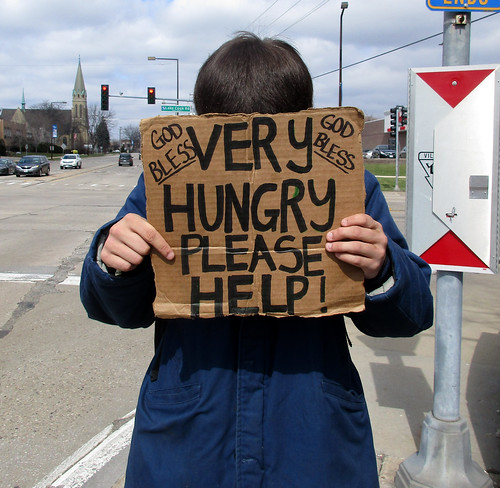
Homeless
Photo © *Hajee | Flickr/Creative Commons
[image: Person with black hair and a blue coat. They are holding a hand-lettered
cardboard sign over their face. Sign reads, "VERY HUNGRY PLEASE HELP!"]
I am not the only Disabled person economically struggling, as disability and poverty go hand in hand. Why is that? The answer is complex, since disability leads to poverty and poverty leads to disability. It's a vicious cycle and sometimes a downward spiral, leading people to lead lives perpetually circling the drain, always on the edge of annihilation.

Let me see if I can untangle some of it for you.

“You’re dooming yourself to a hand-to-mouth existence.”

That’s what my parents told me when I dropped out of high school. And they were right.

Well, they were half-right, anyway. I have spent the last three decades living hand to mouth, but it is not a fate that I brought upon myself. I am Autistic, but that is only part of the picture. I am multiply Disabled and the requirements and limitations of my various disabilities bounce off each other in difficult and sometimes devastating ways.

These cycles of disability and poverty can go all the way back to childhood. Starting life in poverty is an immediate disadvantage in life. That’s probably obvious, right? Less money often means poorer health coverage and poorer nutrition, which can cause additional health problems for the rest of a person’s life, even creating new disability where none was to start with.

A family without financial resources is not able to help their children launch into the world as successfully as a family that can afford to help young people with their start in life. Fewer resources mean less attention paid to mental health needs. A family with one or more disabled members will have additional costs. And expenses considered burdensome for a middle-class family can be the difference between life and death for a poor family.

A disability present from childhood can mean less access to a quality education; poverty also lowers access to such an education. Disability and poverty together can block a child’s future earning potential entirely. But the cycle of disability and poverty do not stop at childhood’s end. Nor does growing up in a middle-class home necessarily shelter a disabled adult from falling into and/or failing to climb out of poverty.

The poverty rate for disabled working-age adults in the United States is more than twice as high as for non-disabled adults in the same age range. A September 2009 Center for Economic and Poverty Research report on poverty and disability found that half of all adults who have experienced at least one year of poverty are disabled, two-thirds of those with longer periods of poverty have a disability, and people with disabilities are significantly more likely to experience homelessness, food insecurity, and inadequate health care when compared to non-disabled people with the same income.

How can it be that disabled people have more serious markers of poverty at the same income level as non-disabled people? Literally, our poverty is “more poor.” One reason is that we have higher needs than most non-disabled people. Some of us need medications or medical devices that are not covered by Medicaid or other insurance. Some of us require special diets that cost more. Some of us need apartments on the bottom floor, so we can access them, or on the top floor, to mitigate sensory sensitivities, and have to pay more for an accessible apartment (and “accessible” does not always mean the same thing from person to person, so many disabled people have access needs that are not well understood or supported, even by ADA laws meant to protect us),

A 2012 study, published by the National Disability Institute, found that 70% of people with disabilities said they “certainly or probably” could not come up with $2000 in an emergency while only 37% of people without disabilities said the same. Without a savings cushion, an annoyance becomes expensive, and an expense becomes deadly.

Not so long ago, I looked at my tax records and saw that I have a lifetime earning total of $17,358. Since that sum covers the years from 1985 through 2016, it averages to $542 per year. That’s not a lot of money.

How have I lived on an average of $542 per year? Some of that time was spent institutionalized. Much of it was spent homeless. I’ve eaten at soup kitchens and out of dumpsters. I’ve slept under bushes and in public bathrooms. I’ve escaped the heat of summer and the cold of winter in shopping malls and libraries—often even when I had a place to live, because when I have had a roof over my head, it’s often a roof that leaks. I’ve lived without heat, running water, or even panes of glass in the windows.

And much of that substandard housing was only made possible because I have been receiving Supplemental Security Income (SSI) for disability since 1994.

“So you shouldn’t have dropped out of high school,” you say. “You should work harder. You should get a better job. You should try harder. Give up that dream of supporting yourself through writing and go get a real job.”

Let me see if I can untangle some of that for you.

I was forced out of high school because no one was protecting me from severe bullying that included having rocks thrown at my head and bleach thrown on my clothes. I had books and papers stolen. Bullies slipped laxatives into my food, so I stopped eating or drinking at school. And I was pushed into isolated building niches where I was sexually molested.

This is why I am so stern about the incredible burden of bullying that Autistic students endure. Bullies stole my guaranteed education and my future earning potential from me. Bullies stole the life I might have had, and set me on this hand-to-mouth path, one I have been fighting for three decades to escape.

As I detailed in my book, The ABCs of Autism Acceptance, CBS reports that 63% of Autistic children have been bullied, and they are three times more likely to be bullied than children without autism. Time Magazine reports a 46% bullying rate for Autistic children and cites that figure as being nearly five times higher than non-autistic classmates. And the bullying Autistic students face is particularly brutal, including documented cases such as being covered in human excrement, choked and threatened with a knife, or having both hands blown off by explosives.

If we want to fight the life-long poverty so many Autists live with, we cannot ignore the role that abuse from both age peers and adults plays in setting us up for ongoing poverty, whether due to not completing our educations, or mental distress and complex PTSD from being targeted by bullies, or both.

Mental health issues are huge when it comes to keeping disabled people in poverty. Some people’s primary disability is psychiatric, while others develop psychiatric disabilities as a result of the poverty and isolation brought on by living with another disability in a society that does not adequately address the needs of disabled adults.

Those of us with developmental disabilities often have added cognitive burdens. For example, my executive dysfunction already makes it difficult for me to focus on a task. Once I am well into the task, I have strong abilities to hyperfocus—I wrote my book, No You Don’t: Essays from an Unstrange Mind, in just two weeks because I was finally living alone with no one to distract me from my work. But any distraction is fatal to my flow, and it can take me hours to get back on task.

My executive function worsens when I am sick or stressed out. Not having enough money to eat or pay my bills is incredibly stressful. That means that one of the factors that keeps me in poverty—my uneven energy and focus abilities—worsens with poverty, making me even more likely to remain in poverty once I find myself firmly wedged there. I am like a plane that keeps circling the runway because I can’t get enough power to take off and the circling is running through my fuel reserves, ensuring that my plane will never leave the tarmac.

Another disability I live with is Ehlers Danlos Syndrome (EDS), which is a connective tissue disorder that may turn out to be one of autism’s “genetic hitchhikers,” potentially occurring more often among us than in the general population. Anecdotally, a significant proportion of the Autists I know are also diagnosed with EDS or related syndromes. Having EDS has led to a range of seemingly unrelated health conditions. (Doctors have a saying, “if you can’t connect the issues, think connective tissues.”) Along with such “delights” as pelvic organ prolapse and intermittent gastroparesis, EDS has given me feet that shred and tear when I use them. After much expensive experimentation (and a lot of classes missed because my feet were so damaged I could only crawl), I found shoes that don’t damage my feet. They cost over $100 and need to be replaced every six months when I have walked holes through the soles. That’s $100 that has to come from a budget stretched so thin I regularly go days without food.

I count myself lucky, though. I know people with cerebral palsy who have to replace their shoes on a monthly basis because their gait destroys even the toughest shoes in a matter of weeks. And this is something that has to come from our budgets because Medicaid won’t pay for non-prescription clothing. And those of us living on Supplemental Social Security (SSI) are roughly 20% below the poverty threshold to start with.

The federal poverty threshold in the United States for a household of one is currently $12,060. That’s $1005 per month. Right now, I get $735 per month to live on, but starting in December the government will be holding back $73.50, leaving $661.50 per month because I earned $1229 from my writing last year—and that means I owe the government some of the SSI money it gave me. Social Security’s rules are set up to help disabled people transition from SSI to employment, but since I began writing I have learned that those rules are not as easy to live with for those trying to build their own business rather than stepping into traditional employment for others.

So why don’t I just go get a job? Yeah, I tried that. I tried it a lot. Before I finally got on SSI, I’d held 27 jobs and none of them for a full month. I work hard and learn quickly but I … well, employers have always been careful what they said when they fired me, but from what I gather, I kind of creep people out. I don’t smile at the right time. I do smile at the wrong time. I don’t respond to sudden, unexpected questions the way people expect people to respond. I’m too rule-bound (or, conversely, I break rules that “everyone knows” but were never explained to me).

My job pool was limited early on by a neurological disorder I was born with, called delayed sleep phase syndrome (DSPS). From a very early age, I had difficulty staying awake in the daytime, and was unable to sleep at night. But back then it was “diagnosed” as lazy and undisciplined. I never even knew I had a disorder until my thirties, when it shifted into a much more severe related disorder, hypernychthemeral syndrome (also known as non-24-hour sleep-wake syndrome or N24 for short) that shares many genetic markers with DSPS.

DSPS and N24 are also “genetic hitchhikers,” occurring much more frequently among Autists than in the general population. When I was exhausted or asleep in the daytime and wide awake at night, my job options were largely limited to restaurant and bar work, or night security guard.

Once I developed N24, my brain’s subjective “day” became longer than 24 hours, and my wakeful period began moving every day. Imagine if you had to go to work an hour earlier every day, until your 9 to 5 job went from a 9am start time to a 9pm start time in just a couple of weeks, and then continued to get earlier until you were arriving at work at 9am again ... but completely drained from weeks of little or no sleep. That’s what it feels like to try to function with N24.

That is why I cannot work for someone else. I can’t keep someone else’s hours because it’s as if my brain and body are living on Mars time while every employer out there has a timeclock programmed in Earth hours. Even Vocational Rehabilitation admitted that there was nothing they could do to help someone with my circadian rhythm disability.

I have estimated that Autistic people are three times more likely to have a sleep-related disorder than the general population. (I can’t cite a source for this, because I came at this number by combing through medical studies and running lots of calculations. It would take an entire paper all its own to show my work—and I might write that paper at some point.)

With an estimated prevalence of 1% in the general population and as much as 16% among adolescents (most of whom grow out of circadian disruptions by their mid twenties), Autistic rates of circadian disorders could range from 3% to as much as 48% (since many of the studies I analyzed were of youth and no one to date has studied lifespan prevalence of circadian disorders among Autists).

While I know many Autistics who have little or no circadian struggles, those of us who do experience these neurological sleep disruptions are destined to struggle with employment. Those of us with N24 tend to find employment altogether impossible. And, of course, not being able to work is a major contributor to poverty.

So it’s clear that there’s a problem with disability and poverty, but what are some solutions we can work toward?

  • Disabled people need mentors to help them navigate governmental systems. Many disabilities make it more difficult to fill out forms, make phone calls, travel to offices to meet in person, or even understand the complex legalese so much of the government information about benefits is written in. I’m not talking about payees or guardians but mentors—workers dedicated to helping disabled people to live more fully, with full agency and autonomy.
  • We need to raise the asset limits for people receiving benefits. Currently, SSI recipients are not allowed to have more than $2000 in assets. Yes, the ABLE Act increased that asset limit, but only for those with documentation of disability onset before age 26. That doesn’t help those with disabilities that occurred later in life, and it doesn’t help a lot of Autistics, even though we were born Autistic, because not all Autists can produce acceptable documentation.

    I wrestled for a while with the Social Security Administration (SSA), trying to get my benefits changed from SSI to SSDI-Adult Child. I qualify in every way, and have clear documentation of disability from age 17, but the SSA repeatedly refused to accept that my institutionalization —for the same disability I was later awarded SSI for—counts as evidence. I finally gave up the fight through sheer exhaustion. I could not find a lawyer to represent my case because I am poor, plus switching from SSI to SSDI would not create a back payment to pay the lawyer with.

    Because of that battle, I have not even bothered to see if I could get an ABLE account. (See my point above about Disabled people needing a mentor to help them navigate these shark-infested waters of government benefits.) I am assuming the answer would be “no.”
  • Reform the work rules to make it easier for Disabled people to earn money and eventually transition out of poverty.
  • Raise the SSI amount to the poverty threshold. It is scandalous that SSI recipients are expected to live in poverty, since the program is specifically designed for those who cannot work. The most recent report (2007) showed that only 19.5% of people on SSDI, and 12.6% of people on SSI, worked in that year. Only 2.9% of disability beneficiaries earned income at the poverty threshold or above in that year.
  • Support more job opportunities for disabled people. Work programs for Autistic people should not be limited to tech jobs, as those only target a narrow slice of the Autistic population. Encourage supported work in the community rather than sheltered workshops. Encourage programs for Autistics to start and build their own businesses. Support programs that offer legitimate opportunities for Autistics to work from home. Create mentorship programs to help Autistics who have never created a resume or CV, have never gone on a professional job interview, and are lost when it comes to the networking that is so crucial for many careers.
  • Support affordable housing for disabled people in the community that are not institutions or group homes.
  • Help eliminate “food deserts,” those communities where it is impossible or very difficult for those with limited mobility or transportation resources to access healthy food for reasonable prices.

The list of what we Autistics specifically and Disabled people in general need is overwhelming. And this is a bare bones list, just a starting point. What we really need is huge: a complete overhaul in how society views us.

Until we achieve that shift in social perspective, let’s start chipping away at the barriers. Write letters and make phone calls—not just to politicians, but to entrepreneurs and charitable organizations as well. Advocate for Disabled people’s unmet needs, and promote that social shift at the same time, as and how you can.

Stop people when they talk about “moochers” and “welfare leeches” because that kind of talk primarily hurts disabled people. Seventy-five percent of food stamp recipients are families with dependent children. Twenty-five percent of food stamp recipients are elderly or disabled. Allowing gripes about “people who don’t want to work” to go unanswered adds to the stigma that keeps disabled people in poverty.

We are counting on you to help. Disabled people can’t fight this battle—a fight for our lives!—alone.
Share: