Showing posts with label acceptance. Show all posts

Dangerous Assumptions

proud parents
Photo © Lucy Downey | Flickr / Creative Commons
[image: Two Canada geese swimming with a fluffy baby gosling.]

Julia Bascom
juststimming.wordpress.com

There is this thing that happens sometimes.

Parent has an autistic child. Autistic child doesn’t speak, or their speech isn’t an accurate window into what they are thinking. Autistic child is presumed to be very significantly intellectually disabled.

Years later, a method of communication is found that works for the child, and it turns out that they are in fact very smart. Very smart! The parents are overjoyed. They begin talking about presuming competence, the least dangerous assumption, that not being able to speak is not the same as not having anything to say.

They are so, so excited.

And they start talking about all the incorrect assumptions they had. If we’d known, they say, we wouldn’t have done X. If we had known they could read, think, hear us.

And it’s a big problem, because the way they talk… they think the problem was that they treated their child like they were intellectually disabled, and they weren’t. But that’s not the problem. The problem is that they thought their child was intellectually disabled, and so they didn’t treat them like a person.

These revelations, about presuming competence, human dignity, and the least dangerous assumption—they don’t apply only to kids who are secret geniuses. They apply to everyone. They are the most important for the kids who really do have intellectual disabilities, who really can’t read or use full sentences and who really do need extensive support. The people who came up with these terms came up with them for a population where there is very little doubt that significant disability is a factor. These terms don’t mean assume they aren’t actually disabled. These terms mean assume they are a person, and remember what you don’t know.

When the neurodiversity movement first got its legs, oh so many years ago, we got a LOT of pushback from people who thought we were denying disability. And we had to be clear that we meant everyone. And I worry, more and more, that certain very academic circles have left that behind, in practice as much as in theory. It makes liars out of the rest of us, and it makes a lot of work very, very difficult.

If I told the parents in question that I am thinking about this, they wouldn’t understand. They’re not saying intellectual disability doesn’t exist, they would say. But the truth is, they’re either saying that, or they’re saying thank god, it wasn’t my kid.

And it’s a slap in the face, every time.

----

Originally published at juststimming.wordpress.com. Sincere thanks to Julia for allowing us to share it here.
Share:

The Importance and Power of Autistic Self Diagnosis

White person with blue eyes and a Freddie Krueger sweater taking a selfie in a mirror,  except a smaller circular mirror is inverting their face where their head would usually be.
Image © Stig Andersen | Flickr / Creative Commons
[image: White person with blue eyes and a Freddie Krueger sweater taking a selfie in a mirror,
except a smaller circular mirror is inverting their face where their head would usually be.]

Solveig Standal

We autistics need to have a serious talk about autism and self-diagnosis: what self-diagnosis means, and what effects it will have on us when inevitably both autistic and non-autistic people attempt to gatekeep our own autistic identities.

Ultimately, we know that it’s not autistic people who dictate who we allegedly are and what is allegedly best for us. Neurotypicals continue to dominate the conversation and speak over autistic voices, which ultimately reinforces a pathologizing viewpoint about us, and centers around the idea that somehow we fundamentally cannot speak for ourselves, purely because of our neurology.

The medical community continues to ignore people who do not fit the white cisgender male stereotype of autism—something that more closely resembles the cultural images of Rain Man or Sheldon Cooper. The medical community, as well as charities run on our behalf by non-disabled people, frequently overlook autistic girls and people of color. In the United States, the CDC does not even publish prevalence rates of autism in adults. Effectively, this means that the needs of most autistic people continue to be ignored, and the accommodations that are provided have a tendency to drop off as we reach adulthood.

We know what it’s like to see autism charities run by neurotypicals, whose primary focus is to paint a picture where we are the burdens that they must endure. At best, we are inspiration fodder intended to make neurotypicals feel better about themselves. At worst, we are portrayed as the driving wedge that ruins otherwise-healthy marriages. We are portrayed as highly disruptive, problematic, unteachable. We are portrayed as literal puppets, and given no autonomy whatsoever.

We know what it’s like to have our needs constantly ignored by the people who are supposed to be supporting us. Personally, I have sat in countless meetings centered around my disability accommodations in public school, where teachers and counselors discussed my situation as if I were not even in the room. Where so many people were very eager to tell me who I was, and what I needed, and how I felt, and where they all seemed to insist that they knew me better than I could possibly ever know myself. And as hard as things were for me, I know I would have been abused even worse if I were not white. Racism and police brutality is an inextricably critical part of understanding the dynamics of abuse we face every day.

I grew up in the 1980s in a very rural setting, and our access to information about autism was extremely limited. One of my earliest memories was a television news special about autism, where they asked questions about whether or not we were really people inside, or just walking automatons. At a later date, my parents were interviewed about me. I very distinctly remember the news channel interviewer describing the "emptiness" in my eyes, as if there was nobody inside of me. As if I were not a real person.

This was also during a time where Bruno Bettelheim and Andrew Wakefield’s beliefs were so widespread; they argued that autism was caused by vaccines, or by cold and unloving mothers. Self-proclaimed autism professionals preyed on parents of autistic children, demanding them to go to extreme measures in false hopes that they could cure us of our autism. They also pressured parents into therapies that were designed to make us look less autistic, probiotic diets, gluten-free diets, and more. One doctor, after spending less than five minutes with me, suggested that I should immediately be institutionalized. Finally, seeing no other options, my parents contacted the only autistic self advocate they knew of—Dr. Temple Grandin.

Dr. Grandin wrote back and explained autism to my parents in a way that only an autistic person could. She explained to them how I was not broken, I didn't need to be fixed, and I didn't need a cure. Ultimately, the best thing for them to do for me was to learn to accept me for exactly who I am, and focus on improving quality of life as best they could. And because of her lived experience as an autistic woman, she was able to impart better knowledge to us than all the other medical professionals put together. It was this step—connecting with another autistic person who had first-hand experience of what being autistic was like—that resulted in a bigger, much more profound improvement in my life than years spent with neurotypical professionals.

Many years later, as an adult, I came to realize that I needed to be able to emotionally process everything that happened to me. I needed to find a better understanding for myself in terms of what it means to be autistic, based on my own experiences—not based on what the "experts" see from the outside. I knew the only way to do this was to find other autistic voices to compare notes with. It started out by finding books written by autistic authors like Loud Hands, finding the Autistic Self Advocacy Network, and eventually making my way onto online autistic communities through Twitter.

I have found solace and comfort within our autistic community. I found other autistic people with common experiences and understanding of what it really means to be autistic… and I found people with substantially different experiences and understandings, too. I found a place where my interests aren’t looked down on.

This is a place where autism isn’t described in clinical terms with symptoms and conditions and treatment plans and other pathologizing things. Instead, we are a community of self-advocates who are fighting hard to claim our place as the real experts of what it means to be autistic. As the real experts of autism, we are in a better position to help others recognize their own autistic identities, and we’re in a better position to support them as they figure out what that means to them. In doing this, we are shifting away from a pathologizing clinical narrative that describes us as broken, and moving towards one that allows us to celebrate who we are and recognize our own strengths and our own needs.

Self diagnosis, at its core, is all about recognizing our own neurodivergence and reclaiming our role as the experts in our own lives. Understandably, there are limitations to what we can do with a self diagnosis. We cannot write our own prescriptions for medication, and we would not qualify for the kind of public assistance that requires a formal diagnosis. Self diagnosis does, however, give us better access to that autistic community support I was talking about earlier. It strengthens our network with other people who have shared experiences with us. Self-diagnosed people can access tips on what to expect from those of us who have gone through the formal process, weigh the costs and benefits of a formal diagnosis, and decide whether or not to pursue one in the first place.

Despite all this, there is a movement to restrict autistic community to those who receive a formal diagnosis, and this becomes a problem for a number of different reasons. First, so many of us don’t even know to pursue a formal diagnosis until we recognize in ourselves that we might be autistic, or others start to point things out to us. The process of self-discovery then takes time, and it only stands to benefit when people around us believe that we probably are actually autistic.

Yes, ultimately some of us will come to realize that they are not really autistic, but the exploration still helps them find answers about themselves, and no one is harmed in the process. However, when we deny someone’s autistic identity, we shut them out of the whole process, deny them access to the tools they need to better access the health care system, and potentially deny them their formal diagnosis altogether.

When we deny the validity of self diagnosis, we fail to recognize how broken health care systems can be. We effectively restrict our support to those privileged to afford a formal diagnosis. We ignore the fact that doctors notoriously ignore the needs of patients who aren’t white cisgender males. We pretend that autistic people of color are seen as potential threats who are sent into the juvenile justice system, and not seen as neurodivergent students with accommodation needs that are being unfulfilled. And worst of all, when autistic people find themselves neglected, ignored, and belittled by the very professionals who are supposed to be supporting them, they are neglected, ignored, and belittled by their neurosiblings as well. This cannot be allowed to happen.

As we continue to claim our rightful place in leading conversations and crafting policies about autism, we need to remember that self diagnosis is one of our strongest assets. We need to remember our own process of self-discovery and everything that we struggled with along the way. We need to ensure that future generations of autistic people do not have to suffer through the things we suffered through, because it’s the right thing to do.
Share:

Against The Autism Parent Feedback Loop of Woe

Kerima Cevik
http://theautismwars.blogspot.com
"Please try to remember that what they believe, as well as what they do and cause you to endure does not testify to your inferiority but to their inhumanity."
-James Baldwin
The Fire Next Time
Photo © Kerima Cevik, posted with subject's permission
[Image: The author's biracial nonverbal autistic son, 
at about age five, expressing shock through the 
gestural language he created.]
San Francisco Autism Society Board Member Stephen Prutsman recently posted an opinion piece* to his organization's blog, and while browsing newsfeeds on social media, I read it. The blog post disturbed me so much I posted a brief response in the comment section (which they did not publish).

Mr. Prutsman headed his article with two images, a rainbow infinity symbol image he meant to represent the neurodiversity movement, and a disturbing photograph previously posted by his ASA chapter president (now removed), alleging to show property damage to the upholstered seats of her car done by her autistic son.

Despite the reality that all content not spontaneously live streamed online is curated content, no one questioned the veracity of the statement that property damage to this car was inflicted by an autistic teen. That was something that bothered me. I wasn't there when the alleged incident took place. I am a stranger viewing this content and reading the hashtag of autism awareness beneath it. How do I know how the seats of this vehicle were damaged? I am presuming the honesty of a parent who shamelessly posts her own son's worst moments for the shock value. People can only ascertain character from words and deeds not from organization position and status. Status and power are not equal to ethics so, despite my presumption that the chapter president wouldn't post a claim that is untrue, it should still be pointed out that broadcasting anything to a public audience needs fact-checking. That means accusations about the behavior of another human being that cannot be verified should be viewed with skepticism when the accused individual is disabled such that they cannot defend themselves.

Prutsman's article also included a disturbing comparison that clumsily used African Americans and Sickle Cell Disorder. That was, in fact, a type of clueless racial microaggression. But the nature of Prutsman's blog post disturbed me so much I decided to address the inappropriate use of race and race-related illness as an extension of the use of Black suffering by affluent white people to gain an edge in debates having nothing to do with issues of race or African American people like myself elsewhere.

I am guessing his goal was to lay out his thesis while defending his chapter president's right to display negative content about her disabled son on the "raising awareness" excuse of what they both define as the "real" or "true" manifestation of autism.

It got me thinking about this large problem I once thought our community would work at solving. The problem is an autism parent emotional sink that is Internet-hosted, blog and social media-fed, and toxic.
Photo © Kerima Cevik, posted with subject's permission
[image: The author’s son, an Afro-Latino presenting male,
with brown curly hair wearing a black turtleneck sweater,
holding an iPad equipped with TouchChat AAC.
Green trees can be seen in the background.]
It isn't because nonverbal autistics like my son are "acute" as Mr. Prutsman infers in his essay. It is my hypothesis that such an emotional sink happens when parents like Mr. Prutsman and his ASA chapter president begin losing the emotional and physical wherewithal to support their disabled family member's needs without help. Under these circumstances, when negative events happen, these parents retaliate by venting their clinical depression, sleep deprivation, frustration, and distress on the autistic offspring by posting their worst moments on social media.

When I named my blog The Autism Wars I meant the wars for accommodation, inclusion, and representation for my son and his neurological peers. The wars for the presumption of his competence. From what I understood of his essay, Mr. Prutsman believes the autism community can be divided into two warring camps and his camp, camp B, is at war with the neurodiversity camp, camp A.

I am not at war with Mr. Prutsman, his oversharing chapter president or the SFASA. If I am at war with anything, it is the culture where ableist attitudes like theirs are incubated.

Is this group of parents within SFASA, led by its executives like Mr. Prutsman and its chapter president, caught up in what I call the autism parent feedback loop of woe? If so, as this pain/frustration feedback loop escalates unencumbered, is there a genuine risk of catastrophic outcomes?

I have had these concerns since encountering parental rhetoric similar to parts of Mr. Prutsman's essay in blogs by others whose written displays of frustration and despair escalated to a deadly conclusion. That is why seeing such a post from an executive of an autism advocacy chapter so disturbed me. He and his chapter president are part of the leadership of an advocacy organization supposedly existing to champion autistics like my son. What message is this sending to the disabled members of this chapter? I wonder if they realize how many autistic adults parent autistic children? How many such parents will happen upon Prutsman's blog through social media browsing?

Let me take a minute to define how I think this feedback loop works:

  1. Digital Exhibitionism: Autism parent group leaders who constantly overshare about their challenges with their kids, who make every disability-related challenge experienced by their offspring about them rather than the child, are using this as a coping mechanism for their own frustration and individual distress. They are typically overwhelmed (frustrated, sleep deprived, clinically depressed, etc) and as a result, may be making decisions with compromised executive function.
  2. The Positive Feedback Loop of Pain, Grief, Frustration: These de facto peer-moderated support groups for overwhelmed parents, if left unregulated, include lots of positive attention for expressing distress and pain. The more the lead parent posts, the louder that parent complains, the more attention they get.
  3. If left unchecked, getting attention for being in pain becomes its own reward. The more that state of mind is rewarded, the more motivation there is to constantly express pain through digital exhibitionism and the publishing of more dramatic negative content.
  4. This feedback loop does damage to a person's motivation to seek actual long-term help for the targeted disabled child or themselves because it's easier, more accessible, and more rewarding short-term when people need immediate comfort after a distressing situation at the expense of one's autistic child. This is especially the case when the autistic target is nonverbal and multiply-disabled.
  5. Any attempt to express concern for the disabled target of the negative content to a group in this state of mind will only strengthen its resolve because it encourages the group to make the problem about those they perceive as their attackers. It discourages introspection and allows further wallowing in frustrated angry pain. It promotes in-group solidarity because now there's a common enemy who they believe is persecuting them.
  6. Without urgent, long-term, quality trauma-informed care for the parents triggering this cycle by generating and posting the curated, negative content such groups need to validate their anger/pain/frustration, people who are caught in this feedback loop risk eventually escalating to violence towards the targeted disabled family members and themselves. The fact that people who have done this are excused for their behavior and the violence is made to seem inevitable (and the fault of the target) further compounds the issue.

The case of Isabelle Stapleton, the autistic young woman who was the target of her mother Kelli's escalating digital exhibitionism and eventually became the victim of her mother's attempt to murder her, is an example of how constant inappropriate validation for posting such negative content online can escalate and become dangerous to the disabled target.

Kelli Stapleton's constant postings of videos and images violating Isabelle's HIPAA rights, and her blog about parenting Isabelle—deliberately named The Status Woe—acquired a large, cult-like following of parents. The resulting frustration and defiance at anyone expressing concern when Kelli and other parents posted negative content about their children is similar in tone and approach to parts of Mr. Prutsman's written content.

I believe groups and individuals with large public platforms who promote this culture of validating negative content targeting autistic offspring create an attitudinal shift that enables escalating risks of potential harm to the autistic youth targeted by such digital assaults.

The plight of artificial intelligence exposed to negative or offensive social media content gives us a painful clue of what impact negative social media curating and consumption can have on people. Norman, the MIT AI that was fed with Reddit data and which now only thinks of murder and death, and Tay, Microsoft's chatbot that was taught by Twitter trolls to be racist and misogynist, show us that the culture of frustration, perpetual mourning, infantilization, hostile objectification of autistics with high support needs, and resentment that drives oversharing and defense of negative content in these autism parent groups may pervert the minds of exhausted, distressed parents.

Our community has an abnormally high rate of filicide-suicides. I believe this phenomenon needs to be studied in the context of the influence of online groups caught in these feedback loops.

Here is my other concern with Prutsman's article.

Mr. Prutsman's thesis in his essay was meant to explain his answering 'yes' to the question “Is it Time to Give Up on a Single Diagnostic Label for Autism?” citing the title of a questionable commentary by Dr. Simon Baron-Cohen in Scientific American.

Prutsman's essay argues for a new label as a kind of weaponized tool for him to wield as an autism dad. His demand for a new label for "acute" autism is not because the group diagnostic designation fails to encompass the entire autistic population, but because he views the label autism as being "tainted" by any group that disagrees with or disputes their parental group's rigid, negative, definition of autism. Prutsman defines severity and indeed autism itself by how he and parents like his chapter president view any negative behaviors, rather than by proper diagnostic standards.

He appears to blame the neurodiversity movement for what he calls 'tainting' of the autism label. Prutsman writes that this tainting happened by presenting autism as an identity, and overemphasis on positive attributes of being autistic by the neurodiversity movement.

What is interesting about how he defines the neurodiversity philosophy is that it is not at all accurate. Unfortunately, the term 'neurodiversity' has been conflated, and the popularity of the book NeuroTribes has led to some parents being confused rather than comprehending.

It is clear now that a great many autism parents don't understand what neurodiversity is. Let me repeat one of the best quotes I have ever read about neurodiversity :
"Neurodiversity isn't about pretending that autism, other developmental disabilities and psychiatric disabilities are all sunshine and rainbows. It's about believing that we should be able to live our lives on our own terms and that our community should continue to exist, and doing whatever we can to make sure that happens."
-Shain M. Neumeier, Esq.
Mr. Prutsman othered anyone who might object to the targeting of autistic youth by the digital display his chapter president employed. He lumped them together into a stereotyped 'other' by listing commentary from those he did not know—and dismissing it. Under the category of non-relevant commentators, he cited the neurodiversity movement or "group A," non-participating chapter members, and online readers like me who were not local. This allowed him to define a collective enemy for his group to view as antagonists.

Prutsman implies that the enemy has won the autism label battle. Now his group must have a new autism label for their kids, one that restores complete power and control of the autism conversation and public policy dictatorship to them.

The sad reality of things is that parents like Mr. Prutsman and SFASA's chapter president, who are affluent, white, and embedded in the feedback loop of woe, are still the loudest and most heard voices in our community. Yet that massive platform is drowning out the voices of the autistics they are supposedly speaking for doesn't seem to be enough.

Their resentment of everyone else, particularly autistic adults having agency in the future of what happens in their own lives, harms my son by perpetuating a deep-seeded ableism that negatively influences the public view of nonverbal, high-support-need autistic youth.

Autism parent feedback loops of pain and frustration don't provide any solutions to the behavioral challenges parents like Mr. Prutsman want constantly highlighted by generating and promoting negative curated content.

The emotional opinion that professional diagnostic labels should be changed to disenfranchise one part of the community, and allow control of autism public policy to rest completely in the hands of enclaves of parents too wrapped up in their own feedback loops of misery to see the need to protect their own disabled offspring by not oversharing negative content, is a risky proposition on his part.

Prutsman is not really asking for a new autism diagnostic label. He's asking for a legal or medical excuse to excise a massive part of the autism community, so parents can run the autism world. Without the consent or voices of their own autistic loved ones, or parents like me.

(And here is a sidenote. Yes, nonverbal humans can indicate consent—if they are allowed to. Once competence is presumed, and communication pathways actively sought for nonspeaking people, yes and no gestures, switches, even eye blinks are possible.)

I don't need a new DSM label for my autistic son. Nor do I need a parent who is oblivious to what our son needs demanding one in the name of all high support needs parents and their offspring. What I need is for parents like Mr. Prutsman to grasp that every stakeholder in our community has a right to equal representation, whether he agrees with it or not. He can't live in a world segregated by those he accepts and those he doesn't. I'm Black. I don't need to remind us that my racial peers are still suffering from that idea.

Abusing one's large platform to enable digital oversharing and abusive content generation is contrary to the principles of an autism advocacy chapter executive. But what can be done to reach such parents? I am afraid the nature of Internet interaction makes such an effort futile.

The question for us is: What can be done to help break the toxic online culture that builds these enclaves of parents trapped in the autism parent feedback loop of woe? How can advocacy groups reach parents who are in this state? What happens when the loop exists within an advocacy organization's power base?

Because something has to change here. This type of dysfunction is the root of community altercations, and I suspect the root of eventual harm to autistic children and youth. We must seek solutions.

This is unsustainable.

--------

*Prutsman changed the analogy on the SFASA site to Scandinavian rather than African-American. Our link is to an archived version of the original post.
Share:

I'm Not Just Socially Awkward

Photo courtesy the author
[image: Blurry photo of a pink ride-on bouncy balloon with
an animal face and two "horns" for handles. Overlaid white text
reads, "I'm not just socially awkward." Smaller white text in the
lower right corner reads, "@oufoxgloved"
and "Autnot.Wordpress.com"]
Rhi Lloyd-Williams
autistrhi.com

When I tell people I’m autistic, it usually goes one of two ways; either they can’t make me fit into their idea of what autism is and completely reject it, or they mark me down as “socially awkward” and leave it there.

Autism explains my lack of constant contact, it explains my monologuing about things that interest me, it explains why on social occasions I move around a room like a loose cog in a machine—catching on things, getting stuck in places, jarring against this and that before being knocked into a corner and staying there.

Those are the things about me that you can see. What you can’t see are the other bits; my problems with Executive Function, my never-ending battle with literalness, my lip-reading over auditory-processing, my sensory issues, my affinity with numbers and disassociation with names, and on and on and on.

When people classify me as “socially awkward” they expect too much from me. They’re surprised when I find some things hard. I’m not telling you that I can’t make a shopping list because it’s boring and takes time, I’m telling you that it’s incredibly hard. There are too many variables, I have to hold them all in my head, I can’t, it gets too big. I falter and have to start again, but then the same thing happens. I cannot juggle the thoughts needed like that. I cannot think in a linear way, I have to include all the forks going off in different directions.

You may think in straight lines, but my thoughts are like lightning bolts. They flash brightly, sparking off in every direction, and by the time the thunder rumbles, I have lost the central bolt and am caught in how my hairs all stand on end.

I am not socially awkward, I am socially different. Autism isn’t about not making connections, it’s about making different ones.

I am built to logicise and problem-solve, and this means I am brilliant at certain aspects of thinking, but terrible at things that other people take for granted as "easy."

When I say I find something hard, please don’t tell me how easy it is. Please don’t tell me I just have to do it like this or like that. It will never be easy for me. It will always take time and energy that could be spent elsewhere. If you found quadratic equations hard, I wouldn’t tell you how easy they are. I wouldn’t tell you to just do this or just do that. I accept that although I can explain and help you get to the answer, this may be something you will always need support with.

I am not socially awkward and lazy or incompetent. I did not get this autism diagnosis diagnosis because of shyness. I am autistic, with all the joys and pains being human brings. I am creative and imaginative, I am loving and thoughtful, I am good at things and bad at things. The things you find easy may not be the same as the things I find easy, and that is just fine too.
Share:

At Home in Ourselves: A Mindful Acceptance of My Autistic Son

Star jump
Photo © Stuart Anthony | Flickr/Creative Commons
[Image: Two backlit people attempting to jump over a horizon-adjacent sun.]
Leslie J. Davis
www.dharmamamas.com
"When I practice breathing in and I say, 'I have arrived,' that is an achievement. Now I am fully present, one hundred percent alive. The present moment has become my true home. When I breathe out I say, 'I am home.' If you do not feel you are home, you will continue to run. And you will continue to be afraid. But if you feel you are already home, then you do not need to run anymore. This is the secret of the practice. When we live in the present moment, it is possible to live in true happiness." –Thich Nhat Hanh, "No Death, No Fear: Comforting Wisdom for Life"
Every Monday night I sit with my meditation group and practice breathing in and out in an attempt to calm my racing thoughts, to learn how my mind works, to remember that I have a body. I sit on a brown zafu cushion and breathe in and out, saying to myself, "I have arrived. I am home." On the in breath: Arrived. On the out breath: Home.

This practice of breathing slowly in and out allows me to slow down, so I can stop running. So I can stop being afraid. So I can stop worrying. Often the fear and the worries rush back in after the meditation session is over, but doing the sitting helps me bring an essence of calm and a sense of being "home" into my daily life when I'm not on the cushion.

Having this capacity to slow down so I can be at home in myself has allowed me to trust that my autistic teen son is also at home in himself. It allows me the space to observe him closely and notice him for who he is, instead of trying to change him to be someone I want him to be, expect him to be, or that society expects him to be.

My autistic son has a rich and vivid inner life. I see him watch, listen, and notice. He uses spoken language and communicates well, yet I know there is much that he isn't sharing because he can't, or chooses not to. I know there are oceans inside of him that he isn't revealing to anyone. Because of my meditation practice and spending time on the cushion, I'm able to watch him, listen to him, and notice.

Recently I had a coffee date with a dear friend and we had heart-to-heart on an important experience in my life. Afterwards, all these thoughts ran through my mind: There's so much more I didn't have a chance to say! There's so much more I could say but am choosing not to say. There's so much more to this that I don't yet understand. There are experiences in my life that this relates to but we didn't have time to talk about it. I don't want to tell her everything; I want to keep some of it to myself.

There is so much going on inside of a person that we don't know about. On all the levels: spiritual, emotional, intellectual, hormonal, ancestral, etc. Our inner lives are rich with detail and feelings—on any given day there is so much we don't share with other human beings. Why would we non-autistic people think this is any different for an autistic person?

When my son was a young child his imagination astonished me with the depth and detail of his creations and made-up worlds. I used to try to get him to write it out, draw it, speak about it, until I realized, Who am I to force him to open those places up to me? When he wanted to talk to me about his made-up worlds, he would. When he decided to draw maps of his world, he would draw maps for days, and I would watch, marvel at his concentration and creativity, gently asking a question or two here and there. Sometimes he was excited to talk about it and other times, not. When I shifted my perspective I could accept that when he's in his own world in his mind, he is safe, he is home.

His present moment is his true home.

As a mom, breathing and staying calm aided me in seeing him for who he truly was: a boy completely at home in his own world—comfortable and calm and free--unless I was the one pressuring him into doing things I "thought" would help him, doing things my societal conditioning told me was right, or was expected of him. When social norms whispered in my ear—or more accurately, shouted in my ear—they came via comments and suggestions from non-autistic people, doctors, therapists, teachers, or the voices in my own head based on my own upbringing in a neurotypical society.

When I listened to these outside voices, I'd yell at my son, insulting his individuality, trying to pressure him into a mold, and attempting to define who he was in a way other people would understand. Putting others first and ourselves, second. But when I stayed mindfully aware of his essence, I saw that he was happy and free. That he was smart and expressive and curious. There was no need for me to intrude.

But intrude I did, for many years. Before having the conditions to set my mind at rest and put my trust in him, before an autism diagnosis, before my meditation practice steadied me, before I let go of outside expectations and trusted my intuition, I intruded in ways I'm not proud of. For years I was a messy conglomeration of views, theories, approaches and therapies. I swung back and forth between being a toxic, controlling, fear-driven, socially-influenced mom, and being a steady, confident, calm, trusting advocate for my son whose actions from a place of love. Both were happening at the same time. It caused a lot of suffering in our home—mostly for our son.

One of my son's occupational therapists used to ask, "What Would Love Do?" and I would cry every time she said it, because my desire to move from a place of love was so deep—and at the same time I was clutched in the grip of a neurotypical world's expectations, and operating through the lens of mainstream expectations and ideologies.

Eventually, our family embraced a non-conventional lifestyle in regards to my son's education and care, and chose to pursue our own path of support for him through homeschooling, private therapies, and mindfulness practices. Letting go of conventional views set us free to be at home in ourselves.

"I am large, I contain multitudes." -Walt Whitman

When I practice meditation and remember to return home to myself in the present moment, I know that my autistic son contains multitudes—oceans of thoughts, feelings, sensations, awareness and insights that he doesn't share with me. And I accept that he has the right to be at home in himself and be the owner of his own experience, and of his own happiness.

Mindful Parenting Resources:
Share:

Autism, Transmasculine Identity, and Invisibility

Transgender Pride flag
The Transgender Pride Flag
By SVG file Dlloyd based on Monica Helms design [Public domain], via Wikimedia Commons
[image: A flag with five horizontal stripes. The center stripe is white, flanked by two pink stripes,
then a light blue stripe at the top and the bottom.

Devin S. Turk
@devinst97

Everyone in my life knows that I’m transgender. Comparatively, very few people know about another major part of me: that I’m autistic.

At age twenty-one, I’ve come to understand that many of my young adult years have centered around trying to bridge the gap between my two ways of being: The way that I present myself to the world, and the way that I perceive who I am. I imagine that someday, hopefully soon, those two components of my life won’t feel far apart. And hey, sharing this essay might even help.

I realized I was trans when I was fifteen, but just a year before had come a revelation of similar scale and importance to me; my diagnosis of Asperger’s syndrome (which is now referred to as Autism Spectrum Disorder.) I experience many symptoms or “traits” of ASD, and I won’t mention all of them here, but it’s worth saying that my traits are not obvious to the untrained eye. Underneath the mask, though, lies a deep unsureness of how to regulate social interaction. To cope, I copy, or “mirror” other people in order to appear more socially fluent and less awkward. And it works. Many people close to me might say that I “blend in” very well, in more ways than one.

Now that I’ve been on testosterone hormone replacement therapy for close to three years now, my voice is deeper, my jaw is squarer, and I even have a bit of facial hair. When I tell people that I was assigned the sex “female” at birth, they often say something to the effect of “I would have never guessed!” This is typically meant as a compliment, but to me, it feels patronizing.

In an eerily parallel way, people react very similarly when I disclose to them that I’m autistic. In both scenarios, the disbelief is caused by the preconceived notions of what it “looks like” to be transgender or autistic. I credit the testosterone as the reason I am not read as female, and to some degree, I credit my socialization as a reason I am not perceived as autistic.

Professionals who diagnose Autism Spectrum Disorder are, in general, proficient at recognizing autistic traits in males. After all, the original model for autism was based on studies of mostly young boys. Some doctors are still catching up to being able to recognize such traits in girls and women, but people are becoming increasingly aware that autism presents itself differently in girls than in boys. For example, autistic girls are more likely than boys to be masters of “social camouflage,” which masks their traits of ASD.

So, where do I fit into this framework as a transmasculine person? Yes, I identify as more male than female. However, I lived the first eighteen years of my life as a girl, and so I believe many of my ways of interacting with the world are byproducts of being socialized as female. But when I walk into my doctor’s office, they will likely overlook the significance of my history because they see that I now present as male, despite having a lot of learning experience in the world as a girl.

I’m the same degree of socially clumsy and unsure as when I was presenting as female, yet doctors who are new to my case and doctors who don’t know me well are less likely to agree with my diagnosis. Doctors will commonly overlook my noticeable lack of eye contact and my significant difficulties with Sensory Processing Disorder (which is a common co-occurring condition in autistic people) or severely under-appreciate just how utterly exhausting it is for me to engage with others. Maybe they don’t understand how much my executive dysfunction holds me back. Maybe they don’t believe me when I tell them that when I’m alone, I often flap my hands when I get excited as a means of expression, or that I rock back and forth when I’m focused on something. All of these experiences are very real to me, and yet they seem invisible to so many medical professionals, simply because I don’t outwardly appear to check all the boxes while I’m sitting across from them.

In addition to feeling unheard and unseen, my autistic traits are sometimes swept under the clinical rug and regarded as symptoms of conditions such as depression or severe social anxiety. I suppose it’s an easy enough mistake to make, but such a misunderstanding of my neurotype can lead to misdiagnosis, which could potentially then cause doctors to prescribe medicine and recommend treatments that may do more harm than good.

After receiving handfuls of labels from the DSM as well as literally dozens of unsuccessful psychiatric medications over the years, I’ve learned that much of the way I am is not something to be treated with various therapies and pills. This is not to say that autistic individuals cannot experience things like depression or anxiety which may be very much relieved via therapy and/or medication. I have simply realized that in my specific situation, the best route from here forward is perhaps to make peace with and embrace the qualities that set me apart from neurotypicals, or those who don’t experience neurological differences.

The intersection of being both autistic and transgender is more common than one might think. While the dialogue around autism and gender identity is expanding, I have a bit of trouble figuring out where I fit into the whole picture. So, I decided to do my own research, and while this subject is a fairly new field of study, I found some pretty astounding statistics:

In 2014, a U.S. study of 147 children (ages 6 to 18) diagnosed with ASD found that autistic participants were 7.59 times more likely to express gender variance than the comparison groups. Another study, conducted in the UK in 2015, involved 166 parents of teenagers with Gender Dysphoria (63% were assigned female-at-birth.) Based on parents’ report of their children on the Social Responsiveness Scale, the study found that 54% of the teenagers scored in the mild/moderate or severe clinical range for Autism.

The relationship has only begun to be explored in research in recent years, but I’ve come to realize that there are a lot of autistic trans people out there in the world. As someone who very much values human connection and simultaneously struggles with it, I have to say that looking at those figures provided me an amount of comfort. I discovered that there are a lot of people just like me.

Being autistic and being transgender certainly each has their own respective challenges, though one that they share is a lack of societal acceptance due to stigma. Many people still believe that who I am as a transmasculine person is inherently invalid, just like many other people still believe autism is some kind of tragedy that is to be cured. In contrast, I feel very strongly that who I am as a person is heavily dependent on both my trans and autistic identities, and that they are beautiful things. 

I would not be the person I am today if I did not have the incredible perspective that being transgender as well as being autistic has given me. My worldview has been altered by these two factors in particular in ways that I consider enlightening. Sure, I have tough days. But would I exchange all that I am in return for the promise of a simpler, more typical life? Most definitely not. Because after all, I’ve found that one of the best things about being dealt a different hand of cards is the unambiguous and fulfilling joy that is learning to accept oneself wholeheartedly.
Share:

Mental Health and Autism: Why Acceptance Matters

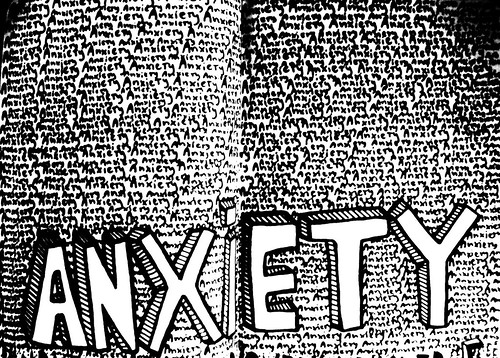
Anxiety
Photo © Mariana Zanatta | Flickr/Creative Commons
[image: Hand-drawn black-and-white outlined block letters spelling "anxiety"
on a background of "anxiety" written repeatedly in black & filling all space.]
Christine Motokane
www.workingthedoubleshift.com

It is well known that individuals on the autism spectrum are likely to have co-occurring mental health issues such as depression and anxiety. However, mental health is a less-discussed topic surrounding autism, compared to behavior and social challenges, etc.

As an autistic young adult with anxiety,  I can give personal insight on this high prevalence. A big part of our susceptibility to issues like anxiety has to do with how we were slowly socialized, either implicitly or explicitly, to believe that an autistic lifestyle is something that is defective and therefore needs fixing. A recent Independent article sums up the strong link between lack of autism acceptance and the development of mental health disorders in autistic people: Research shows that lack of acceptance externally from others and internally from the self significantly predicts depression and anxiety in young adults with autism.

Yet mental health, and having a positive relationship with an autistic identity, are not usual priorities for helping autistic people. And if mental health issues are mentioned with regards to autism, they are are addressed in a pathological way. In this post I am going to write about my experience as someone on the spectrum who lives with mental health issues.

I have written about my struggle with anxiety in an earlier post. However, in that post I talked about some of the symptoms of how my anxiety manifests. I have never written that extensively about the root cause of my mental turmoil being related to lack of acceptance of my being autistic. Although I come across as a "confident self advocate" when I speak about my life experiences, the truth is that I struggle with deep self-confidence issues, and sometimes actually doubt some of my own advice. There is a "monster voice" in my head that constantly tells me, "I am wrong," or that "I am not deserving of support," and other negative scripts. I constantly say, "I'm sorry" to my family or others whenever I feel that my autistic mind takes over. My monster voice is always constantly bringing me down by saying that I am not "entitled to my feelings because I am autistic," and battles with my positive voice or the voice of confidence. I am so hard on myself and I blame myself for all the challenges that life brings me.

Lately, I have been wondering: how did I become this way, or how did I develop such negative thinking which resembles mental self injury? I then realize that the negative scripts and inner anxiety that I developed in my head today were the result of years of growing up, and slowly realizing that disability is something that needed to be fixed. Unlike the children growing up today with the neurodiversity framework, I did not come of age at at time in which autistic advocates were respectfully regarded as the "true experts."

As much as I hate to blast some of my lovely support people like my therapist or my family members on this blog post, they unintentionally—through no fault of their own—contributed to my negative script that I have for myself. Before I go ahead and critique some of the interventions that I received, I want to be clear that I am thankful that I have gotten interventions that enabled me get to the point where I am today. The social skills, emotional and self-advocacy skills that I learned during my adolescence enabled me to be the strong advocate I am today. But for autism intervention, there is always room for improvement.

Throughout my school years, I was taught to camouflage my symptoms in order to blend in and function in the mainstream environment. This was reinforced through behavioral therapy and the school system. A few examples that I can remember include that I was pressured to join clubs, and also sit with a group of kids because that is how typical high schoolers socialized. I was discouraged from socializing with adults such as the other aides at school, or the computer teacher in middle school, because it wasn't considered appropriate. I was socialized to learn about  the fashion and other interests that teens through social groups that my behaviorist made (e.g. the "cool" or "not cool" chart) in an attempt were to make me "fit in" better.

All these experiences and others have taught me that I should camouflage and suppress my natural self because I should appear normal. Friends were chosen for me, because people wanted me to be more social. I went along with the recommendations of my support people and parents, and pretended to live as a neurotypical, because I thought they knew best. I tried all I could to suppress my natural way of being—at the expense of my self esteem, and acceptance of my unique neurology.

What the people who helped me didn't realize at the time were the future implications of my mental health as an autistic person. This was because their focus was on making me as self-sufficient and socially adjusted as possible, and by the time I reached adulthood nobody ever considered that what they were doing could unintentionally affect my self-identity and self esteem. But all my energy spent camouflaging myself in order to appear "normal" became mentally exhausting. I started second-guessing myself, and internally beating myself up, over minor social infractions. This is a big part of my anxiety in living as an autistic person.

My experience with special education and ABA demonstrates how the dichotomy of interventions that are designed to optimize the quality of life for individuals on the spectrum can also adversely impact their mental health, and also their self-acceptance of an autistic identity. This is why so many autistic self-advocates are concerned about behavioral modification programs: because of the long-term effects they can have on autistic people's mental health. This is why we need to preach autism acceptance, and center self advocates in developing appropriate supports for autistic people. That means we need to take autistic people's insights, feelings, and desires into account, instead of dismissing them.

Acceptance means training mental health service providers to look at autism and other disabilities as a part of a person's identity, rather than a problem that needs to be fixed. Acceptance means helping to create a world where autistic people don't have to camouflage themselves as neurotypical. Acceptance also means giving supports and accommodations to autistic people of all abilities and support levels when it's asked for and needed. If the world becomes more embracing of the autistic lifestyle, I believe the severity of the mental health problems autistic people have can, in many cases, be lessened.

----

This article was originally published at redefiningnormalayoungwomansjourney.blogspot.com.
Share:

Parents: Let's Talk About Grief and Disability

Spectrum Disordered
www.facebook.com/asdisordered

Let's talk about grief.

To be specific, let's talk about a specific way the term “grief” is used: as a suggested framework given to parents to process the news that their child has some type of disability.

I’ve encountered this outlook throughout my life. My parents, by well-meaning professionals, were set up to view my disability as a loss: I was not normal, and would have to fight against my deficits for my whole life. They would not know what my future looked like and could not plan. They should feel Very. Sad. About. This.

Having a grief mindset instilled into my parents was the single most devastating thing that has happened in my entire life. I learned very quickly that I was broken, and that there was something wrong with me. I learned very quickly—and at a very young age—that my parents would have preferred a version of me that did not have a disability, rather than the only version of me that will ever exist—the actual me. How could they not? I overheard countless conversations of how scared they were for me. How I wasn’t normal, and what they should do about that fact. How to fix me.

I’ve been actively involved in autism advocacy for just under 15 years, facilitating support groups, public speaking, ranting on the internet. You may be somewhat aware that the views of autistic adults don’t always align with the view of NT parents of autistic children (surprise). During those 15 years, I’ve also seen tremendous positive change in what people, including parents, believe about autism, but this “grief” crap JUST WON’T DIE. Several years ago I severed ties with an autism non-profit I was a founding member of. The reason? A disagreement about the value of parents “grieving” the autism diagnosis their children had received.

When this disagreement has come up, I almost always get the “parent card” thrown at me: I didn’t have kids, so I COULDN'T understand what it is like to “go through” the experience of parenting a child with a disability. I was told that parents need to “grieve.” That it is an important part of the process that allows parents to “heal.” That “if you have children, you will understand how scary it is to get ‘a diagnosis’.”

On January 12, 2018, my wife gave birth to our beautiful, amazing baby boy, our first child. I had no idea how quickly I would find myself confronting “grief.”

Our boy was born exactly one month before his due date. He was born just before 8:00 in the morning, and it was with indescribable joy that we saw him enter the world. Knowing that the lungs are the last organs to mature, we were overjoyed to hear him cry!

Our baby cried for about five seconds. Then he fell silent, as he stopped breathing.

I watched as the nurse steadily escalated breathing support for my son. I heard the anxiety in her voice as she called for another nurse to assist. I watched his color change. His lips turn blue. I watched muscles pull tight against his chest, but his chest would not compress.

Fear. Fear that resists description. Thick. Heavy. Numbing. Draining. I walked behind my son as he was wheeled into NICU, crying, wringing my hands, feeling helpless. Another family was waiting in reception adjacent to the NICU. I saw their face light up with smiles, then they saw my baby, then they saw me. Their smiles drained. They looked away, a momentary expression of horror crossing their faces. “Please don’t let that happen to us,” they had to be thinking.

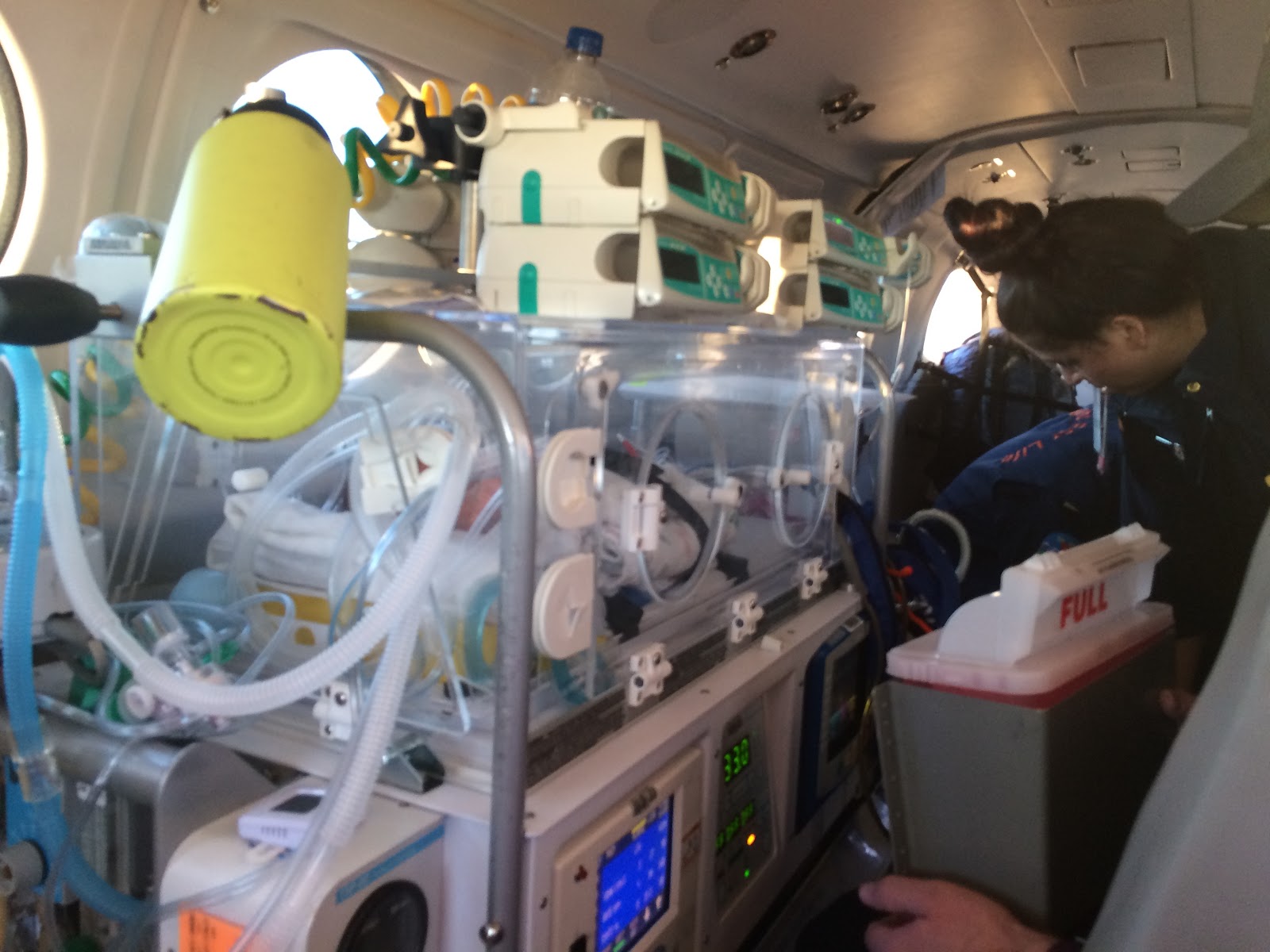
In NICU, our baby was stabilized but still struggling. We were informed he needed to be transferred to a hospital across the state, and that a flight for life crew was coming to get him. Our boy was intubated and placed on a respirator. And, a mere few hours after giving birth, my wife was rush-discharged so she could sit on a jumpseat in a tiny airplane with our baby boy, who was covered in wires and alone in a plastic box on a gurney. We had not even had a chance to hold him.

Private flights are apparently how our little man rolls
[image: newborn infant in an incubator, barely visible behind tubes and wires,
inside a flight for life plane, with a medical attendant.]
His plane had no room for me. I had to drive seven hours to get to the hospital. I had been awake for 35 hours straight, and had 20 more before I would see sleep. It felt like everything in my body hurt, my blood, my teeth. Everything humming in pain.

This is the end of the bad stuff. Our baby’s vitals were great on the flight. Immediately after admittance on the receiving end, he was taken off a respirator and began only getting oxygen by CPAP. My wife texted me pictures of her finally holding her baby boy, thirteen hours after he was born. I cried in relief. By the time I arrived, he was taken off the CPAP was and just getting oxygen. The next day he was taken off of oxygen and breathing fully independently.

We had planned for a lot of things, but never this. Life was wonderful, we had our baby. We could hold our baby. Eventually we would leave the hospital and start our life as a family.

On the morning of the second day in NICU, we had the composure to finally discuss what had happened. My wife was not yet aware that our baby had stopped breathing. I told her about the walk down the hallway. Told her what I felt and feared. She told me the first 24 hours of our baby’s life was both the best and worst day of her life, all wrapped in one. We talked about how powerless we felt, how afraid, how unsure and helpless and paralyzed by the unknowns of what would happen and what the future looked like, if there was a future. It was awful.

The neonatal nurse practitioner walked in while we were discussing what had happened. Every day she works, she sees people processing these same experiences. She has had this discussion with thousands of people.

She told us we needed to grieve. Grieve to process what had happened. That our baby did not have a normal birth. That we needed to move through the stages of grief to acceptance. That this would help us.

I was dumbfounded. It was a surreal moment to process that I was indeed a parent, getting the advice I have been told for years I would only understand as a parent.

Bullshit! We have nothing to grieve, as we have lost nothing. The story of our baby entering the world contains an eventful day and the expectation of some epic medical bills. Telling us to grieve takes away our agency. We wanted a baby. We have an amazing baby. Sometimes babies enter the world this way. Nobody did anything to us or stole anything from us. And oh my goodness is our baby amazing! Our baby, a matter of weeks old, is already showing us he is a smartass. He’s going to run circles around us. Our baby will be equally amazing if he has atypical development. He probably will, born to an autistic dad and two older parents.

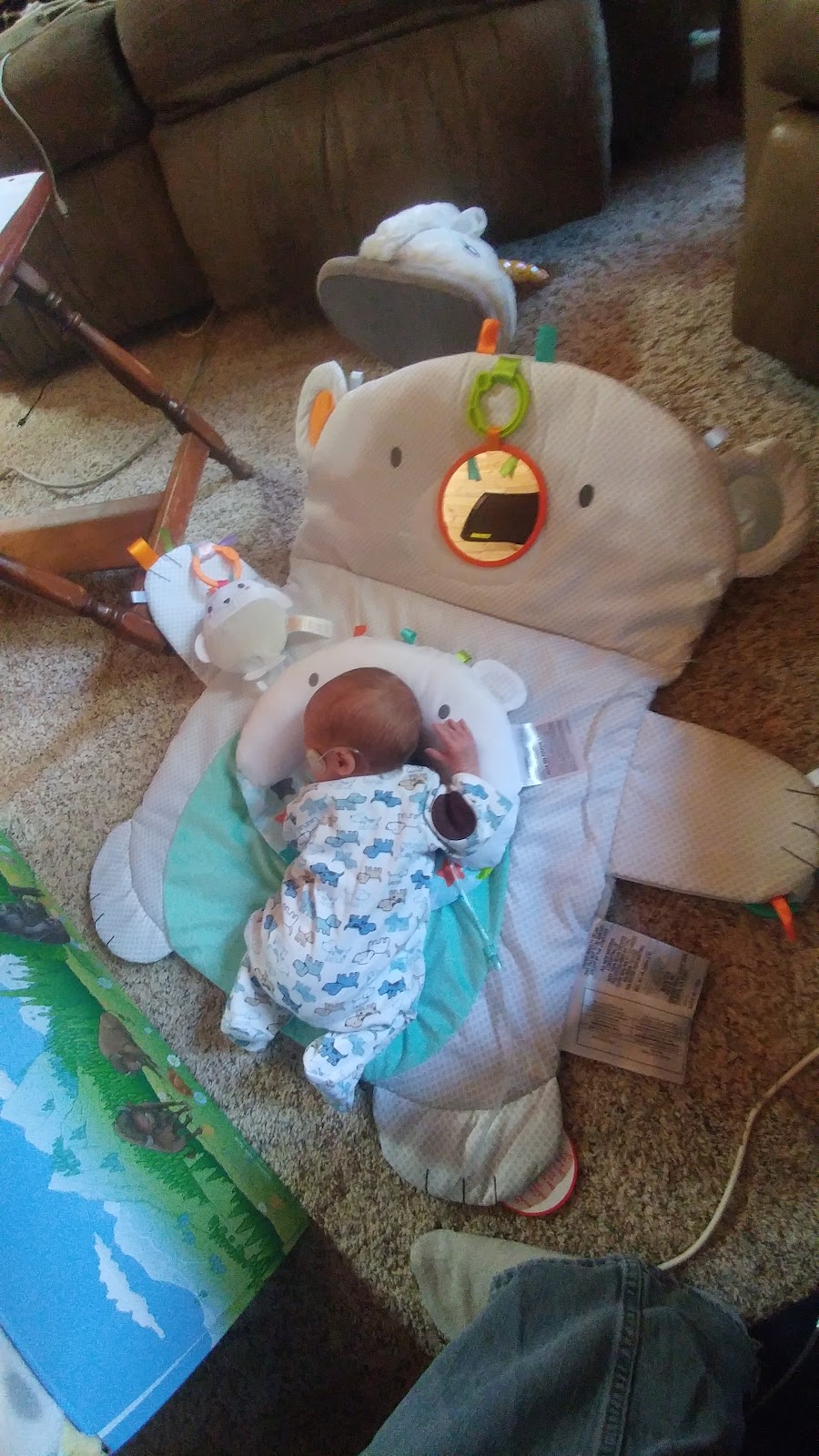
Home.
[image: Newborn baby on its belly, seen from above, lying on a
fuzzy mat on an even bigger fuzzy bear cushion.]
This experience isn’t grief. I’ve talked with thousands of parents of autistic children who are still processing what it means to have an autistic child. I hear expressions of fear. Their roadmap of expectations of what the future holds for their child has been taken away, replaced with uncertainty. Doubt. Worse case scenarios running wild. They experience the exact same types of emotions that we experienced in a very acute, very severe way on our baby’s first day in this world.

We are failing these parents by telling them to grieve. What we need to give these parents is empathy. Their fears need to be acknowledged. They need support to build a new roadmap to process their fears. To move to hope, understanding, and of course, acceptance.

Our autistic community has millions of people who have been through this process, and yet we continue to fail new parents, leaving them susceptible to subjecting their children to harmful sham treatments, to traumatic experiences, to quantifiable harm to their children that they love dearly—chasing that thing that they were told they lost, that thing that snake-oil salesman promise to retrieve—that unfortunate idea of normal.

We can do better.
Share:

Autism and Intense Interests: Why We Love What We Love and Why It Should Matter to You

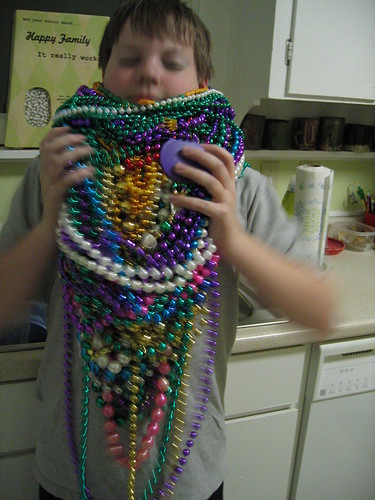
mardi gras bead overload
Photo © Deanna | Flickr/Creative Commons
[image: White child with short brown hair holding up
a massive bunch of colorful Mardi Gras beads.]
Maxfield Sparrow
unstrangemind.com

If you know an Autistic person or are Autistic yourself, you are familiar with the intense interests and consuming passions that we can get so engrossed by that we forget to eat, sleep, or even use the bathroom. While not every Autist has one or more deeply-lived interests*, the laser-focus with which we can approach preferred things is generally considered one of the hallmark traits of autism.

An Australian research study from 2016  demonstrated the tremendous value of going directly to Autists, by asking us about this tendency in order to discern our motivations. The researchers wanted to answer the question: why are Autists drawn with such intensity to the things that catch their interest? To that end, they developed a 20-item, self-administered assessment called the Special Interest Motivation Scale (SIMS). Statements about why one pursues one’s deep interests such as “because I enjoy broadening my knowledge about my special interest” were ranked on a seven point Likert scale.

The 20 items were divided into five broad categories:
  • Personal life values and goals
  • Intrinsic interest and knowledge
  • Prestige
  • Engagement and “flow”
  • Achievement
Based on the results of the SIMS—from 158 professionally-diagnosed Autists (86 males and 72 females), 185 non-autistic parents of Autists (35 males, 150 females), and a control group of 267 people with no autism and no psychiatric history (193 males, 74 females)—the study found that Autists had a higher motivation to pursue interests than non-autistic parents or controls.

The highest particular motivations were intrinsic and associated with “positive affect”—in other words, we pursue our interests because it makes us happy. This is one of the best, most accurate scientific studies of an Autistic trait I’ve ever seen. That’s exactly why we pursue strong interests -- it is inherently satisfying and fulfilling to us.

While some intense interests can lead to satisfying careers, it’s important that our interests not be considered valid or valued according to monetary measures. I see so much emphasis placed on turning intense interests into a career; just last week on Twitter many Autistic adults were debating with a therapist who had said that no Autistic child should be permitted to pursue any intense interest that would not lead to a career.

A valid argument the Autistic adults were making was that you can’t predict whether an interest would lead to a career or not—some do and some don’t. Some topics that seem ill-suited for vocational purposes lead to a life’s calling, while some rather mainstream interests like math or history have not turned into a career for the Autists who intensely pursued them.

But setting that argument aside for the moment, how can it be good for a child to forbid them to pursue an intense interest that is bringing them deep joy and feelings of self-worth and satisfaction? Yes, of course children (and adults!) cannot spend every waking moment pursuing an interest to the exclusion of all other activities. But the therapist with whom we debated talked about preventing all non-vocational interests.

Do we insist that non-autistic children cannot watch their favorite cartoon because it is not likely to lead to a future career? Of course we don’t! Most parents will not allow their child to park in front of the television 24/7, but the thought of telling a child they cannot ever watch Steven Universe because it will not lead to a good career is absolutely ludicrous! Do not hold Autistic children to unrealistic standards their non-autistic peers are not held to.

But there is a more serious reason still why Autistic people of all ages should be encouraged to spend time pursuing their intense interests. (Yes, I said encouraged to pursue their interests, not merely permitted to pursue them.) Whether an Autist is deeply interested in calculus or crochet, plate tectonics or toilets, history or license plate numbers, astrophysics or plucking blades of grass, being encouraged to spend time with those interests is vital for preserving our mental health.

The Autistic members of our human family are in crisis. Anxiety and depression occur at alarmingly high rates, and our rates of suicidal thoughts, attempts, and completions are horrifying. Encouraging Autists to spend time with our intense interests is not enabling or coddling us. It is crucial to our well-being, happiness, thriving, growth, and -- overly-dramatic though it might sound to you -- keeping us alive. Whether it’s categorizing every leaf from every tree in the neighborhood or taking 127 photos of the cat doesn’t matter. What matters is that the interest is special to us, of our own choosing, and warmly encouraged. I am not being hyperbolic when I tell you this is a matter of life and death for us.

The Journal of Autism and Developmental Disorders published a study last month which found that being accepted (or not) was significantly correlated with levels of depression among Autistic people. Let me spell what that means out for you: not accepting an Autist’s intense interest directly contributes to their depression. Accepting and encouraging an Autistic person to be true to themselves is healing and healthy.

When the researchers ran multiple regression analyses of their data, they found that being pressured to “camouflage” Autistic traits also makes Autistic people depressed. This means that it is counterproductive and harmful to have the goal to make an Autistic person “indistinguishable from their peers,” because that is the sort of pressure that leads to the shockingly high suicide rates researchers keep finding whenever they study us.

Oh, and the acceptance that Autistics need in order to be happy? The study found that it must come from within as well as from without. It’s not enough for the world to accept us; we must accept ourselves. I’m here to tell you that it is a tough task, trying to accept myself when the world clearly does not accept me. Autism acceptance from within is so much easier when I meet acceptance from without.

Autism acceptance therefore does not mean valuing me and my interests because they could earn me money some day—it means valuing me and respecting what I value, because I am a worthy human being deserving of dignity and happiness. I work hard to build up my own sense of self-worth, and encourage other Autistic people to build up theirs as well. Imagine my heartbreak and anger a few days ago when a parent commented on my YouTube video supporting suicidal Autistics and encouraging them to develop tools of self-acceptance and told the world that their child’s life was pointless because she would never marry, hold a job, or live independently!

Don’t bother looking for the comment; I removed it. But I am still reeling from it. How could a parent think it was okay to say their child’s life was pointless? And how cruel does a person have to be to say such a thing on a resource meant to help keep suicidal people—people like their own child—alive and aiming toward happiness? Cruel seems too mild a word for it. It was an evil thing to say.

Your life is not pointless. Your child’s life is not pointless. It doesn’t matter whether a person marries or not. It doesn’t matter whether a person drives, holds a job, feeds themselves, gets dressed without prompting, or not. No one’s life is pointless!

As Jesse Jackson told my generation on Sesame Street, whether you are poor, young, on welfare, small, make mistakes, have different clothes, a different face, different hair, are black, brown, white, speak a different language—no matter who you are, you must be respected, protected, never rejected, because you are somebody.

So the next time you are tempted to tell an Autistic person their interest is silly, trivial, a waste of time, weird, or pointless, stop—and remember why we love what we love. We are somebody, too, and we must be respected, protected, and never rejected. Encourage our intense interests. And if you are Autistic, do not feel ashamed of or guilty about your intense interests.

We love what we love because we are who we are. And that is a beautiful thing.

----

*While the standard term for these deeply satisfying interests is “special interest,” I only use that phrase when I’m quoting someone else. It’s a point on which I differ with a large number of Autists, but I don’t like the term “special interest” (often abbreviated as “SI”.) I feel like it belongs in the bin with similar terms like “special needs” and “special education.” As the Down Syndrome community’s public service campaign reminds us, our needs are not special.

I would argue that the only thing “special” about our interests is their meaning to us; our interests are special to us.

I don’t call them “special interests” because we don’t say Bob Ross’ interest in painting was “special” or that Dr. Richard Feynman had a “special interest” in teaching. Being passionately consumed with a topic is a positive trait and I feel like calling it “special” just because the person being passionately consumed is Autistic is unnecessarily “othering.” Autism is a difference in intensity and frequency of traits found in non-Autistic people as well.

However, many Autists do embrace this language and love calling their passions “special interests” and I do not fault them for it. If you are not Autistic and are interacting with someone who is Autistic you should always follow their lead as far as what language they would like their identity and experience to be framed in.
Share:

The Best Bar Mitzvah Boy

Todd Drezner
www.lovinglamppostsmovie.com

Dov and Sam | Photo © Brad Alpernin
[image: Two white Jewish pre-teen boys, wearing suit jackets and ties
at their Bar Mitzvah service, posing together and smiling for the camera.]  
We told our son Sam that there is no applause at Bar Mitzvah services. But when he finished his speech, a wave of clapping and cheering burst forth from the crowd—a genuine display of emotion that no religious custom could have stopped.

There was a lot of feeling behind that applause. Love, certainly. Appreciation of a job well done. But also amazement. It’s probably safe to say that not everyone in attendance had expected to see what they’d just seen. And here is where the story gets interesting.

But first some background. A Jewish boy becomes a Bar Mitzvah when he turns 13 (a Jewish girl becomes a Bat Mitzvah). Traditionally, the Bar Mitzvah leads a Shabbat (Sabbath) service, the heart of which is when he chants from the Torah (one of the five books of the Old Testament).

As anyone who’s ever done it can tell you, reading from the Torah is tricky, even if you’re fluent in Hebrew. Unlike standard written Hebrew, the Hebrew of the Torah has no vowels. Without them, you can’t know simply by looking at the words how they’re pronounced, or in some cases what words they are. Thus, the only way for a 13-year-old to “read” the Torah is really to memorize it.

But even if you’ve done that, you’re still not done. Because the Torah is not just read, but rather chanted using a complicated melody with origins going back centuries. Again, the best way to do it is to memorize it. And it helps if you can sing.

If you were to design a kid with the characteristics needed to perform well under these circumstances, you would probably wind up with someone very much like Sam. He can recite entire Pixar movies from memory, along with various Kristen Wiig sketches, iPad puppet shows of his own creation, and conversations that happened years ago. Five minutes of Torah was a breeze.

Then, too, Sam has perfect pitch and is a great mimic: he can even match pitch with our bathroom fan and tell when it’s malfunctioning. Once he heard the Torah portion chanted correctly, he was able to chant it note-perfectly.

So my wife and I were confident that when it came to the heart of the Shabbat service, Sam would be in good shape. But still, it would not necessarily be easy. Sam had no real experience speaking in front of a large group. He has significant anxiety. His focus and attention can wander easily, and it wasn’t clear how well he could maintain his concentration over a 90-minute service.

But my wife and I knew that when we set a goal for Sam—or he set one for himself—he could achieve it as long as he had the necessary support. The key was to start early, and to find people who could help Sam learn what we knew he could learn.

Fortunately, there were lots of people who could help.  Most important was the fact that Sam would share the service with his cousin Dov, who lives with my sister and her husband a mile away from us in Brooklyn. From the time they were toddlers, my typically-developing nephew was a bit of a Sam Whisperer. When they were two, he would look over at Sam in his car seat, turn back to us, and say matter of factly, “Sam’s not talkin'.”

And ever since then, Dov has been exquisitely sensitive to Sam, knowing not only when talking was too much, but also how to draw Sam out of himself and into the world. Having Dov co-lead the service meant that Sam wouldn’t have to do everything. More important, there would be someone there whom Sam loved and trusted, and who could gently direct his attention to where it needed to be. Of course, my nephew had his own Torah portion to learn and speech to give, but the kid is talented. And he had backup from his younger sister, Sam’s other cousin, who’s also deeply practiced in the ways of Sam, and was sitting in the front row. They were our aces in the hole.

So we were confident Sam could do his part to lead the service. But would it mean anything to him? With all the logistics that come with raising an autistic kid—finding the right school, setting up therapy appointments and swim lessons, building a community that would love and support Sam as he is—we had neglected the small matter of providing Sam with a formal religious education.  We observed major Jewish holidays and occasionally went to synagogue, but to the extent that Judaism is the story of a people, it was a story Sam didn’t know.

Fortunately, a member of our synagogue had a lot of experience providing Bar Mitzvah tutoring to kids with disabilities. We went out for coffee with him. “A lot of parents tell me they don’t think their kid will be able to do it,” he told us. Knowing a set-up when I heard one, I joked, “I don’t think our kid will be able to do it.”

But, as we already knew, he could. Sam and his tutor started meeting in March of 2015, a full two-and-a-half years before the scheduled Bar Mitzvah service. Together, using unusual combinations of action figures from Frozen, Monsters Inc., and The Incredibles, they acted out stories from the Bible, a process they would use to make their way through most of the Old Testament by the time of the service. Sam is not a rabbinical scholar, but he now knows his Abrahams, Isaacs, & Jacobs, and his Sarahs, Rebeccas, Rachels, & Leahs.

And the tutor started teaching him Hebrew. Sam picked it up with the same hyperlexic ability that had him reading English at three years old. We were just about set.

The last element of the service was perhaps the most challenging. A Bar Mitzvah gives a “D’Var Torah,” a speech in which he’s supposed to offer an interpretation of his Torah portion. Because of Sam’s language processing delays, he would have trouble understanding his portion. And writing did not come easily to him.

Together with our rabbi, we decided that Sam would offer a few basic thoughts about his Torah portion, but would spend the bulk of his speech focusing on what he loved about his family members who were there to support him.

Though we helped him a bit with the writing and the organization of the speech, the thoughts were Sam's. We often remind others that although Sam presents as a younger child because of his language processing delays, he has as full a personality and thinking as complex as any other young teenager’s. We worked with him to help shape the thoughts we already knew were there. He spoke in an Irish accent and a French accent, to mimic characters that his beloved uncle created for him. He told his cousin that he’s loved him for as long as he can remember, “And I can remember a lot.” When he listed the reasons why he loves me, he started with, “Daddy, you do my laundry.”

Sometimes, he didn’t realize how funny he was being. (I think he’s honestly very happy that I do his laundry.) But for our guests, who had already seen him chant his Torah portion and were now laughing at every line, he was a revelation. The applause washed over him like the climax of an after-school special.

What, exactly, was that applause for? Had they doubted him? In some ways, the reaction of our guests wasn’t a surprise. I have a large extended family, and when we’re together, it’s a bit overwhelming for Sam. He tends to withdraw in those situations, and so many of our guests had only seen him spend a lot of time pacing back and forth at the edges of various ballrooms. They were surprised to see him thriving as the center of attention. And even among our friends who had spent more time with Sam, the reaction tended toward amazement. Sam had outperformed expectations.

The fact is, very few people at the service understood Sam’s capabilities as well as my wife and I did. We always believed he would do well because we knew he was capable and had worked hard. But to our guests, it may have seemed like his performance came out of nowhere.

To some extent, this demonstrates the continuing thrall of the word “autism.” All of our friends and family know of our commitment to autism acceptance, and to a person, they support it. Indeed, many of them have been vital to helping us build a community that is welcoming to Sam. And yet, even having done so, they may have been surprised to see him excitedly greeting guests outside the synagogue. They may not have been prepared to see him seeking out eye contact with each person he mentioned in his speech. No one necessarily doubted an autistic person could lead a Bar Mitzvah service. But perhaps no one expected him to enjoy it so much.

As autism has become more common over the past 20-30 years, autistic people and their allies have tried to move beyond “awareness” to “acceptance.” But there’s still not a lot of talk about “joy.” Too often, there’s a misconception that acceptance means only accepting behaviors that are considered non-standard, or accepting that an autistic person may not hit the same milestones as a non-autistic one. Yet acceptance can lead to moments like Sam's Bar Mitzvah service.

Sam chanted from the Torah so well because of the strengths he derives, in part, from autism. He gave a speech about all the people he loves because they accept him as he is, rather than trying to change him. The end goal of acceptance isn’t a life that you trudge through pushing away your wish that your kid could be typical. Rather, the goal is to find the joy, and to celebrate your child, as he is.
Share:

Why Everyone Should Read The ABCs of Autism Acceptance

Patricia George
www.persnicketypatricia.ca

image: Book cover, with white text reading "The ABCs of Autism Acceptance" on a background of multicolored representations of letters of the Roman alphabet, above black text on a white background, reading, "by Sparrow Rose Jones."
The ABCs of Autism Acceptance
[image: Book cover, with white text reading
"The ABCs of Autism Acceptance" on a
background of multicolored representations
of letters of the Roman alphabet,
above black text on a white background,
reading, "by Sparrow Rose Jones."]
I’ve been an avid reader my whole life, so when I was asked to review The ABCs of Autism Acceptance by Maxfield Sparrow, and saw that it was "only" 152 pages, I thought, "this won't take long to read, so sure, I'd love to!"


I was wrong. This is the largest 152-page book I've ever read. In fact, I wrote more notes for this book than I did for a 500-plus page book I reviewed in 2015.


The book's title is straight-forward: Maxfield uses the Roman alphabet as a way to educate the reader about autism acceptance from an autistic person’s point of view, while interlacing quotes and links from other Autistics. The resulting resource makes this book an invaluable asset to furthering Autistic acceptance.


The ABCs of Autism Acceptance started out as a self-challenge for the author during the controversial month of April. I remember the post in which Maxfield began discussing this undertaking. I also remember thinking, what a fantastic idea! It was time to take April back and show why, without acceptance, autism awareness is actually a huge disservice to autistic people. 


Sparrow also aimed to make this book relatable to a diverse audience. Something a fellow Autistic could read, but so could our siblings, our teachers, our doctors, our friends ... and other people too. Especially people well outside our ally circle. We need them all!


As I looked over my sixteen pages of notes, I tried to think of a direction to take this. My pattern recognition noticed certain words appeared over and over again: 'acceptance,' 'dignity,' 'respect,' and 'Autistic.' And I noticed my notes had certain quotes from the book that I circled and underlined, with  exclamation points. I want to share how those quotes make me feel as an Autistic person. (Props to the book for helping me feel more confident about capitalizing 'Autistic.')  


“Autism acceptance is seeing us as whole, complete human beings worthy of respect.” (pg. 13)


Everyone needs to read and absorb that sentence. Autistic people are not broken versions of our normal selves. Living life feeling that way is an early death sentence. I feel like this needs to be the benchmark for how we're treated. If you're not seeing us this way then you have some work to do.

“Do not expect us to harm ourselves in order for you to feel as if we care for you. Respect our ways of being, our ways of knowing, our ways of loving.” (pg. 42)


Coming into being autistic later in life means I've struggled with just how much love has come to mean pain for me, in one way or another. And I don't mean things like heartbreak, from the loss of some one/thing/place.

When I write "love has come to mean pain for me," I'm remembering all the times I took on the weight and overload of a person/place/thing, etc., and it ended up costing me self-respect and dignity. I struggle 'til this very day with a choir of ghosts-of-the-past in my head, singing “everyone hates you."

Autism awareness does absolutely nothing to fix these kinds of crises for autistic people. "Awareness" would like you to think the crisis is us, and the increase in autism diagnoses. But the crisis is really what's not happening for us.

“ ... above all we need autism acceptance because we will never get our healthcare needs met until we are fully recognized as deserving of respect and dignity, and until we are widely understood as valuable not for what we can do, but for who we are.” (pg. 59)


I went a decade, my entire 30's, without a doctor. Various medical professionals still don't take my over- and under- reactions to medications seriously. Just last week, I was totally shut down by a doctor because I said there was a link between Ehlers-Danlos syndrome and Autism, and the doctor took umbrage with that. 

I knew autistics had trouble being taken seriously by medical professionals before I read Sparrow's book, but now I've confirmed that I am not alone in experiences like these. Autism "awareness" fails us Autistics, time and time again.

“Awareness without acceptance is fear. Fear of autism hurts Autistics. A culture of fear leads to murder.” (pg. 76)


This really hit me hard. One of the most sobering things I've ever experienced in my life was the reading of the names of people with disabilities who had been murdered by their parents—at the time 70 people in five years—for the 2015 Disability Day of Mourning. I read a poem from a past submission of another autistic poet. I participated online.


The number of autistic and disabled people killed grows, and doesn't slow. Awareness isn't making this horror any better. Awareness get murdering parents put on TV, and people somehow rationalizing parents' killings of their disabled children. This is why acceptance is desperately needed. It will save Autistic people’s lives!


“When a person pushes me to overload, especially when they over-ride my protests to do so, I experience a massive loss of trust for that person.” (pg. 91)

Having someone push me to overload after they've been educated about, and agreed to, the boundaries I put in place to help me with things like trust—that is something I really can't take any longer. I pay such a huge personal price. That relationship doesn't stand much of a chance, not without big changes on their part.


I feel like I lose my dignity when I melt down, even though I know it's not my fault. If the person pushing me past my boundaries into a meltdown was able to see me through a lens of acceptance, would they still act that way, still insist on hurting me? I doubt it.

I deserve to maintain my dignity. It's so hard to have it stolen away. 

And besides, we Autistics are pretty loyal people. Why wouldn't you want our trust?

“When comparing myself to all women, I feel lost and alien. When comparing myself to Autistic women, I feel a sense of belonging.” (pg. 134) 


Awareness would make you believe Autistic women couldn't possibly even get along. And awareness still tries to erase us with outdated statistics. But I, and countless other Autistic women, will tell you a very different story.


I was recently on a women's panel at an autism conference, with two Autistic women in our 40's, and two in their 20's. We were all so different—but our commonalities were so powerfully connecting that our differences became things to celebrate. We don't just need acceptance from society, we also need to accept ourselves, and it is imperative to have reflections of ourselves,  to allow that to happen.

I ended up reading and writing this review in April, and took The ABCs of Autism Acceptance many places with me: It went to a lunch where an Autistic woman close to my age saw herself reflected back as turned the pages, which made her light up. I took it to my doctor's office and she said she'd like to read it.


It's important to get to know this book. Sparrow has, in my opinion, succeeded in what he set out to do: create something that a diverse audience could read and learn from. I came away with so much new knowledge and validation, and a desire to learn more.


I'll leave the last words to the author; powerful words that when turned into action can make autism acceptance truly possible:


“Cherish our yes, respect our no.” (pg. 135)


----
 

Note: All page numbers are from the paperback version of the book.
Share: