Showing posts with label language. Show all posts

Being Hyper-Verbal Is A Real—And Disabling—Autistic Experience

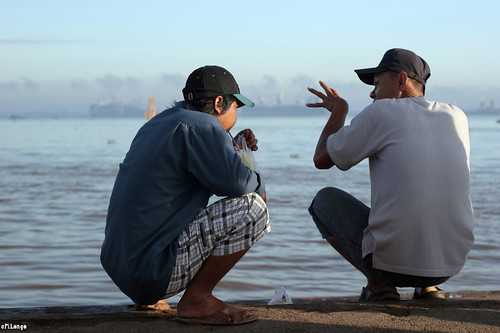
Two Vietnamese men, seen from behind, wearing billed caps and squatting as they have a conversation. The man on the right is gesticulating with his left hand
Photo © ePi.Longo | Flickr / Creative Commons
[image: Two Vietnamese men, seen from behind, wearing billed caps and squatting as
they have a conversation. The man on the right is gesticulating with his left hand.]

M. Kelter
www.TheInvisibleStrings.com

Content note: This article discusses suicide risk factors specific to the autistic experience.

I worry that too many people think of hyper-verbal autistic speech as being synonymous with "articulate" or "fast" or as something purely beneficial. This is actually not correct. Hyper-verbal autism is autism, and it is a disability. I want to provide a few details about how it generally works, so that I can draw a line connecting it to what people generally think of, when they think of autism.

I am on the spectrum, and I was fortunate enough to spend a few years working with a specialist who taught me the parameters of my particular way of engaging with language. We found that my verbal processing tends to create difficulties for me when it connects up with three factors: Emotional volume, thought speed, and social pragmatics.

What I am going to describe here is the way hyper-verbal speech works for myself—one, non -representative individual—and the way that these factors are exactly what you would expect to find in the realm of autism.

Some who have children with significant degrees of intellectual disability feel like conversations like this can obscure what they call "real" autism. But this, too, is incorrect. The distinction they are making only manages to cut the common thread that connects varied autistic experiences into a coherent neurological profile.

To explain what I mean by that: there simply is no reason to see different experiences with autism as mutually exclusive, as if they are in competition for territory. Autism is a disability that impacts communication. And because there is predominantly a genetic basis—there are currently 102 genes associated with ASD—you would actually expect for people on the spectrum to be very different from one another. The genetic complexity means that people are taking many different neurological pathways into an autistic profile.

The unifying component of autism is communication, not the many individualized forms communication can take. If you focus only on differences at the expression side of autism—whether someone is verbal or non-verbal—you are going to skip over that essential shared ground. Variations are not invalidating of a diagnosis, they are what you would expect to find in a condition this genetically heterogeneous.

So, that's how the different types of autistic communication link up, but I do want to go into some detail about accelerated language since it is one of the ways that autistic communication happens.

Take that word "accelerated" and think of hyper-verbal speech as an accelerant or a fuel, something combustible that can turn volatile when mixed with the wrong variables (like fire, for example). Then take that accelerant and throw it on a mood.

When words are naturally assembled in such a way that they bring a detailed, granular focus to an experience, it can become quite destabilizing if that experience is an emotion. The words take the volume of a mood and turn them to a much higher level.

Hyper-verbal autism is no joke. It is not an affectation. When anger or depression or self-hatred gets a boost from this kind of added intensity, it can be very difficult to steer in a better direction. The interplay between mood volume and hyper-verbal speech is under-discussed and under-appreciated as a risk factor for suicide in autistic people. Please believe me when I tell you this.

These concerns include risks for children, as well as teens and adults. If you are a parent and you do not believe me when I say this kind of speech can be extraordinarily difficult to manage, ask another parent of a hyper-verbal autistic child. I am quite confident that they will tell you, at least in many cases, that the internal fights these children go through as they battle with their own words; it can be a terribly difficult situation.

If we are thinking of words as a kind of fuel, thoughts are what drive the vehicle. The speed with which words can form and race to new and varied patterns can make concentration a daily, hourly nightmare. I am rarely able to concentrate. Simple tasks are not simple. Every possible thought is instantly ten alternate thoughts that quickly grow to a hundred and then more and when you take that head space into a grocery store or a school test or a job interview, most of every day can feel like an incredibly frustrating obstacle course.

That's internally. Externally, people interpret your concentration issues a lot of way. It can scan as not paying attention, as rude, as flighty, as indifferent, as lacking empathy (because you're too overwhelmed to notice subtle emotions and people, not understanding autism, feel neglected and inadvertently spread myths about empathy) and so on. The concentration issue alone can lead to significant degrees of impact and disability when it comes to daily functioning.

Take the mood thing, the thought thing and imagine how they play out in the middle of a real-time social interaction. It can be extremely disruptive. The impact of this kind of autistic speech can be significant and—due to the hostile reactions it receives from the rest of the word—it can easily lead to depression and social isolation.

Via front-line observation, I can report to you that in social contexts, hyper-verbal autistic speech functions like a chain event. As a child, I had social needs, I liked approaching other kids and sharing my thoughts, but that's now how interactions work. You have to know the social codes and hidden social rituals, and my words blew past all of that like a boulder going downhill. I would approach kids and start talking out of my head in a deluge of monologue, and that only ever drove kids away, or elicited bullying (aka violence). Mood disorders and social isolation ensued. It was a chain event.

To be clear, the answer back then would not have simply been to have me talk less. People tried that, but it didn't take because that's not how autism works. The answer would have had a lot more to do with changing the way people react to autistic differences, but we can take that up in another post.

If you are someone who generally believes that hyper-verbal autistics are arrogant, or have it easy, or that they do not have "real" autism: please know that you do not understand what autism is, and you are not helping autism conversations. What you are doing is are disparaging a group that doesn't need more disparagement. My only hope is that you can sense that I am trying to share good information with you here, and that you do not need to shout at autistics on twitter because they said a thing.

I honestly believe people will have an easier time understanding the autism spectrum the instant they stop creating nonsensical barriers between autistic people and their lived experience, and the ways that they engage with communication. New school, 2019 autism is simply a better conversation to have. I did not like the old one.
Share:

What Good Representation of Autistic Characters Looks Like, Part II: Diversity in Autistic Characteristics and Demographics

Elizabeth Bartmess 
elizabethbartmess.com

This is a three-part series. Part I explores autistic interiority and neurology. Part III explores Setting, Plot, and Character Growth. 

In Part I, I talked about how neurological differences affect autistic people's internal experiences and strategies, and how we change over time as a result. Today, I'll talk about variation in autistic characteristics, in our and others' relationship to our diagnosis (or lack of it), and variation in demographics, as well as how others' perceptions of us influence how they treat us, and how we change in response. On Friday, I'll bring everything together and add some thoughts and links to advice on writing autistic characters, along with a list of some common aspects of autistic experience that are underrepresented in fiction, plus a list of all the books and short stories I've mentioned.

Even though autistic people have many things in common, we also vary a lot. Ideally, fiction reflects this, for multiple reasons: it's accurate; it helps autistic people be correctly identified as autistic even when we don't meet stereotypes; and it helps more autistic people see ourselves reflected and understood in fiction.

Representing our range of variation is a task for fiction as a whole—no single book or short story can capture our diversity—but on the level of an individual book, good representation means portraying realistically how a character's (or characters') particular configuration of autistic and demographic characteristics affect our experiences.

While reading, keep in mind that every autistic person is an individual with their own specific life experiences and personality; our specific autistic and demographic characteristics influence us but they aren't the sum total of who we are.

I also want to be clear that stories I list in this series are by authors who are already creating good representation; when I talk about how some things are underrepresented, the problem lies with the large amount of crap representation that I'm not including in this series. The best way to increase representation of underrepresented autistic characteristics and demographics is for agents, editors and publishers to replace bad representation with good representation that portrays diverse autistic experiences. (Supporting individual authors through Patreon or other crowdfunding platforms is also a good option for people who can afford to do so.)

Autistic People Differ, and Others Are Often Mistaken About What Those Differences Mean

Autism is “a combination of impairments in cognition, communication, sensory perception, and movement [which] combine in different ways.” Our specific configurations of neurological differences vary; the strategies we develop to deal with them vary; and our corresponding experiences vary. For example, one person with executive dysfunction that makes it hard to be on time and stay organized might develop extensive, effortful tracking systems, at the cost of having energy to socialize; another person might decide to reserve their energy for interacting with other people, and instead try to diffuse others' reactions to their being late or disorganized. These two people will have very different experiences.

[image: YA Book cover featuring a
depiction of a white-appearing person with
green wavy hair in one-quarter profile, on a
sea-foam background with white text above
and by their face reading "M in the Middle"]
Multiple stories explicitly reference this variation. M in the Middle and Experimental Film both give variations on a ubiquitous saying commonly attributed in real life to Stephen Shore: "If you've met one person with autism, you've met one person with autism." In a Wizard Alone (New Millennium Edition) one character notes that "there are probably as many kinds of autism as there are autistics" (location 631). In Harmonic Feedback, Drea's doctor notes that "No two people with Asperger's—or with autism, for that matter—are the same" (66). Iwunen Interstellar Investigations shows this variation by having a wide range of autistic characters.

Most people don't understand these differences well. There are very often discrepancies between the needs, abilities, and experiences a given autistic person has, and what other people attribute to them. Often, others think that if we do something once in one context, we can do it in pretty much any context at any time without much cost. They may also believe the converse—that if we can't do something in a particular context, we must be unable to do it in any context—which can mean our skills and abilities are underestimated and go unsupported or are responded to weirdly when do show them. Sometimes others attempt to mentally categorize individual autistic people into either an "essentially neurotypical" box or a "disabled and incapable" box, which misses important complexity that can make a huge difference to individual people (I won't go into this extensively, but if you want to read more, here are some links: 1, 2, 3, 4, 5, 6, 7, 8, 9, 10.)

Good representation might show these social dynamics in action, or describe them through narration. In Queens of Geek, Taylor's friend Jamie pushes her to join the Queen Firestone trivia contest at a convention, saying she can do it because she came to the convention "[e]ven though it’s a big deal for you. Even with the crowds, the noise, and everything, you haven’t seemed overwhelmed at all” (50). Taylor responds: "I planned this. I prepared for this. I knew this was coming for weeks....Just because I made it here doesn’t mean it was easy. And just because I don’t seem overwhelmed doesn't mean I'm not" (50-51), and then she excuses herself to have an anxiety attack in the bathroom, overwhelmed by everything including Jamie's assumption. In The State of Grace, Grace expresses frustration with other people's lack of understanding that social interaction is draining and she needs downtime afterward. In A Desperate Fortune, Sara's sister has helped her with social skills to the point that her parents won't believe she's autistic.

In "Difference of Opinion," Keiya thinks about the surprise and difficulty non-disabled people have accepting that she can be both disabled and communicate, or that she can judge her own quality of life, and that she and similarly disabled people can mobilize politically. In "Inappropriate Behavior," the pediatric neurologist who sees Annie doesn't listen when she tries repeatedly to convey an emergency situation to him, assuming that his interpretation of events must be right and that instead of trying to convey something important, she's engaging in inappropriate behavior that he sees his role as teaching her to stop.

In an accepting environment, like the planet of autistic people in Iwunen Interstellar Investigations or the planet of disabled people in This Alien Shore, these dynamics might be completely absent.

We change in response to the discrepancy between reality and others' misperceptions. Repeated experiences like this change our self-concept and our relationship to other people; they change how we expect to be treated, and how we approach and respond to new situations. In Experimental Film, Lois expresses something I've often heard autistic people express about growing up with a lifetime of experiences with having needs that other people don't share and may not believe in:
"I’d already learned a long time ago how the way other people thought about whatever I was doing at any given time was always the most important thing, and that when it came to my own desires—my own needs—there was no contest, none at all; they came last, always, not first" (locations 934-936).
Often, we wind up hiding access needs, or pretending we don't have them, even though it makes it harder for us to do things. In "Unauthorized Access," the protagonist can communicate more clearly through text, and would much rather do so, but doesn't, because others don't understand why it helps her:
"She could write out an explanation—hell, she could link one. But the last time she’d tried that, the response had been an irritated Just explain it to me; I don’t want to read all this stuff, and anyway not a lot of people really got how much more comfortable she was communicating through writing than through voice."
We may also hide skills. In "Difference of Opinion," Keiya has stopped doing anti-eugenics activism because of non-disabled people's reactions to her work. We may also learn to hide skills if they're misinterpreted as proof we don't have deficits, because we can't afford the withdrawal of support that may follow.

This is really important: Other people's beliefs about what we can and can't do—and their willingness to listen when we say what we can and can't do, and what kind of support we need—make a huge difference in our lives.

It's particularly valuable to portray how our abilities and inabilities vary, but that variation doesn't fit into neat categories; to show how our actual patterns of skills don't consistently match up with others' expectations; to show how context and support can be important; to show how draining hiding abilities and inabilities is; and to show how stressful trying to negotiate this with other people is. That involves a lot of work that often goes unrecognized; seeing it in fiction can be very validating for people who do that work, and it can also be informative for people who don't have to.

Having (Or Not Having) a Label, And The Many Experiences Surrounding It

The availability of the label "autistic," and whether we and/or other people know it applies to us, can play a complex role in our experiences, along with whatever life history we went through before learning we were autistic—if we learned it at all. In the absence of an explanation, we struggle with not knowing why we're different or treated differently. In a setting where the label exists, accessing it can still be quite difficult; stereotypes of what autistic people look and act like can result in providers misdiagnosing or failing to diagnose us and can prevent us from realizing we're autistic (something common for people who are female-presenting, and/or nonwhite, or adult, or who can speak or make eye contact or any of a number of other things).

Some people may not seek a diagnosis for themselves or for a family member because it may be unaffordable, or there may be no one knowledgeable in travel distance, or due to realistic fears about the diagnosis leading to medical discrimination for other conditions or being used against them in a custody battle, or because they don't currently need formal accommodations, or they judge that knowing they're autistic is enough, or because they've been trained to think of their attempts to get autism-related needs met as equivalent to hurting others.

If we're diagnosed and others know about it, we may get understanding and support, or we may get disbelief and dismissal, or we may get mistreatment and discrimination, or harmful or unhelpful therapy; or we may get all of the above.

The stories in this series reflect some of our varied experiences surrounding diagnosis. In The Real Boy Oscar is undiagnosed (no label exists where he is) and his struggle with not knowing why he's different from others is evident. In various other stories, protagonists are (or were) diagnosed as children. In M is for Autism, the diagnosis is a relief; in the sequel, M in the Middle, some of her teachers respond well and others don't. In Queens of Geek (diagnosed in high school) the diagnosis is a relief. The protagonists of Anything But Typical, "Inappropriate Behavior," and Harmonic Feedback have more complex relationships to their diagnosis, and more experiences of mistreatment when others know about it. In The State of Grace, Grace's diagnosis has helped her make sense of her experiences, even though teachers sometimes refuse to honor her very minimal accommodations and people sometimes say inaccurate and insensitive things to her about autism. Kiara in Rogue realizes she's autistic during the course of the book, after a neighbor suggests it and she reads about it in books and on the Internet (including reading some misinformation). In On the Edge of Gone, Denise, a part-Dutch, part-Surinamese Black teenage girl, received a long history of misdiagnosis despite clear autistic symptoms, due to racism and sexism:
"Therapists and teachers labeled me as bipolar, as psychotic, as having oppositional defiant disorder, as intellectually disabled, and as just straight-up difficult....At the time, I thought the diagnosis was delayed because I was bad at being autistic, the same way I was bad at everything else; it took me years to realize that since I wasn't only Black, but a Black girl, it's like the DSM shrank to a handful of options, and many psychologists were loath to even consider those" (210).
Sara in A Desperate Fortune was diagnosed as an adult; her parents refuse to believe her diagnosis, and she was given harmful misinformation by providers (such as being told she'd never be able to have a relationship). Rikki in Water Bound is undiagnosed and worries, incorrectly, that she's a sociopath, though other characters disagree. Lillian in "The Scrape of Tooth and Bone," set in an alternate Victorian era, was misdiagnosed with hysteria when younger (although, in one of the more optimal possible stories involving stigmatizing misdiagnosis, she got a vibrator out of it). Lois in Experimental Film had the common experience of realizing she was autistic as an adult after her child was diagnosed and she began learning about autism.

It's useful to portray similarities and variation surrounding our self-knowledge and diagnosis-related experiences in fiction because many people—including many autistic people—have misconceptions about how easy it is to get a diagnosis (not very), how accurate or inaccurate the diagnosis process is (autism is often missed), how knowledgeable providers are (often not very), and how knowing and not knowing we're autistic affects how we think of ourselves.

Demographic Variation

The demographic stereotype of autism is of a white middle-class cishet (or desexualized) boy or man. If a boy, the stereotype may be a nonspeaking bundle of "behaviors"; if a man, he's more likely to portrayed as a quirky genius with STEM talents and no significant disability. Neither of these stereotypes represent white middle-class cishet autistic boys and men well; they also result in people who don't that narrow demographic slot having even rarer good representation.

While I believe all the stories I'm going to mention portray autism well, I can't consistently speak to how effectively they portray all the other identities and experiences I'll talk about, though I've tried to be consistent with what I've seen autistic people in demographics other than my own. As with all things in this section, no group is a monolith: within a demographic, experiences will still vary; they can vary even for people who share multiple demographic characteristics in common. Finally, few issues are completely exclusive to one group, but some things affect some groups more strongly than others, and that can be very important.

Gender role expectations are complicated, contextual, and can be difficult to learn. Gender role expectations for (and by) girls and women tend to be particularly incompatible with autistic people's neurologies. Those expectations involve higher demands for accurate emotional caretaking of others, for managing others' executive function in addition to our own, for detecting unspoken expectations and rapidly complying with them, and for having fewer needs or at least avoiding displaying them (or, sometimes, to act like we have different needs than we do, so that people who do have those needs will feel more comfortable).

Good representation reflects this, when it's relevant to the character and story. In Queens of Geek, Taylor talks to her good friend Charlie about Taylor's gender nonconformity, which she worries will make it harder for her to have a successful relationship:
“Sometimes I don’t think I’m being a girl right. I have an undercut and wear clothes I’ve bought from the boys’ section, and I don’t wear makeup or do my nails. I watch horror movies and play video games and burp and swear and don’t talk about my feelings or any of that crap” (182). 
In The Scrape of Tooth and Bone, Lillian is expected to sit at home, "pretending to do needlepoint and having maybe one interesting robotics project per year," which she's uninterested in doing; she also comments to her love interest about how meltdowns conflict with gendered expectations: "I’m so ladylike and good most of the time and then I turn bestial at a moment’s notice, and I can’t control it." In M is for Autism, M says "Sometimes I find it easier to talk to boys than girls. I find boys straightforward. They just ask a question and I answer it. I ask a question and they answer it" (45).

Healthcare providers are less likely to diagnose autistic people they perceive as girls or women (which includes cis girls and women, many trans girls and women, many trans men who have not transitioned or don't pass as men, and many nonbinary people). Autism diagnoses have historically focused on boys (and to a lesser extent men), and this biases many people's expectations for what autism looks like toward a particular kind of presentation (which isn't universal to men or boys, but is more common for them). Providers are also less likely to diagnose people they perceive as girls and women even when they have the same presenting characteristics as boys and men. (The general tendency for healthcare professionals to take women and female-presenting people's concerns less seriously probably also plays a role in underdiagnosis.) In M is for Autism, M's counselor clarifies it's an "outdated view" that it's a boys' condition and that "[m]ore and more girls are being diagnosed with autism" (78). In Harmonic Feedback, Drea's doctor tells her that "females have less obvious symptoms" (66, although I think this is outdated now; a lot is known about what less stereotypical autistic characteristics look like, we just need healthcare providers to know what they are and to look for them).

This doesn't mean autistic men and boys don't undergo gender role pressures that are incompatible with autistic characteristics, or that healthcare providers always correctly diagnose autistic people they perceive as boys or men, even though the problems seem to be worse for other people; good representation can show this too. In Anything But Typical, Jason relates a story about how his mother bought him comfortable leggings in nursery school because he couldn't stand how the waistbands of pants felt; in kindergarten, when she heard other boys teasing him by repeatedly asking if he was a ballerina, his mother took away his leggings and made him wear pants.

Trans/nonbinary genders: It's common for autistic people to be transgender/nonbinary (I'm using a slash here because some nonbinary autistic people don't identify as transgender and some do). In this set of studies, autistic people were about three times more likely than non-autistic people to identify as a gender other than the one they were assigned at birth (overall, about 23% of autistic people assigned male at birth and about 33% of autistic people assigned female at birth).

There are multiple representations of trans and/or nonbinary autistic characters in Science Fiction and Fantasy (SFF), though I'm not aware of any outside of SFF. In "Iron Aria," an autistic trans man uses metallurgical magic against an opposing force (there is also a trans woman general, though I don't think she's autistic). Iwunen Interstellar Investigations features nonbinary autistic characters who are nonbinary in different ways having adventures. "Geometries of Belonging" includes a genderqueer autistic teenager. In "How to Become a Robot in 12 Easy Steps," the main character, Tesla, identifies as a robot (or wants to become a robot—they describe it in both ways), and it's implied that this also involves not identifying as their assigned gender. In An Unkindness of Ghosts, Aster (who is also intersex) describes her gender as "a boy and a girl and a witch all wrapped into one very strange, flimsy, indecisive body" (location 4441), and nonconformity to expected gender roles is one of various ongoing themes in the book.

Race and ethnicity: Of the good portrayals I've found of autistic characters, about a quarter feature autistic characters of color. (Not all of these are set in the U.S., but for comparison, the figure for the U.S. population is about 40%.) Several include commonly discussed issues among autistic people of color, such as underdiagnosis and misdiagnosis, increased risk of violence from police, and eugenics. There are other issues I've seen discussed, such as disability communities' failures to be racially inclusive and to take into account the way that racism combines with ableism, that I haven't seen portrayed; I'll include some of those on Friday in my list of common real-life things that are underrepresented in fiction.

In the previous section, I mentioned Denise's delayed diagnosis due to racism and sexism in On the Edge of Gone. In An Unkindness of Ghosts, set on a generation ship where the black inhabitants on the lower decks are slaves to the white inhabitants on the upper decks, the protagonist, Aster, has multiple encounters with guards involving violence or threats of violence; her difficulty with language and social interaction increase the danger. In "Difference of Opinion," Keiya includes her "brownish" skin color along with visible disability-related differences in a list of things that make her a eugenics target. In Rogue, Kiara, a character with an El Salvadorian mother, mentions that when she stopped speaking in kindergarten, her grandmother said (incorrectly) it was because she was learning two languages at once, similar to real-life situations where autism-related speech delays are inaccurately attributed to bilingualism. In "The Book of How to Live," Efronia is from a rural village; her accent is mocked by the city-dwellers and her contributions are taken advantage of by a university that previously admitted a cohort of ethnic minority students for long enough to complete a set of inventions, then rescinded their admission, imprisoned them, and kept the inventions.

In "They Jump Through Fires," the protagonist is of Mexican descent and part of the story involves family folklore. In A Boy Called Bat, the illustrations show Bat's father as Asian (and he's confirmed to be of Chinese descent in the sequel, due out later this year); in A Wizard Alone (New Millennium Edition), the autistic character Darryl is black; in The Someday Birds, Charlie's mother was Mexican. Two stories include an all non-white cast: "Grandmother-nai-Leylit's Cloth of Winds," noted in the author's story notes, and The Real Boy; the author notes in this comment that the characters are Middle Eastern and North African.

Sexual orientation: The set of studies I mentioned above for gender identity also looked at sexual orientation and found that about 70% of autistic people identify as non-heterosexual (with about a third of that 70% identifying as asexual), compared to about 30% of non-autistic participants.
A number of stories include autistic characters who are or were in a same-sex relationship. In "The Scrape of Tooth and Bone," there is a romantic subplot between the female autistic protagonist and another woman; in "They Jump Through Fires," the female character is mourning the death of her girlfriend; in This Other World, the female autistic protagonist is married to a woman; in Failure to Communicate, the female protagonist is attracted to both a male character and a female character; and in "Difference of Opinion," the autistic protagonist has had a past relationship with a man and a current one with a woman. "Carry the Ocean" has two gay men in a relationship, with homophobia as a major theme.

Several stories feature autistic characters explicitly on the asexual spectrum: In Kea's Flight, an autistic secondary character is an asexual lesbian in a romantic relationship with another woman, with a brief subplot surrounding her realization of her asexuality. In "How to Become a Robot in 12 Easy Steps," the protagonist self-describes as "probably asexual." In Iwunen Interstellar Investigations, one of the nonbinary characters is demisexual.

Other things: Various other demographic characteristics influence autistic people's experiences; here are just a few.

  • Age: In real life, older autistic people are often undiagnosed and invisible. This Other World features an autistic menopausal woman; in Experimental Film, the autistic protagonist is 44. In Harmonic Feedback, the doctor Drea sees mentions that he has other patients "of all ages—children to grandparents" (67; also, Drea's grandmother, though not explicitly autistic, shows some autistic traits).
  • Parenthood: Lois in Experimental Film is an autistic parent of an autistic child, which plays a role in the story; in Iwunen Interstellar Investigations, the protagonist has an autistic child. In This Other World, the protagonist has a non-autistic adult son.
  • Cultural setting: The contemporary real-world stories I found were all in Westernized settings, which at least partly reflects my inability to evaluate stories in languages other than English. (This is harder to judge for SFF stories.) Two of the SFF stories feature autistic characters living and working in cultures other than their culture of origin: This Other World and The Book of How to Live.
  • Socioeconomic status: Two contemporary real-world stories feature low-socioeconomic-status characters: Harmonic Feedback and Rogue. The SFF stories are sometimes harder to characterize—it's not always clear what the protagonist's situation is or what the surrounding economic system is like—but in "Difference of Opinion," Keiya works a menial job as a janitor; in Failure to Communicate, after leaving home but before the events of the story, Xandri spent a number of years living on the streets. (Also, although I'm hesitant to include this in with "socioeconomic status," in An Unkindness of Ghosts, Aster is a slave, as is Oscar in The Real Boy.)
  • Physical disability: In Experimental Film, Lois has chronic pain; in This Other World, Vonika is waiting on a knee replacement.

Conclusion

Autistic people vary. A given autistic person will have their own individual configuration of neurological differences, associated life experiences, and related skills and strategies; they will also have a particular life history surrounding their and others' knowledge (or lack of knowledge) that they're autistic, which may or may not include a formal diagnosis and/or misdiagnoses. They will also have particular demographic characteristics that can influence their experiences in a variety of ways, including via other people's responses. All this influences how we think about ourselves, how we think about others, how we approach new situations, and how we respond to those situations.

Autistic characters will vary in autistic characteristics, life history surrounding whether they know they're autistic (and sometimes diagnosis), and demographic characteristics and related life experiences. Not all of this will be relevant to a particular story, and not all of it has to be planned out or made explicit in the story, but good representation will usually specify—often but not always explicitly—the ones that are relevant, and show their effects realistically.

In the third and final part of this series, I'll bring all of this together with setting, plot, and character growth, along with the promised links for writers, list of some real-life things underrepresented in fiction, and a list of books and short stories.
Share:

What Good Representation of Autistic Characters Looks Like, Part I: Interiority and Neurology

Elizabeth Bartmess
elizabethbartmess.com

This is a three-part series. Part II explores Diversity in Autistic Characteristics and Demographics. Part III explores Setting, Plot, and Character Growth.
"A lot of writers and actors seem to be able to get their heads around what autism basically is, in terms of language, sensory, and social communication difficulties. But then it’s as if they don’t know, or can’t extrapolate to, the full range of experiences that autistic people actually live. That things have happened to us, and things have happened in certain ways for us all our lives, and those things have had consequences for who we become and who we are....[T]he autistic characters [readers and viewers] are used to seeing have no depth of experience. They are people without history." —Chavisory, at Chavisory's Notebook
This series is about what autistic characters look like when they're written well, when they have the depth of experience referenced in the above quote. I've included examples from books and short stories, mainly middle grade and young adult books and adult science fiction and fantasy, where I've found the best representation.

Today, I'll talk about interiority and neurology: how autistic people are people with inner experiences who do things for reasons, with those reasons influenced by common aspects of our neurologies. I'll give examples of good portrayals, and I'll talk about common consequences of having these kinds of experiences, and how they shape who we are.

Tomorrow in Part II, I'll talk about variation in autistic traits and in demographic characteristics, how others respond to us based on their perceptions and beliefs, and how that shapes us, along with examples of good portrayals. I'll also talk briefly about setting, plot, and character growth, and why they're relevant to good representation.

On Friday in Part III, I'll wrap things up and add some links for writers along with a list of some real-life things often missing from fiction. I'll also list all the books and short stories I've mentioned, with content warnings and links to reviews.

Although I've focused on autistic characters, I think much of this also applies to other disabled people and characters, particularly "autistic cousins": people who share significant life experiences with autistic people due to hydrocephalus, cerebral palsy, ADHD, PTSD/CPTSD, or something else. When I use the term neurotypical in this series, I'm using it to mean, loosely, "people who are neither autistic nor autistic cousins." Because I've focused on stories with autistic characters, I often wind up contrasting "autistic people" with "neurotypical people," but I don't mean that to suggest that there are no other people in the world.

Interiority: People With Inner Experiences Who Do Things For Reasons

Like all people, autistic people are people with inner experiences who do things for reasons. We differ neurologically from neurotypical people in various ways, including sensory perception, language and speech, social abilities and skills, and ability to take intense enjoyment in specific interests, and a variety of other things. We may also have co-conditions that aren't part of autism but are more common in autistic people, like depression or OCD.

Our neurological differences mean that our experiences can differ from neurotypical people's experiences, in significant ways. We might look like we're in the same situation as a neurotypical person, yet the situation can be different for us—and our actions need to be responses to the situations we're actually in.

When others don't understand our experiences and don't understand how our actions are meaningful responses to them, they may think our actions don't make sense, and try to control them in ways that are harmful to us. That changes the situations we're in, too.

These experiences build up over our lifetimes, and when we can, we develop strategies—sometimes quite effortfully—for coping with and influencing situations and others' responses to our actions.

Bad representation in fiction upholds the idea that our actions are "behaviors" without reasons or causes, and doesn't take into account that we change in response to our experiences. Good representation portrays autistic characters' experiences and actions as comprehensible, often through narration or (if the autistic character is not the viewpoint character) someone else's awareness of our experiences and the reasons for our actions—which can include our expectations and skills learned from past situations. Showing us as comprehensible helps neurotypical people understand autistic people better, and—importantly—lets autistic people see themselves understood and reflected, something that's often missing from real life and is extremely satisfying to encounter, whether in real life or in fiction.

While reading this, keep in mind that while autistic people have neurological differences from neurotypical people, we're not made up of neurological differences; we're full people whose experiences often differ from neurotypical people's, and whose strategies for living in the world have to take our differences into account.

Sensory Differences

Sensory differences can make the world more painful; they can also make some sensory experiences exceptionally meaningful and rewarding. Often other people don't understand the intensity of these experiences or how they affect us.

[image: The book You Look Different in
Real Life, with a black background, white
block text reading "You Look Different"
over blue script text reading "in real life"
over an illustration of four teens sitting on
a gray wall, with a hoodie-wearing teen
standing in front, with one arm raised.]
Many stories show our experiences of sensory overload, and how that leads to our responses. In You Look Different in Real Life, a group of teenagers are in a busy city looking for one character's missing mother. The autistic character, Rory, is undergoing increasing sensory overload, and her experiences are clearly shown through her body language: when a car honks, she jumps, freezes, and then breathes in slowly to get herself under control; she winces when people shout, when a baby cries, when dogs bark, and finally has a meltdown in response to sirens and kids shouting. (Note that while her breathing in slowly is a strategy, her meltdown is not. Meltdowns aren't strategies; they're involuntary responses that happen when all our other strategies for managing intolerable situations aren't enough.)

In The Someday Birds, Charlie has an overly intense sense of smell. He's on a cross-country road trip with family, and his siblings have adopted a dog who's packed into the car with them. Charlie describes his experience evocatively: "[The dog] started out smelling like rotting fish. Now he smells like rotting fish someone left in a public porta potty overnight. I am gagging so bad, I'm riding with my head out the window" (location 1167). Other stories that show sensory sensitivities particularly well include M is for Autism, The State of Grace, and Water Bound.

Many autistic people take special joy in particular sensory experiences, including stimming: forms of fidgeting like hand-flapping, rocking, leg-jiggling, which can help regulate sensory overload, lower anxiety, and increase concentration. In Water Bound, Rikki stims for enjoyment by using her magical ability to manipulate water. She also immerses herself in water's sensory qualities to calm herself; her relaxation and intense enjoyment are vividly described, as is her love interest's enjoyment when he psychically shares her sensory experiences. In M in the Middle, M's teacher shows her Van Gogh's paintings Sunflowers and Starry Night:
"And I was struck. Just like being love struck. I could feel myself slipping...disappearing, sinking into these orange colours and fragile textures....Little electric explosions fire off all round my body. It's like nothing I'd ever seen before and my eyes were sharpened!" (211-212).
Some stories show characters using stimming as a strategy to help self-regulate sensory overload or manage distress. In On the Edge of Gone, Denise is trying to get her family onto a generation ship after an apocalyptic meteor hits the Earth, and is overwhelmed from multiple stressful situations:
"I'm rocking, I realize....moving like this helps keep the thoughts at bay, lets me focus on the shifting, roiling pressure and relief, like that of shrugging into a soft robe after coming inside from the rain, or turning down the volume after it's been screeching in my ears for hours" (356). 
Some other stories with relevant stimming-as-coping-strategy scenes include Failure to Communicate and Queens of Geek.

All these stories show the autistic characters' sensory experiences and reasons for actions, either through narration by the characters themselves or evocative descriptions from someone who knows them well.

Language and Speech Differences

Autistic people can have various language and speech differences, including ongoing or intermittent difficulty or inability to speak, using speech in different ways, difficulty with auditory processing, and a preference for text over speech.

In "Difference of Opinion," Keiya, a janitor and a former anti-eugenics activist, uses a tablet to communicate, but is reluctant to communicate at all, both because it's difficult to organize her thoughts and because she's had her past work co-opted for non-disabled people's inspiration and edification. In "Iron Aria," the protagonist Kyru's difficulty with expressive speech is described in sensory, immediate terms: "The words clink and scrape, wrong angles and too loud against his teeth." In A Wizard Alone (New Millennium Edition), Darryl needs extra time to compose most spoken sentences; when the protagonist, Kit, takes on some of Darryl's characteristics as a result of magic, he has even more difficulty speaking, because he has Darryl's difficulties with speech but not Darryl's strategies for managing it. In Experimental Film, the autistic protagonist Lois's also-autistic son Clark uses echolalia to communicate: he "speaks mainly in echolalia; haphazardly grafting great chunks of memorized dialogue from movies, cartoons, commercials, and songs together to get a point across" (locations 266-267). In An Unkindness of Ghosts, Aster learned to speak late and speaks pedantically and precisely as an adult; she sometimes has difficulty speaking, and uses echolalia to help prompt herself back into speech. Many other stories show or reference ongoing or episodic speech difficulties or differences, including "Geometries of Belonging," "Grandmother-nai-Leylit's Cloth of Winds," Al Capone Does My Shirts, M in the Middle, "They Jump Through Fires," A Wizard Alone (New Millennium Edition), Failure to Communicate, and The Real Boy.

The State of Grace shows auditory processing difficulties visually on the page, during a date at a sensorily overloading bowling alley:
"I can't hear very well and now my brain's doing that thing it does where it sort of goes on a
delay
so
when
someone
speaks
I
watch their mouth move but the processor takes a moment to translate the words and by the time I've caught what they mean they've started to say something else." (127-128). 
Aster from An Unkindness of Ghosts has similar intermittent auditory processing problems.

Multiple stories reflect a common real-world autistic preference for text over speech. In Unauthorized Access, Aedo notes that typing would give her:
"a chance to get all the information in the right order instead of just blurting it out and hoping the recipient could extract the meaning from all the noise....If she sat down and thought through the sentences, she wasn’t talking fast enough; if she talked fast enough, her words were a mess. She was so much more comfortable in text, where latency was fine." 
The autistic protagonists in Queens of Geek and A Boy Called Bat share this preference.

These stories use various techniques to show characters' interior experiences and the reasons their speech and comprehension differ, including direct explanation by the protagonist, other characters' observations, and the actual appearance of text on the page.

Social Skills and Abilities

Autistic people often have difficulty performing social interactions in ways expected of us. In addition to language and speech difficulties, we may be unable to get adequate information about what other people mean or want, may not know what responses are expected, or may be unable to enact those responses. Despite this, we can work quite hard to learn them.

In The Real Boy, Oscar, a young boy who's learned to interpret the nonverbal behavior and words of the people he lives with, has difficulty understanding people he knows less well:
"They said words they did not mean, and their conversations seemed to follow all kinds of rules–rules that no one had ever explained to Oscar. And if that weren’t enough, people talked in other ways, too, ways that had nothing to do with the things coming out of their mouths" (31). 
This description makes his difficulty enacting socially expected responses completely comprehensible. Other stories that show similar issues: An Unkindness of Ghosts, The State of Grace, On the Edge of Gone. A Desperate Fortune, Harmonic Feedback, and Rogue reference extensive past support from family members in learning to interpret and respond to social situations, and in Failure to Communicate the protagonist has learned on her own through intensive observation.

Even when we do know what responses others expect from us, performing them can be intensely draining. Good portrayals acknowledge this cost. In The State of Grace, Grace describes the burden this imposes:
"[M]y head is full of all the things I have to remember when I'm being a person every day: don't be rude, don't stare, don't look blankly into space when you're not thinking anything, shut down the noises of everything talking, concentrate, hold it together, don't have a meltdown.…Oh God" (101-102). 
Eye contact is a particular point of contention, because it's often uncomfortable and uninformative. In On the Edge of Gone, Denise's love interest asks whether eye contact hurts her. She responds:
"'Eye contact? No. Maybe it hurts for some people, but not for me. It's...' I've tried for years to put it into words. All the things I want to compare it to—music that's too loud, flavor that's too strong, images that flash too quickly—are different for other people too, so it never feels quite right....'I can do it for, like, half a second. Anything longer is just too much. Too intense. It scrambles my brain.' It's intimate, I think but don't say aloud" (232). 
In A Rational Arrangement and A Boy Called Bat both autistic protagonists note that the information others expect them to get from eye contact simply isn't there. Other stories: M is for Autism, How to Become a Robot in 12 Easy Steps, Anything But Typical.

Although we're stereotyped as lacking empathy, many autistic people describe high levels of empathy, though often difficulty figuring out how other people want us to express it. In A Boy Called Bat, Bat wants to do something kind for his sister Janie, so he gives a pet baby skunk Janie's favorite pajama top so the skunk will develop a bond with her; when this upsets her, he suggests a way to make her feel better. In Rogue, Kiara uses her skills with video editing and setting scenes to music to evoke in her mother the empathy Kiara feels for her friend Chad, who has gone through a particularly devastating family situation. Other stories with good portrayals of empathy include Queens of Geek, Failure to Communicate, A Wizard Alone (New Millennium Edition), and A Desperate Fortune.

Sometimes, we develop unusual social strengths due to workarounds. We frequently interact with people whose communication is not intuitive to us, and consciously learn skills for it. Several speculative fiction stories extend this, showing an autistic character as the first person to figure out how an alien species communicates ("Touch of Tides," "Becoming," and Failure to Communicate).

In these stories, we see characters' social difficulties, the reasons for those difficulties, their consequences, and the skills they develop—as well as the effort that goes into learning and enacting those skills. When this is shown on the page, our social miscommunications are more comprehensible to neurotypical readers, something especially important in a real-world context where our social difficulties are sometimes misinterpreted as being uncooperative or unempathic.

Special Interests

Many autistic people derive intense enjoyment, and sometimes other benefits, from special interests in particular topics. These provide fun and respite in an often-unfriendly world, although neurotypical people don't always understand the extent to which they're important and valuable, and may try to take them away from us.

In Harmonic Feedback, Drea's special interest is sound design. She becomes absorbed in sounds and ideas when making music with her friends:
"My fingertips buzzed with anticipation, and I heard a billion different guitar melodies over the top....Every note made me shiver, each one building into something even more amazing...It tore at my gut and haunted my mind until all I wanted to do was get lost in it for hours" (110-111). 
In Al Capone Does My Shirts, Moose's sister Natalie has a collection of buttons which she has memorized and loves to arrange; when a school takes them away from her, it's extremely upsetting to her. In The State of Grace, "You Have to Follow the Rules," and Queens of Geek, characters' special interests in real and fictional fandoms are fun, rewarding, and social.

In some cases, special interests help us make sense of the world. In Rogue, Kiara uses her special interest in the X-Men to help her understand other people, by mapping people and events onto ones she's read about. In You Look Different in Real Life, Rory explains why she finds Tudor-era history so compelling:
“Because it’s full of characters who are more interesting than the ones in any fiction book I’ve read, except these were real people. The more I learn about them, the more I learn about people in general” (109). 
In "Difference of Opinion," the protagonist, Keiya, frequently references relevant lyrics from her favorite singer Nash, using them to characterize situations and to help cope.

Some special interests can facilitate a career, when economically valued and when we have the other skills or support needed to develop them. In "The Scrape of Tooth and Bone," Lillian uses her robotics skills to maintain robots used on fossil excavations; in A Desperate Fortune, the protagonist, Sara, works as a code-breaker; in This Alien Shore, Masada is an expert programmer, and his wife (also autistic) was a musician; and in Experimental Film Lois previously worked as a film critic and teacher.

The stories I've included for this series have many other examples of special interests, including birds (The Someday Birds), writing (Anything But Typical), rocks ("Inappropriate Behavior"), herbs (The Real Boy), and magic ("Geometries of Belonging"); in "Difference of Opinion" the protagonist has multiple special interests, including the fictional singer Nash and polar coordinates.

By showing what special interests do for us, good representation helps show how our interests are reasonable and valuable. It's important to note, though, that special interests don't have to lead to a career or social connections to have value—any more than hobbies do.

Other Common Neurological Differences

Earlier, I talked about sensory, language, and social differences, plus skills and special interests. Autistic people have many other common neurological differences, as well as co-occurring neurological conditions; often, these are underrecognized in real life and underrepresented in fiction.

Executive function refers to the many abilities needed for planning and carrying out tasks. This can include many daily life activities that neurotypical people have relatively little difficulty with, like remembering what you're doing, changing from one task to another, or keeping your space clean. I've only found a couple instances of executive function difficulties in stories with good representation: In "Inappropriate Behavior," Annie attempts to alert her therapist to an emergency situation; she has difficulty with working memory, and when he repeatedly interrupts her, she's unable to remember it long enough to keep bringing it up. In The State of Grace, Grace can't keep her room clean, to the point that the carpet can't be seen. When her grandmother helps clean out her room, they throw away trash bags' worth of junk.

Executive dysfunction is valuable to portray because it's often misunderstood as laziness or willfulness, rather than an inability that's intensely frustrating to us—a common misconception that results in counterproductive demands that we "just do" things that are very effortful or impossible.

Change is especially hard; routines and structures help. Change disrupts the structure and routines that help us manage executive dysfunction, sensory overload, and stress and anxiety. In A Wizard Alone (New Millennium Edition), a character notes that structure is important because it helps autistic people manage the pressure and intensity of daily life. In M is for Autism, M describes what happens when her timetable for the day suddenly changes: "A vast, scary nothingness is opening up ahead of me which I cannot measure or feel, like other people seem to" (63). It's valuable to portray why change is hard and how routines and structures help us, because in real life they are often treated as irrelevant and counterproductive attachments that we need to be broken of—rather than the coping skills that they actually are.

Motor difficulties are common in autistic people. These include difficulty initiating, planning, and coordinating movements, and difficulty imitating others' movements. In Failure to Communicate, the protagonist has both gross motor issues and fine motor issues; she can't tie a knot, has difficulty navigating uneven ground, and has to work very hard to learn the complex system of bows used by the culture she's being a diplomat for. The autistic character in "Geometries of Belonging" often falls and breaks things. In "Difference of Opinion," there's a toe-walking scene with socially trenchant commentary. Motor difficulties are also briefly referenced in Blind Lake, Al Capone Does My Shirts, A Wizard Alone (New Millennium Edition), and A Boy Called Bat, though they don't play a role in the story. Showing that these are neurological differences related to autism, rather than carelessness or laziness, is important.

Other neurological differences: The State of Grace references prosopagnosia (difficulty recognizing faces) and sleep dysregulation. Failure to Communicate and "They Jump Through Fires" both portray grieving in ways that don't necessarily match what's expected of us. The protagonist in Failure to Communicate has difficulty remembering to eat and eating enough, causing the captain of her ship to explicitly assign people to make sure she at least eats protein bars. A Wizard Alone (New Millennium Edition) references intense emotions, and hyperfocus and burnout are both important to the storyline. On the Edge of Gone and "Difference of Opinion" both show self-injury as a consequence of severe stress.

There are many other autistic characteristics I haven't (yet) found good representation of, and I'll mention some on Friday.

Co-Conditions: Various neurological and psychiatric conditions are more likely in autistic people, such as synesthesia ("Touch of Tides," "Becoming," Failure to Communicate), OCD (The Someday Birds), anxiety (vividly described in both Queens of Geek and M is for Autism), depression (Experimental Film, "How to Become a Robot in 12 Easy Steps"), and ADHD (referenced in Harmonic Feedback). Representing these is valuable both because it reflects real life and because autism is commonly overlooked in favor of other conditions by healthcare providers (though the reverse sometimes happens, too). These aren't the only common co-conditions, and I'll mention some of these on Friday as well.

Intellectual disability is common in real life, though rarer in good representation. I could not find good representation with explicitly intellectually disabled autistic characters, although there are several characters who may be, including Natalie from Al Capone Does My Shirts, Kami from "Grandmother-nai-Leylit's Cloth of Winds," and Clark from Experimental Film (who his mother Lois mentions can't be assessed because he's not currently able to take standardized tests). Good representation with intellectually disabled characters is important because in real life, intellectually disabled people's experiences are often discounted by other people, despite being as real and important as everyone else's experiences.

Conclusion, And a Note About Voice and Detail

Today I've talked about how good representation portrays our interiority, including how our experiences influence our actions, and how those experiences build up over time and affect who we are and how we approach situations.

Many of these stories are narrated in first person, in realistic voices. The characters primarily describe their experiences rather than describing themselves as they would be seen through a neurotypical person's eyes. This helps avoid the phenomenon where characters perform autism for an assumed-neurotypical audience, whether through a narrative style that focuses the audience on the character's otherness at the expense of the story or by being turned into a self-narrating zoo exhibit. It's realistic, and it helps autistic readers connect with the characters, too.

Often stories with good representation do include more detail when describing autistic characters' experiences and actions than when describing neurotypical characters' experiences and actions. This helps neurotypical people understand us better; it also helps build autistic readers' trust and let us see ourselves reflected and understood. In an ideal world, we wouldn't need any extra detail, because autistic people would already be understood, and we'd be able to see ourselves reflected in real life. But we don't live in that ideal world; we live in this one.

An important caveat: in real life, giving this level of detail is effortful and sometimes impossible. We might sometimes decide to do so anyway, but we shouldn't be required to justify our actions, disclose very personal details, and be extremely skilled at explanation to receive support and understanding.

In Part II, I'll talk about how autistic people vary both in autistic traits and demographic characteristics, how other people respond to us, and how that affects us. In Part III, I'll talk briefly about how everything I've discussed relates to setting, plot, and character growth. I'll also give some links for writers, a list of some real-life things often missing from fiction, and a list of books and short stories I've mentioned.
Share: