Showing posts with label Kerima Cevik. Show all posts

Forcing Friendships Doesn't Equal Autistic Youth Gaining Social Skills

My son's first friendships were with family.
[Image of a hug between Mu and his adult big sister. His back is to the camera.
His sister is smiling. Posted with the permission of the subjects.
Image by their father, Nuri Cevik.]
Kerima Çevik
theautismwars.blogspot.com

"How do I handle my child seeing the children of every new family who moves into the neighborhood surrounding us included in outdoor play knowing he is being excluded from the group?"

I saw another parent posting this question as one of the most frequent questions autism parents ask as their kids become preteens and teenagers, and I cringed a bit. It is a common concern for all families with autistic youth trying to navigate a world where they are often othered and mistreated. My son and I also see them when we hang out on our deck or the backyard in the summer, or on snow days. Kids his age, teenagers, will for the most part either ignore him, ridicule him, or ask to do his respite care to fulfill their community service requirement at school. They never ask him what he wants.

That last bit is particularly anger-inducing. Asking for my son as if you are doing me the favor of walking the family dog is dehumanizing to my son in a dismissive way that reeks of ableism on steroids. These are not the kinds of interactions that will help him build the self-confidence he will need to navigate this world after his father and I are gone. He needs to understand that random people may be ableist and some people are dangerous. He needs to know that some will offer friendship as a ruse to some other end. He must be given the chance to interact enough to grasp the differences between true friendship and all other types of approaches.

My son is not just Autistic. He is the son of a Black woman. Survival social skill building is a requirement of being Black in America. Like code-switching to gain access to better education and employment opportunities, knowing who hates you and what that looks like can keep you alive. In approaching/considering my son’s interactions with others, my racial and ethnic experiences inform my stance on his human rights.

Parts of my childhood were spent in areas where my siblings and I were the only African American children in predominantly white neighborhoods and schools. We were in North Carolina in 1972, where "This is Klan Country" billboards appeared on highways in several parts of the state. We never lived or went to school with the expectation of friendship. We were taught to survive the environments, which were for the most part hostile to us.

My mother was an educator. Her parenting flaws were legion but she had a tendency to rise like a phoenix in times of adversity. When I came home at age twelve with a bruise on my cheek asking what an n-word was, she pulled out an unabridged dictionary and had me look it up. Then she told me in terms that I could understand what this slur was meant to do and why it was untrue. We discussed how I would handle my bullies. She warned that even those in authority might hold biases and turn away while I was being beaten and how to reduce situations ripe for being dragged off and beaten up at school in the future.

My mother said something to me back then that was life-changing. She said people were not required to like me or befriend me. They were required to respect my right to exist, to move in the same space, and to be treated equally under the law.

That is what I want my son to learn. I want him to know, as an Autistic person, that he can choose to befriend someone or not. An autistic young person has the right to have an active and willing agency in the process of deciding who to befriend, what boundaries should be set on such friendships and who they are just not comfortable with. Before any of that can happen, they must understand not to comply with every demand made to them from everyone. They need to understand they have a right to say no to people. And they need to know what kinds of behaviors are abusive and wrong.

But I don't see this happening with parents. The focus is on finding friends, even finding dates when children become teens and adults, without assessment or understanding of their children’s needs, wants, or ability to protect themselves from harm. This goes hand in hand with the belief that friendship by any means necessary with "normal" teens will "rub off." As long as parents force friendships their autistic kids will someday go to sleep at night and wake up magically typical in the morning. Any sign of intolerance from their autistic offspring for whatever the parent views as ideal social interactions with peers is then a behavioral challenge needing to be imposed not only on the disabled child but on peers in the neighborhood. This escalates to pleas to communities to create normalizing events by inducing pity for the autistic child or young adult to elicit a response from the schools, friends, or neighbors.

I hope I never embarrass my son by blasting a social media demand that someone come and befriend him without his consent. He played with other children on playgrounds until he didn't wish to go to them anymore. The noise of a gaggle of young folk filling a sidewalk and refusing to yield to his wheelchair is not particularly pleasant for him. If the non-disabled peers who are his neighbors don't even have the courtesy to yield when needed unless he glares at them, how can I as a parent demand that those same teens befriend him?

Contrary to assertions that these forced experiences are a necessary part of the social skills process, the aggressive demand of parents that other teens interact or befriend their autistic teen can backfire by being off-putting. Negative responses from teens cliques/groups parents wish their autistic teen was part of are NOT teachable moments. My view is that my son is a human being, not a social science project. He doesn't exist to teach his non-disabled peers tolerance.

Two cautionary tales of autistic teens irrevocably harmed by the mistaken parental idea that somehow they had neighborhood friends are the cases of the autistic teen boy in Ohio who was assaulted by five teen males with bodily fluids during a faked ice bucket challenge, and the case of an autistic teen boy who was systematically tortured during snow days and holidays by two teen girls. In both cases, parents spoke of insisting their teens leave with their abusers, even when they showed reluctance to do so.

The parents spoke of being relieved their offspring had made friends with typical neighborhood peers. They had no idea their children were being victimized by their "friends." The need for the parents to want their children to have friends in order to make parents feel better overrode possible red flags about these relationships they might have spotted immediately otherwise.

In contrast, every person who has genuinely befriended my son has come directly to him, not me, and extended their hand or signed to him or asked him if he would like to sit with them. They made it clear to my son that they wanted his friendship and their intent was transparent. And yes, they knew he was a nonverbal autistic. They only asked how he communicated, respected boundaries, and made an effort to find activities that allowed him to see us and understand he could return to us anytime he wished.

My point is simple. We parents shouldn't push friendships on our autistic children because we think they need to have them to reach a goal of being indistinguishable from their typical peers. We shouldn’t presume their incompetence at acquiring friends or berate them for not having any or enough friends. We should not create or force participation in events requiring typical partners and then send social media lamentation that our kid is autistic and has no friends when things don't go well. What parents do by this behavior is to broadcast across a global platform that they have a vulnerable disabled person who is friendless. They broadcast that they are willing to force their autistic loved one to comply with anyone who presents themselves as a potential friend to them. This destroys our young people’s self-worth, reinforces the belief that they must comply with everyone’s demands, and leaves them with a sense of helplessness and lack of agency in their own lives.

Look at what your autistic offspring like, what they want, and how they navigate the world first. Consider what would work for them. Then sit with them and however they communicate with you, explain consent and boundaries. Only when parents are certain their autistic teens want friendship facilitation and understand boundaries and consent should friendship facilitation happen with the active agency of the autistic teen. Otherwise, this is about us, not them.

P.S. Friendship facilitation does not mean broadcasting your teen's lack of friends online or trying to gaslight other teens into taking them to events like homecoming dances, proms, or birthday parties. It means looking for meetups and events that will be accessible to your autistic teen, asking them if they want to participate, and allowing them to leave if and when they wish.

This could save our children from irreparable trauma.

Peace.

----

A version of this article was previously published at The Autism Wars.
Share:

#AutisticWhileBlack: Diezel Braxton And Becoming Indistinguishable From One's Peers

Kerima Çevik
theautismwars.blogspot.com

The author's idea of what displaying autism positivity looks like
[Image: a Black woman over 50 with braided gray hair wearing
Neurodiversity 3.0 by ThinkGeek, a black T-shirt with a world globe
 design on the upper chest area in the shape of a human brain,
colored in physical map fashion i.e., water is colored light blue
 and land masses green, clouds white, looking to her left
 over bent wire-rimmed glasses in that way that mothers look at
 their children when an outrageous behavior has just ensued.]
There is an article in a paper called The Daily Net, about singer Toni Braxton's 16-year-old son Diezel working as a professional model for the past two years. The article refers to him as "formerly autistic." It goes on to say he has, "fortunately, moved past" autism and is now a celebrity himself.

Apparently, when her son was thirteen, Ms. Braxton was told he no longer met the criteria for autism. According to the article, she goes on to say:

“I am one of the lucky parents. Early diagnosis changes everything. I will tell you this. I will shout it from the rooftops. My son Diezel is off the spectrum. Off the spectrum being autistic.”

I beg to differ. There is no cure for autism.

Autism is a neurological divergence that doesn't just go away. One doesn't "move past" the wiring of a brain that has obvious neurological and physical differences. Calling current interventions for autism "treatments" is a misnomer that confuses parents. These interventions do not cure autism. They suppress visible signs of neurodivergent minds, forcing a type of behavioral code-switching that allows an autistic person to appear to navigate the world around them, such that they blend in with nonautistic peers.

This is not a cure. The price paid when forced training in compliance and the suppression of coping mechanisms is pursued—instead of investigating and addressing the root causes of coping mechanisms and misunderstood behaviors—may later manifest later in "formerly autistic" adults as mental health challenges, and PTSD.

A parental demand that Diezel should not display any sign that he is autistic has been issued for public consumption, from a mother who has no understanding of being autistic—except to view her son's brain as an enemy he must fight, and defeat. Is telling your adult son to hate his own brain, and how it works, a good thing? This sounds more like the very definition of how internalized ableism happens.

Toni Braxton would not tell her son that his melanin and hair are abhorrent things that he must combat and chemically suppress so he can be "indistinguishable from his white peers." I wonder why its okay to tell him to hate the nature of his own neurology? Most of the innovations, discoveries, and creative artistry in this world came from neurodivergent minds. Nina Simone was bipolar, as were many other great musicians. Many creative people are autistic. Presumption of a cure when the symptoms of a divergent mind are no longer apparent deprives neurodivergent individuals of their future rights to critical mental health, and other supports they may need to access going forward.

It is truly harmful to hold up an autistic teen and call him "formerly" autistic. If he has trauma, anxiety, or any future issues, his own mother's insistence that his lifelong disability is gone might lead him to hesitate in seeking help, to feel inadequate, to feel unable to request critical accommodations and supports that might significantly improve the quality of his life—or save it.

Diezel is the son of a celebrity, so his life is at this moment might appear significantly better than that of his African American peers. But this path of using an incorrect term for his becoming indistinguishable from his peers is dangerous to our community, and wrong.

Toni Braxton's type of rhetoric, along with parading her teen son around as inspiration porn, could have other parents exerting increased pressure on their own offspring to be "formerly autistic"—and if those young people have a degree of disability that makes becoming indistinguishable from their peers unrealistic, it could irrevocably harm them.

The author's idea of an autism positive autistic male model. 
With permission, and yes, we have matching Neurodiversity 3.0 
t-shirts. He is wearing his, bought deliberately 
large because the collar would disturb him otherwise.
 The photo matters because it defies professional
assessments of his degree of disability.
 He is facing me while I'm photographing him,
 he's looking right at me, and he's sending a
kiss in my direction. 
[Image of a multiracial teen with curly hair
at a table in a black t-shirt with a
drawing of a human brain
colored to look like a physical map of the world
 with the word Neurodiversity in all caps
 and green lettering beneath it.
A refrigerator can be seen in the background as
can parts of a sitting room behind him. © Kerima Cevik]
The crushing element of structural ableism, which breeds internalized ableism when nurtured by this type of parental gaslighting, may have emotional consequences at a later time in Diezel's life, and that truly concerns me. His mother clearly hates the autism label, and views autism in the same way she views the Lupus diagnosis she carries. I wonder how this has informed his identity and his sense of self-worth? I wonder if Diezel has been assessed for conditions like prosopagnosia, synesthesia, or auditory processing disorders? Has he been tested for Ehlers-Danlos Syndrome (EDS)? These common autism traits and co-occurring conditions are rarely tested for, or addressed, in African American autistic populations.

As African Americans, we are forced to code switch, to suppress African American Vernacular English (AAVE) and cultural differences that make us who we are—unless those differences in language and manner have already been culturally appropriated. Ebonics is still deliberately treated as something less than acceptable. It is still a major issue when natural hair is worn to school, or work. It is still a risk when AAVE is used in traditional work settings, or public spaces. The suppression of Black identity that necessitates code-switching to gain employment perpetuates structural racism. This type of racism has been exposed, deconstructed, and understood to be harmful. We now insist on being ourselves, and this has direct positive effects on the acceptance of our own Black identities. This reduces internalized racism and has created an entirely new generation of young Black activists who are able to continue to fight for the basic human rights we deserve as African Americans.

Toni Braxton's celebrity, and her wrongheaded understanding of autism, have been used for years to muddle the African American community's attitudes about autism. She allowed herself to be used to present autistic brains as things to be eradicated, and this is unacceptable. Her attitude sets up a dangerous mentality that is unsustainable, as you cannot eradicate your child's brain.

Braxton has been vocal and public in her portrayal of autism as a disease to be suppressed and defeated, rather than as a lifelong disability, and this has had a devastating impact on how our people view their own autistic children. We have a disproportionate number of autistic high school graduates who could succeed in college with the understanding that supports exist to help them navigate university life on every college campus. Our community views autism as a mark of shame, an embarrassment, and celebrity parents like Ms. Braxton continue to be instrumental in perpetuating these attitudes of ableism that hold multitudes of autistic youth back, when her intention appears to give our people some sort of hope and inspiration.

It is time to make the harm Braxton is causing clear, and speak up for the sake of so many autistic young adults and teens who live with self-loathing in part because of celebrity parents who inadvertently gaslight them with the attitudes that the things that make a young person autistic must be code switched off, suppressed—and who they really are must be either hidden away, or eradicated.

The average life expectancy of an autistic person is 36. I would argue that what makes navigating this world as an autistic person so risky is not just being autistic; it is the way every layer of society bakes ableism into the structure of autistic lives, such that from childhood to adolescence it becomes internalized, and increases risks of harm. We parents have to stop contributing to this cycle of loathing and alienation with misinformation, myths, and false narratives. It's time we understand the impact that our words and actions have on our children, and on the entire autism community.

I can't keep Toni Braxton from misinforming the public about her opinions on autism or her son. I can't keep her from continuing to speak about him without him, although he is now a celebrity in his own right and supposedly capable of speaking for himself. But what I can do is point out what is wrong about her behavior, and the damage it is doing. What we can all do is recognize what Braxton is doing, and not pave the road to autism hell by allowing ourselves to be led by celebrity or personalities. We need to seek peer-reviewed factual knowledge of what autism is, and understand how we can facilitate a better life for our children, by arming them with accurate, empowering facts.
Share:

Against The Autism Parent Feedback Loop of Woe

Kerima Cevik
http://theautismwars.blogspot.com
"Please try to remember that what they believe, as well as what they do and cause you to endure does not testify to your inferiority but to their inhumanity."
-James Baldwin
The Fire Next Time
Photo © Kerima Cevik, posted with subject's permission
[Image: The author's biracial nonverbal autistic son, 
at about age five, expressing shock through the 
gestural language he created.]
San Francisco Autism Society Board Member Stephen Prutsman recently posted an opinion piece* to his organization's blog, and while browsing newsfeeds on social media, I read it. The blog post disturbed me so much I posted a brief response in the comment section (which they did not publish).

Mr. Prutsman headed his article with two images, a rainbow infinity symbol image he meant to represent the neurodiversity movement, and a disturbing photograph previously posted by his ASA chapter president (now removed), alleging to show property damage to the upholstered seats of her car done by her autistic son.

Despite the reality that all content not spontaneously live streamed online is curated content, no one questioned the veracity of the statement that property damage to this car was inflicted by an autistic teen. That was something that bothered me. I wasn't there when the alleged incident took place. I am a stranger viewing this content and reading the hashtag of autism awareness beneath it. How do I know how the seats of this vehicle were damaged? I am presuming the honesty of a parent who shamelessly posts her own son's worst moments for the shock value. People can only ascertain character from words and deeds not from organization position and status. Status and power are not equal to ethics so, despite my presumption that the chapter president wouldn't post a claim that is untrue, it should still be pointed out that broadcasting anything to a public audience needs fact-checking. That means accusations about the behavior of another human being that cannot be verified should be viewed with skepticism when the accused individual is disabled such that they cannot defend themselves.

Prutsman's article also included a disturbing comparison that clumsily used African Americans and Sickle Cell Disorder. That was, in fact, a type of clueless racial microaggression. But the nature of Prutsman's blog post disturbed me so much I decided to address the inappropriate use of race and race-related illness as an extension of the use of Black suffering by affluent white people to gain an edge in debates having nothing to do with issues of race or African American people like myself elsewhere.

I am guessing his goal was to lay out his thesis while defending his chapter president's right to display negative content about her disabled son on the "raising awareness" excuse of what they both define as the "real" or "true" manifestation of autism.

It got me thinking about this large problem I once thought our community would work at solving. The problem is an autism parent emotional sink that is Internet-hosted, blog and social media-fed, and toxic.
Photo © Kerima Cevik, posted with subject's permission
[image: The author’s son, an Afro-Latino presenting male,
with brown curly hair wearing a black turtleneck sweater,
holding an iPad equipped with TouchChat AAC.
Green trees can be seen in the background.]
It isn't because nonverbal autistics like my son are "acute" as Mr. Prutsman infers in his essay. It is my hypothesis that such an emotional sink happens when parents like Mr. Prutsman and his ASA chapter president begin losing the emotional and physical wherewithal to support their disabled family member's needs without help. Under these circumstances, when negative events happen, these parents retaliate by venting their clinical depression, sleep deprivation, frustration, and distress on the autistic offspring by posting their worst moments on social media.

When I named my blog The Autism Wars I meant the wars for accommodation, inclusion, and representation for my son and his neurological peers. The wars for the presumption of his competence. From what I understood of his essay, Mr. Prutsman believes the autism community can be divided into two warring camps and his camp, camp B, is at war with the neurodiversity camp, camp A.

I am not at war with Mr. Prutsman, his oversharing chapter president or the SFASA. If I am at war with anything, it is the culture where ableist attitudes like theirs are incubated.

Is this group of parents within SFASA, led by its executives like Mr. Prutsman and its chapter president, caught up in what I call the autism parent feedback loop of woe? If so, as this pain/frustration feedback loop escalates unencumbered, is there a genuine risk of catastrophic outcomes?

I have had these concerns since encountering parental rhetoric similar to parts of Mr. Prutsman's essay in blogs by others whose written displays of frustration and despair escalated to a deadly conclusion. That is why seeing such a post from an executive of an autism advocacy chapter so disturbed me. He and his chapter president are part of the leadership of an advocacy organization supposedly existing to champion autistics like my son. What message is this sending to the disabled members of this chapter? I wonder if they realize how many autistic adults parent autistic children? How many such parents will happen upon Prutsman's blog through social media browsing?

Let me take a minute to define how I think this feedback loop works:

  1. Digital Exhibitionism: Autism parent group leaders who constantly overshare about their challenges with their kids, who make every disability-related challenge experienced by their offspring about them rather than the child, are using this as a coping mechanism for their own frustration and individual distress. They are typically overwhelmed (frustrated, sleep deprived, clinically depressed, etc) and as a result, may be making decisions with compromised executive function.
  2. The Positive Feedback Loop of Pain, Grief, Frustration: These de facto peer-moderated support groups for overwhelmed parents, if left unregulated, include lots of positive attention for expressing distress and pain. The more the lead parent posts, the louder that parent complains, the more attention they get.
  3. If left unchecked, getting attention for being in pain becomes its own reward. The more that state of mind is rewarded, the more motivation there is to constantly express pain through digital exhibitionism and the publishing of more dramatic negative content.
  4. This feedback loop does damage to a person's motivation to seek actual long-term help for the targeted disabled child or themselves because it's easier, more accessible, and more rewarding short-term when people need immediate comfort after a distressing situation at the expense of one's autistic child. This is especially the case when the autistic target is nonverbal and multiply-disabled.
  5. Any attempt to express concern for the disabled target of the negative content to a group in this state of mind will only strengthen its resolve because it encourages the group to make the problem about those they perceive as their attackers. It discourages introspection and allows further wallowing in frustrated angry pain. It promotes in-group solidarity because now there's a common enemy who they believe is persecuting them.
  6. Without urgent, long-term, quality trauma-informed care for the parents triggering this cycle by generating and posting the curated, negative content such groups need to validate their anger/pain/frustration, people who are caught in this feedback loop risk eventually escalating to violence towards the targeted disabled family members and themselves. The fact that people who have done this are excused for their behavior and the violence is made to seem inevitable (and the fault of the target) further compounds the issue.

The case of Isabelle Stapleton, the autistic young woman who was the target of her mother Kelli's escalating digital exhibitionism and eventually became the victim of her mother's attempt to murder her, is an example of how constant inappropriate validation for posting such negative content online can escalate and become dangerous to the disabled target.

Kelli Stapleton's constant postings of videos and images violating Isabelle's HIPAA rights, and her blog about parenting Isabelle—deliberately named The Status Woe—acquired a large, cult-like following of parents. The resulting frustration and defiance at anyone expressing concern when Kelli and other parents posted negative content about their children is similar in tone and approach to parts of Mr. Prutsman's written content.

I believe groups and individuals with large public platforms who promote this culture of validating negative content targeting autistic offspring create an attitudinal shift that enables escalating risks of potential harm to the autistic youth targeted by such digital assaults.

The plight of artificial intelligence exposed to negative or offensive social media content gives us a painful clue of what impact negative social media curating and consumption can have on people. Norman, the MIT AI that was fed with Reddit data and which now only thinks of murder and death, and Tay, Microsoft's chatbot that was taught by Twitter trolls to be racist and misogynist, show us that the culture of frustration, perpetual mourning, infantilization, hostile objectification of autistics with high support needs, and resentment that drives oversharing and defense of negative content in these autism parent groups may pervert the minds of exhausted, distressed parents.

Our community has an abnormally high rate of filicide-suicides. I believe this phenomenon needs to be studied in the context of the influence of online groups caught in these feedback loops.

Here is my other concern with Prutsman's article.

Mr. Prutsman's thesis in his essay was meant to explain his answering 'yes' to the question “Is it Time to Give Up on a Single Diagnostic Label for Autism?” citing the title of a questionable commentary by Dr. Simon Baron-Cohen in Scientific American.

Prutsman's essay argues for a new label as a kind of weaponized tool for him to wield as an autism dad. His demand for a new label for "acute" autism is not because the group diagnostic designation fails to encompass the entire autistic population, but because he views the label autism as being "tainted" by any group that disagrees with or disputes their parental group's rigid, negative, definition of autism. Prutsman defines severity and indeed autism itself by how he and parents like his chapter president view any negative behaviors, rather than by proper diagnostic standards.

He appears to blame the neurodiversity movement for what he calls 'tainting' of the autism label. Prutsman writes that this tainting happened by presenting autism as an identity, and overemphasis on positive attributes of being autistic by the neurodiversity movement.

What is interesting about how he defines the neurodiversity philosophy is that it is not at all accurate. Unfortunately, the term 'neurodiversity' has been conflated, and the popularity of the book NeuroTribes has led to some parents being confused rather than comprehending.

It is clear now that a great many autism parents don't understand what neurodiversity is. Let me repeat one of the best quotes I have ever read about neurodiversity :
"Neurodiversity isn't about pretending that autism, other developmental disabilities and psychiatric disabilities are all sunshine and rainbows. It's about believing that we should be able to live our lives on our own terms and that our community should continue to exist, and doing whatever we can to make sure that happens."
-Shain M. Neumeier, Esq.
Mr. Prutsman othered anyone who might object to the targeting of autistic youth by the digital display his chapter president employed. He lumped them together into a stereotyped 'other' by listing commentary from those he did not know—and dismissing it. Under the category of non-relevant commentators, he cited the neurodiversity movement or "group A," non-participating chapter members, and online readers like me who were not local. This allowed him to define a collective enemy for his group to view as antagonists.

Prutsman implies that the enemy has won the autism label battle. Now his group must have a new autism label for their kids, one that restores complete power and control of the autism conversation and public policy dictatorship to them.

The sad reality of things is that parents like Mr. Prutsman and SFASA's chapter president, who are affluent, white, and embedded in the feedback loop of woe, are still the loudest and most heard voices in our community. Yet that massive platform is drowning out the voices of the autistics they are supposedly speaking for doesn't seem to be enough.

Their resentment of everyone else, particularly autistic adults having agency in the future of what happens in their own lives, harms my son by perpetuating a deep-seeded ableism that negatively influences the public view of nonverbal, high-support-need autistic youth.

Autism parent feedback loops of pain and frustration don't provide any solutions to the behavioral challenges parents like Mr. Prutsman want constantly highlighted by generating and promoting negative curated content.

The emotional opinion that professional diagnostic labels should be changed to disenfranchise one part of the community, and allow control of autism public policy to rest completely in the hands of enclaves of parents too wrapped up in their own feedback loops of misery to see the need to protect their own disabled offspring by not oversharing negative content, is a risky proposition on his part.

Prutsman is not really asking for a new autism diagnostic label. He's asking for a legal or medical excuse to excise a massive part of the autism community, so parents can run the autism world. Without the consent or voices of their own autistic loved ones, or parents like me.

(And here is a sidenote. Yes, nonverbal humans can indicate consent—if they are allowed to. Once competence is presumed, and communication pathways actively sought for nonspeaking people, yes and no gestures, switches, even eye blinks are possible.)

I don't need a new DSM label for my autistic son. Nor do I need a parent who is oblivious to what our son needs demanding one in the name of all high support needs parents and their offspring. What I need is for parents like Mr. Prutsman to grasp that every stakeholder in our community has a right to equal representation, whether he agrees with it or not. He can't live in a world segregated by those he accepts and those he doesn't. I'm Black. I don't need to remind us that my racial peers are still suffering from that idea.

Abusing one's large platform to enable digital oversharing and abusive content generation is contrary to the principles of an autism advocacy chapter executive. But what can be done to reach such parents? I am afraid the nature of Internet interaction makes such an effort futile.

The question for us is: What can be done to help break the toxic online culture that builds these enclaves of parents trapped in the autism parent feedback loop of woe? How can advocacy groups reach parents who are in this state? What happens when the loop exists within an advocacy organization's power base?

Because something has to change here. This type of dysfunction is the root of community altercations, and I suspect the root of eventual harm to autistic children and youth. We must seek solutions.

This is unsustainable.

--------

*Prutsman changed the analogy on the SFASA site to Scandinavian rather than African-American. Our link is to an archived version of the original post.
Share:

#AutisticWhileBlack: To Siri With Love's Shallow, Dangerous Take on Forced Sterilization

Kerima Çevik
intersecteddisability.blogspot.com
theautismwars.blogspot.com

Kerima Çevik, photo courtesy the author
[image: Gray haired Afro-Latina woman
next to a windowshade, looking to the left.]

[Content note: Contains descriptions of involuntary medical procedure, including sterilization, on Black and disabled people.]

I am trying to plow my way through Judith Newman's autism parenting book To Siri with Love: A Mother, Her Autistic Son, and the Kindness of Machines. It is slow, painful reading.

How can I explain my serious ethical concerns about yet another bestselling autism book that capitalizes on presenting the experience of disability from a parent's reduction of a disabled individual’s worth to how he makes his mother and those around them feel?

I can tell you that Newman's passage about looking forward to acquiring a medical power of attorney so she could involuntarily sterilize her autistic son Gus tainted the rest of the book for me. A vasectomy, she says. That passage has so much wrong packed into it that shocks, frightens and disturbs me as both a Black woman, and the parent of a nonspeaking autistic teenaged son of color.

I read what Newman wrote, and the years of harm to the black body—borne by my entire race—burst open like a septic wound. Combined with a year of escalation in harm to our people, it was just too much.

Newman writes about looking forward to being able to sterilize her child. This sent chills down my spine. The presumption that Gus might inadvertently father a child, and that this would be some sort of calamity, is both extremely ableist and demonstrates a clear disdain for any potential her son might have to lead the autonomous, inclusive community-based life that is the legal and human right of every disabled adult in our society.

Newman's assumption presents the disabled young adult as passive and inept, when in reality parents are responsible for ensuring that our children's primary life skills include sex education that might protect them from abuse and harm. This need, and the realities about sexual assault of disabled children and adults were featured in a recent NPR series, with statistics that tell a frightening story of helplessness and cyclic abuse because we insist on viewing our own children as having to be 'fixed,' rather than educated, and taught boundaries and self-protection.

Sex education for neurodivergent youth and adults exists. These courses teach students all they need to know about of their own bodies, setting and respecting boundaries, reproduction, self-care, and how to avoid harm in accessible language.

The author writes that she avails herself of access to autistic adults willing to be information resources, yet displays a lack of information about the existing resources for her son to navigate higher education and other aspects of life as a disabled adult. This contradiction in her book is confusing, as well as disturbing.

Gus might turn out to be a more patient, kinder, and understanding parent because he knows what it means to be disabled and subjected to maltreatment as a result. Gus may choose not to be a parent because he knows what it means to be disabled and subjected to maltreatment as a result. Gus is able to speak for himself. The choice, with supported decision-making if he needs it, should be his.

Forced sterilization is part of a larger nightmare of systemic abuse of the black body we've survived but can't forget. The practice of modern gynecology was built on the torturing of the black female body, without the benefit of anesthesia. J Marion Simms cut away at our ancestors' bodies, forcing slave women to hold down their fellow helpless enslaved victims while he did horrible surgeries on them. He brushed aside protests and outcry, by insisting that our women could not feel pain.

He is hailed as a great man. Statues stand in his honor.

Ms. Newman cannot feel what that legacy does to people. She blithely brushes it off in a great hat trick of compartmentalization, secure in her mistaken idea that all parents agree with her view of their disabled children. I beg to disagree. This parent does not hold Ms. Newman’s view of disabled children.

"Mississippi Appendectomy"

See, I can't forget what happened to Fannie Lou Hamer and the African American women of Sunflower County, Mississippi:
"Diagnosed with a small uterine tumor in 1961, Ms. Hamer checked into the Sunflower City Hospital to have it removed. Without her knowledge or consent, without any indication of medical necessity, the operating physician took the liberty of performing a complete hysterectomy.
"Three years later, as a leader of the Mississippi Freedom Democratic Party, Ms. Hamer spoke about her experience to an audience in Washington D.C. – telling them that she was one of many black women in her area that had been a victim of a “Mississippi appendectomy” (an unwanted, unrequested and unwarranted hysterectomy given to poor and unsuspecting Black women). According to her research, 60% of the black women in Sunflower County, Mississippi were subjected to postpartum sterilizations at Sunflower City Hospital without their permission. A number of physicians who examined these women after the procedure was performed confirm that the practice of sterilizing Southern Black women through trickery or deceit was widespread."
Even if Newman claims she's changed her mind now, even if she chose to retract that vile passage from all future copies of her book, this random musing of Ms. Newman's has opened the floodgates to dangerous thinking. Involuntary sterilization is not an idea that should be recirculated in a time of resurgent racism, and vile ableism. It is not an idea that should reemerge in an environment where disabled parents must constantly fight to keep custody of their own children. It should not be introduced to parents as some sort of justifiable option, particularly couched in literary sarcasm or humor, in a nation where Buck v. Bell has not yet been overturned.

Though in the book Newman gives a partial checklist overview of the history of disability and sterilization, she never mentions Buck v. Bell. How is this possible?" Every parent of a neurodivergent offspring in America should know about Buck v Bell, the harm visited upon innocents because of it, and the potential harm that can still be done to others because of it. Here:

Buck v. Bell, 274 U.S. 200 (1927) is a decision of the United States Supreme Court, written by Justice Oliver Wendell Holmes, Jr., in which the Court ruled that a state statute permitting compulsory sterilization of the unfit, including the intellectually disabled, "for the protection and health of the state" did not violate the Due Process clause of the Fourteenth Amendment to the United States Constitution. The decision was largely seen as an endorsement of negative eugenics—the attempt to improve the human race by eliminating "defectives" from the gene pool. The Supreme Court has never expressly overturned Buck v. Bell.

Buck v. Bell allowed the forced sterilization of a neurodivergent young woman and her 52-year-old disabled mother. Buck v. Bell was used to justify thousands of forced sterilizations of disabled people. Then came the thousands of forced sterilizations of African American women and African American girls who were raped. That escalated into the forced sterilization of poor white males and females. Forced sterilization continues today:
"A 2013 report from the Center for Investigative Reporting found that in California between the late 1990s and 2010, hundreds of female prisoners were sterilized without proper state approval. As a result of the investigation, Governor Jerry Brown signed a law banning forced sterilizations in the California prison system."
In 1986, Canada had its own Buck v. Bell moment. It was called the Eve decision, and it ensures forced sterilization doesn't happen there. Perhaps it is time to challenge and defeat Buck v. Bell in the U.S. Perhaps it is too late. But we should all be afraid because forced sterilization has already happened here, and continues to happen.

In her one unfortunate passage, Ms. Newman may have opened Pandora's box.

Here's what disturbs me the most: Our children aren't dogs or cats. They are human beings who need varying degrees of support. Now that you all know what was done to people of color, disabled people, and other marginalized groups, try to feel our distress. Don't treat disabled human beings, your own children, as othered creatures to be de-barked, spayed or neutered into compliance for our convenience. We know in our hearts this path is wrong. This is not something to daydream about or look forward to doing. This is a eugenics rabbit hole.

Literature shapes societal attitudes. What we write in the Internet age, particularly when content creators have as massive a platform as Ms. Newman has, can change the fate of thousands of autistic teens and young adults. We are their parents. Not their wardens, overlords, or owners. What we write can lead to events and public policy changes that might literally make their lives hell on earth.

We are living in a nation grappling with a chief executive who has recorded incidences of racially disparaging and ableist remarks, and who is trying to legislate based upon his personal biases. His remarks have enabled a harmful nationwide attitude shift, and as a result people are moving from vocalizing bigotry to acting on it. We have also seen escalated attempts to enact major changes in public policy, changes that may cause unprecedented harm to disabled people, people of color, and multiply-marginalized groups.

This means all parents authoring autism-related content must think about the consequences of what they write, before rushing to look for provocative vignettes for their bestsellers.

People took the right of consent from us for generations because they didn't like our color. They believed our race was 'defective.' All these unjust, stereotypical labels are being hung on our disabled children now. I cannot accept my son’s right to agency in his own life being taken from him and his people, because some author couldn’t imagine a world where her son has the competence to decide his own fate. It is her obligation as his mother to take the actions necessary to ensure he gains the skills required to gain such agency.

To me, seeing this book written from the perspective of white privilege, yet much-lauded, and hailed as witty, honest, and moving, is heartbreaking.

But unlike Ms. Newman, I won't generalize and assert that other parents in the autism community agree with me.

----

Resources:

The Sexual Assault Epidemic No One Talks About
https://www.npr.org/2018/01/08/570224090/the-sexual-assault-epidemic-no-one-talks-about

The Negro Project
https://www.nyu.edu/projects/sanger/articles/bc_or_race_control.php

Literal Silencing
http://www.autistichoya.com/2013/09/literal-silencing.html

Rocking the Cradle: Ensuring the Rights of Parents with Disabilities and Their Children
https://www.ncd.gov/publications/2012/Sep272012

Buck v. Bell
https://supreme.justia.com/cases/federal/us/274/200/case.html
https://www.democracynow.org/2016/3/17/buck_v_bell_inside_the_scotus

The Eve Decision: Why Forced Sterilization is not a fear in Canada
(with thanks to Emma van der Klift)
https://cic.arts.ubc.ca/the-eve-decision-1986/

Authoring Autism
https://www.dukeupress.edu/authoring-autism
Professor Melanie Yergeau's book addresses the ways literature is used to present stereotypes that dehumanize autistic characters, thus perpetuating structural ableism.
Share:

Why To Siri With Love Is a Wrecking Ball of a Book

Maxfield Sparrow
unstrangemind.com

[Content note: possible triggers include: forcible sterilization of minorities including Autistic people, forcible gynecological experimentation on minorities, Judge Rotenberg Center, electric shock, stereotypes about Autistics lacking empathy or a sense of humor, stereotypes about Autistics or Black people lacking the ability to feel pain, snakes and feeding live rodents, harmful Supreme Court verdicts, dehumanizing of Autists, getting drunk, preferring drunkenness to talking with Autistic children, humanizing the author of a grossly dehumanizing book.]

Come mothers and fathers / Throughout the land 
And don't criticize / What you can't understand 
Your sons and your daughters / Are beyond your command 
Your old road is rapidly aging. 
Please get out of the new one / If you can't lend your hand 
For the times they are a-changin'. 
-Bob Dylan
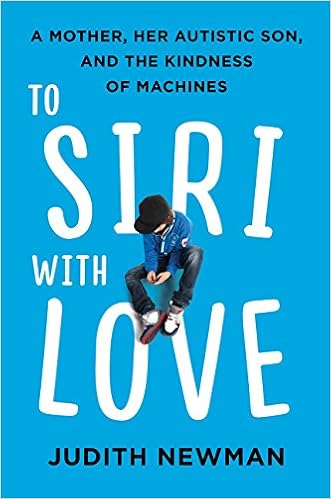
[image: Book cover: A blue background
with informal font white text reading,
"To Siri With Love," with a photo of a
child looking at an iPhone seated in the
middle of the text, wearing a baseball cap
and seen from overhead.]
Like many of my fellow Autists, I first heard about Judith Newman’s book To Siri With Love: A Mother, her Autistic Son, and the Kindness of Machines through the Twitter hashtag #BoycottToSiri. The book itself is expanded from Newman's same-titled 2014 New York Times Fashion/Style column, and is a memoir of her New York City life with twin boys, Gus and Henry. Gus is diagnosed Autistic; Henry is not.

#BoycottToSiri arose on Twitter after an encounter between Newman and Autistic activist and educator, Amythest Schaber. In To Siri With Love, Newman described Schaber as “look[ing] like everyone’s favorite manic pixie dream girl” (page 42). Schaber was understandably displeased with this description, as it is not a compliment.

"Manic Pixie Dream Girl" was coined by Nathan Rabin, a film critic who described a Manic Pixie Dream Girl as “that bubbly, shallow cinematic creature that exists solely in the fevered imaginations of sensitive writer-directors to teach broodingly soulful young men to embrace life and its infinite mysteries and adventures.” Two years later, Rabin and colleagues wrote an article about the Manic Pixie Dream Girl (MPDG) in which they compared the sexist trope to a racist film trope known as “the Magical Negro,” saying both archetypes are, “largely defined by secondary status and lack of an inner life.”

I have a passion for film studies, so I can't gauge how widespread awareness of these movie tropes are. But MPDG and many other tropes are featured on a website, TV Tropes, that has an Alexa ranking of 664th in the United States, where over half its traffic originates. That’s pretty popular. For semi-random comparison, Autism Speaks—the largest autism charity in the world—has a U.S. Alexa ranking of 8,241. I’d say that means there’s a strong likelihood that Amythest and I are not the only people out there immediately aware that “Manic Pixie Dream Girl” is a grave insult. Newman, whose life appears to be quite filled with family and career, may not be as much a film buff as some of the rest of us, but MPDG is such an odd phrase that I would have looked it up before I felt comfortable including it in a piece of writing in which I could have simply referred to a person as “pixie-like”...if I felt the need to describe their appearance at all.

Perhaps I have waxed over-long, gentle reader, on a sexist slur innocently cast upon someone Newman clearly admired. After all, as Newman and her fans pointed out several times, the words following MPDG were a description of some of Schaber’s t-shirt slogans, followed by, “These videos should be required viewing for every parent of an autistic child.”  But I want you to understand what pre-formed opinions I brought to my reading of To Siri With Love.

The confrontation between Newman and Schaber quickly escalated to a full-out battle with recriminations and mass blockings. If you’ve ever been swept into a Twitter war, you have some idea of how stressful the event must have been for all involved, particularly the duo at the center of the maelstrom. What caught my eye in the midst of it all were multiple warnings under the hashtag, telling me that Newman wanted to sterilize her teenage son. Of course I then wanted to read that book for myself and review it, so here we are.

I’d like to move forward, but first a few background links regarding the Twitter battle and boycott call. Amythest Schaber posted their own Twitter thread about the boycott. Culturess wrote about the boycott, including a link to a lengthy Twitter thread by Autistic reviewer Kaelan Rhywiol. Romper’s article about the boycott includes a USA Today video clip in which you can see glimpses of Gus for yourself. Senior editor of The Thinking Person’s Guide to Autism, Shannon Des Roches Rosa, supports the boycott in an essay on her personal blog, Squidalicious. And although I have been participating in the #CrippingTheMighty Boycott for a few years now, I made a lone exception to read their article about #BoycottToSiri and was favorably impressed with their reporting. And while I was working on writing this review, Schaber released a video discussing #BoycottToSiri.

It took me three days to read the book. Yes, I am a slow reader, but also no, I’m not that slow of a reader. I wanted to take my time with the text, to read it carefully and critically, and take time to process the actual content of what I was reading. I also read in a state of dread, not entirely dissimilar to the sensation one experiences in a commercial haunted house, continually apprehensive about what may be jumping out around the next corner. Maintaining this state of high alarm for days is draining and I needed lots of time to rest and recover from the work of reading a book that had raised such intense emotions in my communities, both among those who had read the book and those who had not.

External control over the reproductive rights of disabled adults is an understandably emotional topic in the autistic community. I do not want to co-opt any other group’s struggle, but it is difficult to convey how strongly we feel about this issue without pointing to related suffering among other minorities: Deaf people who were regularly sterilized and refused immigration to the United States, for example. Marge Piercy’s sci-fi classic Woman on the Edge of Time explores the aftermath of the protagonist’s forced sterilization for the “crime” of being poor and a Woman of Color in 1970s New York City—a scenario that actually happened repeatedly.

For additional context, activist, mother of a Black Autistic teenager, and dear friend Kerima Çevik, wrote of Newman’s book:
“This is a human rights affront. It is presenting the idea of involuntary sterilization of her son to a mass audience that may not have considered this in a time when eugenics is waxing globally. There is no context in which this is okay. There is no teachable moment here. The book is published and the idea is out there. For me, knowing what harm forced sterilization did to my race and to disabled people in the past, this is an unacceptable thing, and her thoughtless, cruel words in her vain book have now placed thousands of disabled adults at risk. There is ignorance and there is this Pandora’s box of an evil book that can have devastating public policy consequences.”
Later, Çevik shared a video with many of us, discussing atrocities committed against Black women’s reproductive rights. (The mini-documentary was so distressing that it took me four viewing sessions to make it through its four minutes of video.) A parallel between the Black experience and the Autistic experience leapt out at me: Doctor James Marion Sims, inventor of the gynecological speculum, conducted many experiments and surgeries on enslaved women without the benefit of anesthesia. Some of the women had over 30 surgeries at Sims’ hands, all without any pain relief whatsoever because of the false belief that Black people did not feel pain.

Hearing this history, I had to stop viewing the video and collect myself, because I immediately thought of the long history of claims that Autists do not feel pain, which culminated in testimony at an FDA hearing concerning whether it was okay to use electric shocks on Autistic children. Beyond the revulsion I feel at the fact that anyone needed to debate the ethics of using a Graduated Electronic Decelerator on children, I am nauseated by testimony and debate concerning “whether autistic people feel pain, if pain equates to harm, and if individuals with disabilities suffer any harm from being shocked.”

As I said, I don’t want to co-opt another marginalized group’s struggles, but there are so many similarities in the reproductive oppressions of Black people and those of developmentally disabled people that knowledge of the issues facing both communities, historically and currently, is crucial. Leaving aside the complexity of intersectionality—people like Çevik’s son who are both Black and Autistic experience exponentially increased struggles stemming from the union of two marginalized identities—understanding the systematic dehumanization slaves and their descendants have faced shines a light on the systematic dehumanization that developmentally disabled people face. I absolutely agree with Çevik that advocating for taking control of someone else’s reproductive rights is unacceptable, normalizing the removal of a disabled adult’s capacity to reproduce has devastating public policy consequences, and a book that would promote such ideas is an evil book.

It was with these thoughts in mind that I sat down to read To Siri With Love. I spent those three days reading it because I wanted to provide the most unbiased reading and review I possibly could. But I confess that I am completely biased when it comes to human rights issues. I had already witnessed the author calling Schaber a “brat” and snidely questioning their upbringing. Facebook and Twitter were abuzz with fury, with the words “transphobic” and “forced sterilization” appearing again and again. I opened the book feeling as if I were entering enemy territory.

To Siri With Love began well, with Newman explaining quite eloquently why PC insistence on person-first language is misplaced: “‘Person with autism’ also suggests that autism is something bad that one needs distance from,” Newman writes—and it’s perfectly fine to use the word “autistic.” But didn’t take long to learn why Newman was being called transphobic. Before page one, before the introduction, I got my first slap from Newman’s book in the author’s note.

Newman writes of a friend who wrote a book on parenting and used the singular "they" rather than "he" or "she." Never mind that using the singular they as a pronoun for unknown or generalized people long pre-dates the 18th century linguistic prescription movement. Newman declares it, as well as the use of the word “cisgender,” to be “ugly and imprecise.” I cannot argue for or against “ugly” as qualitative assessments are subject to the proverbial eye of the beholder, but for the great utility of the singular they one needs only look to the writing of William Shakespeare or Jane Austen. As for the cis-/trans- pairing, which dates back to the mid 1990s (or, as has been pointed out, as far back as 1914) it has as much linguistic utility as other pairings such as het-/homo- or masc-/fem-.

The book has many high points: Newman champions the right and necessity of Autistic stimming on pages 41 through 43, for example. It also has many low points, such as Newman repeatedly describing her son Gus’s interests as bizarre, even going so far as to suggest it “require[s] magic mushrooms to see it the way he does” (page 41).

Overall, I was left with the impression of an author who loves her children much in the same way she loves her dogs. She cares about their safety and welfare. She cares about feeding them nutritious food and ensuring they get sufficient sleep. She wants them to be happy and feel loved. She understands them only as well as one can understand a distinctly separate species. And she feels she has ownership of their bodies and minds.

In one passage, on page 35, Newman compares her intense interest in repeatedly reading and re-reading the opening words of Nabokov’s famous novel of chronic child rape, Lolita, to her son’s love of a fifteen-minute video of the wooden escalators at Macy’s department store. Newman insinuates that her preoccupation with a novel in which the middle-aged narrator begins by referring to a 12-year-old girl as “light of my life, fire of my loins” is somehow more elevated, wholesome, and comprehensible than the beauty of escalators: ridged plates neatly sliding through grooves to fold upon themselves and return to their point of origin, mystically creating interlocking platforms—shining metallic magic carpets endlessly conveying people on an intricate conveyor belt that looks just like stairs and does not abduct children to spend three years driving them across the country, raping them in hotel rooms while destroying their lives.

Yes, I can see how Newman might find Gus’ interests mundane and intolerably boring when contrasted to the delights of literary hebephilia.

That last sentence, by the way, was sarcasm. For those not in the know, sarcasm is a form of cutting humor. I explain, because Newman has repeatedly announced that Autistic people do not like her book because we are unable to understand humor and cannot see that her book is just so funny.

I had a private online discussion with Newman within an hour of finishing her book but before I began writing this review. My opening comment to her:
“I just finished reading your book about 15 minutes ago. I have spent the last three days reading it and taking notes. And I understand that it is probably frightening to talk to me. I'm a bit terrified, myself.”
Newman's opening comment to me:
“I was just saying, Maxfield, to someone online, that what NT people liked about this book was that it looked at the funnier side of things that are often, in books about autism, seen as upsetting. But it is difficult, often impossible, to explain humor. I am not sure that people here see the difference between laughing ABOUT something and laughing AT someone.  There is a huge difference. I laugh at a lot of things -- at myself, at my family, at Gus -- but they are not the butt of my jokes, if you see what I mean.”
This is not Newman’s first or last time to insinuate that Autistic people do not like her book because we cannot understand humor. Not only is she making blanket assumptions about our abilities, she is engaging in one of the most classic forms of gaslighting: telling others they have no sense of humor, or don’t know how to take a joke.

I just don’t think it’s funny to say (repeatedly) that no one will ever want to date your son, and that if they did have sex with him the result would  be so ludicrous it would require a Benny Hill soundtrack to accompany it (page 116). I don’t think it’s funny to say that you are glad vasectomies can be reversed because you will be able to get one for your son when he turns 18 and reverse it when he’s 35 so you can have grandchildren (page 117). And I don’t think it’s funny to tell us that you’re able to bond with your non-autistic child despite the fact that “the overlapping area in the Venn diagram of our common interests is the size of a pinhead” (page 39), but your Autistic child bores you so much that the only remedy is to get drunk to escape “discussing weather, trains, or Disney villains” (page 40).

Two nights after our first long chat, I was two-thirds of the way through writing this review and feeling mentally and emotionally drained. You see, our lengthy private discussion started off on a rough tone and for quite some time I felt that Newman was evading actually talking about the issues I had with her book. Early in, she seemed to dismiss the entire possibility of talking, writing,
“Max, you are the reviewer so you write exactly what you want. I’m sorry we don’t see this the same way. I hope you write the book about your life that best represents you and people you love. That’s all any of us can do.” 
That was where we found our volta, our fulcrum, our swerve. Our non-conversation took a turn into real connection.
“I have written books about my life,” I typed to her. “That's part of why I don't want to attack you on this. I know what it feels like to put personal life details out there. Most of my family will no longer speak to me because of things I have written about my grandfather.” 
And then we started to talk. We left talk of her book aside and just chatted—mostly about me, since I already knew so much of her life from reading her book. I came away feeling conflicted at first. We had talked until bedtime and then stayed up another hour, talking some more. We said goodnight by sending one another animated animal gifs. I liked her and I sensed that she liked me, too.

But ... her book. Her book is evil.

Yes, evil, and I do not use that word lightly. Despite being an atheist, I have drawn my understanding of the definition of evil from reading Augustine. In my understanding—slightly modified from the Augustinian concept—“good and evil” are purely human constructs that do not exist in nature. “Good” is anything that increases the sum total of compassion and caring in the world. “Evil” is somewhat akin to the scientific definition of cold as the absence of heat. Just as the Kelvin temperature scale has an absolute zero, so does the measure of human goodness have an absolute zero and that is where one finds evil.

To Siri With Love is an evil book because it normalizes the notion of owning another human being. When we discuss the ethics of having one’s pet neutered, we talk about responsible pet ownership, the fate of stray animals, overpopulation of cats and dogs but those who personally identify with the notion of a cat’s loss of “manhood” are dismissed as overly sentimental and irrelevant. The dog or cat does not get a vote in the matter.

Newman seems to grow agitated whenever I use the word, “sterilize,” because she never wrote about permanently neutering her child like a pet, but rather delaying his ability to procreate until she felt he was ready. I, however, do not see those two positions as occupying different ethical zip codes. Both are reprehensible. The idea of sterilizing one’s child is not something isolated or unusual. Forced sterilization has been explicitly legal in all fifty states since the famous 1927 Supreme Court Case, Buck v. Bell.

Justice Oliver Wendell Holmes, Jr. used the precedent of mandatory vaccination to justify sterilization of those “manifestly unfit” to prevent society’s need to “execute degenerate offspring for crime” or the social cost of letting “them starve for their imbecility.” The decision was eight to one, with Justice Pierce Butler, a staunch Catholic, the lone dissenter. As a result of the court case, Carrie Elizabeth Buck was permanently sterilized.

Although many people remain appalled by the ruling, Buck v. Bell has never been explicitly overturned. In fact this very month the state of Washington has been working on creating forms to make it much easier for parents to pursue sterilization of their children. I believe that sterilizing people because of their I.Q. or developmental disability is evil, just as is sterilizing people for their race, religion, or other disability—all of which have been enacted in the United States within my lifetime. I agree with Julia Bascom, president of the Autistic Self Advocacy Network (ASAN) who recently said in her ASAN Gala speech, “there is not an IQ test that determines when human rights are relevant.”

To Siri With Love is an evil book, just as Çevik wrote, because it makes it easier for parents to choose the reprehensible option that is legally open to them, that of having their child sterilized. “Wait,” you may be thinking, “you said earlier that Newman had good things to say about identity-first language, the importance of stimming, and more. Yet you say that evil is the absence of good. How can a book with such good things in it be evil?” To you I respond that those apparently good things in To Siri With Love merely bolster the core of evil it contains by serving as the sugar coating that makes a toxic pill inviting to swallow.

Critics have praised the book as courageous, honest, moving. Those qualities make it more likely that parents will feel validated in choosing to sterilize their child, just as they read about in that courageous and moving book. Newman lays her fears bare in ways other parents can’t help but connect with. From page 17 through page 28, Newman ruminates on the causes of autism and lists out the many ways she and her husband could have been responsible for Gus’ autism. This line of thinking has likely kept many a neurotypical parent of an Autistic child awake at night, filled with self-recrimination. On pages 11 and 12, Newman writes a particularly evocative passage about the paralyzing grip of fear, comparing it to the last moments of the live mice she fed to her childhood pet boa constrictor, Julius Squeezer. I felt the cold grip of horror and fear, reading that passage. What parent who had experienced fear upon learning their child’s diagnosis would not feel an immediate kinship with Newman, upon reading those words?

So I stand firm: To Siri With Love is an evil book, and it is evil because of those passages of proclaimed love for Gus, not in spite of them.

But Judith Newman is not an evil person. Evil is the absence of good and I do believe Newman has good in her. Like all of us, she is complex. I hate her book, as I hate all that is evil. But I do not hate Newman. Last night the library closed and I turned off my computer and bought dinner: popcorn, and a bottle of merlot. I only drink alcohol two or three times per year; it takes more than a boring child to encourage me to reach for a bottle. It took coping with my growing cognitive dissonance about Judith Newman and her book.

Under the influence of the grape, I turned to Newman once more. “Still working on the review. Hoping to finish tomorrow. It's tearing my heart to shreds.” We chatted for a couple more hours. I could never have predicted it, but Newman encouraged me to finish my review of her book and to write it honestly. “It’s important for you to write what you think,” she told me.

She also told me again that we do not understand her. “I have gotten a great many notes from autistic people, and autistic parents, who are afraid to say that they really enjoyed it, and that they knew I wasn't going to sterilize my son.”
“He’s not getting a vasectomy,” Newman told me later in the same chat. “It’s ridiculous. But I also think I would be an irresponsible person and an asshole if I didn't think about what's going to happen to my son when I'm gone. And what would happen to a CHILD of his when I'm gone.”
The thing is, so many of us—Autistic and allistic alike—did come away from reading her book with the strong feeling that she was going to pursue that vasectomy she kept mentioning. And no matter how ambiguous Newman’s feelings about her child’s reproduction may be, it is unethical to permit that same ambiguity to surround her discussion of the topic.

Several times, Newman mentioned censorship and said all writers must be free to say exactly what they think and feel. I, too, am against censorship but I don’t believe censorship is the issue here. My father had a folksy saying that he had probably gotten from his own father: “your right to swing your fist ends where  my nose begins.” Newman has a right to say exactly what she thinks and feels, but that right ends at the point where she does harm to me and my people. Yes, she has force of law behind her as the Supreme Court decided in 1969’s Brandenburg v Ohio that speech can only be prohibited if it is “directed at inciting or producing imminent lawless action,” and also “likely to produce such action.”

And, as much as I hate it, sterilizing one’s developmentally disabled child—whether permanently or temporarily—is not illegal. Newman has the law on her side. But it is a law I resist, just as Martin Luther King Jr. said we must when he wrote from the Birmingham Jail:
“One may well ask: 'How can you advocate breaking some laws and obeying others?' The answer lies in the fact that there are two types of laws: just and unjust. I would be the first to advocate obeying just laws. One has not only a legal but a moral responsibility to obey just laws. Conversely, one has a moral responsibility to disobey unjust laws. I would agree with St. Augustine that 'an unjust law is no law at all.'”
But, upon reflection, I find that I do not want to censor Newman. She says we do not understand her, and that may be true, but she stands by her words because she does not understand us. She takes it for granted that people say dangerous things. She told me she will continue to block every person who writes a death threat to her, yet she does not grasp that what she has written is implicitly a death threat for an entire people and we do not have the luxury of simply blocking her book.

She loves Gus and wrestles with the reality that some parents do not love their Autistic children. She told me that some people should never have become parents, and by that she meant those parents who harm and murder their Autistic children. But she naively assumes that no real harm can come from her words because she takes it for granted that most families are like hers.

This is a natural human tendency, taking our good fortune for granted. For years I took so many things granted because my skin is white. There are still things, currently unknown to me, that I take for granted because my skin is white and I have never known the struggle and oppression People of Color face every day.

When one is part of the group that has set the rules for what is “normal,” “natural,” and “healthy,” as Judith Newman is, one isn’t grateful to be considered those things any more than a person who has never experienced respiratory distress is grateful to take each breath.

Last night, Newman urged me to finish writing this review, telling me to pretend she would not read it and adding that she would not ... at least not for a while. She is feeling raw and wounded and misunderstood, and cannot understand why so many people are so angry with her. We discovered with surprise that we had independently chosen the same dinner that night—popcorn and wine. Despite massive differences, she and I are so alike and we are also each utterly convinced that we are right and that the other just doesn’t understand.

I don’t want to censor Newman, but I do fervently want her to change her mind. I realize that I don’t have the right to force that on her any more than I believe that she has the right to tell the world she wants to take control of her son’s reproductive choices. But I wish it anyway, because my heart is broken at finding a potential friend in someone who has written a very evil book.
Share: