Showing posts with label To Siri With Love. Show all posts

The Stories We Don’t Tell: My Mom On Raising An Autistic Child And Why She’ll Never Write About Me

Sarah Kurchak and her Mother Jane Kurchak
 [image: Cheerfully geeky selfie of the author, a white Canadian woman wearing
glasses and also goggles on top of her head; and her mother, a white woman
also wearing glasses plus a pinstriped blue collared shirt, tie, and white jacket.]

Sarah Kurchak
www.riskyfuel.com

When I’m feeling particularly frustrated with my career, I offer to ghostwrite a memoir for my mom. It’s a slightly bitter, semi-serious joke. I’m mostly taking a shot at the fact that the memoirs that non-autistic parents write about raising their autistic children have a much better shot at getting published and selling than anything that I, as an autistic person, could ever hope to write about autism. But there’s also a little part of me that just wants that payday. (I can’t extend this offer to my dad, because he’s a fellow autist and no one seems particularly interested in hearing what autistic parents have to say about these things, either. Or acknowledging that autistic parents even exist.)

My mom is a funny person, and usually quite indulgent when it comes to my humor, but she always shuts this joke down pretty quickly. Even in jest, her answer is clear. This isn’t her story to tell.

As I’ve watched the autistic community respond to the latest offerings from this wretched subgenre and wondered how I could contribute to the conversation at a time where I don’t feel intellectually or emotionally equipped to properly tackle the issue as a writer or an advocate, I kept coming back to this point. So I asked my mom to read two of the most recent and high-profile examples of the Autism Parent memoir, Judith Newman’s To Siri With Love, and the excerpt from Whitney Ellenby’s forthcoming Autism Uncensored that was recently published in The Washington Post. And then I asked her if I could interview her about them. And about us.

The following has been lightly edited for length and clarity. And I’m not so sure it helped the latter. I’m not convinced that I perfectly articulated my points, but it’s the best that I can do right now and I’m hoping you can get the general idea from what I have said.

People argue that no one represents the real autism. This, in its somewhat rambling, possibly overly earnest, and well-meaning glory, is also the real autism.

Sarah Kurchak: You read To Siri With Love recently. Can you give me your general impression of that book?

Jane Kurchak: OK, what I went through while reading was a range of emotions. Mostly it was anger, and then sadness. But, I guess, ultimately I felt that Gus was the punchline and he wasn’t in on the joke. And that bothered me. And I kept thinking…she’s his mother, and that individual that should be the most secure person, place, everything on earth was [instead] doing this end run behind him and telling the whole world about his bathroom issues. And it wasn’t her story to tell.

I always put you in the kid’s position. How would you feel if that were going on? How would you feel? How is Gus going to feel in ten years when maybe the reality of that book hits him? It may or may not, but it still was never her story to tell.

Another thing that bothered me were the number of people and celebrities that were gushing over this book. I kept thinking…why is nobody saying to her “Maybe you shouldn’t be telling Gus’s toilet secrets?” I don’t know. So that’s what Siri did to me. And, in that case…I never, ever questioned that she loved Gus. I just don’t think that she went about all of this the right way. And who am I to judge? But she put the book out there. It’s for all of us to read. We’re going to have opinions. And I just don’t think that was her story to tell.

Which brings us to the article in The Washington Post that we read last week, which was called “Bystanders were horrified. But my son has autism and I was desperate.” Can you give me your general impressions on that?

That made me cry. As upset as I was with the whole Siri book, that pales by comparison to that article I read. That’s child abuse. It is. And, again, I put you in that kid’s position. And never…and I’m not saying that I’m parent of the year, or any of those things. I stumbled through this. I didn’t know. But I cannot, for the life of me, ever ever imagine thinking that was a good idea. To do it wasn’t a good idea. And to write about it is as repugnant as the action.

I was thinking…what the eff is that lady thinking? “I was desperate? People were watching me?” You took him into the damned situation in the first place! This isn’t about her. It shouldn’t be about her. She wanted him to see Elmo.

What I noticed in that piece, even more than in Judith Newman’s observations, was that she kept blaming situations on her child’s autism that were actually problems involving people’s perception of her.

This is all about her. This is all about her.

I try to have sympathy. Not just as a human, but as a writer. Because I think we do have somewhat different boundaries. And yet…I am also someone who has significantly benefited from other people protecting my boundaries so that I could get to the point where I could decide to reveal perhaps too much in certain situations. But even though I am an open book in a lot of ways, there’s a lot of stuff that people don’t know.

And there’s a lot of stuff that is probably going to get weirdly meta in this conversation, where we’re going to talk around what we don’t talk about in my life, so that it can’t be Google-able and people can’t attach things that still have a lot of stigma around them to me, so that I can continue to survive and function as a person in the world and as a writer. As small as my profile is, it’s still a public profile. And none of that would be possible if you and dad had ever been more public about my life.

And we’ve talked about this before. It never occurred to me to make any of your stuff public. We talked about your sleep thing. We all knew about your sleep thing and I joked about that. “Sarah didn’t sleep! That’s why she’s an only child.” There were jokes like that.

There are other situations that we will never discuss. But they were never insurmountable and I can tell you that when some of those things were happening, I would simply say “She’s not going to be doing this at ten. She’s not going to be doing this at sixteen.” It was in the moment.

Do you remember…of course you remember wearing the Smurf hat to Pupo’s [Welland, Ontario’s most beloved grocery store].

I also remember wearing the Smurf hat in grade nine.

I do, too. But that was a bit of a dare, and you go for it. But you loved that hat. And then remember we had to convert it into a Smurfette hat, and you had those big yellow yarn braids hanging down? I loved that you wanted to put that on your head and wear it to the grocery store. You had so much fun doing that, why would I not have gone along with that?

And I do want to be clear for anyone who is going to read this and think this is just an example of someone who is quirky and not “really” autistic: This is an example that we can talk about freely. There are other ones that are way more private that we’re not going to get into. But your choices in all of these situations came from the same compassion. They all came from the same logic. And ultimately ended up benefitting me in the same way, too.

Yes, I can see where you’re going. Yes.

In this conversation, we’re talking about To Siri With Love as a book, because we’ve both read it. We have only read Whitney Ellenby’s article that was published in The Washington Post. We haven’t read Autism Uncensored, her forthcoming book, as a whole. And this is, in part, because you have asked me not to. So can we get into why you asked me not to read this book?

Your level of empathy can be debilitating. You’ve always been like this. Always. And I see your daily struggles. I see you try to function in a pull-up-your-bootsraps neurotypical world. And I know if you read this book, it will crush you. It will take a bigger toll on you, by far, than Siri did. And, as your mother, my concern is your ability to continue functioning carrying that level of upset. So it’s a selfish motive because I don’t want you to hurt and I know that what we’ve read is only a small part of what’s gone on. I don’t want you to read it.

If you were a writer, and you decided to write about me and my childhood, how do you think you would approach it versus what you’ve seen from these parent memoirs?

I have always said to you, to anybody that will listen to me, I have learned more about life in the world from you than from anyone or anything else. And if I were to write, it would be about the lessons that I’ve learned from you. Nothing that you’ve learned from me, but what I’ve learned from you. Only from my perspective. I would never, ever expose, without your permission, any of the incidences that have happened. But every one of those was for me to learn more than it was for you to learn.

So I guess it’s that. Watch your child and learn from them. Take you cues from your child. Just because I’m your parent doesn’t make me right. I would write about how you enrich my life. And people might read this and think “You have to say that. You’re a mother.” They can think what they want. My reality is that my life is a better life because of you. I’m a far more tolerant person. I’m a far more understanding person because of the lessons that I’ve learned from you. Not just because you’re autistic but because you’re autistic and the way you view things and the way you approach things has taught me a different way of viewing and approaching. So that’s what I would want people to know.

So I think we’ve already touched on this a bit but I’m going to try to get a bit more explicit because, for me, this isn’t just an issue of what we write about autism. What concerns me is that this gets to the heart of the stories that we tell about autism in daily life. And when I approach these books…I’ll admit, part of it is professional jealousy, because I want to have at least a fraction of the platform that these people have. I want to be able to write about my autistic life or write autistic characters that can make the next generation feel less of whatever the hell it was that I felt growing up.

But it goes beyond that, too, because I am someone who has benefitted—and, I would argue, only survived and reached this point—because of the stories that nobody told about me. Because I had parents who didn’t exploit me, didn’t film my meltdowns, didn’t tell people about, say, how much I lost my shit at the dentist every time I went, didn’t talk about my toilet training, my utter attachment to you to the point where you couldn’t really go anywhere alone without me freaking out. And these are all things that, again, I want to point out to anyone who is reading this, I am glossing over because this is as much detail as I feel safe revealing under my byline now. The only reason that I feel that anyone can come at me and say “You’re not autistic enough to count” or “You’re not the kind of child that they’re talking about here” is because, when I was that kind of child, no one told on me. When that happened, you would take me out of the situation. No one saw it. And then you wouldn’t talk about it later.

And it would never have occurred to me to talk about it later.

You also, I want to point out, suffered because of that. For all of the talk about autistic kids not being aware of their surroundings, I was hyper aware of the level of criticism that you and dad faced, often when I was around, for ostensibly coddling me, or overprotecting, or spoiling me. Obviously it never occurred to you to say anything, but it could have alleviated your burden if you had told people why you were doing it. And you never did.

No. I never really thought of that before. It didn’t occur to me.

We knew what worked for you. If we were to go into a situation with you, we knew what worked and what didn’t. So if we had to remove ourselves from that situation and hang out somewhere else, what was the problem?

I guess there’s a price that you pay…and people judge. We all judge. But we’re so…who wrote the damned book? Who wrote the book on how society has to function? What’s normal? We can apply it to your temperature, but we certainly don’t need to apply that to behaviour.

I think people assumed that I was a nervous, clingy child because I wasn’t pushed enough, when the reality was that you guys were like that because I was a nervous and clingy child and any steps I’ve made in life are because I have a secure home base. A safe place where I’m never going to be exposed or judged or unduly pushed into something.

And that’s what I feel like every single parental home should be, regardless of if you’re 6 or 36. You should be able to come here, to decompress, and the world doesn’t get to peek in.

My main point that I wanted to discuss here is that I’ve been protected by what you and dad didn’t share, but I also want to say that I think I was really nurtured by the fact that you didn’t bring any outside measurements to my growth and development. Ever. You always always wanted to work on my terms and do what actually made me succeed or survive, or grow. I bring up that shoe story that was in Refinery29 to parents a lot, because I think it’s a great example of how practical you were. The modifications didn’t help. They made me sad, because they ruined my shoes. So you were like “That’s not the solution.”

Unfortunately, because of the narrative that we have around autism now, so many parents are so scared of screwing up and so scared of having these autistic children who won’t be “normal” in the future that they just keep hammering away at one thing, even if it’s not working, even if it’s harming their child, like it’s the only answer.

So again we get back to society’s expectations is driving these parents to make these ridiculous decisions. It’s all of these benchmarks. Why are those the rules?

We should probably wrap this up, but one last thing that I want to say is that I am not just concerned about what these books reveal about their subjects and how that harms them, but I’m also dubious about the purpose of them at all. These are books that are intended to expose the “real” autism or shed a light on the plight and what I wonder is who this level of awareness serves. It seems to me that, as long as the actual issues that they’re talking about have stigma attached to them, we’re not helping autistic people by talking about them in this way. We’re helping carers, because people will sympathize with them. If using a diaper is still stigmatized, then talking about an autistic person who uses a diaper is only going to make people sympathize with the person who might have to help them with it, as opposed to helping people accept that some people just happen to use diapers.

Until the actual autistic needs and behaviors are accepted, I don’t see any purpose to this kind of awareness beyond narratives that peddle in tragedy and the lionization of non-autistic people.

That’s it exactly. I don’t know a catchy phrase for it. But they put it out there, you see how the public eats it up and it’s permission to be the victim. So that’s why it’s going to sell. And I bet there are a lot of…I have no idea what the statistics would be, but there’s no way in the world that Dad and I are the only two who let it play out this way. There have to be a ton of people like this, but those stories just aren’t as exciting.

I’ve become associated with a lot of great parents through Twitter, and I know they’re out there. Unfortunately, part of what makes them great parents is that they don’t dominate the conversation, so you don’t see them.

So you’re going to write a story. You know, when you write that story, you’re going to expose yourself to more criticism.

Yeah.

And I’m not going to lie. I think about that. And I wish it wouldn’t happen. But I have to say, in this case, you’ve taken it upon yourself to help someone that can’t really speak for themselves and I’m so fucking proud.

It’s not that they can’t speak or communicate, it’s just that I am lucky enough to have slipped into a platform that…you know, I might have a higher profile career if I weren’t autistic, but it’s still more than a lot of great autistic writers and bloggers are afforded. And I’m just…I don’t know…what is any of this for if the next Sarah has to live all of this the exact same way?

OK. And I just want you to know that I’m proud.

I’m wondering if it’s going to seem incredibly self-serving if we end on my mommy being proud of me.

Well, you can decide whether you want to put that in or not. But I’m not just throwing that in. I am.

----

Originally published at Medium
Share:

The Toxicity of "Autism Parent" Memoirs

An example of a parent modeling language on a symbol-to-speech device
[image: AAC device screen with black block text reading "love you"]
Shannon Rosa
www.squidalicious.com
"When others don't understand our [autistic] experiences and don't understand how our actions are meaningful responses to them, they may think our actions don't make sense, and try to control them in ways that are harmful to us." -Elizabeth Bartmess
I think it should be OK to write about our autistic kids. I do. Because I think other parents, especially those who aren't autistic themselves or who are new to autism, need parent role models who do their best to understand and love their autistic kids, and be the parents those kids need them to be. These role models are needed because media messages and social attitudes about autism and autistic people are consistently fear-ridden and awful, so parents who have never heard anything about autism besides negativity need guidance for accepting who their kids are, so they can avoid blaming their kids for who they aren't. Those parents also need permission to give mainstream social expectations a flying middle finger.

I also think all parents, whether their children share their genes or not, obsess about how alike and how different their children are from them. And some of us want to write about that. So I think it's OK for other people to know that my son's physical intuition and grace astound me, as a naturally clumsy person. I think it’s OK that the world knows my son’s memory and visual navigation skills make my jaw drop, as a forgetful and easily confused person. I think it’s OK, as he matures, to be amazed that my little boy is now a man with a beard and broad shoulders. I also think it's important for the world to know how much I love him, how hard I try to understand what his autistic experience means he needs from me and society.

But most autism parenting stories are not positive, or about doing our best to understand what our autistic kids need and deserve. In recent "autism parent" memoirs like Judith Newman's To Siri With Love and Whitney Ellenby's Autism Uncensored, the authors hang their kids out to dry for being autistic and having intensely legitimate autistic needs, while centering the parent-narrators as victims of that disembodied demon, "autism." That these stories keep getting green-lit is both an embarrassment and a tragedy.

I have to ask these parents: Don't they understand that if they aren't on their autistic kids' sides, it's likely that those kids will spend their entire childhood ENTIRELY WITHOUT SAFE PEOPLE OR SPACES? That if their parents treat them as broken and use traumatizing approaches to "fix" them, then they are they ones who are actually breaking them? That until and unless those kids connect with the wider autistic community, they will have only ever received negative or conditional messages about their self-worth, and that research indicates this kind of life-long bullying contributes to the elevated autistic rates of health problems, mental illness, and suicide?
Unfortunately, I understand why so many parents don't think twice about exploiting their own kids' trauma: We live in a society that not only fears autism and disability, but in which even those considered liberal thought leaders don't think twice about reinforcing dehumanizing stereotypes about autistic people. Because of all those negative messages and stories about autism, parents believe their autistic children must be forced to act and feel like non-autistic people, even when their children are obviously miserable. So it's heartbreaking and horrifying but not surprising when parents feel like they must make the destructive choice to prioritize social expectations over their own child's well being.

I also think parents simply don't understand how contagious, dangerous, and self-reinforcing these negative parenting messages are. And it's not as simple as "If you don't respect and champion your autistic child, who will?" If parents only hear that autism ruins lives and that their kids are burdens, it makes those parents see themselves as victims—a message that is constantly reinforced in the media due to a complete and utter lack of balance—to the extent that parents who murder their autistic and disabled kids are, mind-numbingly, still too-often considered to be victims.

This has to stop. And the first step is to stop publishing toxic, hate-enabling parent memoirs like To Siri With Love and Autism Uncensored. The second is for disability organizations and prominent autism parents like Ron Suskind (who endorsed both books) to stop promoting parent accounts that encourage families, schools, and agencies to torture our community's kids:
What these parents should be doing is trying to make the world a better place for our kids. While I don’t expect a parent memoir or a Today Show story to change the world, I DO expect people of good intent to at least try to not make the world a worse place for my son and his autistic kinfolk. I want to see more stories about parents doing everything they can to understand what their kids need, so they can lead lives that are easier for their kids as well as for themselves.

This approach doesn't have conflict with the usual excuse for those wrecking-ball parent memoirs, which is that "parents need to be honest." I think we can talk about what's going on in our lives without blaming our kids, or "autism." I understand, deeply, how parents of autistic kids can feel lonely and lost. I understand that parents want, and should get, guidance, company, community, and empathy. I understand that sometimes we parents can feel damned if we do/damned if we don't talk about our own needs. As I mused recently:
"I think a lot of us parents whose kids need significant support have a hard time talking about our own support needs in a reasonable way. While we do not and cannot blame our kids for matters over which they have no control, it is tricky to talk about why we might need extra space or help without people assuming our kids are the problem, or feeling like we're going for a pity grab. Which, that's all rooted in society's shitty shallow attitudes towards disability, so f**k society for making yet another aspect of living our lives that much more difficult for us."
Parents need to understand that feeling lonely and lost is usually due to a lack of autism-friendly social fabric and services and parent education, and that that is not the fault of one's autistic child, or, again, of "autism." So while I understand to the center of my marrow that parents of autistic kids don't have enough supports either, I am never going to make excuses for parents like Jill Escher who publicly belittle and disrespect their autistic children. Instead, I am a roaring Mama Bear when it comes to demanding that other people treat my autistic son and his people with respect, and on their terms, as long as they're not inconveniencing anyone else.

Another re-occuring theme of these accounts is the parents declaring how much they love their autistic kids. What those parents don't seem to understand is that writing about an autistic child with love but without understanding is still explosively damaging. Consider the video and testimony of Kate Swenson of Finding Cooper's Voice, as featured on The Today Show:
"I had to grieve the life I pictured before I could accept the life that was given to me. My hope for you is that once you have a diagnosed child, and you’ve made it through, I want you make it your mission to be that person for someone else. Say it sucks. Say you hate autism. Say you feel robbed and slighted. Say it is hard having a child with an unknown future. These are the facts that they want to hear. They need to hear them. Don’t sugarcoat it. Don’t lie. Let them cry and be angry. Sit with them in the dark for a while. Listen to their angry, confused, lost, heartbroken words."
And that is the state of autism-parent-as-victim enabling in our society: these kinds of "I love my kid but I hate autism" accounts keep getting propelled, twenty-five years after autistic writer Jim Sinclair addressed those exact feelings in the landmark essay Don't Mourn For Us:
'Continuing focus on the child's autism as a source of grief is damaging for both the parents and the child, and precludes the development of an accepting and authentic relationship between them. For their own sake and for the sake of their children, I urge parents to make radical changes in their perceptions of what autism means.'
Parents need to hear, constantly and from multiple sources, that there are things you get to share publicly, and things you don’t. You don't get to tell the world why you think your kid sucks. You don't get to tell the world about things you wouldn't want other people writing about you without permission, like your toileting habits or sexual experiences. This is especially true for people like dependent autistic children who don’t have any recourse for defending themselves—or suing for libel. Parents need to be taught that their kids deserve boundaries and privacies and basic respect. And they need to hear this from other parents as well as from autistic people and other community members.

Consider autistic writer Ann Memmott's caution to parents of autistic kids who argue that they have "a right to say how it feels":
“Will they go to a school, to find that the more able readers have read all about their toileting habits, and use that information to bully them?  Will they go to start a job, in years to come, and find their employer has Googled their name and is now reading what Dad said about how this person destroyed their lives?  Yes, you can't imagine that your child will ever be in work.  People couldn't believe I was going to work, either.” 
Parents shouldn’t write or publish publicly available accounts about their kids that they wouldn’t want those kids to read. Parents should also presume competence about those kids' ability to read or understand what the parents say, however those kids best access information. My son doesn’t read books like To Siri With Love or Autism Uncensored, but he was featured in the book NeuroTribes, so I got the audiobook version, and we listened to the parts about him together (I skipped some of the sections about autism eugenics and abuse; Mama Bear, again).

That’s the thing about presuming competence, about treating our autistic kids with basic human decency: It’s not about “he probably won’t get this” but rather “what if she gets this?” and erring on the side of that caution. Plus, our autistic kids are known for rarely forgetting anything: My son still asks to see couples who divorced when he was a youngling, for instance. If you really are at a loss as to how your kid’s brain works, then maybe always proceed with caution and thoughtfulness instead of treating your kid like comedy roast fodder. But in To Siri, in Autism Uncensored, these boundaries don’t exist.

This lack of respect or boundaries explains a common tendency by to the authors of these parent memoirs: when they start receiving criticism about exploiting and dehumanizing their own kids, they self-righteously claim that autistic people who can call out parents' misbehavior and fallacies just don't understand the problems of "real" autistic people like the authors' kids. What this defensiveness prevents parents from understanding is that autistic people tend to be on their kids' sides:
Now, it is never helpful to tell people that their feelings are wrong. But the reason parents of autistic kids feel entitled tell the world how much they think autism parenting sucks is, again, based on society-wide fearing, loathing, and misunderstanding about autism—which these memoirs are reinforcing, not battling. What if, instead, publishers understood that parents need autism-positive parent resources? What if, instead, influential parents of autistic kids started working towards a society that welcomed people of all abilities, with the goal that families and people who need extra supports can easily access them?

I am not alone in being out of patience with authors like Newman and Whitby, people who are in a position to make their autistic kids' lives better and don’t. Anyone who knows a damn thing about autism knows that, by default, autistic lives are always hard(er than they have to be), and should recognize that these parents are making matters worse. This is why reactions from the autistic and autistic-aligned community to both Newman's book and Ellenby's recent Washington Post article promoting her book are deservedly critical:
Even though I'm pissed (and tired of being pissed) about the never-ending publication of negative autism parenting memoirs, I also hold out hope that people (and publishers) can change for the better. But for that to happen, we need more people to stand up and tell the world that exploiting your autistic child for "honesty" and profit is unacceptable, and that autistic people and their families deserve better than the constant barrage of misery and pain the publishing industry assumes to be our lot.
Share:

#AutisticWhileBlack: To Siri With Love's Shallow, Dangerous Take on Forced Sterilization

Kerima Çevik
intersecteddisability.blogspot.com
theautismwars.blogspot.com

Kerima Çevik, photo courtesy the author
[image: Gray haired Afro-Latina woman
next to a windowshade, looking to the left.]

[Content note: Contains descriptions of involuntary medical procedure, including sterilization, on Black and disabled people.]

I am trying to plow my way through Judith Newman's autism parenting book To Siri with Love: A Mother, Her Autistic Son, and the Kindness of Machines. It is slow, painful reading.

How can I explain my serious ethical concerns about yet another bestselling autism book that capitalizes on presenting the experience of disability from a parent's reduction of a disabled individual’s worth to how he makes his mother and those around them feel?

I can tell you that Newman's passage about looking forward to acquiring a medical power of attorney so she could involuntarily sterilize her autistic son Gus tainted the rest of the book for me. A vasectomy, she says. That passage has so much wrong packed into it that shocks, frightens and disturbs me as both a Black woman, and the parent of a nonspeaking autistic teenaged son of color.

I read what Newman wrote, and the years of harm to the black body—borne by my entire race—burst open like a septic wound. Combined with a year of escalation in harm to our people, it was just too much.

Newman writes about looking forward to being able to sterilize her child. This sent chills down my spine. The presumption that Gus might inadvertently father a child, and that this would be some sort of calamity, is both extremely ableist and demonstrates a clear disdain for any potential her son might have to lead the autonomous, inclusive community-based life that is the legal and human right of every disabled adult in our society.

Newman's assumption presents the disabled young adult as passive and inept, when in reality parents are responsible for ensuring that our children's primary life skills include sex education that might protect them from abuse and harm. This need, and the realities about sexual assault of disabled children and adults were featured in a recent NPR series, with statistics that tell a frightening story of helplessness and cyclic abuse because we insist on viewing our own children as having to be 'fixed,' rather than educated, and taught boundaries and self-protection.

Sex education for neurodivergent youth and adults exists. These courses teach students all they need to know about of their own bodies, setting and respecting boundaries, reproduction, self-care, and how to avoid harm in accessible language.

The author writes that she avails herself of access to autistic adults willing to be information resources, yet displays a lack of information about the existing resources for her son to navigate higher education and other aspects of life as a disabled adult. This contradiction in her book is confusing, as well as disturbing.

Gus might turn out to be a more patient, kinder, and understanding parent because he knows what it means to be disabled and subjected to maltreatment as a result. Gus may choose not to be a parent because he knows what it means to be disabled and subjected to maltreatment as a result. Gus is able to speak for himself. The choice, with supported decision-making if he needs it, should be his.

Forced sterilization is part of a larger nightmare of systemic abuse of the black body we've survived but can't forget. The practice of modern gynecology was built on the torturing of the black female body, without the benefit of anesthesia. J Marion Simms cut away at our ancestors' bodies, forcing slave women to hold down their fellow helpless enslaved victims while he did horrible surgeries on them. He brushed aside protests and outcry, by insisting that our women could not feel pain.

He is hailed as a great man. Statues stand in his honor.

Ms. Newman cannot feel what that legacy does to people. She blithely brushes it off in a great hat trick of compartmentalization, secure in her mistaken idea that all parents agree with her view of their disabled children. I beg to disagree. This parent does not hold Ms. Newman’s view of disabled children.

"Mississippi Appendectomy"

See, I can't forget what happened to Fannie Lou Hamer and the African American women of Sunflower County, Mississippi:
"Diagnosed with a small uterine tumor in 1961, Ms. Hamer checked into the Sunflower City Hospital to have it removed. Without her knowledge or consent, without any indication of medical necessity, the operating physician took the liberty of performing a complete hysterectomy.
"Three years later, as a leader of the Mississippi Freedom Democratic Party, Ms. Hamer spoke about her experience to an audience in Washington D.C. – telling them that she was one of many black women in her area that had been a victim of a “Mississippi appendectomy” (an unwanted, unrequested and unwarranted hysterectomy given to poor and unsuspecting Black women). According to her research, 60% of the black women in Sunflower County, Mississippi were subjected to postpartum sterilizations at Sunflower City Hospital without their permission. A number of physicians who examined these women after the procedure was performed confirm that the practice of sterilizing Southern Black women through trickery or deceit was widespread."
Even if Newman claims she's changed her mind now, even if she chose to retract that vile passage from all future copies of her book, this random musing of Ms. Newman's has opened the floodgates to dangerous thinking. Involuntary sterilization is not an idea that should be recirculated in a time of resurgent racism, and vile ableism. It is not an idea that should reemerge in an environment where disabled parents must constantly fight to keep custody of their own children. It should not be introduced to parents as some sort of justifiable option, particularly couched in literary sarcasm or humor, in a nation where Buck v. Bell has not yet been overturned.

Though in the book Newman gives a partial checklist overview of the history of disability and sterilization, she never mentions Buck v. Bell. How is this possible?" Every parent of a neurodivergent offspring in America should know about Buck v Bell, the harm visited upon innocents because of it, and the potential harm that can still be done to others because of it. Here:

Buck v. Bell, 274 U.S. 200 (1927) is a decision of the United States Supreme Court, written by Justice Oliver Wendell Holmes, Jr., in which the Court ruled that a state statute permitting compulsory sterilization of the unfit, including the intellectually disabled, "for the protection and health of the state" did not violate the Due Process clause of the Fourteenth Amendment to the United States Constitution. The decision was largely seen as an endorsement of negative eugenics—the attempt to improve the human race by eliminating "defectives" from the gene pool. The Supreme Court has never expressly overturned Buck v. Bell.

Buck v. Bell allowed the forced sterilization of a neurodivergent young woman and her 52-year-old disabled mother. Buck v. Bell was used to justify thousands of forced sterilizations of disabled people. Then came the thousands of forced sterilizations of African American women and African American girls who were raped. That escalated into the forced sterilization of poor white males and females. Forced sterilization continues today:
"A 2013 report from the Center for Investigative Reporting found that in California between the late 1990s and 2010, hundreds of female prisoners were sterilized without proper state approval. As a result of the investigation, Governor Jerry Brown signed a law banning forced sterilizations in the California prison system."
In 1986, Canada had its own Buck v. Bell moment. It was called the Eve decision, and it ensures forced sterilization doesn't happen there. Perhaps it is time to challenge and defeat Buck v. Bell in the U.S. Perhaps it is too late. But we should all be afraid because forced sterilization has already happened here, and continues to happen.

In her one unfortunate passage, Ms. Newman may have opened Pandora's box.

Here's what disturbs me the most: Our children aren't dogs or cats. They are human beings who need varying degrees of support. Now that you all know what was done to people of color, disabled people, and other marginalized groups, try to feel our distress. Don't treat disabled human beings, your own children, as othered creatures to be de-barked, spayed or neutered into compliance for our convenience. We know in our hearts this path is wrong. This is not something to daydream about or look forward to doing. This is a eugenics rabbit hole.

Literature shapes societal attitudes. What we write in the Internet age, particularly when content creators have as massive a platform as Ms. Newman has, can change the fate of thousands of autistic teens and young adults. We are their parents. Not their wardens, overlords, or owners. What we write can lead to events and public policy changes that might literally make their lives hell on earth.

We are living in a nation grappling with a chief executive who has recorded incidences of racially disparaging and ableist remarks, and who is trying to legislate based upon his personal biases. His remarks have enabled a harmful nationwide attitude shift, and as a result people are moving from vocalizing bigotry to acting on it. We have also seen escalated attempts to enact major changes in public policy, changes that may cause unprecedented harm to disabled people, people of color, and multiply-marginalized groups.

This means all parents authoring autism-related content must think about the consequences of what they write, before rushing to look for provocative vignettes for their bestsellers.

People took the right of consent from us for generations because they didn't like our color. They believed our race was 'defective.' All these unjust, stereotypical labels are being hung on our disabled children now. I cannot accept my son’s right to agency in his own life being taken from him and his people, because some author couldn’t imagine a world where her son has the competence to decide his own fate. It is her obligation as his mother to take the actions necessary to ensure he gains the skills required to gain such agency.

To me, seeing this book written from the perspective of white privilege, yet much-lauded, and hailed as witty, honest, and moving, is heartbreaking.

But unlike Ms. Newman, I won't generalize and assert that other parents in the autism community agree with me.

----

Resources:

The Sexual Assault Epidemic No One Talks About
https://www.npr.org/2018/01/08/570224090/the-sexual-assault-epidemic-no-one-talks-about

The Negro Project
https://www.nyu.edu/projects/sanger/articles/bc_or_race_control.php

Literal Silencing
http://www.autistichoya.com/2013/09/literal-silencing.html

Rocking the Cradle: Ensuring the Rights of Parents with Disabilities and Their Children
https://www.ncd.gov/publications/2012/Sep272012

Buck v. Bell
https://supreme.justia.com/cases/federal/us/274/200/case.html
https://www.democracynow.org/2016/3/17/buck_v_bell_inside_the_scotus

The Eve Decision: Why Forced Sterilization is not a fear in Canada
(with thanks to Emma van der Klift)
https://cic.arts.ubc.ca/the-eve-decision-1986/

Authoring Autism
https://www.dukeupress.edu/authoring-autism
Professor Melanie Yergeau's book addresses the ways literature is used to present stereotypes that dehumanize autistic characters, thus perpetuating structural ableism.
Share:

Why To Siri With Love Is a Wrecking Ball of a Book

Maxfield Sparrow
unstrangemind.com

[Content note: possible triggers include: forcible sterilization of minorities including Autistic people, forcible gynecological experimentation on minorities, Judge Rotenberg Center, electric shock, stereotypes about Autistics lacking empathy or a sense of humor, stereotypes about Autistics or Black people lacking the ability to feel pain, snakes and feeding live rodents, harmful Supreme Court verdicts, dehumanizing of Autists, getting drunk, preferring drunkenness to talking with Autistic children, humanizing the author of a grossly dehumanizing book.]

Come mothers and fathers / Throughout the land 
And don't criticize / What you can't understand 
Your sons and your daughters / Are beyond your command 
Your old road is rapidly aging. 
Please get out of the new one / If you can't lend your hand 
For the times they are a-changin'. 
-Bob Dylan

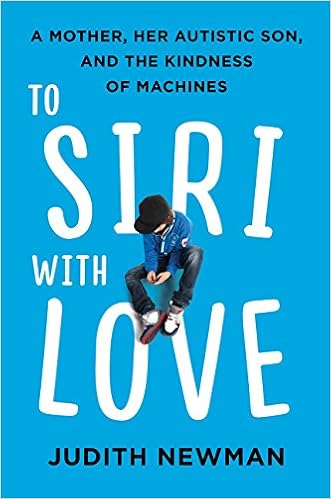
[image: Book cover: A blue background
with informal font white text reading,
"To Siri With Love," with a photo of a
child looking at an iPhone seated in the
middle of the text, wearing a baseball cap
and seen from overhead.]
Like many of my fellow Autists, I first heard about Judith Newman’s book To Siri With Love: A Mother, her Autistic Son, and the Kindness of Machines through the Twitter hashtag #BoycottToSiri. The book itself is expanded from Newman's same-titled 2014 New York Times Fashion/Style column, and is a memoir of her New York City life with twin boys, Gus and Henry. Gus is diagnosed Autistic; Henry is not.

#BoycottToSiri arose on Twitter after an encounter between Newman and Autistic activist and educator, Amythest Schaber. In To Siri With Love, Newman described Schaber as “look[ing] like everyone’s favorite manic pixie dream girl” (page 42). Schaber was understandably displeased with this description, as it is not a compliment.

"Manic Pixie Dream Girl" was coined by Nathan Rabin, a film critic who described a Manic Pixie Dream Girl as “that bubbly, shallow cinematic creature that exists solely in the fevered imaginations of sensitive writer-directors to teach broodingly soulful young men to embrace life and its infinite mysteries and adventures.” Two years later, Rabin and colleagues wrote an article about the Manic Pixie Dream Girl (MPDG) in which they compared the sexist trope to a racist film trope known as “the Magical Negro,” saying both archetypes are, “largely defined by secondary status and lack of an inner life.”

I have a passion for film studies, so I can't gauge how widespread awareness of these movie tropes are. But MPDG and many other tropes are featured on a website, TV Tropes, that has an Alexa ranking of 664th in the United States, where over half its traffic originates. That’s pretty popular. For semi-random comparison, Autism Speaks—the largest autism charity in the world—has a U.S. Alexa ranking of 8,241. I’d say that means there’s a strong likelihood that Amythest and I are not the only people out there immediately aware that “Manic Pixie Dream Girl” is a grave insult. Newman, whose life appears to be quite filled with family and career, may not be as much a film buff as some of the rest of us, but MPDG is such an odd phrase that I would have looked it up before I felt comfortable including it in a piece of writing in which I could have simply referred to a person as “pixie-like”...if I felt the need to describe their appearance at all.

Perhaps I have waxed over-long, gentle reader, on a sexist slur innocently cast upon someone Newman clearly admired. After all, as Newman and her fans pointed out several times, the words following MPDG were a description of some of Schaber’s t-shirt slogans, followed by, “These videos should be required viewing for every parent of an autistic child.”  But I want you to understand what pre-formed opinions I brought to my reading of To Siri With Love.

The confrontation between Newman and Schaber quickly escalated to a full-out battle with recriminations and mass blockings. If you’ve ever been swept into a Twitter war, you have some idea of how stressful the event must have been for all involved, particularly the duo at the center of the maelstrom. What caught my eye in the midst of it all were multiple warnings under the hashtag, telling me that Newman wanted to sterilize her teenage son. Of course I then wanted to read that book for myself and review it, so here we are.

I’d like to move forward, but first a few background links regarding the Twitter battle and boycott call. Amythest Schaber posted their own Twitter thread about the boycott. Culturess wrote about the boycott, including a link to a lengthy Twitter thread by Autistic reviewer Kaelan Rhywiol. Romper’s article about the boycott includes a USA Today video clip in which you can see glimpses of Gus for yourself. Senior editor of The Thinking Person’s Guide to Autism, Shannon Des Roches Rosa, supports the boycott in an essay on her personal blog, Squidalicious. And although I have been participating in the #CrippingTheMighty Boycott for a few years now, I made a lone exception to read their article about #BoycottToSiri and was favorably impressed with their reporting. And while I was working on writing this review, Schaber released a video discussing #BoycottToSiri.

It took me three days to read the book. Yes, I am a slow reader, but also no, I’m not that slow of a reader. I wanted to take my time with the text, to read it carefully and critically, and take time to process the actual content of what I was reading. I also read in a state of dread, not entirely dissimilar to the sensation one experiences in a commercial haunted house, continually apprehensive about what may be jumping out around the next corner. Maintaining this state of high alarm for days is draining and I needed lots of time to rest and recover from the work of reading a book that had raised such intense emotions in my communities, both among those who had read the book and those who had not.

External control over the reproductive rights of disabled adults is an understandably emotional topic in the autistic community. I do not want to co-opt any other group’s struggle, but it is difficult to convey how strongly we feel about this issue without pointing to related suffering among other minorities: Deaf people who were regularly sterilized and refused immigration to the United States, for example. Marge Piercy’s sci-fi classic Woman on the Edge of Time explores the aftermath of the protagonist’s forced sterilization for the “crime” of being poor and a Woman of Color in 1970s New York City—a scenario that actually happened repeatedly.

For additional context, activist, mother of a Black Autistic teenager, and dear friend Kerima Çevik, wrote of Newman’s book:
“This is a human rights affront. It is presenting the idea of involuntary sterilization of her son to a mass audience that may not have considered this in a time when eugenics is waxing globally. There is no context in which this is okay. There is no teachable moment here. The book is published and the idea is out there. For me, knowing what harm forced sterilization did to my race and to disabled people in the past, this is an unacceptable thing, and her thoughtless, cruel words in her vain book have now placed thousands of disabled adults at risk. There is ignorance and there is this Pandora’s box of an evil book that can have devastating public policy consequences.”
Later, Çevik shared a video with many of us, discussing atrocities committed against Black women’s reproductive rights. (The mini-documentary was so distressing that it took me four viewing sessions to make it through its four minutes of video.) A parallel between the Black experience and the Autistic experience leapt out at me: Doctor James Marion Sims, inventor of the gynecological speculum, conducted many experiments and surgeries on enslaved women without the benefit of anesthesia. Some of the women had over 30 surgeries at Sims’ hands, all without any pain relief whatsoever because of the false belief that Black people did not feel pain.

Hearing this history, I had to stop viewing the video and collect myself, because I immediately thought of the long history of claims that Autists do not feel pain, which culminated in testimony at an FDA hearing concerning whether it was okay to use electric shocks on Autistic children. Beyond the revulsion I feel at the fact that anyone needed to debate the ethics of using a Graduated Electronic Decelerator on children, I am nauseated by testimony and debate concerning “whether autistic people feel pain, if pain equates to harm, and if individuals with disabilities suffer any harm from being shocked.”

As I said, I don’t want to co-opt another marginalized group’s struggles, but there are so many similarities in the reproductive oppressions of Black people and those of developmentally disabled people that knowledge of the issues facing both communities, historically and currently, is crucial. Leaving aside the complexity of intersectionality—people like Çevik’s son who are both Black and Autistic experience exponentially increased struggles stemming from the union of two marginalized identities—understanding the systematic dehumanization slaves and their descendants have faced shines a light on the systematic dehumanization that developmentally disabled people face. I absolutely agree with Çevik that advocating for taking control of someone else’s reproductive rights is unacceptable, normalizing the removal of a disabled adult’s capacity to reproduce has devastating public policy consequences, and a book that would promote such ideas is an evil book.

It was with these thoughts in mind that I sat down to read To Siri With Love. I spent those three days reading it because I wanted to provide the most unbiased reading and review I possibly could. But I confess that I am completely biased when it comes to human rights issues. I had already witnessed the author calling Schaber a “brat” and snidely questioning their upbringing. Facebook and Twitter were abuzz with fury, with the words “transphobic” and “forced sterilization” appearing again and again. I opened the book feeling as if I were entering enemy territory.

To Siri With Love began well, with Newman explaining quite eloquently why PC insistence on person-first language is misplaced: “‘Person with autism’ also suggests that autism is something bad that one needs distance from,” Newman writes—and it’s perfectly fine to use the word “autistic.” But didn’t take long to learn why Newman was being called transphobic. Before page one, before the introduction, I got my first slap from Newman’s book in the author’s note.

Newman writes of a friend who wrote a book on parenting and used the singular "they" rather than "he" or "she." Never mind that using the singular they as a pronoun for unknown or generalized people long pre-dates the 18th century linguistic prescription movement. Newman declares it, as well as the use of the word “cisgender,” to be “ugly and imprecise.” I cannot argue for or against “ugly” as qualitative assessments are subject to the proverbial eye of the beholder, but for the great utility of the singular they one needs only look to the writing of William Shakespeare or Jane Austen. As for the cis-/trans- pairing, which dates back to the mid 1990s (or, as has been pointed out, as far back as 1914) it has as much linguistic utility as other pairings such as het-/homo- or masc-/fem-.

The book has many high points: Newman champions the right and necessity of Autistic stimming on pages 41 through 43, for example. It also has many low points, such as Newman repeatedly describing her son Gus’s interests as bizarre, even going so far as to suggest it “require[s] magic mushrooms to see it the way he does” (page 41).

Overall, I was left with the impression of an author who loves her children much in the same way she loves her dogs. She cares about their safety and welfare. She cares about feeding them nutritious food and ensuring they get sufficient sleep. She wants them to be happy and feel loved. She understands them only as well as one can understand a distinctly separate species. And she feels she has ownership of their bodies and minds.

In one passage, on page 35, Newman compares her intense interest in repeatedly reading and re-reading the opening words of Nabokov’s famous novel of chronic child rape, Lolita, to her son’s love of a fifteen-minute video of the wooden escalators at Macy’s department store. Newman insinuates that her preoccupation with a novel in which the middle-aged narrator begins by referring to a 12-year-old girl as “light of my life, fire of my loins” is somehow more elevated, wholesome, and comprehensible than the beauty of escalators: ridged plates neatly sliding through grooves to fold upon themselves and return to their point of origin, mystically creating interlocking platforms—shining metallic magic carpets endlessly conveying people on an intricate conveyor belt that looks just like stairs and does not abduct children to spend three years driving them across the country, raping them in hotel rooms while destroying their lives.

Yes, I can see how Newman might find Gus’ interests mundane and intolerably boring when contrasted to the delights of literary hebephilia.

That last sentence, by the way, was sarcasm. For those not in the know, sarcasm is a form of cutting humor. I explain, because Newman has repeatedly announced that Autistic people do not like her book because we are unable to understand humor and cannot see that her book is just so funny.

I had a private online discussion with Newman within an hour of finishing her book but before I began writing this review. My opening comment to her:
“I just finished reading your book about 15 minutes ago. I have spent the last three days reading it and taking notes. And I understand that it is probably frightening to talk to me. I'm a bit terrified, myself.”
Newman's opening comment to me:
“I was just saying, Maxfield, to someone online, that what NT people liked about this book was that it looked at the funnier side of things that are often, in books about autism, seen as upsetting. But it is difficult, often impossible, to explain humor. I am not sure that people here see the difference between laughing ABOUT something and laughing AT someone.  There is a huge difference. I laugh at a lot of things -- at myself, at my family, at Gus -- but they are not the butt of my jokes, if you see what I mean.”
This is not Newman’s first or last time to insinuate that Autistic people do not like her book because we cannot understand humor. Not only is she making blanket assumptions about our abilities, she is engaging in one of the most classic forms of gaslighting: telling others they have no sense of humor, or don’t know how to take a joke.

I just don’t think it’s funny to say (repeatedly) that no one will ever want to date your son, and that if they did have sex with him the result would  be so ludicrous it would require a Benny Hill soundtrack to accompany it (page 116). I don’t think it’s funny to say that you are glad vasectomies can be reversed because you will be able to get one for your son when he turns 18 and reverse it when he’s 35 so you can have grandchildren (page 117). And I don’t think it’s funny to tell us that you’re able to bond with your non-autistic child despite the fact that “the overlapping area in the Venn diagram of our common interests is the size of a pinhead” (page 39), but your Autistic child bores you so much that the only remedy is to get drunk to escape “discussing weather, trains, or Disney villains” (page 40).

Two nights after our first long chat, I was two-thirds of the way through writing this review and feeling mentally and emotionally drained. You see, our lengthy private discussion started off on a rough tone and for quite some time I felt that Newman was evading actually talking about the issues I had with her book. Early in, she seemed to dismiss the entire possibility of talking, writing,
“Max, you are the reviewer so you write exactly what you want. I’m sorry we don’t see this the same way. I hope you write the book about your life that best represents you and people you love. That’s all any of us can do.” 
That was where we found our volta, our fulcrum, our swerve. Our non-conversation took a turn into real connection.
“I have written books about my life,” I typed to her. “That's part of why I don't want to attack you on this. I know what it feels like to put personal life details out there. Most of my family will no longer speak to me because of things I have written about my grandfather.” 
And then we started to talk. We left talk of her book aside and just chatted—mostly about me, since I already knew so much of her life from reading her book. I came away feeling conflicted at first. We had talked until bedtime and then stayed up another hour, talking some more. We said goodnight by sending one another animated animal gifs. I liked her and I sensed that she liked me, too.

But ... her book. Her book is evil.

Yes, evil, and I do not use that word lightly. Despite being an atheist, I have drawn my understanding of the definition of evil from reading Augustine. In my understanding—slightly modified from the Augustinian concept—“good and evil” are purely human constructs that do not exist in nature. “Good” is anything that increases the sum total of compassion and caring in the world. “Evil” is somewhat akin to the scientific definition of cold as the absence of heat. Just as the Kelvin temperature scale has an absolute zero, so does the measure of human goodness have an absolute zero and that is where one finds evil.

To Siri With Love is an evil book because it normalizes the notion of owning another human being. When we discuss the ethics of having one’s pet neutered, we talk about responsible pet ownership, the fate of stray animals, overpopulation of cats and dogs but those who personally identify with the notion of a cat’s loss of “manhood” are dismissed as overly sentimental and irrelevant. The dog or cat does not get a vote in the matter.

Newman seems to grow agitated whenever I use the word, “sterilize,” because she never wrote about permanently neutering her child like a pet, but rather delaying his ability to procreate until she felt he was ready. I, however, do not see those two positions as occupying different ethical zip codes. Both are reprehensible. The idea of sterilizing one’s child is not something isolated or unusual. Forced sterilization has been explicitly legal in all fifty states since the famous 1927 Supreme Court Case, Buck v. Bell.

Justice Oliver Wendell Holmes, Jr. used the precedent of mandatory vaccination to justify sterilization of those “manifestly unfit” to prevent society’s need to “execute degenerate offspring for crime” or the social cost of letting “them starve for their imbecility.” The decision was eight to one, with Justice Pierce Butler, a staunch Catholic, the lone dissenter. As a result of the court case, Carrie Elizabeth Buck was permanently sterilized.

Although many people remain appalled by the ruling, Buck v. Bell has never been explicitly overturned. In fact this very month the state of Washington has been working on creating forms to make it much easier for parents to pursue sterilization of their children. I believe that sterilizing people because of their I.Q. or developmental disability is evil, just as is sterilizing people for their race, religion, or other disability—all of which have been enacted in the United States within my lifetime. I agree with Julia Bascom, president of the Autistic Self Advocacy Network (ASAN) who recently said in her ASAN Gala speech, “there is not an IQ test that determines when human rights are relevant.”

To Siri With Love is an evil book, just as Çevik wrote, because it makes it easier for parents to choose the reprehensible option that is legally open to them, that of having their child sterilized. “Wait,” you may be thinking, “you said earlier that Newman had good things to say about identity-first language, the importance of stimming, and more. Yet you say that evil is the absence of good. How can a book with such good things in it be evil?” To you I respond that those apparently good things in To Siri With Love merely bolster the core of evil it contains by serving as the sugar coating that makes a toxic pill inviting to swallow.

Critics have praised the book as courageous, honest, moving. Those qualities make it more likely that parents will feel validated in choosing to sterilize their child, just as they read about in that courageous and moving book. Newman lays her fears bare in ways other parents can’t help but connect with. From page 17 through page 28, Newman ruminates on the causes of autism and lists out the many ways she and her husband could have been responsible for Gus’ autism. This line of thinking has likely kept many a neurotypical parent of an Autistic child awake at night, filled with self-recrimination. On pages 11 and 12, Newman writes a particularly evocative passage about the paralyzing grip of fear, comparing it to the last moments of the live mice she fed to her childhood pet boa constrictor, Julius Squeezer. I felt the cold grip of horror and fear, reading that passage. What parent who had experienced fear upon learning their child’s diagnosis would not feel an immediate kinship with Newman, upon reading those words?

So I stand firm: To Siri With Love is an evil book, and it is evil because of those passages of proclaimed love for Gus, not in spite of them.

But Judith Newman is not an evil person. Evil is the absence of good and I do believe Newman has good in her. Like all of us, she is complex. I hate her book, as I hate all that is evil. But I do not hate Newman. Last night the library closed and I turned off my computer and bought dinner: popcorn, and a bottle of merlot. I only drink alcohol two or three times per year; it takes more than a boring child to encourage me to reach for a bottle. It took coping with my growing cognitive dissonance about Judith Newman and her book.

Under the influence of the grape, I turned to Newman once more. “Still working on the review. Hoping to finish tomorrow. It's tearing my heart to shreds.” We chatted for a couple more hours. I could never have predicted it, but Newman encouraged me to finish my review of her book and to write it honestly. “It’s important for you to write what you think,” she told me.

She also told me again that we do not understand her. “I have gotten a great many notes from autistic people, and autistic parents, who are afraid to say that they really enjoyed it, and that they knew I wasn't going to sterilize my son.”
“He’s not getting a vasectomy,” Newman told me later in the same chat. “It’s ridiculous. But I also think I would be an irresponsible person and an asshole if I didn't think about what's going to happen to my son when I'm gone. And what would happen to a CHILD of his when I'm gone.”
The thing is, so many of us—Autistic and allistic alike—did come away from reading her book with the strong feeling that she was going to pursue that vasectomy she kept mentioning. And no matter how ambiguous Newman’s feelings about her child’s reproduction may be, it is unethical to permit that same ambiguity to surround her discussion of the topic.

Several times, Newman mentioned censorship and said all writers must be free to say exactly what they think and feel. I, too, am against censorship but I don’t believe censorship is the issue here. My father had a folksy saying that he had probably gotten from his own father: “your right to swing your fist ends where  my nose begins.” Newman has a right to say exactly what she thinks and feels, but that right ends at the point where she does harm to me and my people. Yes, she has force of law behind her as the Supreme Court decided in 1969’s Brandenburg v Ohio that speech can only be prohibited if it is “directed at inciting or producing imminent lawless action,” and also “likely to produce such action.”

And, as much as I hate it, sterilizing one’s developmentally disabled child—whether permanently or temporarily—is not illegal. Newman has the law on her side. But it is a law I resist, just as Martin Luther King Jr. said we must when he wrote from the Birmingham Jail:
“One may well ask: 'How can you advocate breaking some laws and obeying others?' The answer lies in the fact that there are two types of laws: just and unjust. I would be the first to advocate obeying just laws. One has not only a legal but a moral responsibility to obey just laws. Conversely, one has a moral responsibility to disobey unjust laws. I would agree with St. Augustine that 'an unjust law is no law at all.'”
But, upon reflection, I find that I do not want to censor Newman. She says we do not understand her, and that may be true, but she stands by her words because she does not understand us. She takes it for granted that people say dangerous things. She told me she will continue to block every person who writes a death threat to her, yet she does not grasp that what she has written is implicitly a death threat for an entire people and we do not have the luxury of simply blocking her book.

She loves Gus and wrestles with the reality that some parents do not love their Autistic children. She told me that some people should never have become parents, and by that she meant those parents who harm and murder their Autistic children. But she naively assumes that no real harm can come from her words because she takes it for granted that most families are like hers.

This is a natural human tendency, taking our good fortune for granted. For years I took so many things granted because my skin is white. There are still things, currently unknown to me, that I take for granted because my skin is white and I have never known the struggle and oppression People of Color face every day.

When one is part of the group that has set the rules for what is “normal,” “natural,” and “healthy,” as Judith Newman is, one isn’t grateful to be considered those things any more than a person who has never experienced respiratory distress is grateful to take each breath.

Last night, Newman urged me to finish writing this review, telling me to pretend she would not read it and adding that she would not ... at least not for a while. She is feeling raw and wounded and misunderstood, and cannot understand why so many people are so angry with her. We discovered with surprise that we had independently chosen the same dinner that night—popcorn and wine. Despite massive differences, she and I are so alike and we are also each utterly convinced that we are right and that the other just doesn’t understand.

I don’t want to censor Newman, but I do fervently want her to change her mind. I realize that I don’t have the right to force that on her any more than I believe that she has the right to tell the world she wants to take control of her son’s reproductive choices. But I wish it anyway, because my heart is broken at finding a potential friend in someone who has written a very evil book.
Share: