Parenting Kids With Disabilities: How to Get Through Tough Times

Shannon Des Roches Rosa
www.squidalicious.com

Content note: This article discusses abuse and murder.

Photo © Steve Silberman
[image: a white woman, standing behind a white teen boy
with brown curly short hair. He is looking at the camera.
Her arms are over his shoulder, his arms are up
and tickling under her chin.]
When parents like me talk about our kids with disabilities and intense support needs, we have to be thoughtful. We need to make it quite clear that our kids are much-loved and very awesome human beings. We should never, ever state or imply that any challenges we face as a parent are our children's fault. We need to handle their privacy with delicacy. And we shouldn't accidentally enable disrespect towards children who are already too-frequent magnets for morbid fascination, and pity.

But we do need to talk, because our parenting gig is not like other parenting gigs. It just isn't. We, our kids, and our families need different supports than families whose kids don't have disabilities, and we often need a lot of them. Sometimes we're not always sure where to find those supports, or even aware of available supports; sometimes we're ashamed to pursue the supports we and our kids need. And not having the supports we need for the best quality of life possible can lead to unnecessary hardship for everyone involved.

So, let's talk about what parents like us need, and especially how to get what we need. But first, I need to be forthright on one matter: In no way does lack of services excuse harming our children. Ever.

People with intensive support needs deserve sufficient resources, and so do their families. When these services are minimal or unavailable, that is a large-scale failure on our society's part. However, insufficient resources don't explain or justify murder of disabled children, because such crimes—which are also, frighteningly, not rare—do not actually have lack of services in common. So please don't buy into or spread the dangerous message that if parents don't get enough services, they might kill their autistic or disabled child.

Instead, parents—like me, like you—need to hear that it's not a failure or shameful to ask for help, and we need to feel safe about doing so. For our own sake, of course, and because reaching out also protects our kids.

Being in crisis is not the same as being a failure. Nor is it a personal failure to admit you and your child need help. So we need to work past fear and misinformation, and get educated about what our support options are, both during emergencies, and in general. Misinformation can lead to tragedies, as when parents absorb media-propelled myths that it more understandable for a mother to try to kill her child than to call Child Protective Services (CPS) on herself if she's thinking about harming that child. These dangerous myths sometimes persist because parents don't actually understand the role of CPS in protecting both children and families, nor are they aware of emergency services or rights-based services that were always available to them, if they'd known or been told where to look.

I spoke to Dori Tanaka, Family Resource Specialist Coordinator at Support for Families in San Francisco, who says:
"While contacting CPS is perceived by many families as a negative, it can help families access emergency services. Once CPS is involved, they may be able to assist families with support to get through a crisis. If possible, CPS's goal is the reunification of the family. 
"Unfortunately, it would be better if families did not have to resort to using CPS services; it would be better if services that would help them in caring for their children were easier to access. [But] many parents are often unaware of resources like Support for Families (and its local sister agencies) that help San Francisco families of kids with disabilities navigate IEPs, home health care, childcare access, and insurance scenarios -- services that can help prevent getting to that crisis point in the first place."
But avoiding parenting crises isn't just about services. We also need to be thoughtful and compassionate in how we approach our parenting, because our kids do not exist in a vacuum. They have a relationship with us, they react to us, and if our behavior and parenting choices do not respect our kids' needs and choices, then we parents can actually be the main problem in our kids' lives.
Especially when, as with autistic kids like my son, so many treatments and approaches and interventions are based on "normalizing." If we prioritize compliance and obedience, if we do not allow that autistic people have autistic brains and autistic learning styles, and are ill-served by forcing them to learn in non-autistic ways, that can lead to trouble.

How else can you work on improving your outlook and attitude as a parent? By finding a supportive community. Community matters, when it comes to feeling supported as a parent. It matters a lot. Both online community, and IRL.

You need to be selective, though. You need to connect and talk with people and parents who are good listeners, and avoid those who aren't. Once, when I was feeling particularly overwhelmed, I managed to squeak in a night out with a friend. On the ride home, I confided in her about some of my parenting worries. She responded by telling me about a friend whose children died from degenerative diseases, implying that by comparison I didn't have anything to worry about. I certainly never confided in her again.

Because when when any of us are floundering, depressed, or in crisis, it doesn't matter if other people have things harder. They are not living our lives. We are. So find someone who gets you, who wants to be around you, and/or who wants to listen (and to whom you will return the courtesy, yes?). Then cut the scoffers or other unfriendlies out. Your time and energy are precious, so don't waste them on people who treat you and your heart thoughtlessly.

Unsurprisingly, many of my friends are parents of kids with disabilities, and/or autistic and/or disabled themselves. When we talk, we talk—and talk and talk and talk. We discuss things we would never, ever say in public, out of respect for our kids and also for the reasons listed in this essay's first paragraph.  We coach and advise each other. And we talk about silly things that are totally unrelated to our kids, because all parenting all the time gets old really quickly. It's all cathartic, it's all fair, and it's all necessary. So try to find your people. Either IRL or online is fine, and anyone who tries to tell you that online community isn't real is living in 1994.

A last, much-appreciated resource for me (as I've written many times) is the writings and insights of autistic adults. Parents and professionals are capable of beautiful observations and crucial recommendations, but there is no substitute for having lived an autistic life. Consider also my personal experience: professionals were the ones who lobbied for my son to have early intervention because otherwise he might "never develop" life skills—and left me a panicked, jibbering wreck; autistic people are the ones who soothed my soul by reassuring me that my son's developmental trajectory was his own, and that, like them, he's probably going to be a life-long-learner and developer.

And of course, my son is also good at teaching me what he needs, as long as I'm paying attention. Our relationship is one of affection and synergy rather than one-sided deficit-battling. He is not my precious special angel meant to teach me life lessons, but rather an embodiment of self-advocacy and grace despite the crap that life, silly people, and even well-meaning people constantly throw at him due to his disability. I hope I will always have his back in the way he deserves, and in the way he has mine. Even when things are tough for either of us.

A final reminder about healthy attitudes towards parenting kids with disabilities, from autistic autism parent Ally Grace. I think we all could all use such a reminder. Possibly daily. Possibly hourly.
"My children owe me nothing. I brought them into the world, which was my choice and is my responsibility now. I will unconditionally embrace who they are. Because that's my job. And because that is my ethical obligation to my children, who are fellow and equal human beings. Whatever their neurological makeup."
Please know that I am not saying every parenting crisis of ours is fixable, because that also would be unfair and untrue. But there are tools, there are people, there is information that may prevent crises from happening, and can also help us find our way to the other side when crises do happen. We parents of kids with disabilities both deserve and need to know more, and feel better, about our options.

----

Resources

----

A version of this essay was formerly published at BlogHer.com
Share:

Autism Is Not "Behavioral"

Cal Montgomery

buoy
Photo © Teresa Alexander-Arab | Flickr / Creative Commons
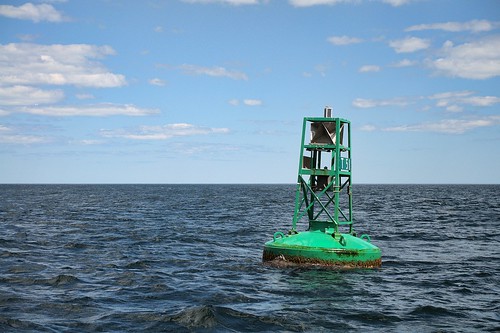
[Image: A green buoy on the surface of a body of water on a sunny day.]
Autism is not behavioral. Atypical behavior is not autism. It is a consequence of autism. It is surface markers by which what is underneath may be suspected, diagnosed, and investigated. Altering behavior doesn't alter autism.

Everything we recognize has surface markers. Fear, for instance, may look like a cold sweat, breathing hard, and dilated pupils, but that is not what fear is.

ABA, the most popular monopoly for interacting with autistics, denies the "underneath." It says that the surface markers are all that matter. It is profoundly dehumanizing. It is also a worldview that is almost impossible to maintain.

When you call autism a behavioral disorder—and I am not touching the "disorder" part right here but I also do not accept it—you are focusing only on the part of the person that you can see, as filtered through your own neurocultural understanding. You are denying that there is something deeper.

Would that be how you would want people to relate to you?

When you say that autistic behavior has only four functions, you are denying that autistic people are moved, that we yearn and are repulsed, that we struggle to do the right thing against self-interest, that we tremble in terror and that we aspire. That we are human. Imagine any of the great poets rewritten to replace deep emotion and the human condition with attention and tangibles.

Would you accept that for yourself?

"They don't feel it like we do" is a dismissal of autistic humanity.

The fundamental core of allistic*/autistic relationships, at least where I am, is a refusal to take autistic humanity seriously, to accept that we are people with real perspectives and real understandings—no matter what our disabilities—that deserve to be taken seriously and treated with respect. These perspectives may not be readily accessible to others, but yet they exist. Instead, facile and frequently self-contradictory assumptions are drawn based on an assumption that the core of humanity is limited or absent, and autistic perspectives are regarded as innately deficient, if they exist at all.

The belief that rich personhood is incompatible with substantial disability, especially intellectual disability, drives this divide, so that personhood can only be acknowledged in those considered fundamentally nondisabled; and acknowledged disability is treated as inherently dehumanizing. It is not. Profound disability and profound personhood coexist everywhere.

Onto the dehumanized figure we project all kinds of horrors, and we become something to be controlled rather than someone to empower. And we return to ABA, a technology of control, of altering the surface behaviors while ignoring what lies beneath.

A child does not become more human because they become more familiar to those who deny their humanity. Aping the majority culture does not take away minority status. It merely makes them more palatable to those with power over their lives.

Is palatability the goal you would choose for yourself?

This is what you are doing when you say autism is behavioral. You are participating in a movement to deny autistic personhood.

----

*"Allistic" means "not autistic."
Share:

INSAR 2019: Yet Useful Research and Autistic Representation Persisted

Shannon Rosa
Senior Editor

The TPGA team attends INSAR, the annual meeting of the International Society for Autism Research, annually and has done so for eight years. We participate as journalists covering important autism research for our community, and also from our combined personal investments as parents of high-support autistic teens, autistic self-advocates, and autism professionals. 

I found INSAR 2019 to be the most progressive annual INSAR meeting since I first started attending in 2011, going by TPGA's priorities of spotlighting research addressing the health and well being of existing autistic people, centering improved autistic quality of life as an optimal outcome, and increasing and acknowledging participation of autistic people themselves. I also appreciate seeing an increasing emphasis on autistic people and their families' day-to-day under-recognized concerns, including co-occurring conditions like GI issues and sleep disturbances, practical considerations of transitions to adulthood, suicidality and other mental health matters, physical activity, and tailoring supports and outreach for low income and/or racially diverse communities.

Most researchers we talked with and listened to seemed to understand that, in undertaking autism research, they are de facto advocates for the underserved and actively marginalized autistic and autism communities. I appreciate their work, as well as their solidarity with INSAR's autistic attendees, and was not alone:

Yet the things I was pleased about at the conference happened despite, not because of, the INSAR powers-that-be. While increasing numbers of conference researchers and presenters recognize that autistic people and their families need all the autism research we need, this year the INSAR board announced it was trying to "restore balance," and de-center non-biomedical autism research.

Why? Politics. We were told the reason was lobbying by SFARI, the Simons Foundation Autism Research Initiative. SFARI prefers the meeting as originally conceived back in 2001: neuroscience-based, and in keeping with SFARI's traditional medical model, deficit-defined approach to autism. While Simons efforts don't dominate INSAR funding, the foundation is a major source of autism research funding. And, like many well-funded-and-connected entities, flexing their influence generally gets results.

Even when those results doesn’t make sense: Excluding or minimizing non-biomedical research at INSAR would unnecessarily limit good and useful autism research, because there aren't any other international autism research conferences of note. Plus, the Society for Neuroscience conference is still happening every year, and continues to have autism content. There's no rational reason to stop making space for as much diversity in research and researchers as annual INSAR conferences can shoehorn in, and, frankly, this "change is bad" approach seems like an ironically rigid and maladaptive move for an organization bent on eliminating or "treating" such traits in the autistic population.

Simons also funds Spectrum Magazine*, which covers autism research, and, in leading up to the INSAR conference, published two pieces titularly about "autism wars" and "tension," but which were really about why a lot of medical model approach people don't want to listen to or respect rights-based autistic advocacy. It seems disingenuous, or at least ill-informed, to highlight and promote arguments that autistic self-advocates—generally known for their dedication to social justice without regard for personal cost (a stance research bears out)—aren't trying to serve the greater good of their entire community. Now, as Spectrum is a Simons effort, I am aware that it is not realistic to expect the magazine to cover autism research in a non-deficit model way. And I certainly don’t mean to imply that the phalanx of Spectrum journalists who cover the annual INSAR meetings are bad people, but rather that they operate according to their mission, just as we do, and that when they get things right by autistic people, that tends to be the exception rather than the rule.

While part of the problem in medical model autism researchers' and journalists' deficits-only lens is a tendency to see autistic people as subjects rather than human beings with opinions and rights, as Sara Luterman noted,
…another issue may be non-autistic people's own communication deficits. We talked with Dr. Catherine Crompton, whose research on Information Transfer between Autistic and Neurotypical People brings quantification to Dr. Damian Milton’s Double Empathy Problem. Her study concluded that, while autistic people communicate well with each other, and non-autistics synch well with non-autistics, there are significant gaps in trying to communicate information between autistic people and non-autistic people. (We interviewed Dr. Crompton during the conference, so stay tuned for our report.)

It may be that this same communication gap was behind attempts to pit researchers and autistic people against each other during the conference:
Which is odd considering that many attending researchers are themselves autistic, and already often discriminated against, including having their expertise and experience met with skepticism—as James Cusack noted:
INSAR needs to stop pushing back against an increased autistic groundswell, if for no other reason that, as INSAR board member and autistic advocate John Elder Robison noted, five percent of registered INSAR 2019 attendees were autistic self-advocates and/or researchers, and/or journalists. Five percent percent of 2200 people is, well, kind of a lot, and if autistic attendance keeps increasing without officially sanctioned, genuine inclusion, INSAR is going to find itself in a pickle.

Autistic researcher Dr. Jac den Houting with their 
poster on participatory research in Australia
[image: A white person with dark pulled-back hair and lip
piercings, next to a study results poster.]
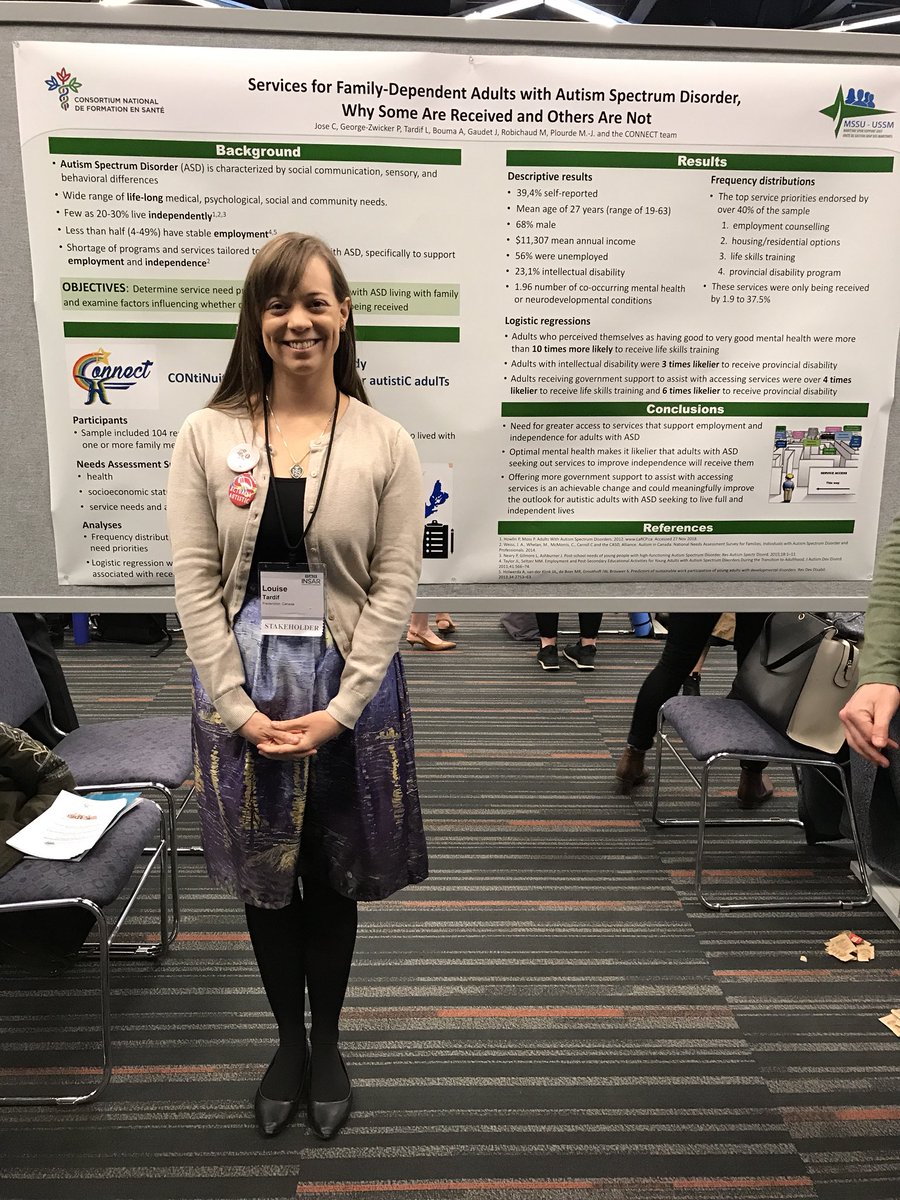
Self-advocate Louise Tardif, presenting a group poster on 
Services for Family-Dependent Adults. Photo © Jon Adams.
[image: A white person with long straight brown hair
with bangs, standing in front of a study results poster.]
And Mr. Robison's five percent estimate doesn’t include the autistic researchers who aren’t officially "out," from either explicit or implicit discouragement from their teams and institutions about disclosing their neurostatus:
So, all, please check out these Autism Acceptance guidelines from The Autistic Self Advocacy Network, and share them liberally with your peers, teams, and organizations.

[*sound of needle being dragged across a record*]

As for the conference programming itself, that was an exercise in sheer FOMO terror. (If you want to experience delayed overwhelm, you can still look through the conference program and abstract book [PDF]). We tried to hit as many sessions as we could, but still missed Sarah Hampton on Autistic Mothers’ Wellbeing during Pregnancy and the Postnatal Period; Dr. Lisa Croen on SSRIs and pregnancy (no link to autism, people!); Dr. Josephine Blagrave, Dr. Emily Bremer, and Dr. Andrew Colombo-Dougovito on caveats, barriers, and best practices for physical activity for autistic people—and even sometimes missed crucial nuggets in panels we did attend, e.g.:

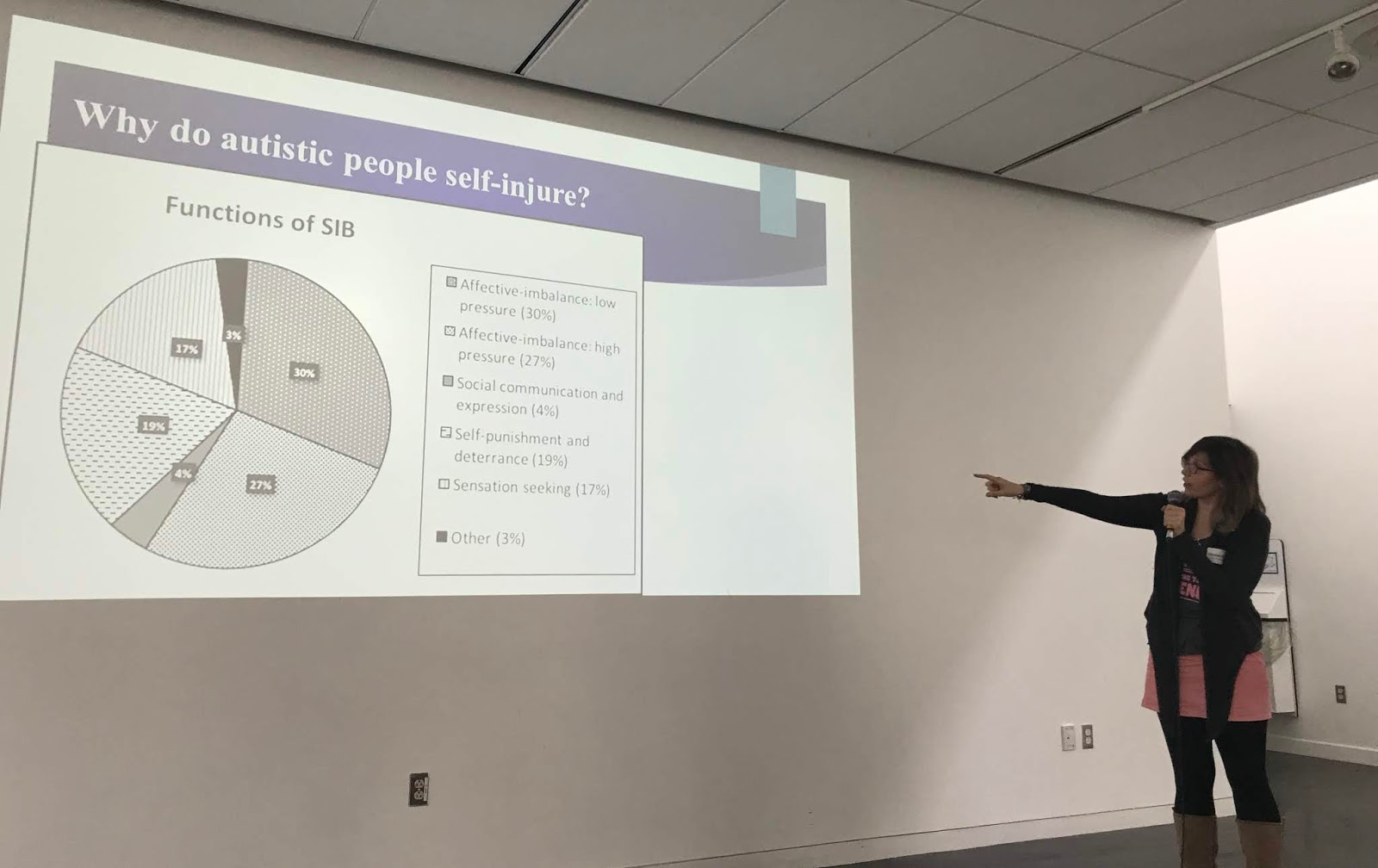
Here's what we did attend: Dr. Sarah Cassidy and group's excellent pre-conference session on autism and mental health (we live tweeted much of it, but it was also recorded in its entirety, so hopefully we will be able to share more about it soon). We were impressed by everything we saw, including Dr. Christina Nicolaidis's presentation of Dora Raymaker's work on autistic burnout, and Dr. Rachel Moseley, whose work on self-injury in autistic people without intellectual disability is sobering—so definitely watch out for our forthcoming interview with Dr. Moseley.

Dr. Rachel Moseley during her presentation on autism and self-injury
[image: White woman with glasses and long dark hair, speaking at a session,
and pointing at a projected slide about reasons autistic people self-injure.]
The INSAR press conference, aside from announcements about wanting the meeting to be a redo of its biomedical sciences origin story, contained exciting and useful research fom Dr. Olivia Veatch on sleep disturbances (not sleeping is bad for all humans, and so, yeah, it's bad for autistic people too), and Dr. Ruth Ann Luna on gut and microbiome issues (we are finally seeing research about co-occurring conditions as separate health issues with autistic-specific expressions, rather than as "treatable" symptoms of autism. This is a relief). We interviewed Dr. Luna, and that article is coming soon too.

One of the highlights of the conference for us was AutINSAR, a conversation between autism researchers and/or autistic community members, both in person and on Twitter, which we co-hosted for the third year in a row. AutINSAR was rollicking good fun with excellent points made by all, and so heavily attended IRL that people had to sit on the floor around the perimeter of the room. It takes a while to compile Twitter chats into usable formats, but rest assured a full summary is coming.

The IRL #AutINSAR crew
Back row: Emily and Manuel Casanova, Jon Adams, Bret Heasman, Sue Fletcher-Watson, Anne Fritz,
Cat Hughes, Aaron Bouma, Bethan Davies, Corina Becker, Stephanie Vreeland, and Steven Kapp
Center row: Sara Luterman, Christina Nicolaidis, Lorcan Kenny, Christine Jenkins,
and Louise Tardif. Front: TPGA editors Shannon Rosa & Carol Greenburg
[image: Crowd of neurodivergent people posing in the corner of the INSAR press room.]

John Elder Robison, reigning over the Stakeholder's luncheon
[image: A tall white man with short silver hair and glasses, 
speaking at a podium, wearing a red paper crown.]
The annual Stakeholder's luncheon was also useful. John Elder Robison was emcee, reminding us about shared community goals and the productive things that can happen when people work together. There were tables and tables of autistic people in proud solidarity, along with parents and other family members (we had at least two siblings at our table). I was glad some high-support individuals were there too, and was not the only person who appreciated some of the autistic attendees' verbal stims, as in my case they reminded me of my son, whom I hadn't seen for a few days. Of the speakers, the most bracing was Dr. Vikram Patel (who also gave a keynote), who reminded us that on a global scale most autistic people have no supports whatsoever.

One table of neurodiverse good company at the INSAR Stakeholder's luncheon.
[image: Nine people of diverse races, autism affiliations, and neurologies:
Back row: Carol Greenburg, Kyle DeCoste, Dr. Deb Karhson, Fernanda Castellon,
Sara Luterman, and Stephanie Vreeland.
Front row: Corina Becker, Elliott Keenan, and Dr. Steven Kapp.]
Dr. Patel's message was a reminder of why we do what we do at TPGA: We aim to generate as much useful and freely available autism information as we can, and get it to people who need it, regardless of what other supports they may have. And even though our resources are still mostly in English, we are open to translating and adapting them for other communities. Ask us!

During the main conference, we attended and live-tweeted several sessions: Co-Morbidities (co-occurring conditions like anxiety, depression, and executive functioning difficulties), Health and Well-Being in Transition-Age Youth and Adults, and Cultural and Structural Factors Underlying Diagnostic and Service Disparities Among Racial/Ethnic Minority Children in the U.S.

We also attended and published highlights on Learning How to Prevent Suicide in Partnership with Autistic People and Their Allies, which featured a pointed and moving talk from autistic artist Jon Adams. The Special Interest Group (SIG) on Gender, Sexuality, and Romantic Relationships addressed real-world concerns, and I particularly welcomed the section on supporting people with intellectual disabilities. We also appreciated the SIG on Autism and Related Disorders in the Context of Humanitarian Emergencies, which included the reminder that we cannot merely translate autism materials; we have to make them culturally-specific and -informed.

All the very practical but non-biomedical sessions we attended were popular, and some, like the Co-Morbidities sessions, had attendees lined up against the walls and sitting on the floor despite the room having hundreds of seats. This means attendees are voting with their feet (and butts). I'd like to think the INSAR board can't ignore how much INSAR attendees want to see quality of life-attuned research.

I also hope the INSAR board takes note that, as Dr. Sue Fletcher-Watson reported, dismissing autistic accommodations at the meeting itself is uncool. Last year the conference tried to promote flappause, AKA flapping one's hands instead of applause, so as not to assault those with auditory sensitivities (i.e., a large section of the autistic population). This year year the board backed off due to non-autistic pressures, and said flappause was a personal choice. I think this was an [expletive] move at an autism conference. Autistic attendees weren't pleased, and flappause continued to happen among increasingly sheepish applause:

We need to increase autistic accommodation at INSAR, not reduce it. Having a sensory/quiet room is a good start, but the poster sessions were still sensory hell, and many autistic attendees publicly reported having a tough time navigating the conference in general. And we know the INSAR board is aware of these issues, as board member John Elder Robison is publicly soliciting, listening to, and taking autistic concerns seriously.
So those are my takeaways from INSAR 2019: Oodles of solid content and autistic representation, despite conference organizers not entirely in touch with the most ethical motivation for autism research: to figure out best practices for helping and supporting the autistic people and their families who are already here, already struggling, and who deserve the best quality of life possible. Hopefully the INSAR board will start listening, with results reflected in next year's 2020 conference in Seattle.

We're interested to hear your take on INSAR 2019.

----

*Disclosure: Editors Shannon Rosa and Carol Greenburg have written for Spectrum Magazine.
Share:

INSAR 2019: Gender, Sexuality, and Romantic Relationships

Today's INSAR 2019 Special Interest Group (SIG) on Gender, Sexuality, and Romantic Relationships was led by Laura Graham Holmes and Jeroen Dewinter, and co-led by Anna van der Miesen. Essentially, relationships and sexuality are central to everyone's health and well-being. But there isn't enough useful research and materials available fo autistic people of all ages and abilities, their families, and healthcare professionals, and many have expressed the need for research and guidance. So that's what the SIG leaders and the participants in this well-attended session talked about. Any errors or omissions in the highlights below are on us.

SIG participants Sara L, Dori Z, Jac dH, and Christina N, in discussion
[image: Four people of varying gender identities and neurotypes,
talking at a conference table.]
Last year’s Gender, Sexuality, and Romantic Relationships INSAR SIG was about determining the most important issues for the autistic community, in terms of gender and sexuality and relationships. The ultimate goal for this SIG is to create a resource hub.

The SIG leaders started out with the World Health Organization (WHO) guidelines:
"Sexual health is a state of physical, mental and social well-being in relation to sexuality. It requires a positive and respectful approach to sexuality and sexual relationships, as well as the possibility of having pleasurable and safe sexual experiences, free of coercion, discrimination and violence."
Sexuality is a holistic concept. It’s not just about risk reduction. It’s also about living good lives.
Sexuality is for everyone, not just those who have relationships with partners.

Gender is separate from sexuality. A useful resource is The Gender Elephant, "an educational tool that can be used by anyone to help learn and teach the concepts of gender identity, gender expression, sex, physical attraction, and romantic attraction."

The Gender Elephant teaches gender and romantic concepts with simplified visuals
[image: Illustration of a pink elephant in a gray suit, next to a visual chart explaining gender
 identity, gender expression, sex assigned at birth, physical attraction, & emotional attraction.]
Most available research about autism and sex is about sexual behavior, knowledge, and attraction, and also identifying as LGBTQ+. Which is good, bt we want more research on matters that can contribute to autistic people’s quality of life.

We need to incorporate concepts like self-determination.

Previous autism & sexuality SIGs revealed three major areas of interest:

  1. Getting a better understanding of autism, sexuality, & relationships.
  2. Supporting sexual wellbeing and relationship satisfaction.
  3. Autistic perspectives in research, healthcare, and society.
We need to take this research on autistic sexuality realities, and bring it back to the community to help counter myths about autism and sexuality, and get people the resources that will actually improve their life quality.

Working closely with autistic people on autism and sexuality matters makes research better and leads to more useful supports.

Commentary: The best information about sexuality and autism is coming from the autistic and advocacy communities right now, not the research community. We need more practical and applied resources.

Seems like lots of people in the autism and sexuality SIG are looking for collaborators. Some folks are working on tools to help autistic young adults have open conversations about autism and sexuality and their personal experiences.

We need to help clinicians break down the uncomfortable conversations about autism and sexuality, especially since these topics should but rarely come up in autism evals like the ADOS. How do we get relevant gender and sexuality questions into autism studies other people are already doing?

We then moved to the discussion group on including and reaching non-speaking people and people with intellectual disabilities (ID).

Sara Luterman talked about the utter lack of sexual resources for people with ID resources, especially for LGBTQ+ needs. People with ID are complicated sexual being too, and autistic people are more likely to be LGBTQ+.

Carol Greenburg, who is both autistic and the parent of a partially-speaking autistic teen, mentioned Autistic people with ID need to learn about health boundaries: Pulling a girl’s ponytail because a kid is attracted to her is NOT OK, with kids w/ID or no.

Sara Luterman reminded group that teens look at pr0n! So how do we support that healthily?

Parent reports on sexuality are NOT going to be accurate. Again, this is true for autistic people w/ID and people with neither of those traits.

To teach sex ed properly, we have to talk the variety of ways in which people express their sexuality. Parents tend to be OK with it, sort of, until LGBTQ+ and tech (vibrators etc.) aspects arise. Then it's considered off-color.

What teaching health sexuality boundaries for people with ID can look like: IT’s OK to take pictures of your own bits, but it is NOT OK to send those pictures to other people without their consent.

What do visual supports for people with ID, in terms of sexuality materials, look like? Is there a SymbolStix symbol for a penis? And visual materials like po_rn are not realistic at all.

We also need good guides about things like masturbation, and consider that parents can introduce the materials, but then have the teens/clients watch the materials on their own. (We recommend Diverse City DVDS) A problem, though: many group homes are run by religious groups, and/or only have one computer in a public place. This means that not only do autistic people not have access to sexuality materials, but if they do, there’s no place to use them in private.

Another autism and sexuality complication for autistic people, from Sara Luterman: When you need more support, then functionally, you have less privacy.

Also: Even in mainstream sex ed, there’s a lot about how to say NO, and not a lot about how to say YES.

Sexuality is not unhealthy! So let’s talk about pleasure and well-being instead.

We also need more training materials about sexual identity matters, as those tend to be lacking in autism contexts.

John Elder Robison: Is the autism neurotype a key matching factor for successful relationships for #autistic people?
We need a self-advocacy curriculum for kids, because sometimes it’s not safe for adults to be involved, and kids need to know when and if to approach adults about sexual safety matters.
Kidpower California was suggested as a resource, but we have not verified it.

Share:

INSAR 2019: Learning How to Prevent Suicide in Partnership with Autistic People and Their Allies

Yesterday we attended the INSAR 2019 panel Where Do We Go from Here? Learning How to Prevent Suicide in Partnership with Autistic People and Their Allies, led by Sarah Cassidy from Nottingham University who has been doing this for four years now. Here is what the speakers had to say. (Any errors or omissions are on us.)

More than 10K stakeholders worldwide have identified the top 10 priorities, with equal representation of #autistic people:
  1. What increased barriers do autistic people experience when seeking help which may put them at greater risk of dying by suicide?
  2. What are the risk and protective factors for suicide in autism across the lifespan?
  3. To what extent are autistic people not believed about the extent of their distress?
  4. How can we further understand suicide where mental health is not a factor across the lifespan?
  5. What are the best ways of identifying and assessing suicidal thoughts and suicidal behaviours, in autistic people, in research and clinical practice?
  6. How should interventions be adapted for autistic people and individual presentations?
  7. What is the experience of suicidality in autsitic people? Is this experience different than the general population?
  8. How do autistic people seek help when they are in a crisis?
  9. How well do existing models of understanding suicide apply to autistic people?
  10. What is the impact of poor sleep on suicide risk in autistic people and how can this be measured?

John Adams, an autistic person and artist on why lived experience is key:

“I don’t live with autism. I live with my wife and two cats. I do live with PTSD."

"We’re losing autistic people daily, and they’re often not remembered."

What barriers do autistic people face? Jon Adams says:
  • Attitudes towards me
  • Attitudes about me
  • The current mental health system
  • Being dismissed
  • No specific autistic pathway
What are the risk and protective factors for suicide in autism across the lifespan?

To what extent are autistic people blamed about the severity of their distress? This leads to trauma.

Adams has heard people say they can’t get treatment for PTSD until the trauma stops? WTF.

"Our narrative is often dismissed and misunderstood."

I want to stay as long as I can, but is leaving a pragmatic decision I need to take if I become infirm?

Autistic people should be leading these discussions, yet our experiences are often written over. The next generation deserves better.

“Mindfulness” is useless. And medication to numb him is not OK either. He wants action, but on #autistic people’s terms.

What is the experience of suicidality in autistic people?

Also: Mental health professionals often cause PTSD in autistic people, according to Jon Adam. Restricted and repetitive behavior SAVED him.

How do autistic people seek help when they are in a crisis?

They’re often called "treatment resistant." Adams says, maybe instead of blaming autistic people, consider how you’re treating them. Why wold they want to “stay” if you blame them so?

Why are the effects of sleep issues on suicidality in autistic people? Sleep problems are bad for everyone, and autistic people are human, so sleep problems in autistic people are bad.

Recommends others treat autistic people with consideration, acceptance, kindness, and genuine listening to unique experiences.  

How can we best identify and assess suicidal thoughts and suicidal behaviors in autistic people?

The validity of tools depends on context:

How can we determine if a tool developed for the general population is OK for autistic people? One factor missing is alexithymia, or not necessarily having access to the real-time experience of one’s own emotions.

We have to involve the autistic community in any tools or interventions for helping people with suicidality.
The Mental Health in Autism project is a participatory research project to deeply new assessment tools for autistic adults.

Theorize that #autistic people would have difficulty communicating their suicidal intent, so they tested the theory.

For threat of suicide attempts, autistic people are more likely than general population that they are having suicidal thoughts, but that this is associated with lifetime   and attempted suicide.

Autistic adults have difficulty attempting certain questions, e.g., questions about what they will do in the future. “I can’t say never, even though I’m not at risk now."

We need to adapt measures to better determine suicidality in the autistic community. We need to do a LOT more work.

Next steps: Measure has been adapted to unrecognizability! Which is good.

Next: Paul Lipkin from Kennedy Krieger, on screening for suicide risk in a pediatric autism population.

WHO say close to 800K people die from suicide every year.

For each death, there are 20 attempts.

Suicide is the 10th leading cause of death for all ages.

The pediatric community has not been on top of this.
Share:

INSAR 2019: #Autism and Related Disorders in the Context of Humanitarian Emergencies

Shannon Rosa
Senior Editor

[Note: This report is based on @thinkingautism live-tweeted coverage, and as such may contain errors or omissions.]

Report from the INSAR 2019 Special Interest Group (SIG) Autism and Related Disorders in the Context of Humanitarian Emergencies.

SIG summary: "UN figures estimate 48 million children are impacted by humanitarian emergencies, including armed conflict and natural disasters. Within this population, children with autism and developmental disorders are extremely vulnerable to poor short and long term outcomes. There is increased awareness of the vulnerability of these children but limited research based knowledge on how to best address their needs. We aim to launch a platform for communication and collaboration between autism researchers and key stake holders in the humanitarian setting to address this gap."

First up was Doctors without Borders and SIG leader Ramzi Nasir, a developmental pediatrician who worked in conflict zones. He asked: Can we use remote consultations to increase support disparities?

We will be hearing from group of professionals with experience with children with developmental disabilities (DDs) and humanitarian emergencies. One effect of trauma during conflict means diagnoses/traits can be muddied, because of the overlap between developmental disabilities and the symptoms of trauma.

There are an estimated 535 million children, nearly 1 in 4 globally, who live in countries affected by conflicts and disasters. And we don’t know enough about the rates of developmental disorders in those countries.

The ultimate aim of this SIG is to collaborate between researchers, professionals, and stakeholders of the affected areas to promote research important for the care of and support of children with autism & related disorders.

Daniel Martinez from MSF (Doctors Without Borders) started an org for areas in post-conflict conditions called everywhereschools.org, to provide support once acute phase of conflict has resolved. MSF struggles with how to speak out during conflict/post-conflict without making things worse. Specific challenges include safety and complex needs. Martinez wanted to emphasize that while the data is not good, conflict areas have mortality rates that have not kept pace with modern improvements—some mortality rates are the same as they were decades ago, while those rates in other countries/regions are improving by contrast.

When we talk about what happens to children during wars, there are special considerations, and we need more research on what the long-term effects of these factors are:
  • Vulnerable population (though in some cases resilience can be enhanced)
  • Loss of opportunity (school/nurturing/protective adults) 
  • Trauma
  • Health (disease/malnutrition)
  • Migration/unaccompanied minors
  • Maltreatment
  • Sexual violence
  • Child soldiers
  • War toxicity/environmental degradation
Ramzi Nasir, a Palestinian man with short light hair  speaking next to a conference display screen
Ramzi Nasir presenting at the SIG
[image: Ramzi Nasir, a Palestinian man with short light hair
speaking next to a conference display screen.]
All of these previous factors already affect typically developing children. But what about children with developmental disabilities in conflict or humanitarian emergency regions? We don’t have a lot of data to show what happens to these kids, or on prevalence. But when we do have data, it tends to be sobering: At least 30% of refugees in Syria and Lebanon have a specific need.

Now: Laura Pacione with WHO/Dept of mental health and substance abuse; on broad overview of humanitarian response, to coordinate and ensure response is coherent and appropriate.

Humanitarian emergencies require a huge amount of coordinated collaboration and cooperation, to ensure kids get care during those crises. Lots of NGOs and government agencies too.

World Health Organization's Interagency Standing Committee (IASC) has Guidelines on mental health and psychosocial support in emergency settings. Frameworks informing the guidelines include WHO's Nuturing Care for Early Childhood Development nurturing-care.org, on providing security, safety, good health, nutrition, and more.

Also of note, the Canadian Government's “Building Back Better” guidelines: We need to ensure we build new services after the end of an emergency. There can be opportunities to create new services for kids with DDs, sometimes ones that didn’t exist before the crisis.

Now Andria Spyridou, of the International Medical Corps (IMC) mission in Syria and the Middle East. Challenges in Syria related to the conflict and displacement: Kids out of school & deprived of support, lack of professionals trained in child development and developmental disabilities, experience of violence an adversities can deteriorate development for all kids but especially for kids w/DDS
WHO Caregiver Skills Training has guidelines for caregiver-mediated intervention for kids with developmental disabilities who are 2-4 yrs old.

IMC also has regional cultural/contextual adaptation process that is modified for humanitarian settings, as material needs to fit the population addressed. Training and supervision of the facilitators is key to success of remote supports and evaluations for kids with developmental disabilities in conflict zones and humanitarian crises, which is why their training includes video recording of kids and remote consultations. Especially important as with displacement people cannot guarantee involvement in long-term programs.

Kerim Munir from Boston Children’s Hospital became involved in this type of work after 1990s earthquakes in Turkey, especially for mental health supports during and after humanitarian emergencies. In the US, the NIH Disaster Research Response is committed to building resilience after crises.

Autism-specific concerns:

  • We need to engage autism communities and maintain communication (e.g., need to take ownership as an international community).
  • Preparedness for crises is relatively low. The impact of crises on autistic people is underestimated. 
  • We need more research in to how emergencies affect autistic people, including resilience. But we don’t have/need to develop the infrastructure for real world supports. 
  • Youth/adolescents with DDs are highly vulnerable group, and can get lost to follow-up, BC most UN etc. goals are focused on young kids.

We know from (limited) research that kids who experience trauma (Chowchilla school bus kidnapping in this case) can all still be affected years later, in terms of loss of adaptive functions.

Summary: For us to actually get more involved in this kind of work and find solutions, we need to know what practical applications are, how we can ACTUALLY help.

To better support/aid people with autism and DDs in humanitarian emergencies, we need to identify priority gaps and action plans in the areas of:
  • Research
  • Clinical
  • Training
  • Advocacy
  • Policy
Research: Do we need different approaches in responding to conflict-based crises and natural disasters? Are there opportunities for better preparation in the former?

During the acute phases of crises, research may be difficult, but the following phase may provide more opportunities for research to better understand of impacts and outcomes, and how this differs by countries—including effects of stigma & discrimination.

How do the experiences between refugees and residents differ during humanitarian crises? What are the differences in access to care and how can we better ensure that access for both groups?

One of the missing data issues is that there are people doing work, but collaboration, e.g., in NGOs, can be siloed. How can we coordinate and synthesize this date in a useful way? For instance as is done with sustainable development goals?

Clinical: Evidence-based practices are important, but cultural factors including stigma can get in the way of accessing services based on that evidence. Identifying local partners (& training them) who can provide long-term supports is crucial.

We have to be aware of local professionals, what their expertise is, and how they can support local people with autism & DDs during humanitarian emergencies.

Approaches to supporting children with autism & DDs in crises needs to be holistic, in terms of supporting entire family too.

Training: Priority gaps: how do we tangibly building capacity, knowledge, and skills?

Need coordination in different levels of gov’t. Need cultural adaptation and tools.

Need database of communication between orgs, to address gaps & prevent duplication of work.

Technology can help with training, communication, instruction, supervision, implementation.

Advocacy: There is no point in translating autism and DD materials into other languages without making them culturally grounded and informed.

In crises & in specific cultures, stigma about autism & DDs can prevent parents & caregivers from seeking help. So sometimes approach to support needs to be needs & capacity-based rather than labels-based. Then group-based approaches can encourage parent solidarity.
Share:

How Autism Conferences Can Better Include and Respect Autistic People

Shannon Des Roches Rosa
Senior Editor, TPGA

[Content note: This article discusses suicidality and ableism]

The 2019 International Meeting for Autism Research in Montreal begins today, so let's discuss how autism conferences can best help the autistic people without whom autism conferences would not exist—based on how past autism conferences have gone, what can improve, and why participatory research (involving autistic people themselves) needs to be prioritized.

Last year's INSAR 2018 conference gave me some hope for the future of autism research. I'd never before seen anything like the slide below at any INSAR conference, not since I first started attending INSAR in 2011 (when it was still "IMFAR"). This Autistica slide, with the the motto of "Long, happy, healthy lives for all autistic people" encapsulates everything I want from INSAR presenters, and autism research:

Photo: Sara Luterman
[image: Projected slide showing a group of human faces in profile,
facing right, in white, blue, and dark orange. Orange text on the left reads,
 "Long, happy, healthy lives for all autistic people." Text at the bottom of the slide
reads, "Autistica" and "Dr. Abigail Thompson"]
It was about damn time that INSAR made autistic people feel welcome and centered. Even so, being the cockeyed optimist that I am, before INSAR 2018 I had already noted how INSAR (then-IMFAR) has become more inclusive of autistic people's priorities, since I first started atteneding in 2011:
"I remain hopeful that these meetings will continue to evolve to meet the needs and interests of autistic people. The schedule for this year’s meeting suggests it will. It features collaborations with autistic people and panels on adolescent and adult issues, mental health, sexuality and quality of life and services."
That hope wobbled when faced with the research covered at the INSAR 2018 press conference, which did not reflect those topics so much, and was a mixed bag: from reassuring parents that autistic kids being bilingual and having screen time was OK, to intriguing brain structure analyses, to yet more robot saviors for autism.

Yet I was grateful, over the three days of the conference to see the #INSAR2018 Twitter stream dominated by autistic people and autistic-informed perspectives:
I was also glad to see autistic-informed research such as Lily Levy's work on the fallout from autistic camouflaging or "masking." As Levy told us when we interviewed her at INSAR 2018, "We’re learning from the experiences of autistic people, instead of imposing this top down research driven, like, “now we’re going to look at your genes.”

Additionally impressive was Sarah Cassidy's INSAR 2018 Special Interest Group (SIG) on autism and suicidality, the third such INSAR SIG in three years, which brought ~60 autistic people and autism researchers and professionals to discuss research on, and factors underlying and mitigating, suicidality in autistic people—as well as next steps for researchers. Cassidy's group continues to do excellent work, recently publishing a paper showing that,
"On the basis of our findings, services should be alerted to the high lifetime risk of suicidal ideation and suicide plans or attempts, especially in individuals receiving a late diagnosis of Asperger's syndrome, in view of the substantial risk in this group."
But despite all the ways in which INSAR 2018 addressed the concerns and well-being of autistic people, journalist Cos, who is from the UK, and who was attending INSAR 2018 for the first time as an Autistica autistic ambassador, was not impressed overall. She had this observation on the conference:
"I knew it would be shocking, but the degree to which the language negated us was overwhelming. Amongst many researchers, it was the casual talk of deficit, of risk, the othering of classification: we were children with autism, males or females with autism. We were people with autism and their interest was in the autism, not the people.  I’ve heard farmers speak of their cattle with more respect for individuality."  
Per Cos's take, researchers need to stop treating autistic people like objects. I encourage every researcher who studies autism to read Becca Lory's article What is it like to participate in research as an autistic person?, at Autism in Adulthood, for a primer in what fair and considerate practices (and do not) look like.

You should also read what autistic advocate Morénike Giwa-Onaiwu said to WHYY on the missed opportunities of most contemporary autism research, and why researchers need to engage with autistic people themselves: “It’s looking at autism as the problem instead of how to improve the world around us so that autistic people can thrive.”

With autistic people making it clear that they don't like being ignored on autism issues, why are autistics still having to fight for recognition and validity at autism conferences? It's not for lack of feedback. INSAR board member John Elder Robison made a barnstorming plea to autism researchers to prioritize autistic people in 2014. At INSAR 2018, he continued this theme, noting,
"I asked the researchers if they recognized that they were not studying life with autism, but rather parental interpretation of life with autism. Accurately studying life with autism means studying actual autistic people, not people who watch us."
It was also in 2014 that I presented at a National Autistic Society (NAS) professionals conference in the UK, and was astounded by how remarkably advanced that conference was, in terms of autistic inclusion. It is NAS policy to open up their conferences with autistic keynote speakers, to set an "us" rather than "them" tone, and make it very clear who the conferences are meant to benefit.

That NAS conference's approach to including and respecting autistic people was revelatory to me, because it was as recently as 2012 that I sat in the back of an IMFAR keynote presentation, listening to a presentation with autistic friends about how they had no empathy or ability to make…friends. (We all laughed openly.)

But 2012 was before UK autistic autism researcher Damian Milton put forth his Double Empathy theory made it clear that "theory of mind" needs to go both ways, in interactions between autistic and non-autistic people:
"Whilst it is true that autistic people can struggle to process and understand the intentions of others within social interactions, when one listens to the accounts of autistic people, one could say such problems are in both directions." 
image: Sara Luterman, a white person with glasses and a knitted cap,  and Damian Milton, a white man with a salt-and-pepper beard, on a Rotterdam street littered with bicycles
Sara Luterman and Damian Milton, during INSAR 2018
[image: Sara Luterman, a white person with glasses and a knitted cap,
and Damian Milton, a white man with a salt-and-pepper beard,
on a Rotterdam street littered with bicycles.]
Though Milton and other autistic folk, including autistic researchers, are increasingly and openly attending autism conferences, this objectification of autistic people continues to happen. But, a shift is happening, in which mischaracterizations of autistic people are longer always tolerated. At the 2018 NAS professionals conference, psychiatrist and researcher Iain McClure he gave a talk advancing embarrassingly objectifying theories about autistic people. He was chastised on the spot by Linda Buchan, a neurodivergent clinical psychologist, who, according to Dean Beadle, an autistic lecturer and former journalist who was present,
 “…called out his regressive, negative and offensive tone and made it clear that those views are a thing of the past. She spoke up for all of our community today and she is a hero. She richly deserved the cheers, claps and ovation that she got.”
What can conference planners do to avoid mistakes like McClure's ableist speech? (Or avoid getting called out publicly for making ableist gaffes?) We spoke to the NAS's Carol Povey after the McClure incident, and she said that while the NAS gives its lecturers guidelines on respectful language about autism and autistic people, sometimes people like McClure ignore them—to their peril. We advise autism conference planners to both follow the NAS's example and try to provide guidelines for respectful language, and to also use The Autistic Self Advocacy Network's freely available guidelines for Making conferences autism-friendly, which reminds planners that, "The autistic spectrum includes a wide variety of persons with a wide variety of support needs. Planning ahead for your Autistic guests will help establish equal participation."

For autism research-specific events like INSAR, folks need to look to orgs like The Participatory Autism Research Collective, "A community for people who want to promote autistic involvement in autism research," and who specifically called out the McClure incident. If we promote an attitude of more participatory approaches to research, ones in partnership with autistic people, that approach will ideally translate to the research presented at INSAR, and the way it is presented.

What does participatory research look like? The August 2018 article Making the future together: Shaping autism research through meaningful participation, from Sue Fletcher-Watson, Jon Adams, Kabie Brook, Tony Charman, Laura Crane, James Cusack, Susan Leekam, Damian Milton, Jeremy R. Parr, and Elizabeth Pellicano discusses how:
"Specific manifestations of participatory research might include leadership by autistic researchers, partnership with autistic people or allies as co-creators of knowledge, engagement with the community in general (e.g. via social media) and consultation with relevant individuals or community organisations."
INSAR professionals would also do well to heed formal autistic/researcher collaborations such as Shaping Autism Research, and AASPIRE. The latter org brought to INSAR 2018 hard copies of the inaugural edition of its journal Autism in Adulthood—full of juicy insights about autism and autism research from autistic adults.

image: Four white people: Christina Nicolaidis,  John Elder Robison, Sara Luterman, and Shannon Rosa, holding up copies of the journal Autism in Adulthood.
Hard copies of Autism in Adulthood's inaugural journal!
[image: Four white people: Christina Nicolaidis, John Elder Robison, Sara Luterman,
and Shannon Rosa, holding up copies of the journal Autism in Adulthood.]
Also useful: AASPIRE recently published "practice-based guidelines for the inclusion of autistic adults, both as research team members and as study participants." And Jac den Houting spoke on prioritizing autistic voices in autism research at the Frankl Open Science Platform:
"Participatory research is important for a number of reasons: empowering the community, ensuring quality data, and making sure that the studies carried out have real potential to improve the lives of people with autism." 
Finally, try to walk the walk of researcher Rosalind Picard, who presented her research on meltdown-detecting wearables for autistic people at INSAR 2018 (as reported by Sara Luterman at NOS Magazine):
"Dr. Picard began her keynote by stressing the importance of autistic feedback in her work. She recalled an autistic friend’s observation that 'my biggest problem is not understanding the emotions of others. My biggest problem is you are not understanding my emotions.''
Thankfully, at INSAR 2019 there will be a way for researchers to figure out how to do right by autistic people: Participating in or following the AutINSAR Twitter chat, an in-person and online discussion about autism research priorities, with the conversation taking place directly between autistic and/or autism researchers. AutINSAR 2019 will take place on Thursday May 2, at 12:30, in the INSAR Press Room. (Until then, please peruse the AutINSAR chats of 2018 and 2017.)

Some of the onsite #AutINSAR participants, left to right: Jon Adams,
Sara LutermanDonna BishAndrew Colombo-DougovitoLily Levy,
Laura CraneMel BovisCarol GreenburgGeorgina Perez Liz,
and Shannon Rosa
Not pictured: Jelle van Dijk
Photo by Josie Blagrave

[Image description: Neurodiverse adults smiling and posing together]
Overall, we know that autistic research priorities need to be more balanced: We need just as much research into quality of life issues as we do in brain structures and genetics. A short list of topics autism researchers could put more weight behind, and thus support the autistic people their work is supposed to be about, include investigating co-occurring conditions like Ehlers-Danlos, the real-world effects of "Early Intervention," and how negative interactions with medical professionals affects autistic people's access to medical care. For a start.

I'll leave you with a quote from Sue Fletcher-Watson's post-INSAR 2018 thoughts, and a stance which I share: "Here’s hoping that at INSAR 2019 and beyond we might hear from a few more scientists whose methods inspire the community as much as they dazzle their fellow scientists."  
Share: