English is Easier to Spell Than You Think. (Really?)

Image result for English Spelling
http://anglozine.com


Probably every writer of English struggles with spelling and word form.  There, their and they're is one nightmarish trap that so many writers fall prey to.

When you ponder the amazing history of our language, you'll realize that we struggle with an olio of Celtic, German, Scandinavian, Pig Latin, French, Hindi, Vietnamese, Arabic, Swahili, Amharic, Martian, Valley Girl, Welsh, Scottish, Irish, Yiddish, vague and rare crossword and scrabble words, all tossed with a smattering of guttural grunts and squeaks, held loosely together with a Latin grammar that has absolutely nothing to do with the structure of English.  Thank God that clicks and pops are more or less out of vogue.
If you think I'm kidding, just watch this wonderful series on the History of English.  The origination of the word "shit" is especially illuminating.
No wonder spelling is in the eye of the beholder.  Don't get me started on grammar.

Early on in my writing career I read something that has stuck with me since.  Don't remember the source, but it sure rings true.  Most writers of English habitually misspell about 100 words, in my case, give or take about a thousand or so.

Of especial frustration is the rule, "i before e except when I use it."  I hate this rule.  I never get it right.

My spelling can be so bad that my computer crashes and refuses to reboot unless I promise to stop trying to sound literate.

Sigh.

Well, wouldn't you know several researchers have the temerity to claim that English spelling has some sort of underlying logic.  I have to believe them.  I didn't spot a single questionable spelling in their entire article.  So they must have the inside dope.

Here's the story with a link to the original.
*  *  *  *  *


The hazards of English spelling:


New findings make it less hazardous
than previously thought

A new study of English spelling practices demonstrates that the way we spell words is much more orderly and self-organizing than previously thought.  Their research examines previously unnoticed systematic aspects of English spelling and explains how the system emerged. 

-ous
One suffix that the authors report on is -ous, found in words like nervous and hazardous, which turns nouns like nerve and hazard into adjectives. They discovered that the final letter sequence ous may serve as a flag, informing readers that a word must be an adjective. The sound of this suffix is a short vowel (linguists call it schwa) followed by s: ?s. The authors found that any written English word that ends in the three letter ous is an adjective and conversely that a word that that ends in the sound ?s but is not an adjective is never spelled with ous: service, genius, menace. They also have found similar patterns for other adjective suffixes, including the -ic of allergic, the -al of final, and the -y of funny.

For each of these affixes, the authors analyzed a large sample of written English documents dating back close to a thousand years. For every word that follows each of the regular pattern nowadays (e.g., hazardous, allergic, final, and funny), the linguists looked at every instance in their sample, keeping track of how it was spelled. They found a number of spellings for each suffix over time (e.g., ose, ows, is, owse, ys, es, ouse, us, and ous for modern ous). For every suffix, though, one spelling eventually won out and each suffix followed the sort of pattern that is known from biological competition between species.

This is a striking example of self-organization: No one is or was in charge of English spelling. As opposed to countries like Italy and France and Israel, where national academies oversee the written language, no English-speaking country has a language academy. And yet, somehow, the written language slowly but gradually evolved a system of marking word categories in cases like nervous -- despite the fact that this system was never purposely designed. What is apparently a nuisance -- we can spell one word ending in more than one way -- is actually the trade-off for the grammatical 'flag' that says (in case of -ous), 'This word is an adjective'.

As a follow-up to this research, the authors are now testing their findings experimentally on fluent readers of English. Do they use the regularities that we found when they read? Furthermore, can these be used to help children and adults to learn to read more quickly and more fluently?

The study "Self-organization in the spelling of English suffixes: The emergence of culture out of anarchy," by Kristian Berg (University of Oldenburg) and Mark Aronoff (Stony Brook University) was published in the March, 2017 issue of the scholarly journal Language.

Story Source:  Materials provided by Linguistic Society of America.  "The hazards of English spelling: New findings make it less hazardous than previously thought." ScienceDaily. 10 March 2017. 
Share:

Do Millionaires Migrate From High Tax to Low Tax States?


In a word, no.  In a study of financial osmosis, researchers at Stanford find that the wealthy are less likely to move than the general population, indicating that lowering taxes to attract the affluent is a losing proposition.  However those at the bottom of the economic ladder are far more likely to relocate, sort of economic Okies.

To a writer, these tidbits add to an overall understanding of why people do things, and understanding that can add to the richness of your prose.  Or poetry, too, I suppose.

Here's the report with a link, as always, to the full study if you're so inclined.
*  *  *  *  *


Study dispels myth about millionaire migration in the US

"Our research indicates that 'millionaire taxes' 
raise a lot of revenue and have very little downside."

The view that the rich are highly mobile has gained much political traction in recent years and has become a central argument in debates about whether there should be "millionaire taxes" on top-income earners. But a new study dispels the common myth about the propensity of millionaires in the United States to move from high to low tax states.

"The most striking finding in our study is how little elites seem willing to move to exploit tax advantages across state lines," said Cristobal Young, an assistant professor of sociology at Stanford University and the lead author of the study. "Millionaire tax flight is occurring, but only at the margins of significance."

In any given year, Young and his fellow researchers found that

  •  roughly 500,000 individuals file tax returns reporting incomes of $1 million or more (constant 2005 dollars). From this population, 
    • only about 12,000 millionaires change their state each year. 
    • The annual millionaire migration rate is 2.4 percent, which is lower than the migration rate of the general population (2.9 percent). 
  • The highest rates of migration are seen among low-income tax filers: migration is 4.5 percent among people who earn around $10,000 a year.

". . .millionaires are no less likely to live in states with high
income taxes (e.g., New Jersey or California) than in states
with low or zero income taxes (e.g., Texas or Florida)."

"There is a widely held perception that elites are extremely mobile -- that they are more attached to money than to place, and with money you can live anywhere you want," said Young, who noted that millionaires are no less likely to live in states with high income taxes (e.g., New Jersey or California) than in states with low or zero income taxes (e.g., Texas or Florida). "We tend to think of migration as a form of freedom and one of the privileges enjoyed by the rich. In practice, migration comes with high social and economic costs -- uprooting one's family, breaking away from one's social networks, and restarting in a new place."

The study finds that family responsibilities are a key factor that limit migration among top-income earners. "Very affluent people are much more likely to be married and to have school-age children, which makes moving more difficult," Young said.

The Working Rich
Young also noted that most millionaires today are "the working rich" and do not live off inherited wealth, but instead rely on earnings from employment. "They work as lawyers, doctors, managers, and financial executives," he said. "They are at the peak of their careers and typically earn million-dollar incomes only for several years. People avoid potentially disruptive moves when they are performing at the very top of their game."

Titled, "Millionaire Migration and Taxation of the Elite: Evidence from Administrative Data," the study, which appears in the June issue of the American Sociological Review, relies on federal income tax returns from all U.S. tax filers who earned $1 million or more in any year between 1999 and 2011. This resulted in a dataset of 45 million tax records from 3.7 million unique tax filers over 13 years. For comparison, Young and his co-authors, Charles Varner, a sociologist and an associate director of the Center on Poverty and Inequality at Stanford University, and Ithai Z. Lurie and Richard Prisinzano, both financial economists at the Office of Tax Analysis at the U.S. Department of Treasury, also drew a 1 percent sample of the total population of tax filers, giving them an additional 24 million tax records from 2.6 million unique filers across the income distribution. The researchers tracked the income and residency of all of the filers over the entire study period.

"Previous studies on elite tax flight have struggled with data limitations either by using narrow segments of the millionaire population, such as professional athletes, or by analyzing limited geographic regions, such as one or two states," Young said. "This study includes every tax record filed by every U.S. millionaire over more than a decade."

According to the study, in the average state, which has an annual population of more than 9,000 individual millionaires, a one percent tax increase on this population would result in an expected loss of 23 of these economic elites. "Yes, a handful of top earners would leave," Young said. "But, more notably, virtually all of the millionaire population would stay."

When Millionaires Migrate. . .
While millionaire migration is extremely limited, there is a grain of truth in the worries about millionaire tax flight, the study finds. "When millionaires do migrate, they are more likely to move to a state with a lower tax rate, and that state is almost always Florida," Young said.

Florida disproportionally attracts millionaires
There are nine states without a state income tax, but only Florida disproportionally attracts millionaires from higher tax states, Young said. The other states, such as Texas, Nevada, and New Hampshire, do not.

"My guess is that if Florida established a 'millionaire tax,' elites would still find Florida appealing because of its climate and geography -- and patterns of elite migration wouldn't really change," Young said.

In fact, the millionaire migration that does occur has so little to do with tax differences that Young and his co-researchers estimate that if all states had the same tax rate -- so there were no tax incentives to move -- there would only be approximately 2.2 percent or about 250 fewer millionaire migrations between states each year.

The study also looked at the millionaire population along the borders between states with different tax rates. "In these narrow geographic regions, you would expect millionaires to cluster on the low tax side of the border, but we see very weak evidence of this," Young said.

As for policy implications, Young said "millionaire taxes" result in minimal tax flight among millionaires and help states raise revenue to improve education, infrastructure, and public services, while reducing inequality.

"Our research indicates that 'millionaire taxes' raise a lot of revenue and have very little downside," Young said.

Story Source: Materials provided by American Sociological Association.  C. Young, C. Varner, I. Z. Lurie, R. Prisinzano. Millionaire Migration and Taxation of the Elite: Evidence from Administrative Data. American Sociological Review, 2016
Share:

Mental Health and Autism: Why Acceptance Matters

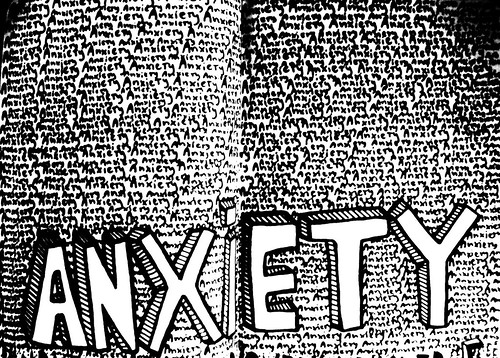
Anxiety
Photo © Mariana Zanatta | Flickr/Creative Commons
[image: Hand-drawn black-and-white outlined block letters spelling "anxiety"
on a background of "anxiety" written repeatedly in black & filling all space.]
Christine Motokane
www.workingthedoubleshift.com

It is well known that individuals on the autism spectrum are likely to have co-occurring mental health issues such as depression and anxiety. However, mental health is a less-discussed topic surrounding autism, compared to behavior and social challenges, etc.

As an autistic young adult with anxiety,  I can give personal insight on this high prevalence. A big part of our susceptibility to issues like anxiety has to do with how we were slowly socialized, either implicitly or explicitly, to believe that an autistic lifestyle is something that is defective and therefore needs fixing. A recent Independent article sums up the strong link between lack of autism acceptance and the development of mental health disorders in autistic people: Research shows that lack of acceptance externally from others and internally from the self significantly predicts depression and anxiety in young adults with autism.

Yet mental health, and having a positive relationship with an autistic identity, are not usual priorities for helping autistic people. And if mental health issues are mentioned with regards to autism, they are are addressed in a pathological way. In this post I am going to write about my experience as someone on the spectrum who lives with mental health issues.

I have written about my struggle with anxiety in an earlier post. However, in that post I talked about some of the symptoms of how my anxiety manifests. I have never written that extensively about the root cause of my mental turmoil being related to lack of acceptance of my being autistic. Although I come across as a "confident self advocate" when I speak about my life experiences, the truth is that I struggle with deep self-confidence issues, and sometimes actually doubt some of my own advice. There is a "monster voice" in my head that constantly tells me, "I am wrong," or that "I am not deserving of support," and other negative scripts. I constantly say, "I'm sorry" to my family or others whenever I feel that my autistic mind takes over. My monster voice is always constantly bringing me down by saying that I am not "entitled to my feelings because I am autistic," and battles with my positive voice or the voice of confidence. I am so hard on myself and I blame myself for all the challenges that life brings me.

Lately, I have been wondering: how did I become this way, or how did I develop such negative thinking which resembles mental self injury? I then realize that the negative scripts and inner anxiety that I developed in my head today were the result of years of growing up, and slowly realizing that disability is something that needed to be fixed. Unlike the children growing up today with the neurodiversity framework, I did not come of age at at time in which autistic advocates were respectfully regarded as the "true experts."

As much as I hate to blast some of my lovely support people like my therapist or my family members on this blog post, they unintentionally—through no fault of their own—contributed to my negative script that I have for myself. Before I go ahead and critique some of the interventions that I received, I want to be clear that I am thankful that I have gotten interventions that enabled me get to the point where I am today. The social skills, emotional and self-advocacy skills that I learned during my adolescence enabled me to be the strong advocate I am today. But for autism intervention, there is always room for improvement.

Throughout my school years, I was taught to camouflage my symptoms in order to blend in and function in the mainstream environment. This was reinforced through behavioral therapy and the school system. A few examples that I can remember include that I was pressured to join clubs, and also sit with a group of kids because that is how typical high schoolers socialized. I was discouraged from socializing with adults such as the other aides at school, or the computer teacher in middle school, because it wasn't considered appropriate. I was socialized to learn about  the fashion and other interests that teens through social groups that my behaviorist made (e.g. the "cool" or "not cool" chart) in an attempt were to make me "fit in" better.

All these experiences and others have taught me that I should camouflage and suppress my natural self because I should appear normal. Friends were chosen for me, because people wanted me to be more social. I went along with the recommendations of my support people and parents, and pretended to live as a neurotypical, because I thought they knew best. I tried all I could to suppress my natural way of being—at the expense of my self esteem, and acceptance of my unique neurology.

What the people who helped me didn't realize at the time were the future implications of my mental health as an autistic person. This was because their focus was on making me as self-sufficient and socially adjusted as possible, and by the time I reached adulthood nobody ever considered that what they were doing could unintentionally affect my self-identity and self esteem. But all my energy spent camouflaging myself in order to appear "normal" became mentally exhausting. I started second-guessing myself, and internally beating myself up, over minor social infractions. This is a big part of my anxiety in living as an autistic person.

My experience with special education and ABA demonstrates how the dichotomy of interventions that are designed to optimize the quality of life for individuals on the spectrum can also adversely impact their mental health, and also their self-acceptance of an autistic identity. This is why so many autistic self-advocates are concerned about behavioral modification programs: because of the long-term effects they can have on autistic people's mental health. This is why we need to preach autism acceptance, and center self advocates in developing appropriate supports for autistic people. That means we need to take autistic people's insights, feelings, and desires into account, instead of dismissing them.

Acceptance means training mental health service providers to look at autism and other disabilities as a part of a person's identity, rather than a problem that needs to be fixed. Acceptance means helping to create a world where autistic people don't have to camouflage themselves as neurotypical. Acceptance also means giving supports and accommodations to autistic people of all abilities and support levels when it's asked for and needed. If the world becomes more embracing of the autistic lifestyle, I believe the severity of the mental health problems autistic people have can, in many cases, be lessened.

----

This article was originally published at redefiningnormalayoungwomansjourney.blogspot.com.
Share:

Personality: Where does it come from? How does it work?

Personality Traits & Personality Types: What is Personality?

"There are many ways to measure personality, but psychologists have
mostly given up on trying to divide humanity neatly into types. Instead, 
they focus on personality traits." (click to read an excellent article by 


This is the question at the core of fiction:  where does a character's personality come from and how does it work?  Sure, there are works where the characters are ill defined and show no growth over the course of the story.  Lots of violence, plenty of sex, and you can't remember a thing about it ten minutes later.  Annoyingly, films and book of this ilk sell revoltingly well.  Happily there are enough works around where a character gains definition over the course of their story and show growth.  (I can't watch or read works where the characters are as shallow as the writer.)

One of my personal favorite acts of fiction are the Lord Peter mysteries by Dorothy Sayers.  It is unusual but not unknown for characters in crime fiction to develop over the course of a story.  Lord Peter, however, starts as a caricature in the first book, the 1923 Whose Body developing into a complex, vulnerable man in 1937's Busman's Honeymoon.  Over these 13 works we see a somewhat vacuous upper class, Berty Wooster-esque quasi-twit become a deeply vulnerable character with endearing flaws and foibles and a very real feeling complexity.

The article below offers a series of ideas and concepts that a writer can use to develop a character beyond the standard "where did they go to school and why do they hate their mother?"  (By the way, Lord Peter's mum is absolutely delightful - as are the ghosts that inhabit his family home.)

Ms. Dweck, the author of this article, points out that we all have three most basic psychological needs, needs we strive to fulfill from birth.  Answer the question of how your character(s) meets or fails to meet these needs, and you have a real person that your readers or viewers will relate to.

Here's the article with a link to the full piece as published.
*  *  *  *  *


Personality: Where does it come from
and how does it work?

How do our personalities develop? What do we come with and what is built from our experiences? Once developed, how does personality work? These questions have been steeped in controversy for almost as long as psychology has existed.

In an article in Psychological Review, Carol Dweck tackles these issues. She proposes that our personalities develop around basic needs, and she begins by documenting the three basic psychological needs we all come with: the need to predict our world, the need to build competence to act on our world, and, because we are social beings, the need for acceptance from others. (She also shows how new needs emerge later from combinations of these basic needs.)

Infants arrive highly prepared to meet these needs -- they are brilliant, voracious learners on the lookout for need-relevant information. Then, as infants try to meet their needs, something important happens. They start building beliefs about their world and their role in it: Is the world good or bad, safe or dangerous? Can I act on my world to meet my needs? These beliefs, plus the emotions and action tendencies that are stored with them, are termed "BEATs." They represent the accumulated experiences people have had trying to meet their needs, and they play a key role in personality -- both the invisible and the visible parts of personality.

The invisible part of personality consists of the needs and BEATs. They form the basis of personality and they drive and guide the visible part. The visible part happens when the needs and BEATs create the actual goals people pursue in the world -- what people actually do.

Take the following example. Some people are conscientious; they actively pursue achievement and exercise self-discipline and perseverance. That's the visible part. Everyone has a need for competence, but how people pursue competence-whether they do so in a conscientious manner -- will depend on their BEATs (the invisible part, such as their beliefs). Research shows that some people hold the belief that their abilities are simply fixed traits. When they are confronted with a challenging task, they may choose an easier one instead because the challenging task carries a risk. It could expose their fixed ability as deficient; it could undermine their sense of competence. However, other people believe that their abilities can be developed. They are more likely to welcome the challenging task and stick to it in the face of setbacks in order to develop their competence. They display the hallmarks of conscientiousness. In other words, underlying BEATs can have a pronounced effect on the visible "personality" people display as they pursue their goals.

Temperament can also be important. For example, if children are shy or fearful it can make certain needs (such as the need for predictability) stronger than others and it can affect the way they react to things that happen to them -- both of which can mold the BEATs they develop and carry forward.

What are the implications of this theory? First, it means that our personality develops around our motivations (our needs and goals) and is not simply about traits we're born with. The theory also reveals the invisible parts of personality and shows how we can identify and address important BEATs (particularly beliefs) to promote personality change.

In short, like large, classic theories of the last century, the current theory brings together our motivations, our personality, and our development within one framework and helps shed light on processes that contribute to well-being and human growth.

Story Source:  Materials provided by American Psychological Association.  Carol S. Dweck. From needs to goals and representations: Foundations for a unified theory of motivation, personality, and development.. Psychological Review, 2017
Share:

Please Stand By Is Not Harmful to Autistic People; It's Just a Bad Movie

Poster for the movie Please Stand By
[image: Dakota Fanning, a white blonde
woman wearing an orange sweater and lots
of colorful lanyards, as the autistic
character Wendy in Please Stand By,]
Amanda Forest Vivian
adeepercountry.blogspot.com

I usually don’t watch movies about autism, but after being told that [TPGA editor] Shannon would make me a gimlet I dipped my toes into the horrible pool. My limply positive impression of the trailer was borne out by the movie: it doesn’t say anything bad about Autistic people, and the main character Wendy breaks some stereotypes. She is female, can’t live on her own but can talk, and isn’t a genius. I don’t think this movie will harm Autistic people, and I’m grateful for that.

However, it’s still a bad movie that has nothing going for it but a dog in a cute sweater. You can see a dog in a cute sweater on YouTube without having to watch someone pretend to be Autistic by yelling things like, “My mom is dead! That means she doesn’t feel anything anymore!”

Dakota Fanning’s performance was just awful. It came off like she and the director had never seen an Autistic person, but based on something they read they decided that to look like an Autistic person, you should just stand very still and look serious. Dakota didn’t stim or have any physical mannerisms that would have particularly made her look like an Autistic person; she just acted like a piece of cardboard and that was the whole performance. Actors who are playing developmentally disabled characters often get made fun of for acting overly emotional, childlike, or awkward in an attempt to come off as disabled—but at least they’re acting.

It was hard to relate to Wendy because of the performance, but the story was also very incoherent, both in terms of the situation the characters were in at the beginning, and the emotional development I guess they were supposed to have.

This review spoils some plot points, such as they are.

At the beginning of the movie, Wendy’s sister Audrey is making her live in a group home after their mother died. Wendy would prefer to live with Audrey’s family, but Audrey not only refuses, she won’t even bring her baby to meet Wendy. Audrey apparently thinks Wendy is dangerous, and there’s no good explanation given for that. Obviously it’s verboten to portray autism parents in a bad light, but it would make more sense if their mom had raised Audrey with a negative view of Wendy and the movie showed Audrey getting out from under that. Instead, we’re given the opposite impression—that the mom treated Wendy much better than Audrey does. It seems Audrey has a problem with Wendy for no reason, yet she’s supposed to be a sympathetic character.

Since this is the conflict at the beginning of the movie, you’d expect it to be addressed when Wendy runs away from her group home in San Francisco and travels to Los Angeles to deliver her submission to a Star Trek scriptwriting contest. You might think that making this journey would be challenging but empowering for Wendy and everyone would see her in a new light because they didn’t expect her to be able to do this.

But Wendy’s journey isn’t meaningful. The only reason it’s challenging is because a bunch of random obstacles get unnaturally placed in her way. These obstacles mostly fall into two categories:
  1. Almost everyone Wendy meets is mean to her. For example, two bus drivers ignore Wendy when she asks them a question; clerks and cashiers glare at her; and the one time she approaches a stranger and tries to make friends with them, she’s robbed.

    At one point she tries to buy candy at a gas station and the cashier tries to trick her into paying $18 for a $2 bag of candy. If you think about the fact that gas stations have security cameras and they have to count up the register at the end of the day, this is a really complicated way to get $16. It’s like the side characters are contractually obligated to drop what they’re doing and torment the poor disabled girl.
  2. Facts of the universe seem to be out to get Wendy as well. A holiday she forgot means she can’t send her submission by mail; she’s traveling with her dog but he’s not allowed on the bus; she doesn’t have enough money for a ticket after being robbed; and she is completely taken aback when she finds out about these things, even though she was waiting to buy the ticket for eleven hours.
Maybe we were supposed to think it was part of Wendy’s disability that she doesn’t anticipate these contingencies and has trouble adjusting to them when they happen. I would welcome seeing this in a movie, but if that was what they were going for, it wasn’t clear at all.

Instead, it comes off like Wendy (or the movie) doesn’t understand rules and considers them to be an affront. There’s a scene where Wendy passionately argues with a ticket agent that he should give her a $22 ticket for $7.22, because she really needs a ticket; when he doesn’t agree, she sneaks onto the bus. About ten minutes later, another scene happens with the same beats—Wendy tries to get someone to bend a rule for her, apparently thinking that she can sway him with an intense speech; the person doesn’t give in because he’s just doing his job; Wendy shrugs, defies the rule, and gets away with it. It seemed to me that these two scenes were intended to be the most empowering moments for Wendy.

The problem with this is glaring. Autistic people aren’t likely to go around trying to break rules all the time. That’s ... kind of our thing? Didn’t the movie try to hammer this very same fact into our heads by having Wendy write down rules about life in her notebook and wear days of the week outfits? Just a little while ago she had to convince herself it was okay not to shower every morning.

Sure, there are exceptions to every generalization about Autistic people, but let’s be real: the movie wasn’t trying to show a refreshingly un-stereotypical Autistic person who doesn’t care about rules and has an easy time disregarding them. They forgot.

Anyway, the only reason Wendy has a difficult journey is that nearly everyone she meets is awful, and nearly everything she’s doing is against a rule. These problems don’t happen because she’s Autistic, because she lives a sheltered life, or because her sister and staff underestimated her. Anyone would have trouble getting to LA if they brought a dog on a Megabus, got robbed, got … well, I don’t have time to list all the hardships that befall Wendy.

Since Wendy’s struggles aren’t caused by who she is, and they’re not challenging to her specifically because of who she is, they aren’t thematically meaningful and they don’t lead to character development. It is unclear what change the characters are supposed to have undergone by the end of the movie. It’s just bad.

At the end, I guess Audrey is supposed to have learned a lesson about Wendy. She now believes it’s okay for Wendy to meet and hold the baby. Scottie, Wendy’s vaguely defined support worker, has learned that she wasn’t engaged enough with Wendy. At least I think so? I’m just spitballing here.

(I won’t try to make sense of Wendy’s living situation or the services she receives. Her group home for Autistic young adults is called an “Assisted Living Facility”—a name that implies it’s for senior citizens—and Audrey must pay for it out of pocket. Also, Wendy is obviously conserved, but if you think about this for one second you’ll start trying to figure out when, why, how, and who; the conclusions you’ll come to are horrifying; and unbelievably, I think the writers didn’t think about it at all.)

It’s definitely a sign of progress that this movie exists. Like I said, it’s not harmful or insulting to Autistic people, just bad. Objectively, the most offensive thing is how Audrey is presented as a sympathetic character when some of her behavior is flat out evil—but her evilness is mostly due to “fridge horror,” which I think is due to lazy writing.

However, what stuck with me the most was all the mean strangers Wendy met. Sure, people can be jerks, but they were so dedicated about it. In my experience as a young white Autistic woman like Wendy, that just isn’t how people act in those situations. Most people have neither that kind of malice, nor that much time and energy to spare on making a stranger’s life miserable.

If I can make a huge generalization, I think most of the barriers disabled people face in everyday life are systemic, not personal. And when an individual poses a problem to another individual, it’s more often out of laziness or ignorance than it is out of sadism or hatred. Mostly, the universe is indifferent.

Even though I think the movie intended to show a positive message about Wendy’s resourcefulness and independence, they misstepped in the way they portrayed the world outside Wendy’s familiar bubble. In real life people can be helpful, uninterested, actively trying to make things worse for you, trying to help while doing the opposite, sympathetic to your problems but unable to fix them, able to help a little but not very much; and so on.

The thing is that you don’t always find the most helpful people in your biological family and/or care providers. You may find them at school or work, on the Internet, by the side of the road, or behind the ticket counter at a bus station. The same goes for where you find the least helpful people. A stranger may do you harm, but so might your family.

This is an important lesson for anyone, but especially for Autistic people, I think. While I attribute this to bad writing and not to intent, the movie gives the impression that if an Autistic person defies their family and care providers, they will be wandering around the world completely alone with everyone either hurting them, ignoring them, or too incompetent to help them (ask me about the hilarious car accident). Bizarrely, the only stranger Wendy makes a positive, touching connection with is a policeman—one of the characters more likely to be dangerous to her, if this journey were happening in real life.
Share:

In re: Valentine's Day: Love (& Fear) Are Whole-brain Activities

Image result for inappropriate valentine's day gift


Happy Valentine's Day, aka, Ash Wednesday, the day we traditionally clean out the fire place after having burned the Yule Log and a few of Santa's Elves, if not the jolly old Elf himself.  In doing so, we honor a fourth century Christian martyr who was either beheaded, burned at the stake, crucified or simply ignored to death (depending on which version you believe) for having performed weddings against the express wishes of the Roman Emperor.  Sheesh, what a grouch.

So, as we experience another blatantly commercial holiday designed to impoverish us all and our descendants unto the Nth generation, here's a neat bit of info about love.

Enjoy.  Happy V.D.
*  *  *  *  *

Love and fear are visible across the brain
instead of being restricted to any brain region

In the field of affective neuroscience, rivalling theories debate whether emotional states can be regarded as an activity of only certain brain regions. According to a new doctoral dissertation at Aalto University, an emotional state affects the operation of the entire brain instead of individual emotions being localised only in specific regions in the brain.

'From the biological point of view, an emotion is a state of the entire brain at a given moment. For example, the brain may interpret certain action models, memories and bodily changes altogether as anger,' explains Doctoral Candidate Heini Saarimäki.
Credit: Heini Saarimäki

An emotional state mainly activates wide, overlapping neural networks. When comparing groups
of emotions, positive emotions activate the anterior prefrontal cortex, negative basic emotions tend
to activate the somatomotor and subcortical regions, and negative social emotions activate brain
areas that process motor and social information.
Different emotional states of the participants were evoked with films, mental imagery or guided imagery based on narratives. After that, a classifier algorithm based on machine learning was trained to connect the specific emotions and the brain data related to them. The classifier algorithm was then tested by giving it new brain data and by measuring how successfully the algorithm recognised the correct emotion solely on the basis of the brain data. The method for measuring brain activity is based on measuring the changes in the blood oxygen content in the brain and it provides information on the activation of the brain with millimetre-accuracy.

The researchers were particularly interested in emotion-specific brain maps, that is, maps on the localisation of emotions in various areas across the entire brain. By analysing the activity of the entire brain, a machine learning algorithm may be able to determine the emotional state in question.

Saarimäki and her colleagues discovered that the brain maps of basic emotions such as anger, happiness, sadness, fear, surprise and disgust were to some extent similar across people. Basic emotions seem to be at least partially biologically determined, whereas social emotions -- gratitude, contempt, pride and shame -- are to a greater extent built on experience. In social emotions, the differences in brain activity between people are greater than in basic emotions.

From groups of similar emotions to the power of empathy
The classifier algorithm makes more mistakes with distinguishing emotions that have similar brain maps than with emotions whose brain maps have little in common. This information can be further compared to how people interpret certain emotions subjectively. Positive emotions, such as happiness, love, gratitude and pride, are more similar both as subjective experiences and at the level of brain activity. Negative emotions, such as fear, anger and sadness, on the other hand, have as a group a similar basis in brain activity. The brain activities during negative social emotions such as shame, guilt and contempt, in turn, resemble each other most but differ from the brain maps of basic negative emotions.

'We also discovered that the accuracy of emotion classification seems to be related to individual differences in emotional processing, such as in the ability to feel empathy. We want to examine in more detail how individual differences, for example in empathy, are linked to the functioning of the emotional systems of the brain. A separate research project investigating this is about to begin,' Saarimäki explains.

The results of the study benefit the treatment of mental health disorders or memory loss diseases, which both appear to be clearly connected to emotional disorders. A better understanding of the brain mechanisms of different emotions may be helpful in planning and targeting treatment correctly.

Story Source:  Materials provided by Aalto University. "Love and fear are visible across the brain instead of being restricted to any brain region." ScienceDaily. 14 February 2018.
Share:

Parents: Let's Talk About Grief and Disability

Spectrum Disordered
www.facebook.com/asdisordered

Let's talk about grief.

To be specific, let's talk about a specific way the term “grief” is used: as a suggested framework given to parents to process the news that their child has some type of disability.

I’ve encountered this outlook throughout my life. My parents, by well-meaning professionals, were set up to view my disability as a loss: I was not normal, and would have to fight against my deficits for my whole life. They would not know what my future looked like and could not plan. They should feel Very. Sad. About. This.

Having a grief mindset instilled into my parents was the single most devastating thing that has happened in my entire life. I learned very quickly that I was broken, and that there was something wrong with me. I learned very quickly—and at a very young age—that my parents would have preferred a version of me that did not have a disability, rather than the only version of me that will ever exist—the actual me. How could they not? I overheard countless conversations of how scared they were for me. How I wasn’t normal, and what they should do about that fact. How to fix me.

I’ve been actively involved in autism advocacy for just under 15 years, facilitating support groups, public speaking, ranting on the internet. You may be somewhat aware that the views of autistic adults don’t always align with the view of NT parents of autistic children (surprise). During those 15 years, I’ve also seen tremendous positive change in what people, including parents, believe about autism, but this “grief” crap JUST WON’T DIE. Several years ago I severed ties with an autism non-profit I was a founding member of. The reason? A disagreement about the value of parents “grieving” the autism diagnosis their children had received.

When this disagreement has come up, I almost always get the “parent card” thrown at me: I didn’t have kids, so I COULDN'T understand what it is like to “go through” the experience of parenting a child with a disability. I was told that parents need to “grieve.” That it is an important part of the process that allows parents to “heal.” That “if you have children, you will understand how scary it is to get ‘a diagnosis’.”

On January 12, 2018, my wife gave birth to our beautiful, amazing baby boy, our first child. I had no idea how quickly I would find myself confronting “grief.”

Our boy was born exactly one month before his due date. He was born just before 8:00 in the morning, and it was with indescribable joy that we saw him enter the world. Knowing that the lungs are the last organs to mature, we were overjoyed to hear him cry!

Our baby cried for about five seconds. Then he fell silent, as he stopped breathing.

I watched as the nurse steadily escalated breathing support for my son. I heard the anxiety in her voice as she called for another nurse to assist. I watched his color change. His lips turn blue. I watched muscles pull tight against his chest, but his chest would not compress.

Fear. Fear that resists description. Thick. Heavy. Numbing. Draining. I walked behind my son as he was wheeled into NICU, crying, wringing my hands, feeling helpless. Another family was waiting in reception adjacent to the NICU. I saw their face light up with smiles, then they saw my baby, then they saw me. Their smiles drained. They looked away, a momentary expression of horror crossing their faces. “Please don’t let that happen to us,” they had to be thinking.

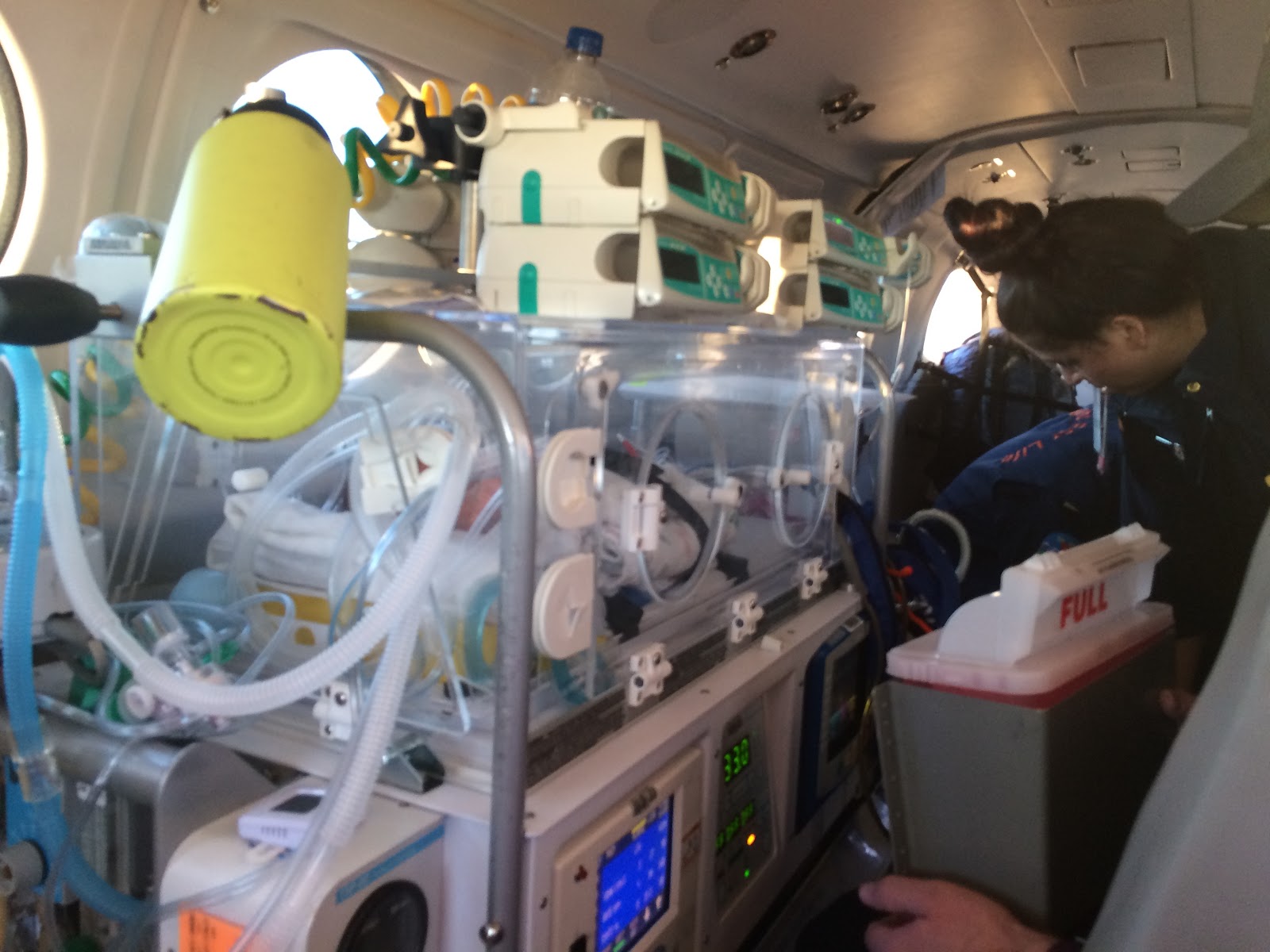
In NICU, our baby was stabilized but still struggling. We were informed he needed to be transferred to a hospital across the state, and that a flight for life crew was coming to get him. Our boy was intubated and placed on a respirator. And, a mere few hours after giving birth, my wife was rush-discharged so she could sit on a jumpseat in a tiny airplane with our baby boy, who was covered in wires and alone in a plastic box on a gurney. We had not even had a chance to hold him.

Private flights are apparently how our little man rolls
[image: newborn infant in an incubator, barely visible behind tubes and wires,
inside a flight for life plane, with a medical attendant.]
His plane had no room for me. I had to drive seven hours to get to the hospital. I had been awake for 35 hours straight, and had 20 more before I would see sleep. It felt like everything in my body hurt, my blood, my teeth. Everything humming in pain.

This is the end of the bad stuff. Our baby’s vitals were great on the flight. Immediately after admittance on the receiving end, he was taken off a respirator and began only getting oxygen by CPAP. My wife texted me pictures of her finally holding her baby boy, thirteen hours after he was born. I cried in relief. By the time I arrived, he was taken off the CPAP was and just getting oxygen. The next day he was taken off of oxygen and breathing fully independently.

We had planned for a lot of things, but never this. Life was wonderful, we had our baby. We could hold our baby. Eventually we would leave the hospital and start our life as a family.

On the morning of the second day in NICU, we had the composure to finally discuss what had happened. My wife was not yet aware that our baby had stopped breathing. I told her about the walk down the hallway. Told her what I felt and feared. She told me the first 24 hours of our baby’s life was both the best and worst day of her life, all wrapped in one. We talked about how powerless we felt, how afraid, how unsure and helpless and paralyzed by the unknowns of what would happen and what the future looked like, if there was a future. It was awful.

The neonatal nurse practitioner walked in while we were discussing what had happened. Every day she works, she sees people processing these same experiences. She has had this discussion with thousands of people.

She told us we needed to grieve. Grieve to process what had happened. That our baby did not have a normal birth. That we needed to move through the stages of grief to acceptance. That this would help us.

I was dumbfounded. It was a surreal moment to process that I was indeed a parent, getting the advice I have been told for years I would only understand as a parent.

Bullshit! We have nothing to grieve, as we have lost nothing. The story of our baby entering the world contains an eventful day and the expectation of some epic medical bills. Telling us to grieve takes away our agency. We wanted a baby. We have an amazing baby. Sometimes babies enter the world this way. Nobody did anything to us or stole anything from us. And oh my goodness is our baby amazing! Our baby, a matter of weeks old, is already showing us he is a smartass. He’s going to run circles around us. Our baby will be equally amazing if he has atypical development. He probably will, born to an autistic dad and two older parents.

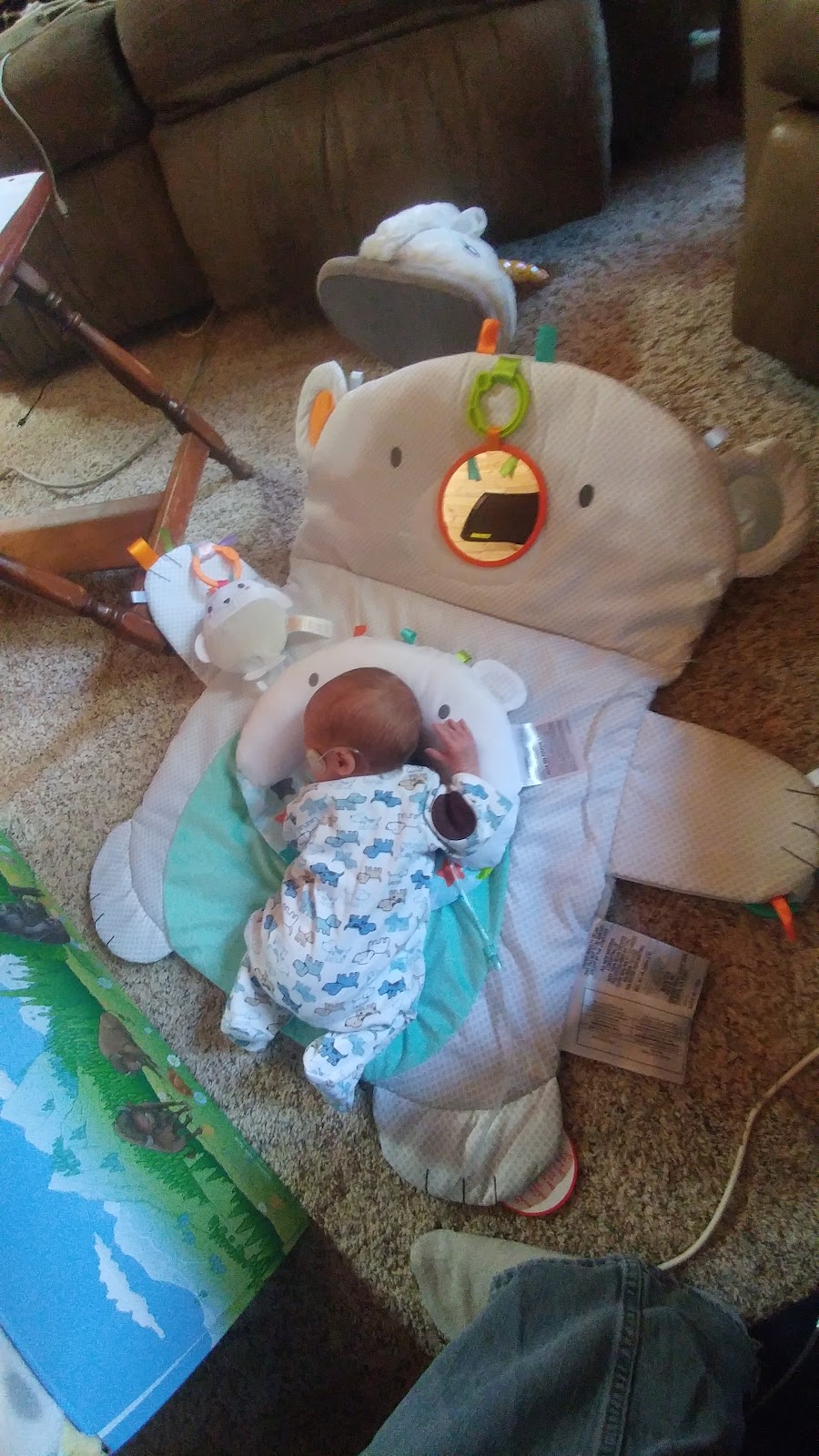
Home.
[image: Newborn baby on its belly, seen from above, lying on a
fuzzy mat on an even bigger fuzzy bear cushion.]
This experience isn’t grief. I’ve talked with thousands of parents of autistic children who are still processing what it means to have an autistic child. I hear expressions of fear. Their roadmap of expectations of what the future holds for their child has been taken away, replaced with uncertainty. Doubt. Worse case scenarios running wild. They experience the exact same types of emotions that we experienced in a very acute, very severe way on our baby’s first day in this world.

We are failing these parents by telling them to grieve. What we need to give these parents is empathy. Their fears need to be acknowledged. They need support to build a new roadmap to process their fears. To move to hope, understanding, and of course, acceptance.

Our autistic community has millions of people who have been through this process, and yet we continue to fail new parents, leaving them susceptible to subjecting their children to harmful sham treatments, to traumatic experiences, to quantifiable harm to their children that they love dearly—chasing that thing that they were told they lost, that thing that snake-oil salesman promise to retrieve—that unfortunate idea of normal.

We can do better.
Share: