We're running out of water - and global warming IS NOT the major cause.

Related image
livetoday.online
How to sound the alarm about a possible future crisis without being a Jeremiah?  Stand up and rant and rave and most people tune you out.

Future problems are something that the writers of fiction and non-fiction can address without being totally off-putting.  We all know that, so the trick for a working writer is to stay current on possible issues and weave these possibilities into your stories.  Besides, some of these potential crises offer some pretty cool possibilities.

What's interesting in this study is that global warming isn't blamed, though it certainly is playing a part.  For example, rather than having snow in the mountains of California, they're getting rain.  Snow provides water through the dry season; rain runs off into the ocean creating a water shortage despite the total precipitation level remaining constant.

A link to the full study is found in the story source.
*  *  *  *  *


Affordable water in the US: A burgeoning crisis

"Water rates have increased 41 percent since 2010."

If water rates continue rising at projected amounts, the number of U.S. households unable to afford water could triple in five years, to nearly 36 percent, finds new research by a Michigan State University scholar.

Elizabeth Mack said a variety of factors, ranging from aging infrastructure to climate change to population decline in urban areas, are making residents' ability to afford water and wastewater services a burgeoning crisis. Published online Jan. 11 in the journal PLOS ONE, her study is one of the first nationwide investigations of water affordability.

"In cities across the United States, water affordability is becoming an increasingly critical issue," said Mack, an assistant geography professor who analyzed water consumption, pricing and demographic and socioeconomic data for the study.

Spending on water and wastewater services combined should make up no more than 4.5 percent of household income, the Environmental Protection Agency recommends. Based on that criteria, some 13.8 million U.S. households (or 11.9 percent of all households) may find water bills unaffordable -- a hardship that hits poor families particularly hard, Mack said.

Water rates have increased 41 percent since 2010, and if they continue at that pace over the next five years the number of households that cannot afford water and wastewater services could soar to an estimated 40.9 million, or 35.6 percent of all households.

Aging infrastructure
One driving factor is aging infrastructure. Experts say it will cost more than $1 trillion to replace World War II-era water systems over the next 25 years. Another pressure is climate change, as more intense weather events fuel a need for improvements to wastewater facilities. Making such adaptations will cost the United States more than $36 billion by 2050, according to estimates.

Shrinking urban populations
Further, shrinking populations in major cities such as Detroit and Philadelphia means fewer people to pay for the large fixed cost of water service.

  1. Some 227,000 customers in Philadelphia, or 4 out of 10 water accounts, are past due, 
  2. while 50,000 delinquent customers in Detroit have had their water service terminated since the start of 2014, the study says.
  3. Households in Atlanta and Seattle are paying more than $300 a month for water and wastewater services (based on a family of four).

Ultimately, the study says, governments, utilities and consumers will need to work together to solve the growing affordability problem.

"Water is a fundamental right for all humans," Mack said. "However, a growing number of people in the United States and globally face daily barriers to accessing clean, affordable water."

The United States remains a relatively understudied country in international work on water affordability issues, she noted.

"The hope is that enhanced awareness of this issue in the developed world will highlight the severity of the issue, which is not isolated to people in the developing world," Mack said.

Story Source:  Materials provided by Michigan State University.  Elizabeth A. Mack, Sarah Wrase. A Burgeoning Crisis? A Nationwide Assessment of the Geography of Water Affordability in the United States. PLOS ONE, 2017
Share:

Einstein, Santa Claus, and Relativity.

Mysteries of Father Christmas/Santa Claus 'solved' by relativity theory

The mystery of how Father Christmas (Santa Claus) can deliver presents to 700 million children in one night, fit down the chimney and arrive without being seen or heard has been 'solved' by a physicist at the University of Exeter.

Santa and his reindeer zoom around the world at such speed that -- according to relativity theory -- they would shrink, enabling Father Christmas and a huge sack of presents to fit down chimneys.

Dr Katy Sheen, a physicist in the Geography department at the University of Exeter, has also found a scientific explanation for why Santa is not heard arriving by children, and why they rarely catch a glimpse of him on Christmas eve.

Santa and Special Relativity
She recently explained to children at the University of Exeter that Santa's stealth delivery is partly explained by special relativity theory devised by Albert Einstein, whom Dr Sheen thinks bares a passing resemblance to Santa.
Image result for Einstein
Was Einstein really Santa Claus?
Ever see them together, at the same
time, 
in the same room?

Relativity theory explains how Father Christmas can fit down the chimney. At the speeds he needs to travel to deliver presents to every child, Father Christmas shrinks -- or gets thinner -- in the direction he is travelling. And he has to be careful not to stop for a mince pie in a chimney, or he could grow back to full size!

Dr Sheen told children at the University of Exeter's Science of Christmas Festival on Dec. 14 that relativity also explains why Father Christmas appears not to have aged throughout the ages, because relativity can slow down clocks.

When Dr Sheen was seven years old she wrote a letter to Father Christmas asking why he never got any older (letter attached). She received a response in shaky handwriting telling her it was 'all magic'. But the budding physicist was not convinced and wanted a rational explanation -- which 26 years later she has now found.

As evidence of how Father Christmas's enormously fast delivery round has kept the years off him, she will present a picture of St Nicholas from 1901 and a photo from this year to the children at her talk.

The physicist has calculated that Santa and his reindeer would have to travel at about 10 million kilometres per hour to deliver presents to every child expected to celebrate Christmas in 31 hours (taking into account world time zones).

Santa, the Rainbow-coloured Blur
If millions of children have been good, and deserve bigger stockings, he may need to travel even faster. Such speed would make him change from red to green and, at greater speeds, he would disappear! Children would not be able to recognise him as he would appear as a rainbow-coloured blur, eventually disappearing to the human eye.

Travelling at more than 200,000 times faster than Usain Bolt, the world's fastest man, the laws of physics explain why Father Christmas is rarely seen by children while delivering presents.

The Doppler effect would make Santa change colour because the light waves he releases would get squashed at such a high speed.

The Doppler effect also explains why children cannot hear Father Christmas arrive. As Santa and his sleigh approach, the sound of bells and his deep 'ho, ho, ho' would get higher and higher (like when an ambulance siren whizzes by) and then become completely silent, because he would move beyond human hearing range. Even the sound of Santa urging on Rudolph would become unrecognisable, and then inaudible to the human ear.

Santa's Sonic Boom
If children hear a bang on Christmas night, it may not be the sound of Santa dropping his presents, landing on their roof in his sleigh, or sliding down the chimney with a plop. Santa's reindeer could have broken the speed of sound, resulting in a 'sonic boom.'

Dr Sheen, a physicist working in the University of Exeter's Geography department, is not planning to present her research to a peer-reviewed journal (it's prepared with the festive spirit in mind), and has done the calculations in her own time to interest children in science and physics.

Sheen will demonstrate the impact of the Doppler effect -- which would make Santa able to deliver his presents without detection -- by letting the children listen to the sound of a speeding ambulance, even though it is much slower than Father Christmas and his sleigh.

The Doppler effect is responsible for making a siren, such as on an ambulance or a police car, increase in pitch as it comes towards you and lower pitched as it drives away. This is because the wave length changes when it moves towards and away from you.

Dr Sheen calculated how fast Father Christmas would have to travel by working out the number of households likely to be celebrating Christmas around the world, along with the number of children likely to be in them. She hopes her explanation for Santa's stealth delivery system -- and therefore his very existence -- will inspire children to take a greater interest in physics, and put a science kit on the list of presents they want in their stockings.

"Visiting around 700 million children in 31 hours would mean he would have to travel at 10 million kilometres an hour if he is to deliver presents to every child," Dr Sheen said. "How does Santa manage to reach these phenomenal speeds? Well that's magic! However, he would certainly need a lot of fuel -- so don't forget his glass of sherry, a mince pie or two and some carrots for the reindeer!"

Story Source:  Materials provided by University of Exeter. "Mysteries of Father Christmas/Santa Claus 'solved' by relativity theory." ScienceDaily, 14 December 2016. 
Share:

ADHD and Creativity. You can't have one without the other.

Image result for ADHD brain activity
Sydney Developmental Clinic

Analysis of mind-wandering studies
offers new perspective on mental disorders

". . .The ADHD mind allows us to think freely and creatively."

During downtime, some of us daydream while others might focus on a to-do list, or get stuck in a negative loop. Psychology has traditionally defined all these thought patterns as variations of "mind-wandering."

But a review of brain imaging studies led by researchers at UC Berkeley and the University of British Columbia offers a new way of looking at spontaneous versus controlled thinking, challenging the adage that a wandering mind is an unhappy mind.

It suggests that increased awareness of how our thoughts move when our brains are at rest could lead to better diagnoses and targeted treatments for such mental illnesses as depression, anxiety and attention deficit hyperactivity disorder (ADHD).


Image result for Zachary Irving, a postdoctoral scholar at UC Berkeley
www.zacharycirving.com

Dr. Irving is developing a new 
theory of mind-wandering as 
unguided attention.
"It's important to know not only the difference between free-ranging mind-wandering and sticky, obsessive thoughts, but also to understand, within this framework, how these types of thinking work together," said review co-author Zachary Irving, a postdoctoral scholar at UC Berkeley.

Irving and fellow authors looked at three different ways in which people think when they're not directly engaged in tasks: spontaneous thought, ruminative thought and goal-directed thought.

The ADHD mind allows us to think freely and creatively
"We propose that mind-wandering isn't an odd quirk of the mind," said the review's lead author Kalina Christoff, a psychology professor at the University of British Columbia. "Rather, it's something that the mind does when it enters into a spontaneous mode. Without this spontaneous mode, we couldn't do things like dream or think creatively."

Irving, who has ADHD, said there are upsides to the most stigmatized mental disorders.

"Everyone's mind has a natural ebb and flow of thought, but our framework reconceptualizes disorders like ADHD, depression and anxiety as extensions of that normal variation in thinking," said Irving. "This framework suggests, in a sense, that we all have someone with anxiety and ADHD in our minds. The anxious mind helps us focus on what's personally important; the ADHD mind allows us to think freely and creatively."

Irving and fellow researchers reviewed nearly 200 neuroscience studies, a large number of which used functional magnetic resonance imaging (fMRI) to scan brains during resting activities.

They found that interactions between large-scale neural networks offered insights into how the resting mind moves. For example, their review of brain-imaging studies found that when the brain was focused on a task at hand, its prefrontal "executive" network, which governs planning and impulse control, among other functions, constrains other brain activity.

When stuck in a negative loop, such as anxious rumination, the brain's "salience" network, which processes emotions, took control, shutting off most other networks. Not surprisingly, spontaneous thought, such as daydreaming, dreaming during sleep and other forms of free association, were linked to far lower activity in the neural networks responsible for controlled thinking, allowing the imagination to flow freely.

Overall, researchers hypothesize that the resting mind naturally transitions between spontaneous and constrained thought.

"Let's say you're walking to the grocery store," Irving said. "At first, your mind wanders to a plethora of ideas: your new shirt, a joke you heard today, an upcoming ski trip to Lake Tahoe. Then your thoughts become automatically constrained when you start to worry about a looming work deadline that needs to be met before the Tahoe trip. Then you realize that your worries are making you miserable, so you deliberately constrain your thoughts, forcing your mind back to grocery shopping."

Historically, Irving said, the field of psychology has approached mental disorders separately, as though each were in a vacuum rather than being interconnected.

"Clinicians have studied compulsive rumination in isolation, and ADHD in isolation, but now there's a huge interest in how we can make sure that the psychology and neuroscience literature is more closely aligned to what is happening in our heads," Irving said.

Story Source:  Materials provided by University of California - Berkeley. Kalina Christoff, Zachary C. Irving, Kieran C. R. Fox, R. Nathan Spreng, Jessica R. Andrews-Hanna. Mind-wandering as spontaneous thought: a dynamic framework. Nature Reviews Neuroscience, 2016
Share:

Consciousness, Fractals and Great Literature

You want mathematics in your understanding of writing, you got mathematics.  You want hard science?  This science is hard.  And to paraphrase that pithyest of pithers, S.J. Perelman: "There is nothing like a report (see below) filled with decimal points and guarded generalizations to put a glaze on your eye like a sung vase (long a, please).

I'm of the school that writers write, editors edit, readers read, agents take ten percent of the gross, and reviewers do something, no one is sure exactly what. Literary theoreticians, to continue the cascade, scare the hell out of everyone.  I have images of graduate assistants assigning nascent authors underlining the fractals, mono-fractals and multi-fractals in a story.  And you thought parsing a sentence was a chore.

Finally, if you understand any of this research, anything at all, even one pseudo-fractal, kindly post your explanation for the rest of us at the end of this story.  In the meantime, I need a drink.  Perhaps a double.  Remember, writers, as Hemingway is alleged to have said, "Write drunk, edit sober." Take your pick before plowing through this research.
*  *  *  *  *


The world's greatest literature reveals
multi-fractals and cascades of consciousness

As far as many bookworms are concerned, advanced 
equations and graphs are the last things which would hold
their interest, but there's no escape from the math.

Credit: Source: IFJ PAN
Sequences of sentence lengths (as measured by number of words) in four
literary works representative of various degree of cascading character.

James Joyce, Julio Cortazar, Marcel Proust, Henryk Sienkiewicz and Umberto Eco. Regardless of the language they were working in, some of the world's greatest writers appear to be, in some respects, constructing fractals*. Statistical analysis carried out at the Institute of Nuclear Physics of the Polish Academy of Sciences, however, revealed something even more intriguing. The composition of works from within a particular genre was characterized by the exceptional dynamics of a cascading or avalanche narrative structure. This type of narrative turns out to be multi-fractal. That is, fractals of fractals are created.
*A fractal is a never-ending pattern. Fractals are infinitely complex patterns that are self-similar across different scales. They are created by repeating a simple process over and over in an ongoing feedback loop. Fractals are images of dynamic systems – the pictures of Chaos. Geometrically, they exist in between our familiar dimensions. Fractal patterns are extremely familiar, since nature is full of fractals. For instance: trees, rivers, coastlines, mountains, clouds, seashells, hurricanes, etc. Abstract fractals can be generated by a computer calculating a simple equation over and over. 
Image result for cascading narrative structure
The Ice-Bound Concordance

This chart has nothing to do with anything.  It is easy to follow.
As far as many bookworms are concerned, advanced equations and graphs are the last things which would hold their interest, but there's no escape from the math. Physicists from the Institute of Nuclear Physics of the Polish Academy of Sciences (IFJ PAN) in Cracow, Poland, performed a detailed statistical analysis of more than one hundred famous works of world literature, written in several languages and representing various literary genres. The books, tested for revealing correlations in variations of sentence length, proved to be governed by the dynamics of a cascade. This means that the construction of these books is in fact a fractal. In the case of several works their mathematical complexity proved to be exceptional, comparable to the structure of complex mathematical objects considered to be multi-fractal. Interestingly, in the analyzed pool of all the works, one genre turned out to be exceptionally multi-fractal in nature.

Image result for sierpinski triangle
A Sierpinski square-based pyramid and its 'inverse'.

Fractals are self-similar mathematical objects: when we begin to expand one fragment or another, what eventually emerges is a structure that resembles the original object. Typical fractals, especially those widely known as the Sierpinski triangle and the Mandelbrot set, are mono-fractals, meaning that the pace of enlargement in any place of a fractal is the same, linear: if they at some point were rescaled x number of times to reveal a structure similar to the original, the same increase in another place would also reveal a similar structure.


Multi-fractals are more highly advanced mathematical structures: fractals of fractals. They arise from fractals 'interwoven' with each other in an appropriate manner and in appropriate proportions. Multi-fractals are not simply the sum of fractals and cannot be divided to return back to their original components, because the way they weave is fractal in nature. The result is that in order to see a structure similar to the original, different portions of a multi-fractal need to expand at different rates. A multi-fractal is therefore non-linear in nature.

"Analyses on multiple scales, carried out using fractals, allow us to neatly grasp information on correlations among data at various levels of complexity of tested systems. As a result, they point to the hierarchical organization of phenomena and structures found in nature. So we can expect natural language, which represents a major evolutionary leap of the natural world, to show such correlations as well. Their existence in literary works, however, had not yet been convincingly documented. Meanwhile, it turned out that when you look at these works from the proper perspective, these correlations appear to be not only common, but in some works they take on a particularly sophisticated mathematical complexity," says Prof. Stanislaw Drozdz (IFJ PAN, Cracow University of Technology).

The study involved 113 literary works written in English, French, German, Italian, Polish, Russian and Spanish by such famous figures as Honore de Balzac, Arthur Conan Doyle, Julio Cortazar, Charles Dickens, Fyodor Dostoevsky, Alexandre Dumas, Umberto Eco, George Elliot, Victor Hugo, James Joyce, Thomas Mann, Marcel Proust, Wladyslaw Reymont, William Shakespeare, Henryk Sienkiewicz, JRR Tolkien, Leo Tolstoy and Virginia Woolf, among others. The selected works were no less than 5,000 sentences long, in order to ensure statistical reliability.

To convert the texts to numerical sequences, sentence length was measured by the number of words (an alternative method of counting characters in the sentence turned out to have no major impact on the conclusions). The dependences were then searched for in the data -- beginning with the simplest, i.e. linear. This is the posited question: if a sentence of a given length is x times longer than the sentences of different lengths, is the same aspect ratio preserved when looking at sentences respectively longer or shorter?

"All of the examined works showed self-similarity in terms of organization of the lengths of sentences. Some were more expressive -- here The Ambassadors by Henry James stood out -- while others to far less of an extreme, as in the case of the French seventeenth-century romance Artamene ou le Grand Cyrus. However, correlations were evident, and therefore these texts were the construction of a fractal," comments Dr. Pawel Oswiecimka (IFJ PAN), who also noted that fractality of a literary text will in practice never be as perfect as in the world of mathematics. It is possible to magnify mathematical fractals up to infinity, while the number of sentences in each book is finite, and at a certain stage of scaling there will always be a cut-off in the form of the end of the dataset.

Things took a particularly interesting turn when physicists from the IFJ PAN began tracking non-linear dependence, which in most of the studied works was present to a slight or moderate degree. However, more than a dozen works revealed a very clear multifractal structure, and almost all of these proved to be representative of one genre, that of stream of consciousness. The only exception was the Bible, specifically the Old Testament, which has so far never been associated with this literary genre.

"The absolute record in terms of multifractality turned out to be Finnegan's Wake by James Joyce. The results of our analysis of this text are virtually indistinguishable from ideal, purely mathematical multifractals," says Prof. Drozdz.

The most multi-fractal works also included A Heartbreaking Work of Staggering Genius by Dave Eggers, Rayuela by Julio Cortazar, The US Trilogy by John Dos Passos, The Waves by Virginia Woolf, 2666 by Roberto Bolano, and Joyce's Ulysses. At the same time a lot of works usually regarded as stream of consciousness turned out to show little correlation to multi-fractality, as it was hardly noticeable in books such as Atlas Shrugged by Ayn Rand and A la recherche du temps perdu by Marcel Proust.

"It is not entirely clear whether stream of consciousness writing actually reveals the deeper qualities of our consciousness, or rather the imagination of the writers. It is hardly surprising that ascribing a work to a particular genre is, for whatever reason, sometimes subjective. We see, moreover, the possibility of an interesting application of our methodology: it may someday help in a more objective assignment of books to one genre or another," notes Prof. Drozdz.

Multifractal analyses of literary texts carried out by the IFJ PAN have been published in Information Sciences, a journal of computer science. The publication has undergone rigorous verification: given the interdisciplinary nature of the subject, editors immediately appointed up to six reviewers.

Story Source: Materials provided by The Henryk Niewodniczanski Institute of Nuclear Physics Polish Academy of Sciences.  StanisÅ‚aw Drożdż, PaweÅ‚ OÅ›wiÈ©cimka, Andrzej Kulig, JarosÅ‚aw KwapieÅ„, Katarzyna Bazarnik, Iwona Grabska-GradziÅ„ska, Jan Rybicki, Marek Stanuszek. Quantifying origin and character of long-range correlations in narrative texts. Information Sciences, 2016.
Share:

How "beardedness" affects women's attraction to men

Image result for beardedness
io9.gizmodo.com

To many authors it appears designing a protagonist is a process of making them über-masculine, often to the point of parody.  What this research points out is that a man with a beard is seen by most women as a better match than the hyper-masculine.  Or the almost feminine.  A small point perhaps, but something to consider.


How beardedness affects women's attraction to men

"Extremely masculine and extremely feminine-looking males were least attractive."

New research suggests that women tend to find beardedness attractive when judging long-term relationships, perhaps as a signal of formidability among males and the potential to provide direct benefits, such as enhanced fertility and survival, to females.

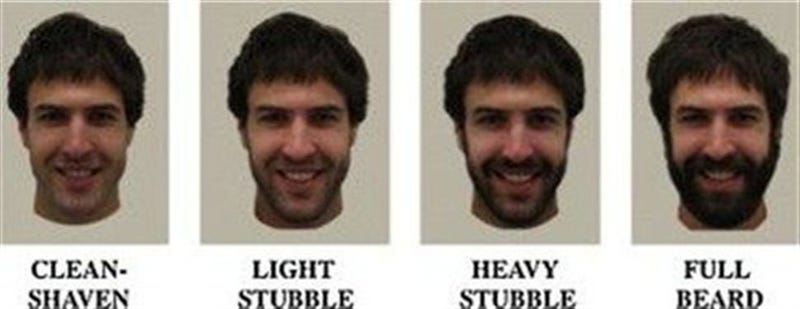
For the study, investigators used computer graphic manipulation to morph male faces varying in facial hair from clean-shaven, light stubble, heavy stubble, and full beards, with additional differences in brow ridge, cheekbones, jawline, and other features so that the same man appeared more or less masculine.

When women viewed the images, masculinized and, to an even greater extent, feminized faces were less attractive than unmanipulated faces when all were clean-shaven. Stubble was judged as most attractive overall and received higher ratings for short-term relationships than full beards, which were more attractive for long-term relationships. Extremely masculine and extremely feminine-looking males were least attractive, irrespective of relationship context.

"Sexual selection via female choice has shaped the evolution of male ornamentation in many species," wrote the authors of the Journal of Evolutionary Biology study.

Story Source: Materials provided by Wiley.  B. J. W. Dixson, D. Sulikowski, A. Gouda-Vossos, M. J. Rantala, R. C. Brooks. The masculinity paradox: facial masculinity and beardedness interact to determine women's ratings of men's facial attractiveness. Journal of Evolutionary Biology, 2016.
Share:

Should gay candidates come out of the (political) closet? Study says yes

Image result for gay political candidates
www.uc.edu
Should gay candidates come out of the
(political) closet? Study says yes

"LGBT elected officials make tremendous public servants because
they are painfully aware of the impact policies have on people's lives."

A political science researcher finds that the sexual orientation of LGBT candidates no longer poses an impediment to being elected to public office -- and, in some cases, may actually help them win.  Drastic shifts in public opinion in the last decade have seen an uptick in gay and lesbian candidates running for -- and winning -- public office as never before.

But experts often advise even openly gay and lesbian candidates to downplay their sexual orientation or risk losing votes.

Now, a new study by David Niven, an assistant professor of political science at the University of Cincinnati, calls that advice into question.

The research suggests that not only does a gay or lesbian candidate's sexual orientation no longer pose a political disadvantage, but that, in some cases, it may actually help them win office.

"Our results call into question the always and everywhere assumption that running as a gay or lesbian candidate is necessarily a hurdle that must be overcome," said Niven.

LGBT candidates are often advised to downplay their sexual orientation for good reason, says Niven. He points to an established body of research documenting how a candidate's sexual orientation can be an impediment to higher office.

"All the research that we have says you have to overcome and to downplay it," he said.

That conclusion, based largely on surveys, offers subjective and interpretive data on how voters react to fictional or hypothetical candidates, but little in the way of how voters respond to actual candidates once they're in a private voting booth, Niven said.

So he decided to test the theory in a real race, with real voters casting ballots for real candidates. Enter the 2016 March primary race for county recorder in Ohio's Franklin County, which includes Columbus.

The Study
Two Democratic candidates vied for the position: Incumbent Terry Brown, an openly gay man seeking his second term in office, and challenger Danny O'Connor, who is straight.

The match-up proved an ideal field study, said Niven. While Brown's website features a photograph of him and his husband, neither he, his opponent nor the "Democrats United" ticket both candidates ran with referenced Brown's sexual orientation or interests in advancing civil rights issues.

Moreover, the low-key race for county recorder drew only minimal media attention, none of which identified Brown as gay, said Niven.

Niven randomly chose 30 precincts for the study. Because most gay and lesbian candidates tend to compete in places where Democrats are likely to win, he said, only households with a registered Democrat in residence were included.

Fifteen of the precincts received one of three 4x6 glossy postcards featuring Brown, while the other half, serving as a control group, received no mailing.

  • The first mailer featured a photograph of Brown and listed his efforts to save taxpayer money, improve the efficiency of the recorder's office and commitment to stamping out real estate fraud.
  • A second mailer included the same campaign claims, but featured a photograph of the candidate and his husband.
  • A third mailing repeated the claims of the previous two and included the same photograph as in the second mailing, but added an additional claim of the candidate's commitment to marriage equality for gay people. 

The Results
Brown ultimately lost the race to O'Connor, but not because of his sexual orientation or commitment to marriage equality, says Niven.

According to the study, Brown actually received slightly less votes from voters who received the first mailer (which included only a photo of him) than he did from those in the control group who didn't receive any mailers.

Swapping a mailer featuring a photograph of the candidate with one of Brown and his husband produced slightly more votes, comparable to those of the control group. That increase, while negligible, speaks volumes, said Niven.

"Study after study suggests there is some kind of penalty gay and lesbian candidates are subject to without exception. That decidedly did not happen here," he concluded.

The results of the third condition, in which voters received a mailer featuring a photograph of the candidate and his husband and listing his commitment to marriage equality, also defied conventional campaign wisdom, says Niven.

In that scenario, Brown received more than four percent more votes than he did in all of the other scenarios.

"A lot of races are won on four percent," said Niven. "This is a pretty startling jump in terms of getting people's attention in a race they wouldn't otherwise give two thoughts about."

Niven says the results strongly suggest that emphasizing Brown's commitment to the rights of gay and lesbian people gave him a political edge.

"He's not just filing deeds, he's on the front lines of the civil rights struggle," he explained. "This is what was compelling to people."

Building Political Power

Niven acknowledges the limitations of the study, which focused on how Democratic voters in a specific region responded in one race. He's planning a follow-up study of the wider electorate this fall.

Nonetheless, he says the data indicates that the nation might be closer to a state of post-gay politics than some realize.

"When candidates hide or downplay their sexual orientation, it sends a message that significant barriers remain for gay and lesbian candidates," Niven said. "This study shows they might be hiding from a reality that isn't as bad as they think."

That comes as welcome news to Aisha C. Moodie-Mills, president and CEO of the Victory Fund, a nonpartisan organization that supports openly lesbian, gay, bisexual and transgender candidates running for public office.

She said the study indicates a growing appreciation amongst voters for LGBT candidates who are open about their lives and policy positions.

"LGBT elected officials make tremendous public servants because they are painfully aware of the impact policies have on people's lives, and therefore think critically about the issues confronting them," she said. "This research offers important insights into the advantages of being an openly LGBT candidate in certain political environments, and provides a fresh perspective on strategies for building long-term political power."

Story Source: Materials provided by University of Cincinnati, original written by Rachel Richardson. "Should gay candidates come out of the (political) closet? Study says yes." ScienceDaily, 12 September 2016. 
Share:

350th Anniversary of the Great Fire of London


Image result for 1666 London Fire

Scene from the "Great fire of London" in ITV's new series

Destruction of Old St Paul's Cathedral highlights
devastating impact of Great Fire of London

Thus lay in ashes that most venerable Church, one of the 
most antient pieces of early piety in the Christian world” 
                                                                    – Writer John Evelyn, 7 September 1666


"Thus lay in ashes that most venerable Church, one of the most antient pieces of early piety in the Christian world," wrote John Evelyn in September 1666. On the 350th anniversary of the fire, to mark the occasion, the University of Leicester Special Collections has made available a number of contemporary eye-witness accounts held within the University archives that illustrate the damage caused to the great historical and religious site of Old St Paul's, as well as highlighting some of its previous unfortunate encounters with fire.

In 1666 the Great Fire of London burned its way through the city, displacing thousands of residents and destroying many buildings - including Old St Paul’s Cathedral.

On the 350th anniversary of the fire, to mark the occasion, the University of Leicester Special Collections has made available a number of contemporary eye-witness accounts held within the University archives that illustrate the damage caused to the great historical and religious site of Old St Paul’s – as well as highlighting some of its previous unfortunate encounters with fire.

Image result for Great Fire of London map
The Great Fire of London lasted between Sunday 2 September to Wednesday 5 September 1666, causing unprecedented damage to the historical city of London.

Diarist and writer John Evelyn provided a vivid eye-witness account of the tragedy on Tuesday 4 September, 1666, writing: “The stones of Paules flew like granados, ye mealting lead running downe the streets in a streame, and the very pavements glowing with fiery rednesse …”

Evelyn wrote again of the wreckage in the aftermath of the Great Fire on Friday 7 September while walking from Whitehall to London Bridge, stating that he passed by the rubble of St Paul’s: “With extraordinary difficulty, clambering over heaps of yet smoking rubbish, and frequently mistaking where I was.

“The ground under my feete so hot, that it even burnt the soles of my shoes’.  That goodly Church St. Paules now a sad ruine, and that beautiful portico … now rent in pieces, flakes of vast stone split asunder …

“It was astonishing to see what immense stones the heate had in a manner calcin’d, so that all the ornaments, columns, freezes, capitals, and projectures of massie Portland-stone flew off, even to the very roofe, where a sheet of lead covering a great space … was total mealted …

“Thus lay in ashes that most venerable Church, one of the most antient pieces of early piety in the Christian world.”

The construction of Old St Paul’s had begun after another fire in 1087, which completely destroyed an Anglo-Saxon church on the same site.

Work on the Cathedral continued for over 200 years, temporarily interrupted by yet another fire in 1135.

The building was enlarged over the years and by the mid-14th century had become, according to later sources, ‘the finest in England in its time’.

The building inspired awe, with its 489 feet high spire and magnificent nave, known as Paul’s Walk, which was 586 feet in length.

The old Cathedral’s greatest glory was arguably the Shrine of St Erkenwald, a popular destination for medieval pilgrims. Many miracles were believed to have occurred after petitioners visited the Shrine.

Old St Paul’s also housed the tombs of many influential figures from history – among them, Ethelred the Unready and the great portrait painter Van Dyck - and was the scene of dramatic and formative events – such as a Thanksgiving Service in 1588 attended by Elizabeth I, after her victory over the Armada.

Architect Christopher Wren, who had plans to repair and restore parts of the Cathedral prior to the Great Fire of London, went on to design the present-day Cathedral, which was completed in 1710 and remained the tallest building in London until the 1960s.

Library Assistant Margaret Maclean from the University of Leicester said: “In the early years of the University (or University College, as it was initially), gifts from private benefactors were crucial to enhancing the reputation of the library, especially in terms of rare books.  The source material for this piece about Old St Paul’s was donated by two of our most notable benefactors, Thomas Hatton and Basil Fairclough. A wealthy local bootmaker, Hatton was an extraordinary man, who, in addition to being a book lover, succeeded as a boxing promoter, founded a crossword-puzzle company, introduced greyhound racing to Leicester and became a leading authority on Charles Dickens. Fairclough began his remarkable collection of 17th century portraiture and books as soon as he left school in 1925 and his enthusiasm remained undimmed until his 70s, when he enrolled on an Open University course on that period.

“Any effort required to get past difficulties presented by the use of contemporary language and spelling (which is often much less than you might expect) is more than rewarded by the freshness and immediacy of the accounts of those who experienced the Great Fire first hand.”

Story Source:  Materials provided by University of Leicester.  Destruction of Old St Paul's Cathedral highlights devastating impact of Great Fire of London." ScienceDaily, 1 September 2016
Share: