Meltdowns: How Autistic Humans Experience Crises

Sonny Hallett 
medium.com/@sonyahallett

This post is about what meltdowns feel like to me, what impacts they’ve had, and what I’m learning about them. Other autistic people may have very different experiences, but if you are autistic yourself, I hope you will find something relatable about my descriptions and illustrations, or something helpful or encouraging in the things I’m learning. If you’re not autistic, I hope this gives you some insight into some aspects of a different way of being, different ways that humans can experience crises, and how your reactions could help or hinder.

----

I’ve been thinking about autistic meltdowns lately, and how little they’re understood. Too much of what society hears about meltdowns, and what gets written, is about autistic kids, their experiences related by parents and professionals. Of course, many autistic people have also talked about their meltdown experiences very eloquently, but as with so many aspects of being autistic, our lived experiences are still very underrepresented in dominant narratives.

I was diagnosed autistic as an adult, at 28. I had always experienced meltdowns and have vivid memories of them happening throughout my childhood, teens and 20s, but I never understood them, and neither did anyone around me. As I got older, these ‘outbursts’ became less and less acceptable and more alarming to others, so I learnt to hide them as much as possible—which was not always.

Now that I understand my meltdowns and their triggers better, I have observed the buildups to usually take two distinct forms: gradual or sudden.

[Click images to enlarge]

Image description: a five panel black-and white cartoon. Panel 1: Sketch of a white large feather on a black background. The tip of the feather is pointing at the lower left corner on a diagonal.  The caption at the top of the panel reads, in white, “Sometimes it builds up over time…” Panel 2: The same feather, its tip pointing at the top right corner, also on a diagonal. The caption continues, “a gradual increase in nervous ENERGY” Panel 3: Sketch of a black door marked “Pull” with a white frame. A person is reaching towards the door handle with their left hand. They are wearing a coat and fingerless gloves. Only their arm is visible.  The caption  continues, “Like STATIC in cold dry weather, a gradual shift from an irritating tickle to pinpricks of electricity”  Panel 4: the same person pulling their hand away from the door. Their hand is surrounded by small white lightning bolts, and a large white lighting bolt is drawn on the top of the page.  The caption continues, “To full-on JOLTING SPARKS” Panel 5: Sketch of bird flying in a cloudy sky at the top of the panel. The rest of the panel is sketched perpendicular to the sky.he panel is the same size as all the previous panels put together. There is a drawing of a loop of road on the far left side of the panel. There is a tangle of arrows and road signs on the right side of the drawing.  The caption finishes, “Sometimes it comes out of the blue… Perhaps from a SUDDEN CHANGE of plan, leaving everything confused and out of control.” In full, the caption reads: “Sometimes it builds up over time… a gradual increase in nervous ENERGY like STATIC in cold dry weather, a gradual shift from an irritating tickle to prinpricks of electricity to full on JOLTING SPARKS[.] Sometimes it comes out of the blue… Perhaps from a SUDDEN CHANGE of plan, leaving everything confused and out of control.”
[Image description: a five panel black-and white cartoon.
Panel 1: Sketch of a white large feather on a black background. The tip of the
feather is pointing at the lower left corner on a diagonal. 
The caption at
the top of the panel reads, in white, “Sometimes it builds up over time…”


Panel 2: The same feather, its tip pointing at the top right corner,  also
on a diagonal. The caption continues, “a gradual increase in nervous ENERGY”


Panel 3: Sketch of a black door marked “Pull” with a white frame. A person
is reaching towards the door handle with their left hand. They are wearing a
coat and fingerless gloves. Only their arm is visible. 
The caption  continues,
“Like STATIC in cold dry weather, a gradual shift from an irritating
tickle to pinpricks of electricity”


Panel 4: the same person pulling their hand away from the door. Their hand
 is surrounded by small white lightning bolts, and a large white lighting
bolt is drawn on the top of the page. 
The caption continues,
“To full-on JOLTING SPARKS”


Panel 5: Sketch of bird flying in a cloudy sky at the top of the panel.
The rest of the panel is sketched perpendicular to the sky. The panel
is the same size as all the previous panels put together. There is a
drawing of a loop of road on the far left side of the panel. There is
a tangle of arrows and road signs on the right side of the drawing. 

The caption finishes, “Sometimes it comes out of the blue…
Perhaps from a SUDDEN CHANGE of plan, leaving everything
confused and out of control.”


In full, the caption reads: “Sometimes it builds up over time…
a gradual increase in nervous ENERGY like STATIC in cold dry
weather, a gradual shift from an irritating tickle to prinpricks of
electricity to full on JOLTING SPARKS[.] Sometimes it comes
out of the blue… Perhaps from a SUDDEN CHANGE of plan,
leaving everything confused and out of control.”]

Whatever the type of buildup, I think it is always a reaction to depleting cognitive load, or in other words, too much stuff taking up my brain’s processing capacity, until it’s overwhelmed. In the case of a sudden change, the unexpected thing, which might be fairly trivial, hits me like a tsunami. All my resources are taken up trying to readjust to the new situation — whether it’s making new plans, figuring out how I feel about it, how to react, etc. This doesn’t actually mean that I’m necessarily bad in a crisis. In fact, many of the crises that happen have clear procedures to follow, or they might be things I’ve made contingency plans for. It’s the things I haven’t had a chance to script for or plan out internally that can throw me.

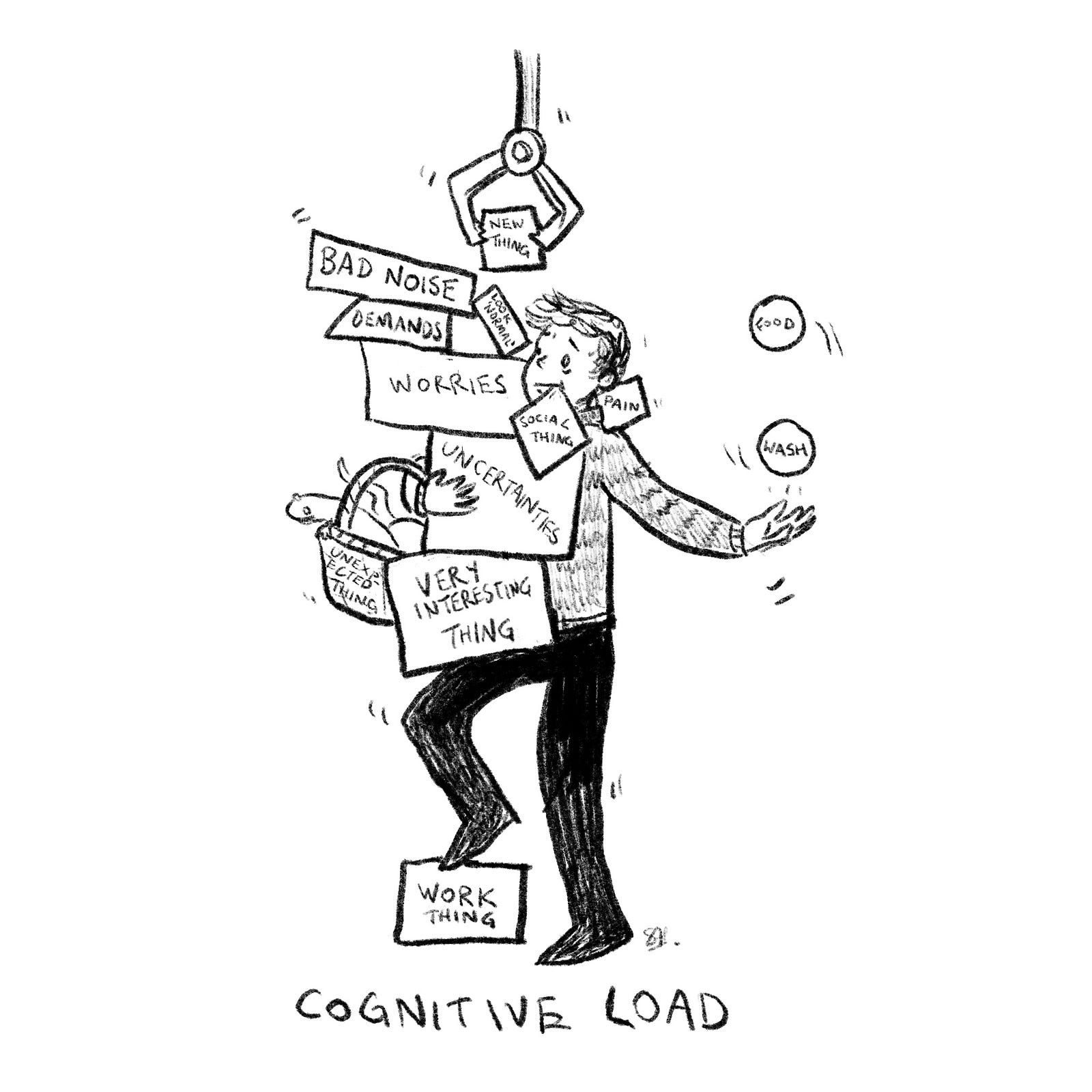
The gradual buildup kind can bring lots of different factors into play. Everything that happens in a day, from needing to eat, dress myself, and walk the dog; to projects for work, social demands, other uncertainties or worries, and illness or pain… all of these take up some of my diminishing resources. It can therefore take a fairly trivial thing to bring them all crashing down.


Image description: drawing of a person looking towards the top right of the window. They are wearing a fuzzy sweater and black pants and shoes, and is perched with one shoe on a rectangle blocks labels “WORK THING.” They are juggling two balls, one labeled “FOOD” and one labeled “WASH,” in his left hand. They are balancing a diamond block labeled “PAIN” on their left shoulder. On  their right side, they are balancing a pile of differently shaped blocks on their thigh and holding them in place with their right hand. The blocks are labeled in all caps, from top to bottom:      •Bad Noise      •Demands     •Look “Normal”     •Worries     •Social Things     •Uncertainties      •Very Uninteresting Things A crane is depositing a square block labeled “NEW THING” on the top of the pile. Finally, the person is also holding a basket full of snakes in the crook of their left arm. The image is captioned “COGNITIVE LOAD.”
[image description: drawing of a person looking towards the top right of the window. They are wearing a fuzzy sweater and black pants and shoes, and is perched with one shoe on a rectangle blocks labels “WORK THING.” They are juggling two balls, one labeled “FOOD” and one labeled “WASH,” in his left hand. They are balancing a diamond block labeled “PAIN” on their left shoulder. On  their right side, they are balancing a pile of differently shaped blocks on their thigh and holding them in place with their right hand. The blocks are labeled in all caps, from top to bottom: 
    •Bad Noise 
    Demands
    Look “Normal”
    Worries
    Social Things
    Uncertainties  
    Very Uninteresting Things
A crane is depositing a square block labeled “NEW THING” on the top of the pile. Finally, the person is also holding a basket full of snakes in the crook of their left arm. The image is captioned “COGNITIVE LOAD.”]
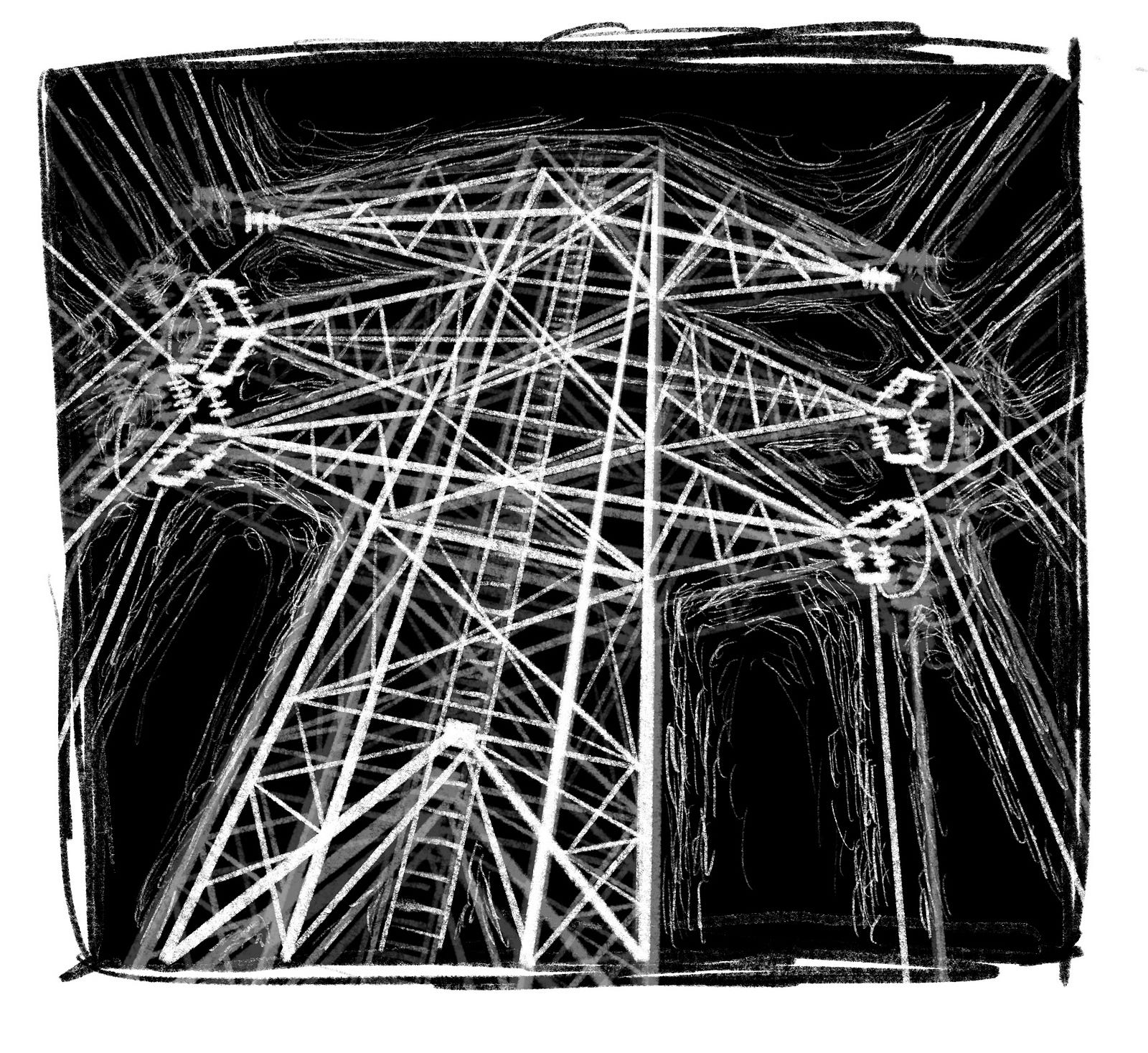
These days, I know that I’m running dangerously low on resources when I start finding everything much harder to do and filled with anxiety, including normally very simple tasks like remembering to eat or choosing what to wear in the morning. I also feel it physically: a gradual buildup background hum, like being under high-voltage pylons. The growing buzz also makes me much more sensorily sensitive: noises I’d normally tolerate become increasingly painful, textures freak me out all over the place, my whole body tenses up.

Image description: a drawing of a white transmission tower on a black background.
[Image description: a drawing of a white transmission tower on a black background.]

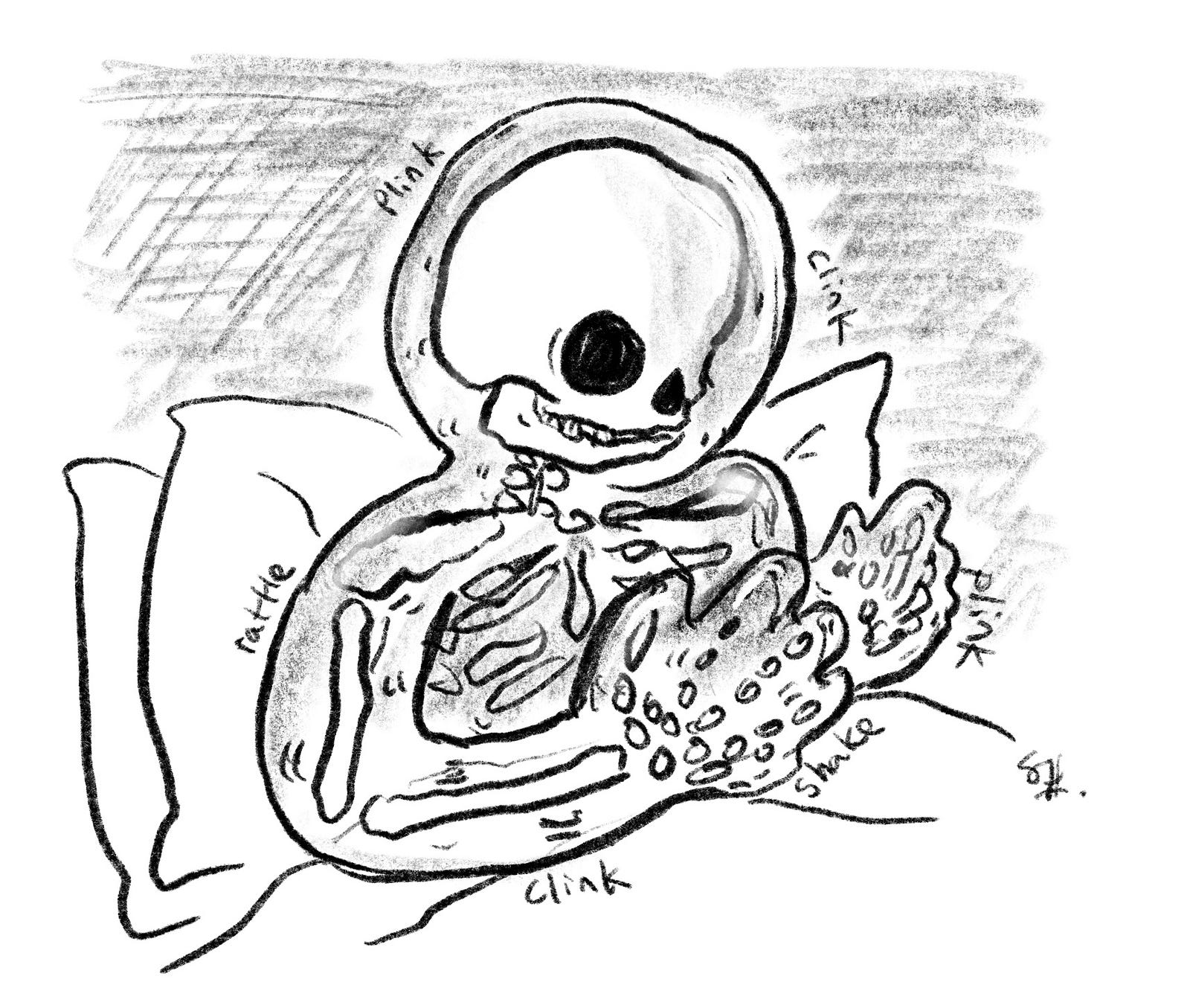
On days like these, I wake up feeling like my bones have been vibrating in my body all night. The energy makes me want to move about and fidget and shout to shake it out, but also fills me with a deep and draining exhaustion.

[Image description: sketch of a body sitting in bed with its skeleton visible. The body is
sitting with its back to a pile of pillows and its legs tucked are under a blanket.
The skeleton is holding its hands in front of its face. The words “plink,” “click,”
 “shake,” “plink,” and “rattle” are written clockwise around the outside of the body.]

In those moments, every additional demand exacerbates and prolongs the pressure. Sensory stuff, decisions I need to make, other people to worry about, or being in public and needing to hide. I might still be able to put off some of the ‘explosion’, but at the expense of things being much more explosive later. The buildup of energy feels like unbearable pressure in my whole body. I need to move or yell or cry. I need to hit things, I need to feel physical pressure or pain so that I can be sure my body isn’t fragmenting.

separated by a long diamond.  In the first section is a drawing of a white palm. The section is captioned “My edges feel fuzzy, like I’m drifting apart.”  The second panel has a drawing of the same hand in a first. It is captioned, “Perhaps that’s partly why…” The third panel contains a drawing of a fist slamming into the bottom of the square, cracking the surface below it. Above the first is  a large, a jagged semi-circle, showing that the fist was slammed down with great force.  The caption finishes, “…I feel like I need to SLAM them back into place.  In full, the caption reads, “My edges feel fuzzy, like I’m rifting apart. Perhaps that’s partly why… …I feel like I need to SLAM them back into place.”]
[Image description: a black square divided into 3 sections split diagonally:
right triangles at the top and and the bottom, separated by a long diamond.

In the first section is a drawing of a white palm. The section is captioned
“My edges feel fuzzy, like I’m drifting apart.” 

The second panel has a drawing of the same hand in a first. It is captioned,
“Perhaps that’s partly why…”

The third panel contains a drawing of a fist slamming into the bottom
 of the square, cracking the surface below it. Above the fist is a large,
jagged semi-circle, showing that the fist was slammed down with great force. 

The caption finishes, “…I feel like I need to SLAM them back into place. 
In full, the caption reads, “My edges feel fuzzy, like I’m rifting apart.
Perhaps that’s partly why… …I feel like I need to SLAM them back into place.”]

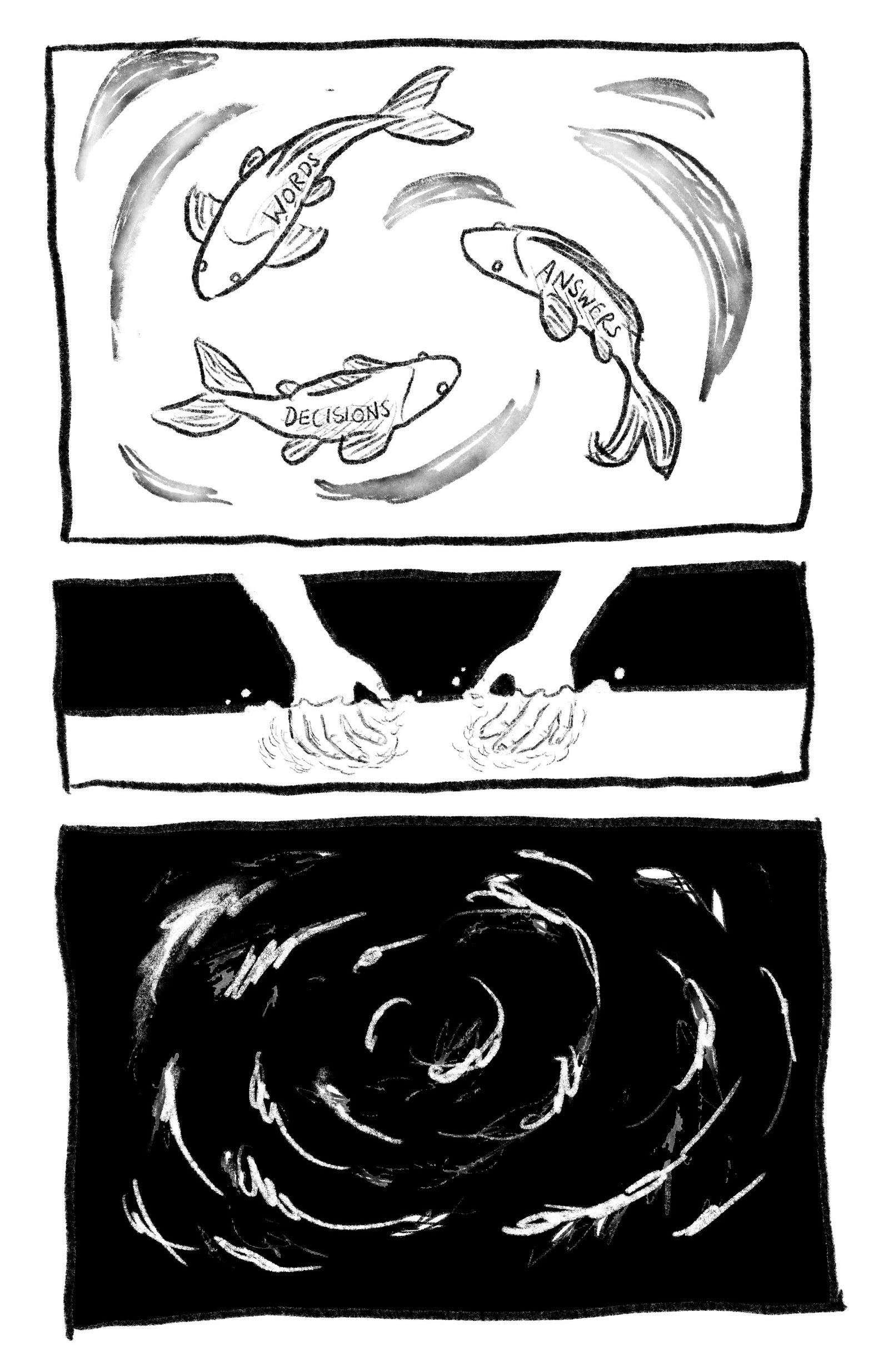
Amidst all this, I have a pretty clear inner voice narrating and observing everything that’s happening, but very diminished in its ability to be in control or make decisions. I can just about make some small judgments about what not to flail at, for example (other people, pets, breakable things), but making more complicated decisions, responding to questions, or even talking can feel overwhelmingly difficult. Trying to chase down my thoughts or words can feel like trying to grab fish in a pond with my bare hands. I need time and quiet to calm down before I can think properly, and every new demand is just prolonging how long that will take.

Image description: a series of 3 sketches.  Sketch 1: three small fish swimming counterclockwise in a circle. The fish are labeled “WORDS,” “DECISIONS,” and “ANSWERS.” Sketch 2: two white hands reaching into a pool of water.  Sketch 3: a spiral of white scribbles on a black background.
[Image description: a series of 3 sketches. 
Sketch 1: three small fish swimming counterclockwise in a circle.
The fish are labeled “WORDS,” “DECISIONS,” and “ANSWERS.”

Sketch 2: two white hands reaching into a pool of water. 
Sketch 3: a spiral of white scribbles on a black background.]

As an pre-diagnosis adult, my meltdowns were one of the most obvious ‘different’ things about me that I was scared of, and didn’t understand. The feeling of overwhelm can be such that I felt like I would do almost anything to make it stop, even if it meant self-injury or breaking things around me. I also worried that I might hurt other people, and the fear and worry my meltdowns elicited in people when they did see them (and they were often people I felt safe around) made me worry that I was dangerous, or bad, or seriously broken in some way.
The fact is that while my actions are normal for an autistic person, most non-autistic people don’t know how to react, and may find it alien and alarming due to a lack of understanding. I often think about how people familiar with panic attacks know that they are not an emergency, that they feel worse than they really are, and learn not to panic.

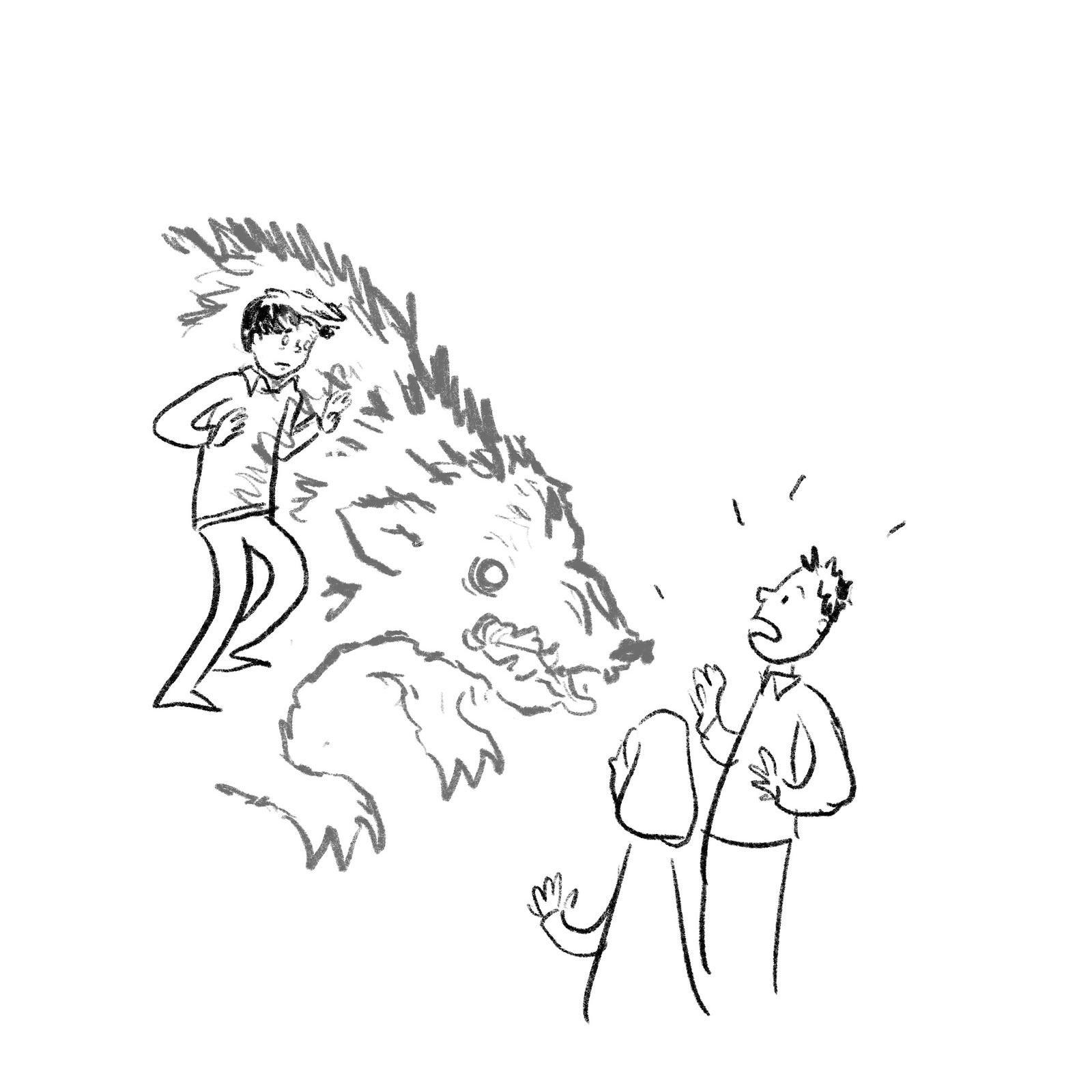
Over the years, I’ve encountered a number of people's reactions to me while I'm in meltdown or near-meltdown: from fear that I was going to be violent or concern that I was having some kind of mental breakdown, to worry that I lacked capacity for making decisions (one ex used to say that those times, and times when I expressed intense joy, made him worry that I didn’t have the ‘mental capacity’ to consent to being in a relationship as an adult). I’ve been told that I am overreacting and need to stop crying, when it’s not in my control, I’ve known people to get angry and tell me I’m ‘acting out’ for attention, and I’ve seen people panic and edge away from me, making me feel like I am some kind of wild animal that they think needs to be contained.

Image description: a person with a frightened expression inside  an angry bear. The bear is snarling at two people in the right  bottom corner. The person on the right is also terrified.
[Image description: a person with a frightened expression inside
an angry bear. The bear is snarling at two people in the right
bottom corner. The person on the right is also terrified.]

I remember a particularly turbulent time in my teens, going to a Samaritans drop-in, desperate for help with the feelings building up inside me. The well-intentioned volunteer didn’t understand what was happening with me, and my frustration and fear at not being able to communicate, plus her suddenly grabbing my hands in an attempt to comfort me, tipped me over into a full-on meltdown. I remember hiding behind the chair trying to get as far away from her as possible, and hitting the chair, the floor, myself. I remember seeing her back away in alarm and panic, call two more people into the room, who quickly escorted me out of the building.
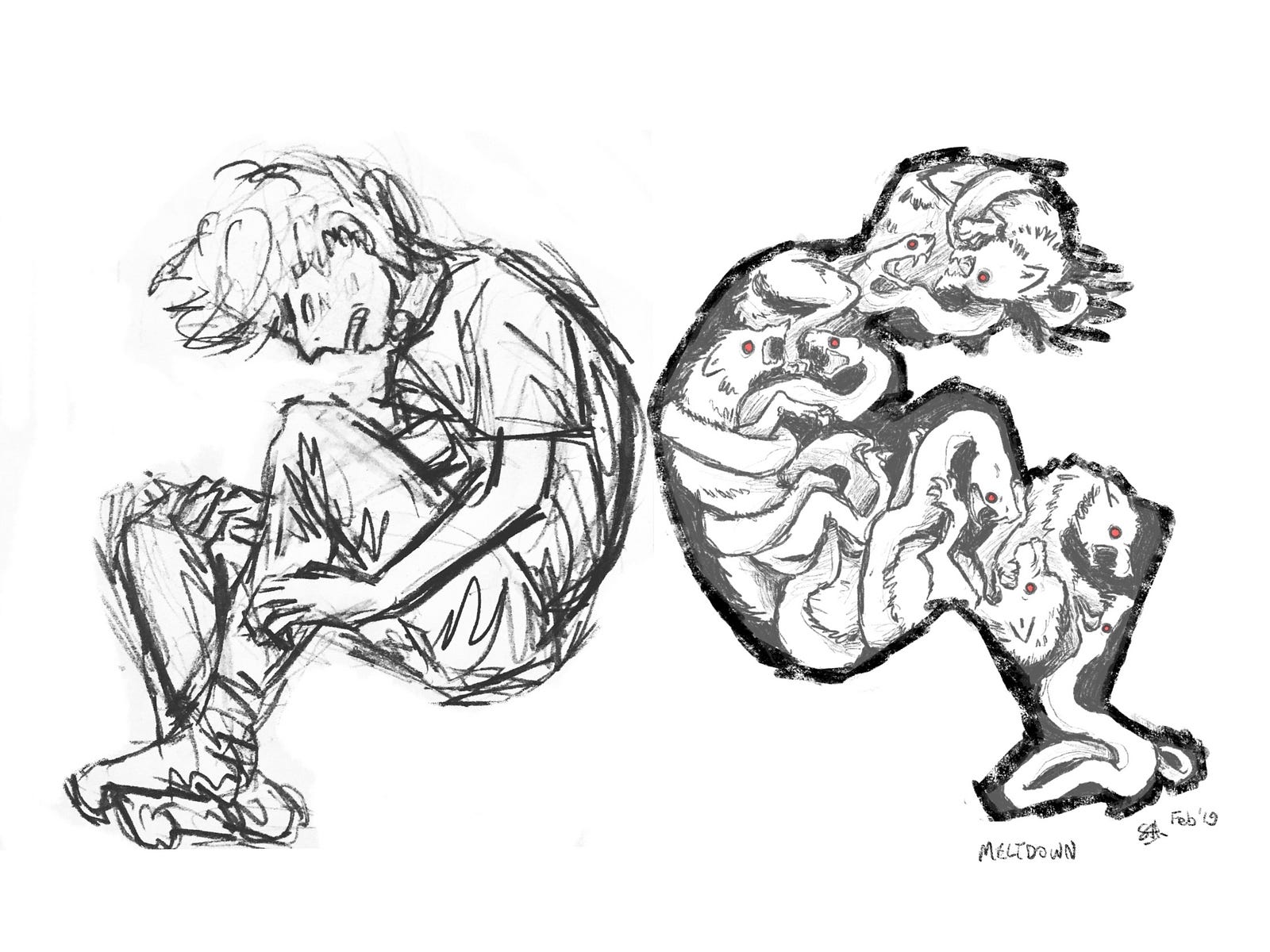
Another time, I was in a French lesson at school. It was a hot summer day, the windows were painted shut, the teacher was behind on the exam syllabus, and was making up for it by simultaneously playing us ‘accelerated learning’ tapes, making us finish written work, and sorting out individual paperwork by calling students up to the front. The heat and noise and fractured focus closed in on me more and more. I remember the walls spinning and my breath getting short and panicky. Nothing was making sense and all my senses hurt. I was trying to focus, but my thoughts felt like they were only slowing down, and I couldn’t filter anything out: the unpleasant texture of my school uniform, the tinny tape speakers, another student dropping a pencil…

Image description: two people sitting back to back. The person on the right has their knees up to their chest and their arms wrapped around themselves. They have an anguished expression on their face. The person to the left is the same shape and size, but is filled with white snakes and hyenas with red eyes screaming at and fighting with each other.
[Image description: two people sitting back to back. The person on the right
has their knees up to their chest and their arms wrapped around themselves.
They have an anguished expression on their face. The person to the left
is the same shape and size, but is filled with white snakes and
hyenas with red eyes screaming at and fighting with each other.]

I felt like a huge force was overwhelming me and I couldn’t stop it: suddenly I got up from my seat, violently, ripped up the paper in front of me in handfuls, and screamed, “THIS IS MAD WE CAN’T WORK LIKE THIS.” I don’t remember anything after that, possibly, except stunned silence and me sobbing. The next day my form tutor said, “I heard you had a funny turn in your French lesson.” I couldn’t explain it, and it wasn’t brought up again asides from by other kids, some of whom would yell, “THIS IS MAD WE CAN’T WORK LIKE THIS!” at me for the rest of my time at that school. I’m still not sure if it was all teasing to be honest, as I think no one else in that class was having a good time that day either.
Some years later, at university, a good friend who used to regularly pop round to my room in the dorms came by after I messaged her saying I was having a tough time. I was under the desk, squeezed in as tightly as I could. I don’t remember what else I was doing but I do remember the expression on her face, and her quickly leaving. We weren’t so close after that.

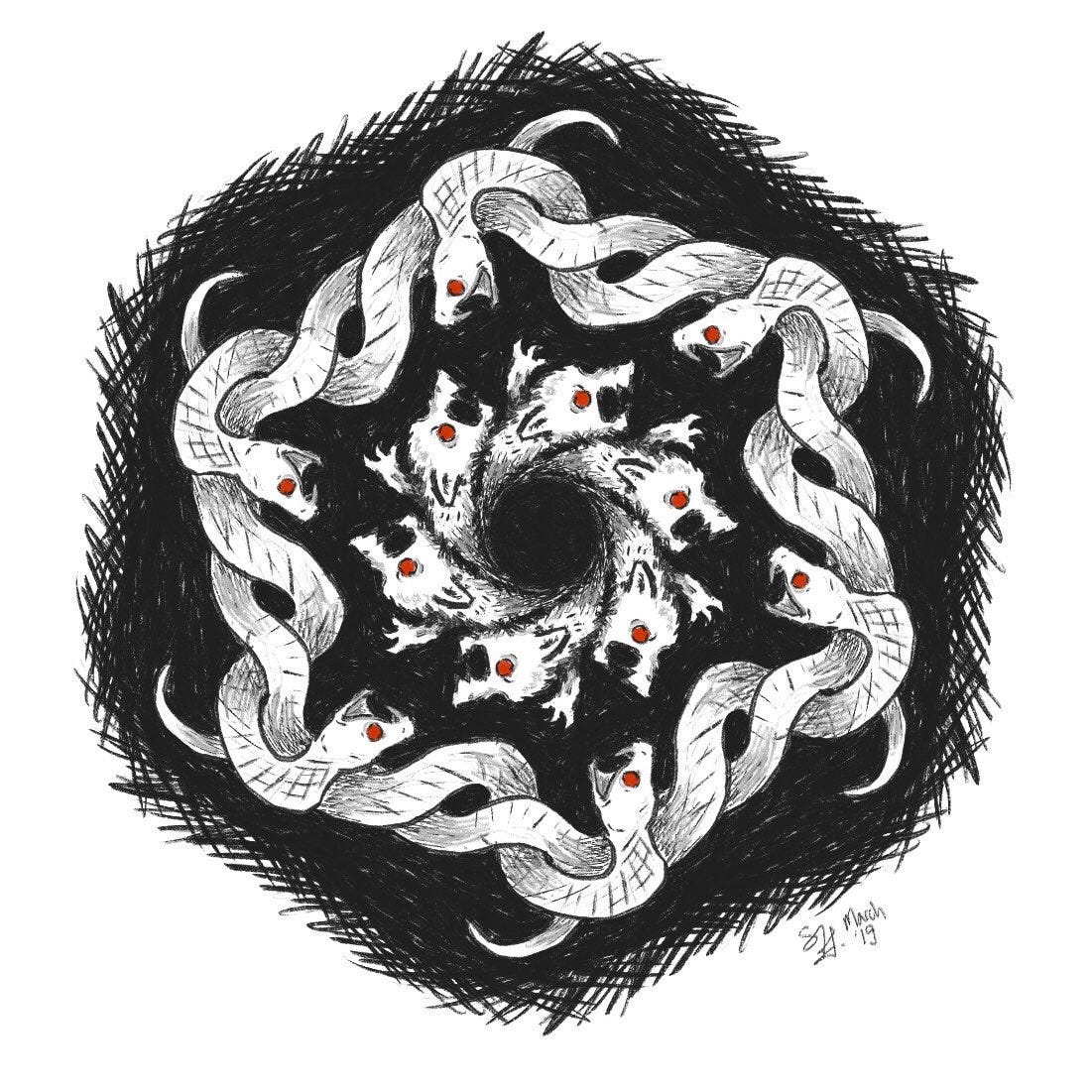
Image description: a loop of overlapping white ferrets with red eyes surrounded by a larger loop of snakes, their bodies wound together. The snakes and ferrets are snarling at each other.
[Image description: a loop of overlapping white ferrets with red eyes
surrounded by a larger loop of snakes, their bodies wound together.
The snakes and ferrets are snarling at each other.]

Learning that I am autistic, and understanding more about what that means for me, made me realise that meltdowns are a normal part of autistic experience. I’m not dangerous, it’s not a sign of some kind of terrible mental deterioration or break from reality — it’s just a response to stress and overwhelm. Don’t get me wrong, meltdowns are still deeply unpleasant, but there is less fear of the unknown attached to them, about what could possibly be happening. I can start to work on learning what my triggers are, when they might be imminent, how to prevent things from escalating, and what I need in those situations.
The fact that I can start to figure these things out for myself, with the help of the brilliant autistic community, as well as great allies and mentors, now means that I am also starting to learn to communicate what I need more clearly to others. 

Taken in isolation, meltdowns are unpleasant, exhausting, frustrating, sometimes even frightening, but they are also self-limiting. Knowing this, and why they happen, means that to me they really aren’t so much of a big deal in the grand scheme of things any more — I’m going to have them now and then, but that’s ok. The things I still worry about relating to meltdowns are almost all to do with the long-term repercussions of what might happen if I have a meltdown, or start getting close to one, around other people.

It seems like a pretty difficult responsibility that society places on us, as autistic people, to often have to do a lot of clear and coherent educating for our own safety, and to reassure others, just when we’re feeling at our least clear and coherent, and are in most need of reassurance ourselves. There are far too many examples of autistic people being arrested or sectioned, let alone reprimanded or ostracised, for having a reaction to difficulty and stress that is normal to our way of being, but not nearly well enough understood by others.

Following a meltdown that others have witnessed, I’m usually stuck endlessly replaying their reactions, worrying about what they might think, whether they are angry or scared or think less of me, dealing with any consequences that may have come from it. But more and more people are also starting to understand. There are several people in my life now, autistic and non-autistic, who I feel safe to be stressed around, even if I feel like a meltdown might be imminent. Times when I haven’t been ok around these people, they have offered the calm and reassurance I needed, and not thought differently of me, and as a result I’ve not been left trapped so much in loops of guilt or worry. Those meltdowns don’t linger as memories of significantly horrible events the way the ones I described earlier do.

Meltdowns are just one piece of autistic experience — an unpleasant and sometimes very difficult one, sure, but the hypersensitivity to sound and touch I feel when stressed is also the hypersensitivity that allows me to get so much joy out of the world when I’m excited. The energy and buzz that can make me writhe and flail in frustration is similar in feeling, in some ways, to the positive energy and drive I get when I’m really getting into a project, or about to do some enthusiastic public speaking. The electricity and anxiety that is part of the experience of being me (and autistic) is powerful, and can be scary, but is also what adds so much richness and focus to my world. I’m excited by how much we can all learn about different ways of being and experiencing, how to support each other, and what this diversity can add to the things that we all do.

----

A version of this essay was previously published at https://medium.com/@sonyahallett.

Images © Sonny Hallett.

Image descriptions by Sara Liss.


Share:

The quest for autism’s causes, and what it reveals about all of us

Emily Willingham
As alarm grew over autism prevalence at the turn of this century, there was much public talk of a growing “epidemic.” That language has since softened, and it is now clear that many autistic people were there all along, their condition unrecognized until relatively recently.

But what is the cause? The emerging narrative today is that there is no single cause—rather, multiple factors, roughly sorted into the categories of genetics and environment, work together in complex ways. Because of this complexity and the hundreds of gene variants that have been implicated, developing human brains may follow many possible paths to arrive at a place on the autism spectrum.

And this may help explain something true about autism: It varies greatly from one person to the next.

As clinicians view it, autism involves communication deficits and formulaic, repetitive behaviors that present obstacles to establishing conventional relationships. The soft borders of that definition—where does communication difficulty cross over into communication deficit?—suggest blurred margins between people who are diagnosed with autism and those who approach, but never quite cross, the line into diagnostic territory.

Those who do have diagnoses display behaviors on a continuum of intensity. Their use of spoken language ranges from not speaking at all to being hyperverbal. They can have a unique interest in the finer details of window blinds or an intense but more socially tolerated fascination with dinosaurs. As with many human behaviors, each feature exists on a spectrum, and these spectra blend in a person to create what clinicians call autism.

By pinpointing risk-associated genes and uncovering their roles, studying the roots of autism also is providing new insights into the development of all human brains, autistic or not. Here is a taste of what we now know, and what we don’t, about autism’s causes—and what that search is teaching us about everybody’s neurology.

They know it when they see it

Despite the many and varied threads that may interweave to cause autism, the condition is largely identifiable. What clinicians are really saying when they diagnose autism, says James McPartland, a clinical psychologist at the Yale Child Study Center, is that they see a recognizable, if broadly defined, constellation of behaviors. “So really, there is something true about autism, and everyone who meets the diagnosis of autism shows these kinds of behaviors.”

US rates of autism diagnoses have increased over the years, as shown in a graph. Numbers are averages of prevalence among 8-year-old children from several reporting sites of the CDC's Autism and Developmental Disabilities Monitoring Network. Not all sites reported in each year shown, and the ranges can be broad (for example, in 2000 the average was 6.7 per 1,000 children, but the range from different reporting sites was 4.5 to 9.9).  At least part of the increase is due to heightened awareness and shifting diagnostic criteria.
[image: Bar chart showing the rise in autism diagnoses from 2000 to 2014,  based on Centers for Disease Control (CDC) data.]
At the same time, the subtle differences in how each autistic person manifests the telltale features make it highly individual, says Pauline Chaste, a child psychiatrist at Inserm U 894, the Centre de Psychiatrie et Neurosciences, in Paris. “We describe a specific behavior that exists — that kind of social impairment and rigidity. You can have more or less of it, but it definitely exists.”

The more or less of autism could trace, in part, to the types of gene variants that contribute to it in a given person. Some of these variants have a big effect by themselves, while others make tiny contributions, and any autistic person could have their own unique mix of both. One thing seems clear: Though there may be something true about autism, as McPartland puts it, the existence of “one true autism gene” or even one gene for each autism feature is unlikely.

Instead, there will be patterns of gene combinations and the results they produce, says epidemiologist Elise Robinson of the Harvard T.H. Chan School of Public Health and an associate member of the Broad Institute. People who have both autism and intellectual disability, for example, tend to have more big-effect gene mutations than people with autism alone.

Facial communication

Looking for these contributing gene variants isn’t simply an exercise in scientific curiosity or in finding potential targets for drug treatments. Because most of these genes direct how human brains develop and nerve cells communicate, learning about how they lead to autism can also reveal a lot about how everyone’s brain works.

For example, a key autism trait is atypical social behaviors, such as, sometimes, not focusing on “social” facial features like the eyes. Although the tendency to look into another person’s eyes seems like something we might learn simply from being around other people, autism research has revealed that genes underlie the instinct.

In a 2017 study, the authors first showed that identical twins are similar in how they look at a video with social content, such as faces. When viewing the same video, the identical twin pairs shifted their eyes with the same timing and focused on the same things far more than did two non-identical siblings or unrelated children. The fact that almost all twin pairs shared this tendency suggests solid genetic underpinnings for the behavior.

Having established a strong genetic contribution to this trait, the investigators, from Emory University and the Marcus Autism Center in Georgia and Washington University in St. Louis, then showed that the tendency to look at the eye and mouth areas of a human face is decreased in autistic children. They concluded that while not all of the inclination to look at certain parts of a face is genetic, much of it is.

Twin studies like this are powerful tools for evaluating how much genes dictate a feature, and such investigations reveal that the genetic contribution to autism is substantial. Autism also tends to cluster in non-twin family members: One in five infants who has an older sibling with autism also develops it.

Genetic determinants

Overall, genetics accounts for about 70 to 80 percent of factors contributing to autism, says neurologist Daniel Geschwind, director of UCLA’s autism research and treatment center. By comparison, a condition like depression has an underlying genetic contribution of about 50 percent, he says. Alessandro Gozzi, neuroscientist and group leader at the Istituto Italiano di Tecnologia, weights the power of genes even more, placing the shared diagnosis rate between twins as high as 95 percent, depending on how strict the diagnostic boundaries are. But regardless of the precise value, he says that the “wide consensus” among autism researchers is that genetics is a powerful determinant of autism.

Going the next step — finding the specific genes involved—is a monumental task. It’s also one that yields dividends for understanding brain function more broadly.

The candidate gene variants are today very numerous, but a few stand out for their potential to exert a large effect. Chaste cites fragile X syndrome and Rett syndrome as examples—both are genetic conditions (termed syndromes because they are defined by a cluster of traits) that are tied to variants of a single gene or chromosome region and are closely associated with autism.

The gene linked to fragile X syndrome lies on the X chromosome. Its name, FMR1, is easily forgettable, but the effects of its variants are not. Studies on the causes of fragile X reveal that the protein this gene encodes, FMRP, acts as a cellular shuttle for RNA molecules that are crucial for nerve-cell communication and plasticity of connections in the brain. In people with fragile X, cells don’t produce the protein, or make very little of it. The FMR1 variants underlying fragile X are the most common known genetic cause of intellectual disability and are implicated in 1 to 6 percent of autism cases.

Like FMR1, the genetic changes involved in Rett syndrome also affect brain development. A gene called methyl CpG binding protein 2, or MECP2, oversees the activity of many brain-related genes, turning them off or on. Because of this pivotal role for MECP2, mutations that affect its function can lead to broad effects. Some of the resulting features look so much like autism that Rett syndrome was categorized as an autism spectrum disorder until 2013.

Other genetic syndromes also include autism as a feature. Some are caused by variants in a gene called SHANK3 which, like most genes implicated in autism, is involved in brain development and function. The protein that it encodes helps to coax nerve extensions to form and take shape so that a nerve cell can communicate with others. The SHANK3 protein also provides a physical scaffold for those cells to link up. In populations of people with mutations that prevent SHANK3 protein production or who are missing the segment of chromosome 22 that contains the gene, most will have autism or Phelan-McDermid syndrome, which often includes autism.

Yet another syndrome arises from the loss or duplication of a chunk of chromosome 16. Researchers linked this chromosomal change to autism in studies comparing the DNA of people with and without the condition, singling out sequence alterations found only in autistic participants.

Despite their clear ties to autism, these syndromes are rare. “Collectively, they are found in about 5 percent of the total population of patients with autism,” Gozzi says. That leaves a great deal to explain.

Inheritance on a spectrum

So where do the other autistic people come from, genetically speaking? Robinson says that their genetics don’t neatly fall into two types of buckets, of either a few genes with big effects or many genes with small effects. “It’s been well established at this point that it’s not either–or,” she says.

In fact, says Gozzi, varying combinations of big-effect mutations and lots of different, smaller-effect ones could explain the wide spectrum of differences observed among autistic people. The evidence supports such a range, he says: everything from a few heavy-hitting variations in some people, to an additive dose from many variants in others, and with overlap between the two patterns in still others.

Graphic illustrating how four different genes affect neurons
Scientists have identified many genetic variants that are linked to a raised risk of autism. Often, these variants affect the function of genes involved in the development and activity of brain cells. Here are four such genes, each of which carries instructions for a protein (called MECP2, PTEN, FMRP and SHANK3) that has an important function in neurons. Studies like this, of autism’s genetic causes, are teaching scientists more about brain biology.
[image: Graphic illustrating how four different genes affect neurons.]
Geschwind adds yet another layer of complexity: the role of the cellular environment that all the other gene variants in a person create, known as the background effect. For example, someone could have a mutation conferring high risk that is either enhanced or diminished by the background input from other genes not directly related to autism, to create a gradation of autism intensity.

Environmental influences

When researchers speak of environmental inputs to traits, diseases and disorders, they are referring to everything from pollutants in the air to subtle perturbations inside cells to cues from other cells. Finding such causative candidates for autism generally involves epidemiological studies that look for correlations between autism rates in a population and an environmental factor of interest.

These connections aren’t easy to locate. In the case of genes, if a study involves enough people, even rare genetic differences that make small contributions to autism can often be plucked from the pile. Not so for environmental influences if their effects are significant but small, says Robinson. Within those epidemiological studies, you have to be able to detect that slight signal and assess its power against the larger, background noise of lots of other variations in the cell, body or outside environment that you might not even be aware of and might not be relevant. “We don’t live in a simple, single-exposure world,” says Kristen Lyall, an epidemiologist at Drexel University in Philadelphia.

And even when a connection is made, its basis is still just math. That is certainly the first step in evaluating a link between an environmental factor and a condition such as autism: As one thing goes up, does the other follow? But two things that track together don’t necessarily share a biological association. (One of the silliest examples to illustrate how misleading correlation can be is how tightly the number of people killed by venomous spiders each year tracks with the number of letters in the winning word of the same year’s Scripps National Spelling Bee.)

In the case of genetic studies, gene changes with tiny effects can still be considered plausible if their usual role relates to brain function in some way. Environmental factors aren’t as well catalogued, measured and tracked. But the better epidemiological studies do look for correlations with credible and pre-identified factors of interest (so, not Scripps Spelling Bee words).

For feasibility’s sake, work on environmental factors in autism has tended to focus on inputs that have broad effects on brain development. Robinson points to extreme preterm birth, which is related to many kinds of neurodevelopmental disorders—autism among them.

Eventually, studies can add up to connect dots and arrive at a plausible story of cause and effect. For example, along with preterm birth, air pollution also has been linked to autism risk. Another recent study found that when oil and power plants close down, preterm births in the region drop. It’s therefore a reasonable hypothesis that very preterm birth operates as an intermediate between air pollution exposure and autism.

Lyall believes that prenatal exposures to environmental pollutants that can behave like hormones are particularly strong candidates for involvement in autism risk. These chemicals, collectively known as endocrine-disrupting compounds, include pesticides and even heavy metals, and they are pretty much everywhere—in air, land, water, food and us.

Some research suggests, for example, that exposure to the endocrine disruptor mercury in air pollution raises autism odds. The studies are few and the data haven’t overwhelmingly showed increases in risk, Lyall acknowledges, “but I think that it’s an interesting and important area for future research given the lack of regulation around these chemicals, their ubiquity in the environment and their known adverse effects on broader neurodevelopment.”

Researchers have also homed in on plausible biological bases for a couple of other potential environmental effects. Gozzi points to animal studies, mostly in mice, that bolster human work linking autism in a child with prenatal exposure to a mother’s ramped-up immune responses as a result of infections. Again, Gozzi stresses that the findings are far from definitive, and most studies involving humans have focused on infections severe enough to require hospitalization.

Another unearthed link is to paternal age at conception: Studies find that autism risk increases with the age of the father, usually starting in the thirties or forties, although the age range and magnitude of the increase vary among different studies. The cells that give rise to sperm tend to accumulate new mutations over the years, so the sperm contain sequence changes that pass to offspring but aren’t present in the father’s own body cells. Some of these changes involve regions or genes already implicated in autism risk. Sperm also show changes in the chemical tagging of DNA that controls the activity of genes.

Establishing environmental cause unequivocally is almost impossible, because of ethical constraints. It’s one thing to examine blood or tissue samples for genetic variants that track with autism diagnoses. It’s another thing entirely to manipulate factors to see if they induce autism or not. No one’s going to deliberately infect a pregnant woman or have a group of men specifically delay fatherhood just to test how these factors influence autism odds.

Researchers instead are stuck finding correlations between these factors and then looking at available measures, such as changes in gene activity, accrual of mutations over the lifespan and studies of autism-like behavior in animal models. And as they look at these associations, they often make discoveries that are relevant beyond autism—ones that have now been extended to studies of schizophrenia, aging and even human evolution. The link between autism and having an older father, for example, has led to studies examining how changes in sperm over time affect brain development in later generations.

While most environmental candidates remain just that—candidates—Lyall says emphatically that one factor is out of the running: vaccines. “That’s pretty conclusively been shown to have no association with autism,” she says, noting the numerous large epidemiological studies that have reached that conclusion.

The settled vaccine question is a small point of clarity in an otherwise blurred landscape of autism cause-and-effect research. Every new finding seems to open up yet more pathways, some leading toward autism, and some toward broader revelations about the brain and how hormones, the immune system, the air we breathe and more add up to make their mark on neural development. The network of genetic and environmental factors that converge and diverge to produce autism may reflect not only the multiplicity of ways of being autistic—but also, more broadly, of being human.

----
Knowable Magazine icon of a lowercase letter K with a rainbow gradient stem, on a white background.

This article originally appeared in Knowable Magazine, an independent journalistic endeavor from Annual Reviews.

Share:

Autistic Children and Toilets: Misunderstanding the Difficulties

A disorientating digitally altered photo  looking down into an empty toilet cubicle
Photo © Ann Memmott
[image: A disorientating digitally altered photo 
looking down into an empty toilet cubicle.]

Ann Memmott

annsautism.blogspot.com

Many autistic children sense the world very differently from how many parents and teachers expect.

Above, an example of how an autistic child may see a room with a toilet and hand basin in it. A tiled wall, a patterned vinyl floor surface. Would you put your feet on that floor? Could you work out what it was? Could you even reliably find the toilet?

Now let's add in the 'smellscape.' Perhaps air fresheners. Toilet cleaners. Hand soaps. Wee. Poo.

Then, let's add in the soundscape. Noisy pipes. The jet-engine-like flush. The deafening smash of wee or poo hitting the water, and the terrifying prospect of freezing water splashing up.

Let's then add in the elements of freezing cold toilet seat, ice cold taps or boiling hot taps, the ice-cold metal of the toilet handle, the taps. The searing rough surface of the hand towel, or the further deafening roar of a hand drying unit perhaps. Then, of course, the pain of dragging clothing down in order to use the toilet.…coping with the complexities of the toilet paper and what to do with it, where to put it. Dragging clothing back up again, like someone using sandpaper against your skin.

Toileting can be the most terrifying experience imaginable for a child whose experience of the world is turned up to 'max.'

For others, each noise and smell, texture and feeling is a fascination and a puzzle which needs exploring, and they may seek out those experiences over and over, trying desperately to make sense of them.

Some may experience difficulties with balance and co-ordination, or with internal signaling to say they need a loo until it's too late. Or with the ability to point or signal that they want the loo.

To their credit, many autistic children endure all of this and actually do use the loo, politely, over and over again, and continue to do so for life. No-one questions whether it's hell, or whether we could design such spaces in ways less exhausting to use. So, let us bear in mind that most autistic children do manage to cope with this ridiculous scenario.

But how easy it is for some adults to misunderstand why an autistic child may avoid using a toilet.  Some children are so desperately afraid of these spaces that they will only wee or poo in a quiet, safe corner. Often on soft material that disguises the noise.

Yet some adults still say, "They're just animals—they just don't care—this is deliberate challenging behaviour—we must find ways to force them…" We even have playwrights writing a horrible play which portrays autistic children as animals, using this theme and dehumanising puppets.

Oh my. No.

Always, always presume competence. Presume that the child wants to learn. Always, always show respect and caring. Take good advice from autistic advisers and our allies, who are experienced and expert. Many are parents, many have vivid memories of their own of the challenges of such spaces.

If you are designing such a space, take good advice on that design. Think about minimising the pain and the disorientation.

Instead of assuming that, since it's OK for you, it must be OK for an autistic child…think differently. Because the solution isn't the child being forced into that hellish toileting space. Instead, we should be working with the child to find answers to each part of their toileting nightmare. Thinking about making the visual experience understandable. Minimising the smells. Minimising the noise. Using soft towels, soft paper. Using clothing that doesn't cause terrible pain when it is pulled up or down.

Work together. Learn from one another.

Thank you for listening.
Share:

The Meaning of Self-Advocacy

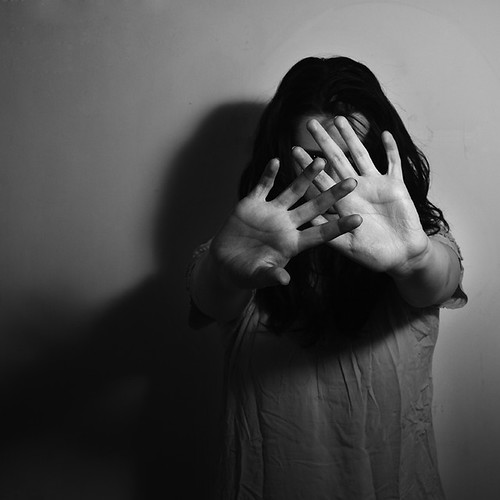
Black and white photo of a person with long dark hair holding their arms straight out towards the camera, with palms facing outward protectively.
Image © Gioia de Antoniis  | Flickr / Creative Commons
[image: Black and white photo of a person with long dark hair holding their arms
straight out towards the camera, with palms facing outward protectively.]


Mel Baggs
withasmoothroundstone.tumblr.com

Too often people define self-advocacy in narrow terms. They define it in terms of formal groups like People First or Autism Network International. They define it in terms of the ability to use standard language in a specific set of ways. They define it in terms of a specific method of going through the legal system, or other usual channels, to get specific kinds of things done. These are all valid kinds of self-advocacy, but they set people up to believe that only certain kinds of people could ever become self-advocates.

When one inmate in an institution fights back against the staff in defense of another inmate who is being brutalized, this is self-advocacy. I have only seen this happen once. She was brave and heroic in the genuine senses of the words, and she paid the price for trying to protect me.

When an autistic teen without a standard means of expressive communication suddenly sits down and refuses to do something he's done day after day, this is self-advocacy. When his initial peaceful methods are ignored in favor of restraining him and violently shoving him into a car so that staff can meet their schedules rather than listen to him, his decision to bite the driver is self-advocacy. I was there in the car with him.

When an autistic person who has been told both overtly and otherwise that she has no future and no personhood reacts by attempting in any way possible to attack the place in which she's been imprisoned and the people who keep her there, this is self-advocacy. That was me and too many others I knew.

When inmates of institutions (both traditional and those that masquerade as community), including those who are said to have no communication, devise covert means of maintaining communication and friendship in spite of staff's attempts to stamp it out, this is self-advocacy.

When people generally said to be incapable of communication find ways of making clear what they do and don't want through means other than words, this is self-advocacy.

When inmates and 'clients' devise both small and big ways of sabotaging staff's attempts to control our lives, this is self-advocacy.

In the book First Contact, Dave Hingsburger describes how people with significant developmental disabilities, normally believed to be incapable of self-advocacy, can and do engage in it:
Helen is her own self-advocate in that her "self" "advocates" that we adapt the world for how she experiences it. This is self advocacy at the grandest level. Why? Because it is immediately apparent that if Helen's personhood can liberate her—our understanding of the personhood of people with disabilities should do the same. Her statement of joy, of self awareness, shows that people who think that she would be better off dead—are simply bigots who choose not to know her. Helen is a radical person. Her message is about radical acceptance. Her life is radically her own. For those labeled "profoundly retarded," emphasize the word "profound."1
Then there's the question of things that get called self-advocacy, but aren't.

When a non-disabled person gets full of ideas about what disabled people should be saying and thinking about our lives, and holds us lockstep in his control while pretending to teach us all these revolutionary ideas, that is not self-advocacy. Nor is it self-advocacy when someone is constantly telling us that our existing methods of advocating for ourselves are wrong, that we need to ask permission to have a voice, and that self-advocacy can only be accomplished once we learn to behave and go through "appropriate" channels. Or when an institution sets up a "self-advocacy group" that it keeps busy doing meaningless work to siphon off the frustrations of inmates and prove to others that they're really about "empowerment." These things often get passed off as self-advocacy, though. Real self-advocacy involves respect and listening to us.

When a disabled person decides to disenfranchise entire categories of disabled people on the basis that they're not as worthy or capable of self-advocacy as her kind of disabled people, that is not self-advocacy. When people run around saying "I can make decisions of my own, but 'retarded' people shouldn't," "People with developmental disabilities shouldn't live in institutions, but can you please tell me how to lock up my crazy brother?" or even "It's perfectly natural for people like me to hate ourselves, that's just how we are..." that's more like oppression than self-advocacy.

There's also a common practice of getting a bunch of disabled people together for a recreation program and calling it a self-advocacy activity. Real self-advocacy involves getting the tools for real power—not bite-sized pieces of power, but the real thing—in the hands of disabled people. Too often people in these 'programs' are punished as showing inappropriate behavior if we engage in real self-advocacy.

Self-advocacy doesn't always look good on paper. It doesn't always stay within the sensibilities of people who want everything neat, orderly, pretty, and civil. People who declare a certain category of person to be uniformly incapable of self-advocacy are usually the same people who view that category of people as people who must be controlled rather than listened to. Self-advocacy doesn't mean staff get to pat us on the head, use the right buzzwords, tell us what wonderful little self-advocates we are, and then chastise us or put us on a behavior program when we get angry at them about their controlling behavior.

Self-advocacy is fundamentally about true equality, respect, and power, and about recognizing and changing the current imbalances in all of those things. Whether it is going through the legal system to close an institution, fighting back physically against intolerable surroundings, talking back to staff, sabotaging the power of staff over the lives of disabled people, being listened to when we communicate in non-standard ways, learning that it's okay to have a voice and make decisions, or passively resisting the dominance of others over our lives, real self-advocacy will always upset the status quo in some way.

No matter how legal and proper it is, self-advocacy won't be comfortable and cushioned. It will not give the people who are used to having power over us a warm fuzzy feeling of helping us, nor will their viewpoints on what we should be doing be able to dominate us and speak through us. They will not be able to pretend away the power inequalities between us and live in fairyland where everyone's the same and that's what counts. It will frighten them and force them to examine themselves. This will be true not only for non-disabled people, but to disabled people who are used to feeling superior to other kinds of disabled people.

I was once told by a surprisingly renowned "parent-advocate" that I only have a voice because Gunnar Dybwad gave me one, and that I should sit back and let parents and professionals do all the work towards closing institutions in my state. I beg to differ. Self-advocacy was not born with Gunnar Dybwad, no matter how much of an ally he was. It was born the first time a suspected changeling tried to run away before anyone could kill him. And the first time an inmate of an institution resisted staff power. The first time someone without a standard system of communication devised one of her own and tried to communicate basic things to other people.

Self-advocacy has been and is still often labeled intransigence, non-compliance, treatment resistance, lack of motivation, behavior issues, violence, manipulation, game-playing, attention-seeking, bad attitude, bad influence, babbling nonsense, self-injurious behavior, inappropriate behavior, disrespect, disruption of the milieu, catatonic behavior, social withdrawal, delusions, septal rage syndrome, and even seizures or reflex activity. Self-advocates have been tortured, intimidated, locked up, separated from our friends and lovers, and killed for our actions since before any organized movements existed. To say that the parent-advocacy movement or any other group of people created our voices is arrogant and shows real disrespect for the price many of us have paid for using our voices. We have always had these voices, in many forms. It is others who have shut us out, shut us up, and refused to listen.

1First Contact, Charting Inner Space: Thoughts about establishing contact with people who have significant developmental disabilities, by Dave Hingsburger. This book is available from Diverse City Press. It talks extensively about how to get to know and listen to people without controlling and projecting your values all over them, and about the roles all people can play in the self-advocacy movement.

----

Originally published at Autistics.org
Share:

Starting Points for Understanding Autism

Oolong
oolong.co.uk

Photo courtesy the author
[image: Photo (light-painting) by the author: a spectral outline
around a hand and arm, raised as if to flap.]
I believe that the best way to understand autistic minds is in terms of a thinking style which tends to concentrate resources in a few interests and concerns at any time, rather than distributing them widely. I wrote in some detail about how this explains the observed features of autism in Me and Monotropism: A Unified Theory of Autism. Here, I want to distill what this means for living and working with autistic people, expanding on the six starting points for understanding autism that I identified in ‘Theories and Practice in Autism.’

I’m writing in the first person here, as a late-identified autistic adult who has worked and talked with many other autistic people in various contexts over many years. I believe that everything I describe here is a common experience for most people on the spectrum, but not necessarily universal. Many will be shared to various degrees by some non-autistic people—there are very interesting questions about the extent that different thinking styles overlap; brains really are very diverse, and psychological classification is a messy business. References, reviews of research and further resources for each section appear at the end.

1. Coping with multiple channels is hard

This can be sensory channels or other information streams.


This shows up in many ways; some of the most obvious ones are social. If my attention is focused on something else, I may not be able to take in what you’re saying. If I’m focusing on what you’re saying, I may not be able to do anything else (or I may need to do something else to absorb excess attention).

Most people assume there are multiple channels of communication going on in any conversation: words, tone of voice, gesture and eye contact. They also assume an ability to hold various other things in mind while talking: social context, social rules, relevant background facts. This works most of the time, for most people, but causes endless confusion in conversations between autistic and non-autistic people. Be prepared for misunderstandings where someone missed out on one or more of the channels you thought were conveying information.

Be aware that autistic communication styles tends to be different, too, for much the same reason. We are expected to maintain multiple channels of communication in socially acceptable configurations at all times, despite missing a lot of non-verbal cues throughout our lives. It often takes conscious effort to emote ‘appropriately’, display expected body language and suppress urges to regulate ourselves with motions people might find weird… all while trying to make sure not to say anything daft. Learning to do all this can be a valuable social skill, but it takes a lot out of a person, and it just doesn’t always work. If you want someone to be able to relax, they need to be able to feel comfortable being themselves—even if that looks odd to you. Learn to read our body language as best you can, but be aware that most people often get it wrong.

2. Filtering is tricky and error-prone

Sometimes I can’t tune things out, other times I filter them out completely.


Filtering is an active process, and it becomes much less effective when our resources are consumed elsewhere. That means our filters tend to be at their wonkiest when we’re worn out or having to keep up appearances. Any work done filtering out unwanted stimuli leaves less energy over for anything else.

Being unable to filter can be intensely uncomfortable, especially if it’s keeping you from something you want to focus on. Please take care of the sensory environment: too much noise and clutter and stimulation can be exhausting, painful and impossible to work with. Sometimes it helps a huge amount to be able to spend some time in an environment where we can control our sensory input, and not have to filter anything for a while.

Some of the most satisfying, relaxing and productive times are when we can enter a flow state, our attention completely absorbed in an activity. At those times, we may filter out almost everything else. If we can’t get rid of enough distractions to begin with, it becomes impossible to enter that state.

3. Changing tracks is destabilising

Task-switching is hard, and new plans take work.


It takes time and effort to get going, to change direction, or to stop. In other words, autistic thought tends to have a lot of inertia: it resists a change in state.

This can be great for working through complex logical puzzles, learning large collections of facts or just getting intensely absorbed in anything, but it can be very inconvenient all the same. Pulling all our tendrils of thought out of one thing and directing them towards another takes much longer than it does for a lot of people, and sometimes it’s hard to make them go where we want them—let alone where other people want them. Give us warnings, give us time, let us recover.

Don’t expect an instant transition from one thing to another, especially if it’s unexpected. It’s hard enough changing tracks even when we know what’s coming. A sudden change of plans means we have to completely reset and work out how to deal with everything about the new circumstances.

4. I often experience things intensely

Usually things that relate to my concerns and interests.


When my attention is fully focused on something, my brain seems to throw everything it can get at that thing. I credit this with my senses often seeming to be more intense and detailed than most people’s. I seem to get more than most people out of being absorbed in my interests, in general; I think this relates, again, to flow states.

On the other hand, unexpected input sometimes really shakes me. This might be something sudden, or just something that doesn’t seem to fit; either way, I can’t ignore it. It’s been suggested that the main difference with autistic brains is that they just have their ‘surprise’ setting turned right up; I wonder if our tendency towards intense surprise comes from having fewer interests or filters active at any given time, and finding the unexpected more jarring because of the intensity of our focus.

Incidentally, one of the side-effects of being surprised a lot is that you do sort of get used to it. I’ve often known autistic people to seem less surprised by things other people seem shocked by.

5. I keep looping back to my interests and concerns

It’s hard to let things drop.


It’s in the nature of interests and concerns that you loop back to them. If you’re interested in something, things are likely to pull your attention back to thinking about it. Monotropic minds tend to get pulled back to the same loops of concern again and again, especially when they have unresolved questions. People are terribly confusing, so we often have lots of unanswered questions. Sometimes a question might have been adequately answered really, but it still doesn’t quite feel like it, so we need to ask anyway. Other times, people are just impossible to predict, and there is no way to lay those worries to rest. These things can haunt us for years, and carrying them around can really sap your energy.

Still, I like how things are so interesting. Fascination is a fun thing, and I’m glad people have hardly ever tried to talk me out of my fascinations. I like working stuff out, and learning new things, but I also like to just get lost in things sometimes. Sometimes people are baffled by the sorts of things I like to do and learn, but really it’s their loss.

6. Other things that drop out of my awareness tend to stay dropped

I may need reminders.


I really need some kind of system to make sure things I’m supposed to think about come back to my attention. It’s so hard keeping tabs on lots of things at once, I’m bound to drop some of them if I don’t get reminded at the right time. This is complicated by the fact that if I’m in the middle of something, I really don’t want to let myself get pulled out of my attention tunnel for anything I can possibly put off.

This means there are all sorts of things other people might expect me to be thinking about, which I might not be unless I’m getting the right prompts. That includes things I genuinely care about, by the way; I hope nobody assumes I’m indifferent to things just because I fail to think about them. I just have so much else going on in my head!

----

I understand all of these features as manifestations of a monotropic thinking style: the more a brain concentrates its resources in a few interests and concerns, the more we should expect these to be true. Other theories can predict and explain many of the same features (see below) but I’m not sure that any other single theory leads us to all of the same predictions.

All of these taken together add up to a world that can be very difficult to deal with. It is no wonder so many autistic people experience so much anxiety, confusion and overwhelm. Our capacity for joy and focus can be some compensation for this, but it is often difficult to navigate a world dominated by people with relatively typical brains. If people can’t or won’t understand and accommodate our needs, problems accumulate. Discomfort can get ramped up higher and higher, until we have to escape or else we’ll melt down or shut down. This can last for a long time, and it is so often avoidable. I hope what I have described gives you some good starting points for working out how.

With the right strategies and understanding in place, most autistic people can thrive. Without them, life can be incredibly difficult, and much of what we have to give to the world gets lost. I wouldn’t change very much about my brain — I mostly like being who I am. I would, however, like to change many things about this world and how it deals with people who think differently.

----

If any of this helps you make sense of things, or changes how you relate to autistic people you know, I would love to hear about it. More important than that, please let me know if there’s anything here that doesn’t ring true for you! These ideas are being actively developed, by myself and others. There may be things we are getting wrong, and there are certainly things we haven’t fully worked out yet. One of the things I am especially interested in working out is what this all means for teachers, and I may soon produce a tailored version of this piece augmented by examples from educational practice.

Research, References, Resources


There is empirical work to be done to establish how well most autistic people feel these descriptions apply to them—beware anecdata, and all that. So far the best direct evidence for Monotropism as a theory of autism is probably Julia Leatherland’s unpublished PhD thesis, Understanding how autistic pupils experience secondary school, which found that Monotropism accounted for more of pupils’ reported experiences than any other single theory. I believe the basic features I describe here are all well-supported both by psychological research and the accounts of autistic writers, but Monotropism as a theory is still crying out for experimental work.

Notes for each of my starting points follow.


  1. Although it took until DSM-5 for perceptual differences to be included in diagnostic criteria, difficulty dealing with multiple sensory streams is attested since early autism research. Lovaas et al were not the first to record it in 1971, and see Marco et al (2011) for a systematic review. Mongillo et al (2008) found that difficulties with speech processing—perhaps unsurprisingly—were associated with social difficulties, and includes the fun fact that autistic people are much less susceptible to the McGurk Effect.
  2. It is well known that filtering is an active cognitive process, keeping the conscious mind from being overwhelmed with too much data. In the Predictive Coding model of the mind, much of what our brains do can be seen as filtering: non-conscious processes work on predicting the input coming in, and only what they fail to predict makes it through to conscious awareness. See Friston & Kiebel (2009) for a technical account, and Van de Cruys et al (2014) for more on the idea of autism as being a manifestation of excessive surprise. Karl Friston’s video on embodiment and Andy Clark’s book Surfing Uncertainty are both excellent introductions to this general approach to cognition, with a bit about how it currently seeks to account for autism.
        It seems natural to expect filtering to take energy, in the sense of both requiring and exhausting cognitive resources. So far I have only found research exploring the former, and not in an autism-specific context: Drummond et al (2012) found that sleep deprivation reduces visual filtering ability; Hasson et al (2013) found that a combination of emotional exhaustion and stress reduced tolerance for loud sounds.
        The National Autistic Society has a pretty good page on autism and the senses in general. On flow states in autism, see Milton (2017) and this video, also by Damian Milton.
  3. This is normally talked about as an aspect of executive function, which has been extensively studied with reference to autism—see e.g Hill (2004), and occasionally posited as an underlying explanation for all autistic cognition—see Russell (ed.) (1997). As I wrote in Autism and Executive Functions, I find it unconvincing as an overall theory of autism, and a bit of a blunt instrument for describing particular difficulties, but it remains an important idea.
  4. Intense experiences are at the very heart of the Intense World theory of autism (Markram et al 2010) which has important points in common with the Monotropism account. Its proponents are oddly reliant on a rodent model of autism, however, and see Remington & Frith (2014) for some very cogent criticisms, including the fact that unlike monotropism, it only seems to account for hypersensitivity in autism, where hyposensitivity is also commonly reported. Mottron et al (2006) write of enhanced perceptual functioning in autism, backing up the impression of sensory input often being both richer and more detailed in autistic people.
  5. Despite ‘restricted’ interests being a feature of accounts of autism going right back to the beginning, the nature and role of autistic interests has been chronically under-researched, and is very poorly accounted for by most theories of autism. However, see Grove et al (2018) for a study demonstrating the shock finding that pursuing their passions is a positive thing for autistic people’s wellbeing. The focused interests of autistic people are often called ‘special interests’, which is fine as long as you think along the lines of Special Interest Groups in tech, but not so much if you think of them as some weird, incomprehensible autistic thing, probably best suppressed. Mostly I prefer the term ‘passion.’
        On the anxiety front, Wigham et al (2014) found intriguing links between anxiety and repetitive behaviours. Both can be seen through the lens of perseveration, as can the way we keep returning to our interests. The idea that autistic anxiety is often associated with social difficulties is well studied—see e.g. White and Robertson-Nay (2004).
  6. This is another thing that’s usually discussed under the heading of ‘executive dysfunction’, not all that informatively. Mazfinch on Twitter has a handy list of possible reminder systems.

Acknowledgements


My partner Sonny Hallett has contributed greatly to my thinking about all this, and coined the useful phrase ‘loop of concern.’ That’s also them in the photo at the top wearing an excellent dinosaur jumper. The underlying concepts were largely formulated by my mother Dinah Murray, with Mike Lesser and Wenn Lawson. Damian Milton, Nick Chown and Richard Woods have all also contributed notably to my understanding.

----

This essay was previously published at Medium.
Share: