IMFAR 2017: Incorporating Autistic Intellect in Autism Research Special Interest Group

IMFAR 2017: Incorporating Autistic Intellect in Autism Research Special Interest Group (2)

IMFAR 2017: Incorporating Autistic Intellect in Autism Research Special Interest Group (2)

Today's panel was a follow-up to last year's SIG: https://storify.com/shannonrosa/bridging-the-research-gap-incoporating-autistic-in
  1. The (fabulous) #IMFAR2017 Incorporating #Autistic Intellect in Research SIG speakers: Steven Kapp, @johnrobison, Dena Gassner, @Tumbalaika. https://t.co/ahi1RZXpR1
    The (fabulous) #IMFAR2017 Incorporating #Autistic Intellect in Research SIG speakers: Steven Kapp, @johnrobison, Dena Gassner, @Tumbalaika. pic.twitter.com/ahi1RZXpR1
  2. [image description for photo above: Three white men and one white woman posing for a photo in a hotel conference room.]
  3. We are about to start our SIG session on involving autistic people in shaping research. Second year for this #IMFAR2017 session
  4. Now: At the IMFAR panel on integrating #autistic intellect in #autism research: Part 2. #IMFAR2017
  5. #Autistic people need to participate in #autism research in roles other than “subject.” #IMFAR2017
  6. We need #autistic people to tell researchers what is working and what is not working, & vice versa #IMFAR2017
  7. Stephen Shore @Tumbalaika talking about need to research what is preventing #autistic ppl from getting proper medical care. #IMFAR2017
  8. …because #autsitic ppl are NOT getting proper medical care, as evidenced by shortened life span, elevated suicidality, etc. #IMFAR2017
  9. @johnrobison talking about teaching neurodiversity at William & Mary, meaning creating welcoming campus for #autistic ppl. #IMFAR2017
  10. Having the students at William & Mary value neurodiversity (& intersectionality) means more woke public servants (W&M specialty). #IMFAR2017
  11. @johnrobison: Asks anyone who is teaching at a university to emphasize the value of #autistic people, as humans & in society. #IMFAR2017
  12. @johnrobison: #Autistic people are also good at connecting researchers with each other/catalyzing, because not competitors. #IMFAR2017
  13. Robison: autistic ppl in research have unique position to facilitate networking between scientists #IMFAR2017
  14. @johnrobison: Encourages #autistic people & allies to connect researchers w/each other, because researchers can’t always do that. #IMFAR2017
  15. Morning #IMFAR2017 SIG on including autism intellect in research process: @johnrobison stresses ability to make connections b/n researchers.
  16. Kapp methods for collecting article feedback: Recruitment through blogs, listservs, forums, social media, #autistic & non- folk. #IMFAR2017
  17. Kapp: Survey revealed persistent #autism myths, such as "most #autstic people are ‘retarded.'” >:( #IMFAR2017
  18. Kapp: This was the first study to directly study, measure, & analyze #autsitic ppls knowledge of #autism. (& compare w/NT info) #IMFAR2017
  19. Kapp: Neurodiversity-aligned perspectives on autism more likely to define as hereditary, & define by capacity, not medical model. #IMFAR2017
  20. Kapp: #Autistic people tended to have lower #autism stigma than non-autistic people (and so did their relatives) #IMFAR2017
  21. Kapp compared autistic and non-autistic people's knowledge about autism and their alignment with neurodiversity movement #IMFAR2017
  22. Autistic people had lower stigma than non-autistic people and were less likely to support cure agenda #IMFAR2017
  23. Kapp: Stigma about #autism was associated with lower autism knowledge. But internalized stigma for #autistics still issue. #IMFAR2017
  24. S Kapp study: "Stigma was associated with greater interest in autism normalization and cure but lower knowledge of autism." #IMFAR2017
  25. Gassner: Real-world repercussions of #autism stigma: Children are being taken away from #autistic mothers in the UK. #IMFAR2017
  26. But importantly stigma was no different when attitudes to normalisation agenda controlled for #IMFAR2017
  27. Becker: Lots of #autistic moms of autistic kids are closeted, because if they come out in parenting groups, they get turned on. #IMFAR2017
  28. @retrowife63 In many cases, sure. But some #autistic parents remain absolutely & intentionally closeted in public, out of fear. #IMFAR2017
  29. @johnrobison being EMPHATIC re: the need to pay #autistic research participants for all their time, not just their on-site time. #IMFAR2017
  30. Didn't realise the SIGs this morning involved group discussion. Hope this wasn't also a shock for actually autistic delegates #IMFAR2017
  31. Discussion at our table #IMFAR2017: how do we find people w/autism in our areas to help design research studies? #AutIMFAR
  32. Similar issue raised during #AutiMFAR: researchers with autism may not wish to self-identify for many reasons; must respect that. #IMFAR2017
  33. Non-#autistic prof who taught neurodiversity uni class, talking re ethical issues involved, +signal boosting of #autistic voices. #IMFAR2017
  34. Teachers/professors who support neurodiversity are in unique position to bust myths students arrive with. #IMFAR2017
  35. Also @SueReviews and @Kabieuk are an academic and autistic person who mentor each other - great example of participation #IMFAR2017
  36. Another great eg is the PARC group @milton_damian setup to get autistic people, academics and autistic academics working together #IMFAR2017
  37. Participated in the SIG on including autistic people in research! Very encouraging! #IMFAR2017
Share:

Why Supported Decision Making Is a Better Choice Than Conservatorship

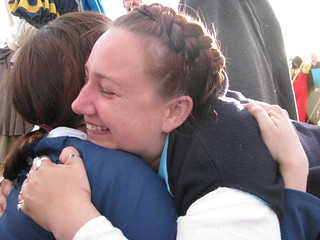
Family hugs

Image © Falashad | Creative Commons
  [image: Smiling white woman with crown braids
hugging a person with an auburn ponytail.]
Many families or guardians assume that when high-support autistic teenagers transition to adulthood, they automatically need to be legally conserved for their own protection. But that's isn't necessarily true. We spoke with UCSF's Dr. Clarissa Kripke about why Supported Decision Making can be a better choice than pursuing conservatorship, and the many reasons why.

----

Dr. Clarissa Kripke: When people with disabilities and their families start to think about transitioning from child to adult services, they are often encouraged to consider conservatorship. 

Conservatorship is a legal process where a court appoints an individual or organization to make decisions for an adult. Courts do this after finding that the adult is unable to provide for his or her own needs for health, food, clothing, or shelter. They must be found unable even with supports, and there must be no less restrictive option available. The court can grant a limited conservatorship to make some decisions, or a full conservatorship to make nearly all decisions. 

Fortunately, there is a less restrictive option, called Supported Decision Making which is less expensive, less burdensome to families, more flexible, and which promotes development, opportunity, and safety.

Thinking Person's Guide to Autism: When it comes to conservatorship, what are some of the main misunderstandings you've observed?

Kripke: Some families fear that they will not be able to continue to provide support, or to be involved with their children’s educational planning, health care, or service planning, unless they are named conservators. Schools often encourage families to include conservatorship as part of transition planning, mistakenly informing parents that without conservatorship they will not be able to participate in their child’s Individual Education Plan meeting. 

This is untrue. Under the Lanterman Act, parents or other authorized representatives are involved as much as their disabled children want and need them to be. A Supported Health Care Decision Making agreement can clarify roles and assure that confidential information can be shared within a circle of support, and that supporters can attend appointments and meetings.

Families often feel that conservatorship will increase their loved one’s safety. However, the best way to ensure safety is to teach and empower a person with disabilities to direct their own life. When people can communicate directly about their preferences they are more likely to end up in a good situation and with people they trust.

Some parents and professionals believe that conservatorships are necessary for people with cognitive disabilities and recommend them routinely as part of transition planning. However, even people with the most profound disabilities can retain their legal capacity, even if they cannot independently meet the legal standard for informed consent for some or all medical decisions. The United Nations Convention on the Rights of Persons with Disabilities provides that disabled people are entitled to legal capacity on an equal basis with others in all areas of life. It obliges states to provide access to support for people with disabilities to exercise their legal capacity.

TPGA: What do the rights of a person who has been conserved look like? 

Kripke: Imagine what your life would be like if, when you reached the age of 18, your parents decided everything about your life—where you live, what you eat, what health care you receive, where you spend your money, and how you spend your day, and with whom? What if a judge said they could make those decisions without consulting you, not just for a few years, but forever? What if people called your parents instead of you about important decisions in your life? Imagine what would happen as your parents got older and a judge handed that power over your life to a stranger who you didn’t get to choose? We do this to people with disabilities when we conserve them.

Fortunately, in California, most regional center clients, even those who have very little expressive communication skills, are unconserved. Regional center clients are entitled to support such as transportation, assistive technology, education, and personal assistance. They still receive health care, disability payments, communication help, services and supports, and participate in their individual program planning to the extent that they are able with the support of family, friends, significant others, service coordinators, clinicians, payees, the client rights advocate, and other service providers. With Supported Decision Making, you can get the support you need to direct your own life.

TPGA: It appears that opting for supported decision making instead of conservatorship gives an individual the highest likelihood of having a strong circle of support. Can you talk about why this is?

Kripke: With Supported Decision Making, you can make agreements with as many people as you wish. For example, many of us would ask a different person for help understanding our finances than we would for understanding our health. Also, many people want different types of support from different people. One person may provide transportation and physical assistance while another provides support for communication.

TPGA: What are some of the benefits of supported decision making for the individual, in terms of growth and learning as an adult?

Kripke: When people are given opportunities to make decisions, they develop skills and learn from mistakes. When people are engaged in the decision-making process and given communication supports, they are more likely to engage. Supported Decision Making gives people with disabilities the opportunity to make choices for themselves. Sometimes this involves taking some risks and taking responsibility for the consequences. This is how we all learn and grow.

TPGA: What are some of the long-term benefits for supported decision making for the family? It seems as though parents' ability to serve as conservators may become more challenging as everyone ages.

Kripke: The people who will provide your child services and supports decades from now, may not have been born yet. People who you have in mind to take over your role may be unwilling or unable to do so by the time they are called to serve. Parents are not the people who will decide who succeeds them as conservator. A judge will. And a judge can remove a parent at any time if they do not like the way they make decisions. They can also compel a conservator to continue to serve even if the conservator moves out of state, or if serving becomes difficult. Parents often develop their own health problems and are less available to provide support over time. Without permission from a judge, nobody else can step in to share the responsibility. This also means that potential successors don’t have an opportunity to learn about your child and their role before they are named conservator.

Supported Decision Making is much more flexible. It keeps the person with a disability in charge of choosing who provides them support and the type of support they want. This typically changes as they age, and as their relationships and circumstances evolve. People can serve for long or short periods of time or share responsibility. Supporters can be friends or family or paid professionals.

TPGA: Do parents in the U.S. have to make a legal decision about their child's future, in terms of conservatorship or supported decision making, by the time the child is 18 years old?

Kripke: No. Just like everybody else, people with disabilities learn and grow—sometimes dramatically. Augmentative and alternative communication (AAC) is an emerging field, and many people who were not able to express themselves in the past are now able to do so. Sometimes new technologies or adaptive equipment can increase people’s skills. 

Supported Decision Making takes into account the fact that capacity fluctuates over time and in different environments and with the type of support they receive. Not only can people with disabilities improve their skills at making decisions and expressing themselves, supporters can improve their skills in learning how to listen.

Currently, only two states have adopted supported decision-making into their legal capacity statutes: Texas and Delaware. It’s important that we see more states adopt Supported Decision Making laws – while supported decision making agreements don’t require legislation in order to be implemented, they are more likely to be respected by banks, clinicians and other entities when they are placed into statute.

TPGA: What if an individual develop skills that afford them more independence after they have been conserved? Can the conservatorship be reversed?

Kripke: Courts evaluate a person at a particular moment in their live without regard to whether the person might develop new skills or their circumstances might change, but their rulings continue indefinitely. Conservatorships are very hard to undo once they are put in place, and it rarely happens. Once someone is conserved, their agency is often overlooked, which has life-long consequences. 

There is no rush. While conservatorships are rarely reversed, a limited conservatorship can be pursued at any time in the future if a need arises that can’t be managed any other way. If someone is already conserved, conservators can still respect will and preference and implement supported decision making principles.

In addition to being very challenging to reverse, there is no guarantee that a conservatorship will transfer as a parent may wish after their death. While a plan may be put in place to set a sibling or other relative as a conservator after the initial one dies, the court has the ultimate decision-making authority: opening up the possibility for people to be placed under professional conservators, who may have dozens of clients and are not actively engaged in a person’s life. This can lead to institutionalization and neglect.

TPGA: What are good resources for families who need guidance about ensuring individuals' rights are protected and respected as they transition into adulthood?

My favorite video about Supported Decision Making is Gabby’s Story. Susan Mizner, Disabilities Counsel from American Civil Liberties Union recently discussed Supported Decision Making (video). ACLU has a helpful Frequently Asked Questions Fact Sheet. To learn more about supported decision-making models around the world, check out the Autistic Self Advocacy Network’s resource The Right To Make Choices. The Office of Developmental Primary Care has videos, training materials, and links to additional resources on its Supported Decision Making page.

----

To improve health outcomes for people with developmental disabilities, you can make a tax deductible donation to support the Office of Developmental Primary Care.

----

Dr. Clarissa Kripke, M.D., FAAFP is Clinical Professor of Family and Community Medicine at the University of California, San Francisco. She is Director of the Office of Developmental Primary Care, and of CART Services, an interdisciplinary, mobile, health care consultation team serving Regional Center clients in Northern California. Our team is deeply committed to supporting people with developmental disabilities to be as healthy as possible. We know that, with access to the right supports and services, even people with the most complex needs can live successfully in the community of their choice.
Share:

Autism and Suicidality: Conversations Between Researchers and Autistic People

Sadness
Photo © Gayan Gunawardana | Creative Commons
[image: Backlit photo of a sad ponytailed person
with their head down, in profile in front of an
ocean sunset.]
Dr. Sarah Cassidy co-chaired a SIG (Special Interest Group) on Autism and Suicidality at IMFAR 2016, in Baltimore. We weren't able to attend her session, but Dr. Cassidy was kind enough to take time, later that same day, to talk with TPGA editors Shannon Rosa and Carol Greenburg, autistic autism researcher Dr. Steven Kapp, and Autistic Self Advocacy Network Executive Director Julia Bascom. The following is a transcript of our conversation.

----

Shannon Rosa: Tell us about what you discussed in the SIG. What has your research revealed about suicidality in autistic people?

Dr. Cassidy: We’ve published two studies so far. The first study we did, which is free to access in the new Lancet (Psychiatry) journal, was a medical chart review, a type of data mining, at the Autism Research Center, Cambridge University, UK. It had a clinic called the Cambridge Lifetime Asperger’s Service (CLASS) Clinic, which was set up by Simon Baron-Cohen, and specialized in the diagnosis of Asperger’s in adulthood.

The clinicians collected a lot of data from individuals before they went though the diagnostic appointment, such as:
  1. Have you ever contemplated suicide in your lifetime
  2. Have you ever planned or attempted suicide in your lifetime
  3. Have you ever been diagnosed with depression.
Everyone seen over a nine-year period was asked these same three questions very consistently. They also completed the AQ and EQ questionnaires.

When we analyzed all the data, we found 374 people had been diagnosed with Asperger’s syndrome, and out of those individuals, 66% had self-reports of contemplating suicide at some point in their lifetime. In the same group, one third had planned or attempted suicide in their lifetime, and about another third had been diagnosed with depression.  

That depression diagnosis was a significant risk factor in planning or attempting suicide, or suicidal ideation—those who had a diagnosis of depression were at significant risk for both those factors.

While everyone in the group had a diagnosis of Asperger’s, those who had planned or attempted suicide also had significantly more self-reported autistic traits than those who didn’t.

Carol Greenburg: I have a question, and I’m not quite sure how to ask it. How can you differentiate between an actual attempt at suicide, and an overdose that happens because of an autistic person’s medication not being properly monitored? Do you control for that?

Cassidy: I think that’s a really excellent question. In this particular study, which was retrospective, we just asked one question—one self-report question—which was “have you ever planned or attempted suicide in your lifetime?”

So it wasn’t looking at “completed” suicides, where you’re not sure if it was an accidental overdose or it it was deliberate. And this was self-report. I think that’s a real challenge, for coroner studies, or studies of “completed” suicides. In the UK, those kinds of suicides are recorded as “open verdict.” We don’t know unless they leave a note.

Greenburg: That’s what we have in the U.S., too; they say that it was not possible to determine whether it was an accidental or deliberate overdose.

Steven Kapp: I’ve seen in many studies that higher numbers of autistic traits, whether in adolescents or adults, or perceived differences from typical peers, or attributing social difficulties to oneself—any way you slice it—exposure to normalization attitudes is usually related to higher rates of depression, and anxiety, and internalized ableism. We did find this even in a self-reporting using an online screener, that a higher level of  autistic traits was related to lower self-endorsed quality of life, and a feeling of disempowerment. Because the stigma is still so high, and there are still so many forces against you, that people might not be disclosing even if they’re relatively comfortable with who they are.

Cassidy: The 66% rate of depression of autistic people in our study was higher than those in other studies, higher than the 59% rate in a sample of patients diagnosed with psychosis, and significantly higher than people diagnosed with one or more medical illnesses, significantly higher than the UK general population, where a similar self-report questionnaire was used, and where the rate is 17%.

Julia Bascom: What are the next steps, in terms of supports and prevention? What did you talk about during the SIG?

Cassidy: It was really eye-opening to hear from autistic people and family members, and quite hard-hitting as well. Because a lot of the limited research, which is really only about eight studies looking at suicidality in adults, adolescents, and children with autism, are usually only counting studies about prevalence, about “how common is it?? But nothing about how does it develop, what are the family experiences and dynamics. What are the interventions we can do now? It’s not enough to talk about rates. You can have as many counting studies as you want, but knowing that the rate is high doesn’t really tell you what to do about it, especially in the short term.

We need to know what the risk factors are, whether there are protective factors? What is the difference between people with autism who experience suicidality and those that don’t, and how does that compare to the general population?

What really came out of the study is that we need some short-term goals, right now, and to come up with useful guidelines for parents and clinicians who are trying to help people experiencing these difficulties.

What was really great is that there were people at the SIG who had access to really big research databases like the Interactive Autism Network, ones in Newcastle and Cambridge, and Swedish databases. We talked about sharing out expertise, and actually do a qualitative survey targeting parents, young people with autism, and adults with autism—and asking them “what kind of supports do you actually need? What would help you, if you were experiencing these kind of difficulties?” So we could try to make recommendations about what the next steps could be, and interventions or preventative measures or supports we need to develop.

Another thing we discussed during the SIG was sharing data. In our study, we have a short set of questions that could be collected routinely in all of the studies that we do, so we could put data together and look at a variety of factors. Things like quality of life are really, really important. And there is really exciting work going on, in developing quality of life measures specifically for people with autism, and the unique challenges that they have. So if we provide these quick questions to go with it, we’d be able to directly compare and pull resources, and ideally untangle some of the causatory factors.

The last thing that came out, because there are lots of research questions to sift through and get feedback on, but another thing we really want to do is to run a seminar series. In the SIG we only had 1 1/2 hours, and could only scratch the surface. So we want to hold a seminar series in the UK, try to get funding for that, and invite people from Canada, Sweden and other European countries, The US, involving autistic people, families, funders, researchers, clinicians who are interested in this topic. I want it to be like the SIG, involving lots of different stakeholders, because it’s really important to include everyone involved when talking about next steps and research priorities.

I think we’ve done as much as we can with the prevalence and counting studies; we need to go a bit further and ask what we’re going to do about it, what is the response going to be, and how can we pull resources so we don’t waste time doing more of the same? So we can do something useful?

Bascom: Was there any discussion (in US or other countries) of where to find supports and resources for people with developmental disabilities and communication disabilities (autistic or not)? Because this is a huge problem—it’s very difficult to find mental health providers for people with developmental disabilities, especially if they’re autistic, especially if they also have intellectual disability, limited speech, or don’t have a good communication system. As an advocacy organization, ASAN considers this area really important, but we often feel like our hands are tied because people will come to us, and ask for resources—and they just don’t exist, because the providers don’t exist. Was there any discussion about how these factors might be affecting the numbers?

Cassidy: What we did discuss—and it was to do with preventative strategies, interventions, and treatments—is trying to improve experiences of hospitalization. There was talk of doctors or clinicians overreacting, and over-intervening, or not knowing how to intervene. We need those guidelines, and there’s so little research on it. Just taking simple steps, like using the NAS hospital passports that give out information like:

  • This is what my pain threshold is like
  • This is how I prefer to be communicated with
  • I’m verbal/I’m not verbal
  • These are my interests
  • This is how you talk to me

And things like that. Also training health providers that they need to provide structure, they need to provide a bit more explanation, a little bit more processing time. Or they have to be aware of really literal interpretations. Just small things like that can make peoples’ experiences with health care scenarios so much better.

But we do need to have a research study, because most of this is anecdotal, from discussions with clinicians experiences with people with autism coming in, and they’re not to sure how to deal with them. And then there are other clinicians who are really excellent, who really do have experience in autism. But it’s not consistent.

Bascom: In the States, we have this huge gap between autistic people who need services and providers. You find people, like primary care providers or therapists, who don’t necessarily have autism training but are good with autistic people—and then people find out about them and then they’re overloaded and can’t take more patients. We have an association, The NADD, that tries to be specifically for people with autism and developmental disabilities who need mental health support, but it’s so tiny, because there just hasn’t been funding for the training, and providers often think accommodating autistic patients is going to be a lot more complicated than it is. There’s a lot of room for specific training, but we certainly don’t have any large US organizations who are trying to do anything like the UK’s NAS Passport yet. ASAN helped AASPIRE develop a customizable healthcare toolkit, and it’s great, but it hasn’t gone to scale in any meaningful way. So it’s interesting to hear that that’s what you’re looking at, as well.

Cassidy: NAS Wales had a great, very customizable toolkit. You go to the website, and you can click on different kinds of difficulties, and you can put in picture symbols.

The UK overall is evaluating the effectiveness of the passports, in terms of what’s the uptake, and what’s the experience of using it.

Bascom: There are people who are going to need specialized expertise. People who, for instance, are autistic and have communication disabilities, and they don’t have good access to AAC, and they have challenging behavioral issues—there are very few practitioners who even know where to start. Which is frustrating, because we know mental health disabilities are underlining a lot of what is going on, though that’s also kind of a separate population from what you (Dr. Cassidy) are talking about, I think. Or maybe there’s an assumption that it’s a separate population. It would be good to know how many of those kids grow up into suicidal adults.

Shannon Rosa: If you’re never accommodated, or understood…

Bascom: I can think of several people I know, who were that way as kids. And now as adults, they seem to be doing a lot better. But when you pay attention to their mental state, it’s a lot more dangerous than maybe when they were a little more open about what they were feeling.

Cassidy: We have a group of adults with autism who experienced suicidality, and they are helping us design a survey that goes into more detail, about the issue of lack of supports, and different kinds of difficulties and what causes them. One of them is a parent who has a diagnosis herself but also her son has a diagnoses. And she was saying similar things to what you (Julia Bascom) are saying, in looking back at the lack of supports throughout. I think it does take its toll, and we’re going to explore that a bit more.

My work is just for adults, but we need to expand it somehow, to look at children, and that developmental pathway. Or following up autistic children, because there are a lot of cohort studies in the UK and overseas, and making sure people include those questions and look at those things is going to be really important.

----

Dr. Cassidy will be co-chairing another SIG on autism and suicidality at IMFAR 2017.

----

SUICIDE RESOURCES

Anyone who is feeling suicidal may receive immediate help by logging onto Suicide.org or by calling 1-800-SUICIDE. Suicide is preventable, and if you are feeling suicidal, you must get help. So please visit Suicide.org or call 1-800-SUICIDE immediately. Please also know that you are not alone.

MHAutism, which focuses on mental health for autistic people, has developed a Safety Plan, which allows those who are vulnerable to plan for when and if they experiencing suicidal thoughts, and also to record information to help other people provide supports.

For autistic people seeking specifically autistic perspectives, please read our archive posts below. While aimed towards younger people, they discuss getting through the kind of tough times familiar to autistic people of any age who have been conditioned into negativity:
Share:

Autism Researchers You Should Know: Dr. Deb Karhson

Dr. Deb Karhson is a postdoc at Stanford University, where she researches biology-rooted therapeutic approaches to improving autistic quality of life. She is also the "baby sib" of an older autistic brother. We are looking forward to having Dr. Karhson as a featured researcher during this week's #AutIMFAR chat at IMFAR, the International Meeting for Autism Research. Even better, we got to  interview her beforehand:

Dr. Deb Karhson
[image: Smiling Sri Lankan/Nigerian-American
woman with long curly black hair pushed to
one side, wearing glasses & hoop earrings.]
TPGA: Tell us about your research: What is your focus?

Dr. Deb Karhson: Broadly my current work is focused on biomarker discovery and drug development in for autism, which simply put means I’m looking for objective, testable, biological signatures of autism and whether candidate biomarkers can be leveraged for biotherapeutic development. And specifically, that means I’m interested in understanding the role of the endocannabinoid system in autism pathophysiology. The endocannabinoid system is the same system that mediates the effects of medical cannabis, so by understanding the role of this system in autism, we can also understand potential therapeutics that also act through/with the endocannabinoid system.

TPGA: What brought you into autism research?

Karhson: I am almost always preoccupied with what people are thinking and that is never truer than with my older brother (who is autistic). Growing up, I always felt like the literature never accurately answered the questions I was asking about autism or about concerned information processing. And then I realized that to study how people think meant understanding how brains worked which lead me to study Neuroscience. And now it’s my vehicle to asking as many questions as I please about autism.

TPGA: If you could be more than one person, what are some other areas of autism research you'd want to pursue, and why?

Karhson: I don’t know, off the top of my head I would split myself into at least three: one for studying language acquisition, which is probably influenced by my dissertation work in auditory attention and autism; one to study aging because there’s very little information on what “successful aging” looks like in autism and I have an older brother who is autistic; and one to study just girls with autism because I am a girl? And I think new research is coming out all the time about how different girls on the Spectrum are, which is both empowering as a woman and really interesting as a brain scientist.

TPGA: What are some changes you'd like to see, in terms of the general directions autism research tends to take?

Karhson: I wish there was greater emphasis placed on serving the current autistic population to improve quality of life. Similarly, if we keep repeating “one person on the spectrum is one person on the spectrum,” it would be nice to couch that in some hard data.

TPGA: Have you had any WTF experiences as a researcher on account of being either a woman, or a person of color—or both? If so, how did you push back?

Karhson: LOL, YES. Sometimes, it’s really subtle, like being told at national conferences that I speak English very well and am very articulate, which is super weird comment considering I’m a first-generation American and native English speaker.

Other times, it’s pretty overt like other students disparaging the need for diversity fellowship to me (i.e., calling me an affirmative action hire—which I would like to be clear, if I am, means I was put into the program to overcome the bias of an inherently prejudice or bigoted system that would otherwise exclude me because of my ethnicity and gender, not the other way around).

I also once attended a pretty elite autism workshop where I was the only under-represented ethnic minority and another participant very blatantly told me they were very surprised “to see someone like me” as a participant.

Push back for me is often time just about showing up, holding space, and speaking out. The higher up I go in academia, the more empowered I feel to really be visible and outspoken.

TPGA: As a sister to a high-support autistic adult, what are some autism myths you'd like to bust wide open?

Karhson: Can my answer be all of them? Vaccines, traumatic birth, or any other causation theorization. Should someone happen upon a data-driven answer to “what causes autism,” there will be no escaping the news of it. And the everyone has “special abilities.” If non-autistic people don’t have to come with a jewel in their belly or a Care Bear power, why are people with disabilities expected to? It is almost like a special ability is expected to justify the existence of people with disabilities.

TPGA: What are your thoughts on how society can better support and include autistic people like your brother?

Karhson: For one, stop messing with the fundamental rights of disabled people to access education, healthcare, and the ability to marry. It would be great to see larger swaths of non-disabled humans care about disability rights.

More urgently, I would really like better continuity between the end of formal state education and long-term post-education programs/systems, and more programs committed to providing meaningful jobs, community, and dignity and respect for adults like my brother.

TPGA: Do you have any advice for well-meaning young students interested in pursuing autism research?

Karhson: I would probably start by disabusing yourself of any savior complex you might have, then get involved in self-advocacy groups, and most importantly, if you don’t aren't autistic—shut up and listen. Just like any other marginalized group of humans, autistic people are the best at identifying areas in need of increased support and, in my case, research. And because of the robust heterogeneity in autism there needs to be more humans listening for overlaps and areas of commonality to improve, as those are likely to be the areas where the greatest impact will be felt for the community.

----

More about Dr. Karhson:

I completed my undergraduate training at Drexel University in biomedical engineering with a concentration in tissue engineering and biomaterials. During undergrad, I had three co-ops (its like an  extended paid internship), two of which were in the Neuroscience department at Baylor College of Medicine. Through these co-ops, I realized that neuroscience was my entry point to acquiring all academic knowledge on autism spectrum disorder (ASD), something I had been interested in since young as a baby sibling of someone on the autism spectrum. So following my co-op experiences, I completed a PhD in Neuroscience at Tulane University as a Southern Regional Education Board Doctoral Scholar. I trained in cognitive neuroscience and electroencephalography (EEG) technique to study auditory attention in neurotypical and non-neurotypical populations. For my dissertation research, I used EEG to measure brain waves and examine the intersection of auditory attention and atypical sensory reactivity in adults with autism.

However, as a baby sib, I wanted to be able to leverage my skills to address a more immediate need like better therapeutics, particularly for things like self-injurous behaviors. So now, I’m extending my training with a postdoc at Stanford University in the Psychiatry and Behavioral Science Department through a NIH T32 postdoctoral fellowship from the Center for Interdisciplinary Brain Sciences Research. My postdoctoral research is focused on understanding the role of the endocannabinoid system in autism pathophysiology. This is the same system that mediates the effects of medical cannabis and my research is studying the body’s natural version of these molecules, called endocannabinoids, and their relationship to core clinical features of autism. It is my hope that my research findings will help identify novel biomarkers of autism, assist in the development of therapeutics that improve quality of life, and elucidates contributing neurocircuitry in autism pathophysiology.

Share:

Why Everyone Should Read The ABCs of Autism Acceptance

Patricia George
www.persnicketypatricia.ca

image: Book cover, with white text reading "The ABCs of Autism Acceptance" on a background of multicolored representations of letters of the Roman alphabet, above black text on a white background, reading, "by Sparrow Rose Jones."
The ABCs of Autism Acceptance
[image: Book cover, with white text reading
"The ABCs of Autism Acceptance" on a
background of multicolored representations
of letters of the Roman alphabet,
above black text on a white background,
reading, "by Sparrow Rose Jones."]
I’ve been an avid reader my whole life, so when I was asked to review The ABCs of Autism Acceptance by Maxfield Sparrow, and saw that it was "only" 152 pages, I thought, "this won't take long to read, so sure, I'd love to!"


I was wrong. This is the largest 152-page book I've ever read. In fact, I wrote more notes for this book than I did for a 500-plus page book I reviewed in 2015.


The book's title is straight-forward: Maxfield uses the Roman alphabet as a way to educate the reader about autism acceptance from an autistic person’s point of view, while interlacing quotes and links from other Autistics. The resulting resource makes this book an invaluable asset to furthering Autistic acceptance.


The ABCs of Autism Acceptance started out as a self-challenge for the author during the controversial month of April. I remember the post in which Maxfield began discussing this undertaking. I also remember thinking, what a fantastic idea! It was time to take April back and show why, without acceptance, autism awareness is actually a huge disservice to autistic people. 


Sparrow also aimed to make this book relatable to a diverse audience. Something a fellow Autistic could read, but so could our siblings, our teachers, our doctors, our friends ... and other people too. Especially people well outside our ally circle. We need them all!


As I looked over my sixteen pages of notes, I tried to think of a direction to take this. My pattern recognition noticed certain words appeared over and over again: 'acceptance,' 'dignity,' 'respect,' and 'Autistic.' And I noticed my notes had certain quotes from the book that I circled and underlined, with  exclamation points. I want to share how those quotes make me feel as an Autistic person. (Props to the book for helping me feel more confident about capitalizing 'Autistic.')  


“Autism acceptance is seeing us as whole, complete human beings worthy of respect.” (pg. 13)


Everyone needs to read and absorb that sentence. Autistic people are not broken versions of our normal selves. Living life feeling that way is an early death sentence. I feel like this needs to be the benchmark for how we're treated. If you're not seeing us this way then you have some work to do.

“Do not expect us to harm ourselves in order for you to feel as if we care for you. Respect our ways of being, our ways of knowing, our ways of loving.” (pg. 42)


Coming into being autistic later in life means I've struggled with just how much love has come to mean pain for me, in one way or another. And I don't mean things like heartbreak, from the loss of some one/thing/place.

When I write "love has come to mean pain for me," I'm remembering all the times I took on the weight and overload of a person/place/thing, etc., and it ended up costing me self-respect and dignity. I struggle 'til this very day with a choir of ghosts-of-the-past in my head, singing “everyone hates you."

Autism awareness does absolutely nothing to fix these kinds of crises for autistic people. "Awareness" would like you to think the crisis is us, and the increase in autism diagnoses. But the crisis is really what's not happening for us.

“ ... above all we need autism acceptance because we will never get our healthcare needs met until we are fully recognized as deserving of respect and dignity, and until we are widely understood as valuable not for what we can do, but for who we are.” (pg. 59)


I went a decade, my entire 30's, without a doctor. Various medical professionals still don't take my over- and under- reactions to medications seriously. Just last week, I was totally shut down by a doctor because I said there was a link between Ehlers-Danlos syndrome and Autism, and the doctor took umbrage with that. 

I knew autistics had trouble being taken seriously by medical professionals before I read Sparrow's book, but now I've confirmed that I am not alone in experiences like these. Autism "awareness" fails us Autistics, time and time again.

“Awareness without acceptance is fear. Fear of autism hurts Autistics. A culture of fear leads to murder.” (pg. 76)


This really hit me hard. One of the most sobering things I've ever experienced in my life was the reading of the names of people with disabilities who had been murdered by their parents—at the time 70 people in five years—for the 2015 Disability Day of Mourning. I read a poem from a past submission of another autistic poet. I participated online.


The number of autistic and disabled people killed grows, and doesn't slow. Awareness isn't making this horror any better. Awareness get murdering parents put on TV, and people somehow rationalizing parents' killings of their disabled children. This is why acceptance is desperately needed. It will save Autistic people’s lives!


“When a person pushes me to overload, especially when they over-ride my protests to do so, I experience a massive loss of trust for that person.” (pg. 91)

Having someone push me to overload after they've been educated about, and agreed to, the boundaries I put in place to help me with things like trust—that is something I really can't take any longer. I pay such a huge personal price. That relationship doesn't stand much of a chance, not without big changes on their part.


I feel like I lose my dignity when I melt down, even though I know it's not my fault. If the person pushing me past my boundaries into a meltdown was able to see me through a lens of acceptance, would they still act that way, still insist on hurting me? I doubt it.

I deserve to maintain my dignity. It's so hard to have it stolen away. 

And besides, we Autistics are pretty loyal people. Why wouldn't you want our trust?

“When comparing myself to all women, I feel lost and alien. When comparing myself to Autistic women, I feel a sense of belonging.” (pg. 134) 


Awareness would make you believe Autistic women couldn't possibly even get along. And awareness still tries to erase us with outdated statistics. But I, and countless other Autistic women, will tell you a very different story.


I was recently on a women's panel at an autism conference, with two Autistic women in our 40's, and two in their 20's. We were all so different—but our commonalities were so powerfully connecting that our differences became things to celebrate. We don't just need acceptance from society, we also need to accept ourselves, and it is imperative to have reflections of ourselves,  to allow that to happen.

I ended up reading and writing this review in April, and took The ABCs of Autism Acceptance many places with me: It went to a lunch where an Autistic woman close to my age saw herself reflected back as turned the pages, which made her light up. I took it to my doctor's office and she said she'd like to read it.


It's important to get to know this book. Sparrow has, in my opinion, succeeded in what he set out to do: create something that a diverse audience could read and learn from. I came away with so much new knowledge and validation, and a desire to learn more.


I'll leave the last words to the author; powerful words that when turned into action can make autism acceptance truly possible:


“Cherish our yes, respect our no.” (pg. 135)


----
 

Note: All page numbers are from the paperback version of the book.
Share:

Eye Contact: For The Recipient's Validation Only

Emma Dalmayne
autisticatedalmayne.com

Screenshot from ABA Video on Tantrums (Content Warning)
[image: Young Filipino girl with long black hair seated at a play table, looking
unhappily up at the camera, while an adult leans in and talks at her.]

Imagine if you will a quiet world, well ordered as long as everything has its place.

Imagine a warmth, cozy and comfortingly familiar. Your own warmth, just your own.

Now imagine headlights, bright and intrusive as in a winters night, burning and intense. They glare through your warmth and safety, and push your eyes deep into their sockets until it’s unbearably painful.

Those headlights are someone’s eyes making intense eye contact with yours.

“Look at me!” The mouth beneath the eyes commands. "I don’t want to, it hurts…" you think.

“This is all part of the problem you see?” The voice says to your parents who nod sadly, “Lack of eye contact, this we must stamp out. It’s a sign of non-compliance, a sign of disregard. The child’s lost, you see…?”

"What?" You think, baffled, "I’m right here!"

Your parents sign a form giving permission for intense Applied Behavior Analysis to begin.

Forty hours per week.

Forty hours of look at me/quiet hands? No more fluttering your hands in a language only you know, no more flapping your hands watching golden drops of happiness fly from your fingertips as you hum … no more angry bolts of lightening flying from your nails as you shake your hands so hard your wrists pound.

No more you.

----

I’ve realized something today.

Eye contact, who’s it for? It’s not for the autistic child. It's for the recipient. It’s for their own validation to reassure them that you know they exist. That you are aware they are speaking that you comply. That you acknowledge them.

It’s not about the child; it’s no benefit to the child to do something that in many cases is painful.

Intrusive.

It’s for them.

They don’t understand the avoidance of eye contact, the rapidly moving hands, the hum and the bounce of the feet.

The rhythmic rock you employ to comfort, a rock that’s universal if they would only look back to a parent rocking a babe: safety.

Predictability.

“Lines are forbidden,” intones the voice. “They are a sign of the child wanting to control the environment they are in! When he starts to make one mess it up immediately,” your parents nod. “Take back the control.” The voice says smugly.

"But I need those!"You think. "They help me make sense of, well everything. They make me safe, when everything else is changing I know they are there!"

The practice of eye contact is not for the child. Too often, society has the misconception that if your eyes are not raised when you or another is communicating, then you have something to hide.

What if that something is your soul?

What if it’s all you have left in a world that’s to bright, loud. and fast? It then makes sense that so many Autistics find peace in natural surroundings.

Bird song, rushing water, and the swish of wind in the trees is surely preferable to beeping horns, bright reflections on glass, and the mindless babble of a hundred conversations at once.

Once words leave a persons mouth where do they go? Do they keep going? As I’m sure many autists hear the echoes of words said long past.

Imagine.

As I know others can’t truly ever know what it’s like to be autistic, to be so comfortable in your own company that a day alone is heaven. Imagine not getting that time, that quiet.

----

Do not seek to validate yourself through your child, if they do not wish to make eye contact do not force it.

If you do, you seek nothing but self service, for the validation that you exist is there in front of you.

Your child.

Validate them. Embrace and champion them. They are not there for your definition, they are there because you made them so.

----

A version of this post was previously published at autisticatedalmayne.com.
Share: